
New chapter, same compelling story?
The uncertainty surrounding Herald Investment Trust (HRI) for almost two years, following Saba Capital’s stake-building and attempts to take control of the trust, appears to have now lifted. A tender offer in July gave Saba a full exit, and a three-year standstill arrangement is now in place, allowing manager Katie Potts and her team to focus on managing HRI’s portfolio of technology companies.
As part of the arrangements, the trust has moved to Aberdeen Investments, where it continues to be run with the same mandate and has access to additional research and marketing resources. Although smaller, HRI appears to remain a viable size trust and now has a share register made up of investors who appear to understand its proposition.
HRI states that it continues to identify and profit from several themes, many linked to artificial intelligence. These include the broadening of AI-related capital expenditure to smaller suppliers, and the shift from the infrastructure to the application stage of AI, which may increasingly create opportunities for smaller technology companies.
Small-cap technology, telecommunications and multi-media
HRI’s objective is to achieve capital appreciation through investments in smaller quoted companies in the areas of technology and communications. Investments may be made across the world, although the portfolio has traditionally had a strong position in UK stocks.
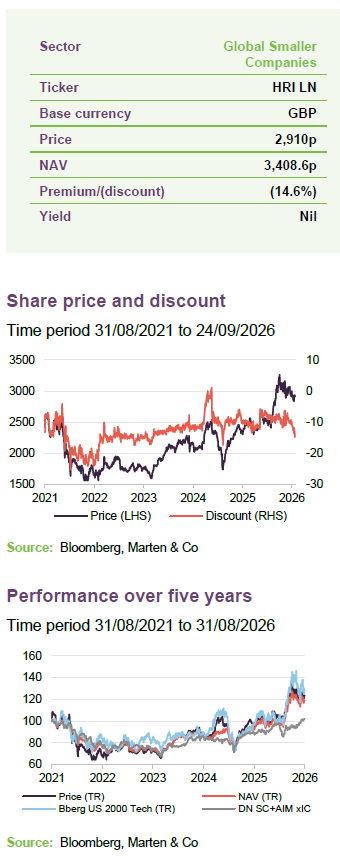
| 12 months ended | Share price total return (%) | NAV total return (%) | Deutsche Numis ex IC plus AIM (%) | B’berg US 2000 Tech TR (%) |
|---|---|---|---|---|
| 31/08/2022 | (32.0) | (22.4) | (21.9) | (15.8) |
| 31/08/2023 | 7.3 | (4.4) | (4.1) | 0.7 |
| 31/08/2024 | 22.0 | 17.8 | 14.6 | 5.5 |
| 31/08/2025 | 9.0 | 6.4 | 3.0 | 9.2 |
| 31/08/2026 | 27.2 | 27.7 | 15.3 | 29.7 |
Aberdeen Investments
Katie and team have moved to Aberdeen Investments.
As part of the package that facilitated Saba Capital’s exit, Aberdeen Investments replaced Herald Investment Management Limited (HIML) as HRI’s AIFM on 1 August 2026. Katie Potts and several members of the HIML team moved to Aberdeen on that date.
Aberdeen brings greater scale and access to a broader pool of investment expertise. This may be particularly relevant in Asia, where markets can be complex and Aberdeen’s established Asian smaller companies franchise complements HRI’s exposure to the region. Aberdeen also has a track record of marketing investment companies to private investors, a source of demand that may be increasingly important as institutional ownership of the sector declines.
Market update
War in Iran, trade uncertainty and AI appear to have dominated market sentiment this year.
Market newsflow appears to have focused on the war in Iran, renewed trade uncertainty and continued interest in artificial intelligence. The conflict, which began at the end of February, disrupted shipping through the Strait of Hormuz, may have contributed to higher energy prices and a broad market sell-off. Smaller companies and growth stocks appeared particularly sensitive to the associated rise in inflation and interest-rate expectations.
Markets subsequently recovered from their March lows, as concerns about a prolonged energy-supply shock appeared to ease and corporate earnings remained stable. The rebound appeared to be led by AI-related shares, particularly semiconductor, memory, networking and data-centre equipment companies, as major technology groups maintained high levels of infrastructure spending.
More recently, that trend appears to have partially reversed. Profit-taking and growing doubts over the returns that companies may earn on their AI investment appear to have weighed on semiconductor and other technology shares, while investors appear to have rotated towards lower-valued and less crowded areas of the market. Nonetheless, equity markets remain higher for the year: as at 18 September, the S&P 500 had gained 11.8%, while the S&P SmallCap 600 was up around 15.2%. UK equities have also risen, with the S&P United Kingdom index rising about 7.3% year-to-date and trading close to its record high.
Of particular relevance to HRI may be the performance of smaller company indices. Figure 1 shows two representative indices: the Bloomberg US 2000 Technology Index, covering small- and mid-cap US technology stocks, and the Deutsche Numis Smaller Companies Plus AIM Ex Investment Companies Index, representing the bottom 10% of the UK market.
Figure 1: Markets over 12 months to 31 August 2026, indices rebased to 100
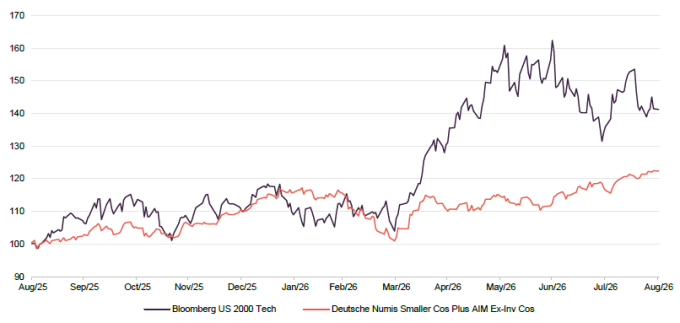
The two indices seemed to follow a broadly similar path until the beginning of March 2026, when they diverged and the Bloomberg US 2000 Technology index rose relative to the other index. This seemingly coincided with the market low following the initial market reaction to the Iran war, and the subsequent increase in risk appetite. The rally appeared to broaden beyond the largest US technology companies, with smaller technology stocks recording larger gains.
More recently, the gap appears to have narrowed as investors took profits in technology shares, questioned returns on AI spending, and showed greater support for UK smaller companies. This appears to be reflected by the convergence of the indices in Figure 1.
Less supportive monetary policy
The Federal Reserve and ECB raised interest rates in September, with the Bank of England keeping its on hold.
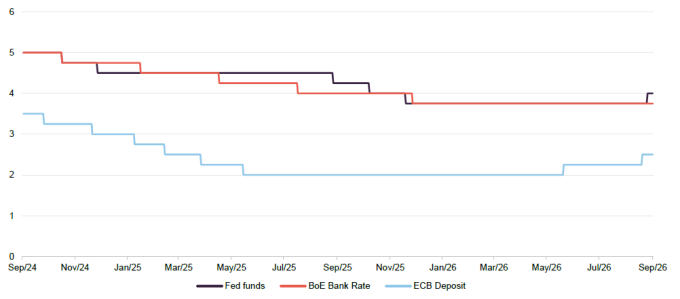
The Federal Reserve increased its target interest rate to 3.75-4% on 17 September, while the European Central Bank (ECB) raised its deposit facility rate by 25 basis points to 2.5% at its latest meeting. The Bank of England held its policy rate at 3.75% at its September meeting, although three of the Monetary Policy Committee’s (MPC) nine members voted for an increase to 4%.
Across all three regions, higher and more volatile energy prices appear to have disrupted the disinflationary trend and raised concerns about second-round effects on wages and other prices. This may have reduced expectations for near-term rate cuts and kept bond yields elevated – potentially a headwind for smaller companies and highly valued growth stocks, whose expected future earnings may be discounted more heavily at higher interest rates.
Figure 2: Interest rates over two years to 22 September 2026
HRI – benefitting from the AI capital expenditure boom
AI capital expenditure has potentially broadened to benefit smaller suppliers.
HRI appears to have benefitted from the increase in AI-related capital expenditure, particularly as the opportunity has potentially broadened beyond the handful of larger companies that initially contributed to returns. Earlier gains for HRI had been concentrated in larger holdings such as Super Micro Computer, Fabrinet, and BE Semiconductor Industries, but more recently the market appears to have increasingly recognised that a wider range of smaller suppliers are also benefitting from ongoing hyperscaler investment.
HRI has identified 49 such smaller holdings it believes are exposed to this trend, which seemed to collectively outperform its larger AI beneficiaries during the first half of its financial year. These holdings generated an internal rate of return of 146.7%, compared with 97.0% from HRI’s top 10 AI holdings. Contributors included Silicon Motion Technology and Vicor, alongside newer positions such as DigitalOcean and Vishay Precision. In the latest Interim Report, the chairman noted that effectively all of HRI’s NAV growth since the start of 2023 has come from companies in the AI supply chain.
Katie cautions that the current pace of capital expenditure and the pricing power enjoyed by infrastructure suppliers may not continue indefinitely. The re-rating of AI-related holdings in the second quarter seemingly gave the team an opportunity to realise profits and raise cash to help fund the tender offer. With share prices having since eased from those levels, the team now seems to be selectively adding to positions where valuations are lower.
Moving from the infrastructure to the application stage of AI
Katie believes the AI opportunity may move from infrastructure to applications.
While HRI has benefitted from the build-out of AI infrastructure, Katie believes that the next phase of the opportunity may increasingly lie in applications. She draws a parallel with the development of the internet, where early beneficiaries such as Cisco Systems and EMC supplied the networking and storage infrastructure before companies such as Amazon, Alphabet and Meta emerged in the application layer.
Katie believes that AI is currently still in the infrastructure phase, but that applications may come next. The emergence of agentic AI systems, which appear to be extending beyond coding into broader knowledge work, provides an early indication of how this transition could develop.
This shift could create a different opportunity set for HRI. Software shares came under pressure in the first quarter of 2026 amid investor concerns that cheap, AI-native products could displace incumbent software-as-a-service providers. Katie believes this pessimism was overdone, and the sector seemingly subsequently recovered during the second quarter. Even so, valuations across much of the technology sector outside the AI infrastructure winners seem to have fallen, which may create potentially attractive opportunities as HRI looks to redeploy cash. However, identifying those companies that may be capable of translating AI into commercially successful applications could be important.
Asset allocation
HRI has continued to shift assets away from the UK.
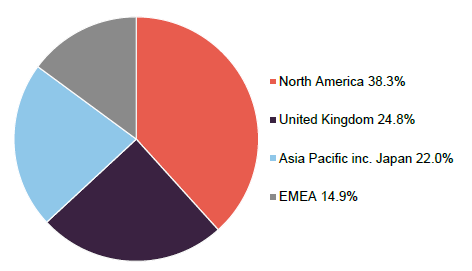
A recurring theme in our notes on HRI has been the increase in exposure to North America, and corresponding decline in the UK. In recent months, to 31 August 2026, the North American exposure ex-cash reduced to 38.3%. UK exposure saw a further fall to 24.8% from 30.0% as at the time of our last note (which used data as at 30 September 2025). In comparison, less than five years ago HRI had double the allocation to the UK compared with North America (47.7% and 22.3%, respectively, in December 2021).
The most recent figures, as at 31 July 2026, were seemingly affected by the cash weighting of 19.5% that was built up ahead of the July tender offer. HRI’s manager raised liquidity gradually, stating that this was to avoid becoming, or being perceived as, a forced seller of relatively illiquid holdings. The numbers in Figures 3 and 4 are therefore ex-cash. With the tender now complete, HRI’s manager expects cash to return towards a single-digit level.
Whilst geographic allocation seemingly remains an important consideration, Katie and the team emphasise that most portfolio companies generate revenues internationally rather than relying on their domestic markets. They generally favour businesses with a global reach, as they consider these to have stronger competitive positions and a broader opportunity set.
Figure 3: Geographic allocation as at 30 September 2025 (ex-cash)*
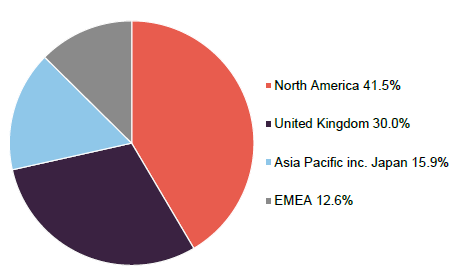
Figure 4: Geographic allocation as at 31 August 2026 (ex-cash)*
Top 10 holdings
Figure 5 shows HRI’s top 10 holdings as at 31 August 2026 and how these have changed since our last note (which used data as at 30 September 2025). BizLink has become the largest holding, with the previous top holding Celestica no longer in the top 10.
Figure 5: Top 10 holdings as at 31 August 2026
| Holding | Sector | Country | Allocation 31/08/26 (%) | Allocation 30/09/25 (%) | Percentage point change |
|---|---|---|---|---|---|
| BizLink | Tech hardware & equipment | Taiwan | 1.8 | 1.1 | 0.7 |
| Red Violet | Software & computer services | US | 1.4 | 0.6 | 0.8 |
| Nordic Semiconductor | Tech hardware and semiconductors | Norway | 1.4 | 1.4 | – |
| Volex | Tech hardware & equipment | UK | 1.3 | 1.3 | – |
| Diploma | Support services | UK | 1.2 | 1.8 | (0.6) |
| Tripod Technology | Tech hardware & equipment | Taiwan | 1.1 | 0.7 | 0.4 |
| Trustpilot | Software & computer services | UK | 1.1 | 1.4 | (0.3) |
| Pegasystems | Software & computer services | US | 1.1 | 1.9 | (0.8) |
| BE Semiconductor Ind. | Tech hardware and semiconductors | Netherlands | 1.1 | 2.0 | (0.9) |
| Varonis Systems | Software & computer services | US | 1.1 | 1.2 | (0.1) |
| Total of top 10 | 12.6 | 20.4 |
There are four new names in the top 10: BizLink, Red Violet, Tripod Technology and Varonis Systems. These have replaced Celestica, Fabrinet, Silicon Motion Technology and Super Micro Computer. We look at these new entrants in some detail below. These are not new names in the portfolio, but instead companies where positions have been built up over time.
The allocations across the top 10 holdings seem to be lower than may ordinarily be expected. This appears to reflect the need for HRI to hold significant cash prior to the tender offer.
BizLink
Figure 6: BizLink (TWD)
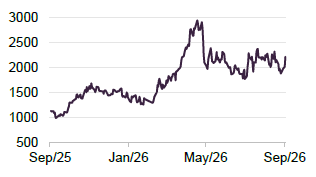
BizLink (www.bizlinktech.com) is a Taiwan-listed manufacturer of cables, connectors and other interconnect products used to transmit power and data. Its products are supplied to a range of markets, including data centres, semiconductor manufacturing equipment and medical technology. The company has seemingly progressively moved beyond individual components towards more complex connectivity systems.
As computing density within data centres increases, more power may need to be delivered to servers while larger amounts of data may need to move between processors and other components at high speed. BizLink supplies both power and data connectivity equipment into this infrastructure. It is also expanding its role within the AI server rack: in June 2026 it agreed to acquire Interplex Datacom, which manufactures mechanical and structural components used within the rack.
Recent growth appears strong. Second-quarter 2026 revenue increased 37% year-on-year to NT$23.3bn, while net income rose 47% to a quarterly record NT$3.0bn. BizLink was seemingly among HRI’s stronger performers in 2025, and moved into the trust’s top 10 AI performers during the first half of 2026.
BizLink
Figure 6: BizLink (TWD)
Red Violet (www.redviolet.com) is a US data and analytics company specialising in identity intelligence. Its technology brings together information relating to people, businesses and assets, which may help customers establish identities, assess risk and identify potential fraud. Its main platforms are IDI, which is used by businesses including financial services providers, insurers and debt collectors, and FOREWARN, which provides identity and safety information to real-estate professionals.
An important part of the investment case for HRI appears to be the combination of Red Violet’s proprietary data with its technology for determining connections between otherwise disparate pieces of information. The company describes its platform as cloud-native and AI-embedded, with an identity graph that is continually updated as new data is added. This may give the business characteristics of a scalable software platform: once the underlying data and technology infrastructure have been built, additional customers and searches may be supported without costs increasing at the same rate.
Growth appears to have accelerated during 2026. Second-quarter revenue increased 23% year-on-year to $26.7m, while adjusted EBITDA increased 48% to $11.2m. Red Violet also added 447 new IDI customers during the quarter, taking the total above 10,800, while FOREWARN had more than 417,000 users at the end of the preceding quarter. The company subsequently raised $115m through a share issue, leaving it with more than $160m of cash, which it may invest in further growth.
Tripod Technology
Figure 8: Tripod Technology (TWD)
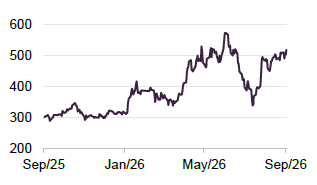
Tripod Technology (www.tripod-tech.com) is a Taiwanese manufacturer of printed circuit boards (PCBs), the boards on which electronic components are mounted and connected. Its products are used across servers, memory modules and consumer devices. Although PCBs are a mature part of the electronics industry, computing systems with increasing performance requirements may require boards capable of handling greater data speeds, power requirements and component density.
Tripod has been held by HRI for several years, but its recent move into the top 10 may reflect a stronger earnings environment for the Asian hardware companies associated with AI-related infrastructure spending.
Demand appears to have been strong for server and memory-related PCBs as investment in AI computing has increased. At the same time, other PCB manufacturers appear to have been directing more capacity towards advanced GPU and AI-server products, potentially creating opportunities for Tripod to pick up additional conventional server business. Higher-value products may also have improved the company’s sales mix and profitability.
This appeared to be reflected in its latest results. Second-quarter 2026 revenue increased 39% year-on-year to a record NT$24.9bn, while net profit rose 59% to NT$3.9bn.
Varonis Systems
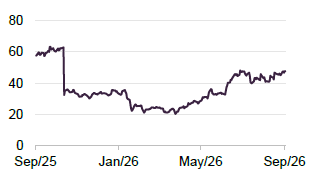
Figure 9: Varonis Systems (USD)
Varonis Systems (www.varonis.com) is a US cybersecurity software company specialising in protecting corporate data. Rather than concentrating primarily on networks or devices, Varonis monitors where organisations’ sensitive information is stored, who can access it and how it is being used. Its platform can identify excessive permissions, classify sensitive information and detect unusual behaviour that could indicate either an external cyberattack or misuse by an employee. HRI has been a shareholder for an extended period.
Varonis has expanded from its traditional data-security products into securing AI applications themselves, including through its Atlas AI Security Platform and integrations with AI tools. Another change is Varonis’s transition from self-hosted software to a cloud-based software-as-a-service (SaaS) model. This transition may have been disruptive: the shares almost halved on 29 October 2025 following third-quarter results and a reduction in full-year annual recurring revenue guidance.
Subsequent results indicated continued growth in the cloud business. SaaS annual recurring revenue reached $726m at the end of the second quarter of 2026, up 52% year-on-year, or 25% excluding customers converted from the old model. The shares have since recovered part of their losses, with takeover interest appearing to provide an additional catalyst.
New holding
Vishay Precision is a relatively new position that increased in value after purchase; however, much of the gain was subsequently reversed.
Vishay Precision
Figure 10: Vishay Precision (USD)
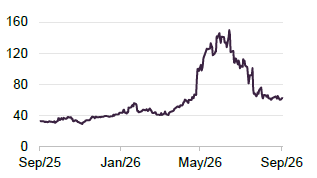
Vishay Precision Group (VPG, www.vpgsensors.com) is a US-listed specialist in precision measurement and sensing technologies. Its products include high-precision resistors, strain gauges, load cells and measurement systems, which are used in applications where accuracy and reliability may be important, including semiconductor manufacturing equipment, data centres, aerospace and defence, industrial automation and transportation.
Through VPG, HRI gains exposure to several technology markets through components that are often relatively small but may be critical to the performance of the systems in which they are used. Demand for VPG’s precision resistors may be benefitting from investment in AI-related semiconductor equipment and data centres, while the company is also developing a position in robotics. Indeed, during the second quarter, VPG received a vendor nomination from its first humanoid robotics customer, potentially positioning it to supply sensors as production ramps.
Q1 results in May appeared to be ahead of expectations, and the shares subsequently rose. More recently, most of this gain has been reversed, with forward guidance appearing not to support the pace of growth that investors had been pricing into the shares.
Performance
HRI has outperformed the Deutsche Numis Smaller Companies plus AIM ex-Investment Companies Index.
As Figures 11 and 12 show, HRI has outperformed the Deutsche Numis Smaller Companies plus AIM ex-Investment Companies Index – which captures the performance of the wider UK small-cap market – in NAV terms over the five years to 31 August 2026. This is seemingly primarily due to a relatively strong first half this year. Relative performance seemed volatile during 2024 and 2025, but was apparently relatively strong during the first half of 2026, as HRI generated positive absolute returns while the UK small-cap benchmark made comparatively modest progress. Conversely, the technology sector recorded positive performance over the half-year. Some of this outperformance appears to have been reversed in recent weeks.
HRI’s performance relative to the Bloomberg US 2000 Technology Index has seemingly been weaker. HRI seemed to recover much of its earlier relative underperformance during the first half of 2025 and briefly moved ahead of the index, but this improvement subsequently reversed. The divergence seemed to become particularly pronounced during the first half of 2026, despite strong absolute NAV returns. This may reflect the returns generated by US smaller technology companies. That trend apparently reversed during July. As detailed on pages 6-7, HRI’s allocation to the US has increased over time, but the portfolio remains more geographically diversified than this US-focused comparator.
Figure 11: HRI’s NAV total return relative to relevant indices, over five years to 31 August 202
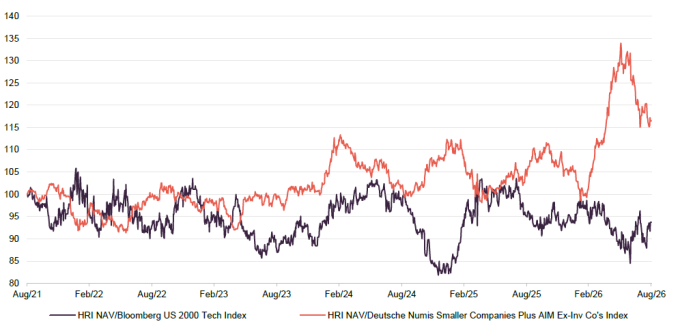
Figure 12: Cumulative total return performance over periods ending 31 August 2026
| 1 month (%) | 3 months (%) | 6 months (%) | 1 year (%) | 3 years (%) | 5 years (%) | |
|---|---|---|---|---|---|---|
| HRI NAV | 3.3 | (4.3) | 20.3 | 27.7 | 60.2 | 18.8 |
| HRI share price | 1.5 | (7.0) | 17.2 | 27.2 | 69.2 | 23.5 |
| Deutsche Numis Smaller Cos plus AIM ex IC | 4.2 | 5.8 | 4.3 | 15.3 | 36.2 | 2.0 |
| Bloomberg US 2000 Technology | 3.0 | (8.3) | 23.2 | 29.7 | 49.4 | 26.8 |
HRI’s higher cash position ahead of the tender offer may have had a mixed impact on performance, potentially limiting participation in rising markets while providing some protection during periods of pressure on growth stocks.
Dividend
HRI is focused primarily on generating capital growth, and dividend income seems to makes up only a small part of returns. HRI states that it only declares a dividend where this is necessary to retain investment trust status, and in practice, no dividend has been declared since 2012.
Premium/(discount)
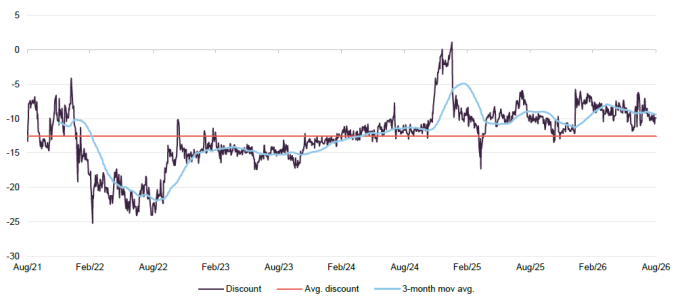
Over the five years ended 31 August 2026, HRI traded on an average discount of 12.6%. However, over the last 12 months the trust traded at a narrower average discount of 9.5%. The range over the 12 months was between 5.7% and 13.4%.
As shown in Figure 13, HRI’s discount seemingly narrowed towards the end of 2024, with the shares briefly trading at a premium around the year-end and again in early 2025. This may have been influenced in large part by buying by Saba. Following the defeat of Saba’s proposals, the shares seemingly returned to trading at a discount, although this apparently remained narrower than the five-year average through 2025 and the first half of 2026.
The recent tender offer appears to have reduced the overhang associated with Saba’s large shareholding. All else being equal, this may be associated with a lower discount. However, the full impact may become clearer once trading in the substantially reduced share capital has settled.
Figure 13: HRI premium/(discount) over five years to 31 August 2026
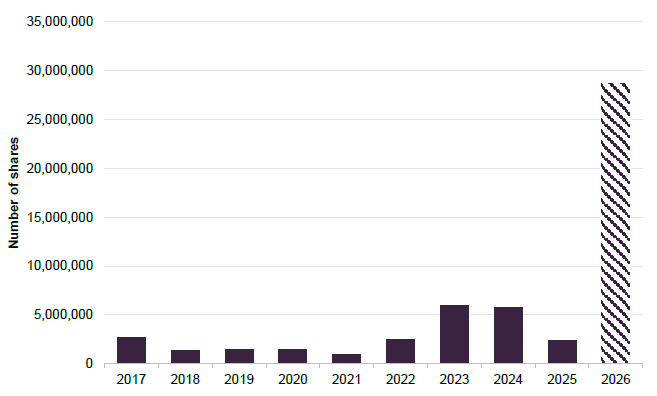
Whilst the board’s general policy is not to attempt to control the discount, given the limited liquidity available within the underlying portfolio companies, the trust may repurchase shares opportunistically. As shown in Figure 14, 2023 and 2024 seemingly saw higher levels of repurchases compared with previous years, before activity moderated in 2025. However, such ad-hoc purchases were apparently much lower than the repurchase made in the tender offer in July.
Figure 14: HRI share repurchases over the past 10 calendar years
Fund profile
More information can be found at the trust’s website: www.heralduk.com.
Established in 1994, HRI invests globally in small technology and communications companies with the aim of achieving capital growth. It appears to be the only listed fund of its type. The trust invests globally. Historically, it has had a bias towards the UK, although this has been reduced in recent years.
New investments in the fund will typically have a market capitalisation of $5bn or less, but are generally much smaller when the first investment is made. Where investments increase in value, these may grow to be a multiple of their original valuation. This type of investing is longer-term in nature and so the trust’s portfolio seemingly tends to have low turnover. Apparently reflecting the risks inherent in this type of investing, and the liquidity constraints of having a small-cap investment remit, the trust maintains a diversified portfolio of investments (typically in excess of 250), which may help mitigate these risks.
HRI’s lead fund manager, Katie Potts, has managed HRI from its launch, and continues to do so after its recent move to Aberdeen Investments. Her track record may indicate the relevance of experience in markets such as these. Katie was a technology analyst at SG Warburg (later UBS) prior to launching the fund.
Katie is supported by a specialist investment team that combines longstanding Herald experience with the broader research resources available through Aberdeen. This may provide continuity in the trust’s investment process and preserve specialist technology and smaller-company expertise built up over many years.
The move appears to have changed the organisational structure around HRI without altering its investment mandate or the stock-picking approach developed under Katie. Aberdeen also appears to provide additional distribution, marketing and investment-trust resources, while the core investment decisions are expected to remain with Katie and the team that has moved across from Herald.
Members of the team include Danny Malach, CFA, who joined Herald Investment Management in 2016, supports the UK portfolio and is responsible for client liaison and shareholder communications; James de Jonge, CFA, who joined in 2022 and manages the European portfolio, with analytical responsibility for the communications sector globally; Hao Luo, CFA, who joined in 2004, leads HRI’s Asian portfolio and retains global responsibility for the hardware sector; and Matthew Lloyd, CFA, who joined in 2019, co-manages the Asian portfolio and has analytical responsibility for the semiconductor sector globally.
HRI’s closed-ended structure can potentially be advantageous during market selloffs.
HRI’s closed-ended structure may be advantageous during market selloffs.
The HRI team has navigated several downturns and has benefitted from its ability to select companies that may weather difficult conditions. Whilst open-ended funds may be required to sell holdings, HRI may use gearing and acquire lines of stocks at lower prices.
HRI states that its size and focus on smaller companies, and the depth of expertise within the management team, mean that it may play a role as a provider of capital to listed technology companies. The company considers this role particularly relevant in a downturn and states that it may offer HRI further opportunities to generate alpha when others may not have been able to.
HRI offers a liquid route for investors seeking access to this part of the market, and HRI believes that an investment in HRI may complement an investment in one of the large-cap technology funds.
Previous publications
Readers interested in further information about HRI may wish to read our previous notes. You can read the notes by clicking on them in Figure 15 or by visiting our website.
Figure 15: QuotedData’s previously published notes on HRI
IMPORTANT INFORMATION
Marten & Co (which is authorised and regulated by the Financial Conduct Authority) was paid to produce this note on Herald Investment Trust Plc.
This note is for information purposes only and is not intended to encourage the reader to deal in the security or securities mentioned within it.
Marten & Co is not authorised to give advice to retail clients. The research does not have regard to the specific investment objectives financial situation and needs of any specific person who may receive it.
The analysts who prepared this note are not constrained from dealing ahead of it but, in practice, and in accordance with our internal code of good conduct, will refrain from doing so for the period from which they first obtained the information necessary to prepare the note until one month after the note’s publication. Nevertheless, they may have an interest in any of the securities mentioned within this note.
This note has been compiled from publicly available information. This note is not directed at any person in any jurisdiction where (by reason of that person’s nationality, residence or otherwise) the publication or availability of this note is prohibited.
Accuracy of Content: Whilst Marten & Co uses reasonable efforts to obtain information from sources which we believe to be reliable and to ensure that the information in this note is up to date and accurate, we make no representation or warranty that the information contained in this note is accurate, reliable or complete. The information contained in this note is provided by Marten & Co for personal use and information purposes generally. You are solely liable for any use you may make of this information. The information is inherently subject to change without notice and may become outdated. You, therefore, should verify any information obtained from this note before you use it.
No Advice: Nothing contained in this note constitutes or should be construed to constitute investment, legal, tax or other advice.
No Representation or Warranty: No representation, warranty or guarantee of any kind, express or implied is given by Marten & Co in respect of any information contained on this note.
Exclusion of Liability: To the fullest extent allowed by law, Marten & Co shall not be liable for any direct or indirect losses, damages, costs or expenses incurred or suffered by you arising out or in connection with the access to, use of or reliance on any information contained on this note. In no circumstance shall Marten & Co and its employees have any liability for consequential or special damages.
Governing Law and Jurisdiction: These terms and conditions and all matters connected with them, are governed by the laws of England and Wales and shall be subject to the exclusive jurisdiction of the English courts. If you access this note from outside the UK, you are responsible for ensuring compliance with any local laws relating to access.
No information contained in this note shall form the basis of, or be relied upon in connection with, any offer or commitment whatsoever in any jurisdiction.
Investment Performance Information: Please remember that past performance is not necessarily a guide to the future and that the value of shares and the income from them can go down as well as up. Exchange rates may also cause the value of underlying overseas investments to go down as well as up. Marten & Co may write on companies that use gearing in a number of forms that can increase volatility and, in some cases, to a complete loss of an investment.