
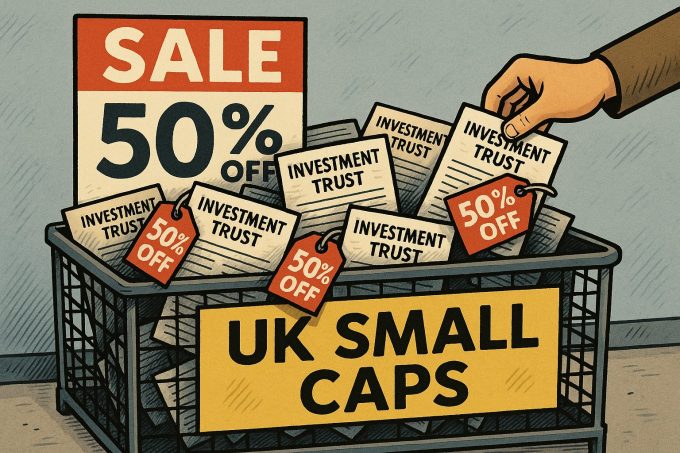
If investors in UK small and mid cap companies were hoping for a big bazooka to turbo-charge the sector in the budget, they were disappointed. The chancellor’s priorities were elsewhere. Nevertheless, some calm after a grim period of uncertainty and speculation may be enough to revive the sector’s flagging fortunes.
It is easy to present UK small and mid cap performance as a disaster. In reality, the average share price return in the UK Smaller Companies sector over the past 12 months is 6.7%[1]. Trusts have an average yield of 2.7%. Investors in UK small caps are not suffering, particularly if they have picked the better-performing trusts. It’s just the opportunity cost that has hurt, with the rest of the UK market doing far better.
Equally, it is tempting to blame weak performance on the UK’s chaotic domestic politics and lacklustre economic growth. That has a kernel of truth, but the weakness of smaller companies has been a global phenomenon. In the US, the MSCI USA Small cap index is over 11% behind the MSCI USA index over the past 12 months.[2]
Cedric Durant des Aulnois, CEO at Montanaro Asset Management, which runs the Montanaro UK Smaller Companies Investment Trust, says: “Small cap has been lagging in most geographies. The main reason is interest rates. The war in Ukraine lifted inflation, and central banks raised interest rates. That had a highly detrimental effect on smaller companies, because they tend to have more of their growth in the future.”
There has also been a sector component to small cap weakness. William Tamworth, co-manager on the Artemis UK Future Leaders trust, says that the strong performance of UK larger companies this year has been led by just a handful of companies – Rolls Royce, HSBC, Lloyds, Barclays, NatWest and BAE Systems. The FTSE 100 has led because it has had more ‘in favour’ sectors such as banks and defence. Smaller cap defence companies such as Babcock, Chemring and Qinetic have all done well.
The question is now – as it has been for much of the past two years – will performance turn? There are a few factors on which most fund managers agree. The first is that small caps are cheap, and that cheapness is a problem of sentiment, not operational performance. Mark Niznik, co-manager on the Artemis UK Future Leaders trust, says across the portfolio, the companies have an average free cash flow yield of 8.5%, double digit earnings growth, and return on capital of over 20%. Debt is low and the average price to earnings ratio is under 12x. At a time when strong returns have pushed up valuations for many areas in global equity markets, UK smaller companies are a stand-out bargain.
Abby Glennie, manager on the Aberdeen UK Smaller Companies Growth Trust, points out that UK smaller companies now have attractive dividend yields and many are undertaking share buyback programmes. They believe in themselves, even if investors don’t. She adds: “UK small caps are cheaper than large caps, global peers. They are the cheapest on earnings, with the highest p/e growth.”
Equally, most managers agree that sentiment is still at rock bottom, though Glennie and Niznik report greater interest in the sector. The outflows from the sector have been relentless – 40 consecutive months and counting, according to the Investment Association. This has created downward pressure on pricing.
A reversal in this selling pressure would be the real agent of change for UK smaller companies. It is difficult to understand why investors would be selling out having weathered three years of underperformance, “it’s far too late,” says Durant des Aulnois. Niznik says: “Pension funds don’t have much left to sell. The impetus could come from wealth managers moving money out of the Magnificent Seven. There is a lack of confidence but when it comes back it could be a big shift.”
He says smaller companies are still fighting the move to passive, but with wobbles in the AI trend, this could change: “There are the seeds of doubt about US markets, and we only need a very small inflow into the UK for it to have a big impact.”
There are still a range of factors that could move the dial on sentiment. Merger and acquisitions are one. There has been a raft of willing corporate and private equity buyers, who have spotted the bargains among the UK’s smaller companies and have been picking them off. That has helped support prices.
Tamworth says it is important that investors don’t believe that this M&A has left UK small caps as a dwindling pool of lower quality assets. He says the M&A phenomenon is real – they’ve had 31 takeovers in their portfolio in the past five years, at an average premium of over 50% – but the small cap universe is not being denuded of its best companies. “There is no shortage of good companies and we’re certainly not having to invest in lower quality companies.”
Interest rates could be a factor in the year ahead. Durant des Aulnois says: “If inflation could be contained and interest rates remain low, it would be a much better backdrop.” Glennie adds: “Forecasts have interest rates coming down to 3% by the end of next year. 3% is a very acceptable level of interest rates where markets could do very well. Also, inflation has been a major challenge, and this is coming down.”
Discounts are relatively wide, though have come in a little over 2025. Artemis Future Leaders is at 12.7%, having been as wide as 17% over the year. Aberdeen UK Smaller Companies Growth trust is in line with its 12 month average, while the Montanaro UK Smaller Companies trust has come in from around 12% discount at the start of the year to 7.2% today.
One factor to bear in mind is the style bias in UK small caps. Durant des Aulnois says: “It used to be about growth, but over the past five years, it has all been about value. The more successful sectors have been areas such as financials and energy, while areas such as healthcare and IT have not done well.” It has also been a tough time for quality managers. A recovery may also bring a style rotation in the sector.
Ultimately, the small cap premium – the faster growth generated by smaller companies over the long term – is still alive and well, it’s just that investors don’t appreciate it at the moment. The sector is poised for a significant rally, but that has been the case for some time. As Durant des Aulnois concludes, “I’ve no doubt it will happen, but timing it is difficult.”
[1] https://quoteddata.com/sector/investment-companies/uk/uk-smaller-companies/
[2] https://www.msci.com/documents/10199/255599/msci-usa-smallcap.pdf
