
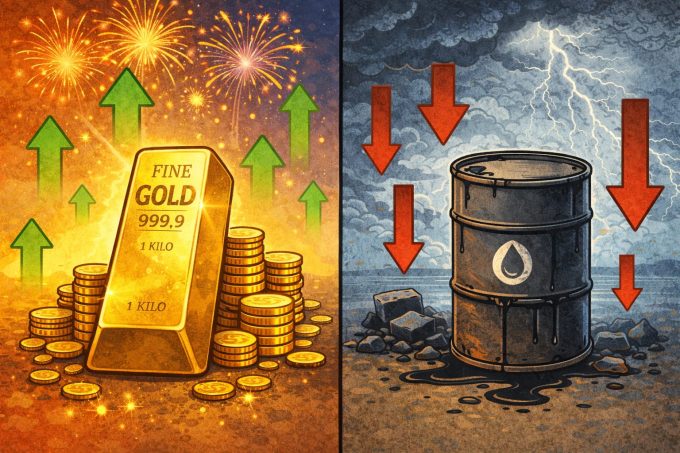
2025 was an exciting year for the commodities and natural resources sector. Trusts exposed to soaring gold and silver prices saw triple-digit returns, but it was a different picture for energy, iron ore and other commodities, where share price returns were unexciting. But with Donald Trump intervening in Venezuela and Iran perhaps on the cusp of political change, could this picture shift in the year ahead?
The top performing resources trust over the past 12 months is Golden Prospect Precious Metals (GPM), which has risen 183.8%. That put it as the best performing of any investment trust. CQS Natural Resources Growth and Income (CYN) and BlackRock World Mining (BRWM) have also been strong, up 128.9% and 96.6% respectively. However, this strength wasn’t universal and depended on having high exposure to precious metals. Riverstone Energy (RSE), which focuses exclusively on global energy assets, fell 13.6% over the year. The company announced in May that it will wind down.
Robert Crayfourd, fund manager on the CQS Natural Resources Growth and Income trust, says: “There is talk of a commodities bull market, but what we’ve really seen is a metals bull market starting with gold and silver. One of the key reasons is the growing view on the debasement trade.” That is, countries have started to move away from treasuries and dollar assets in the face of both sanctions and ballooning US deficits.
Crayfourd points out that China has been adding gold to its strategic reserves for some time, but this is fanning out into other metals including copper and silver. Gold and silver have also been safe haven trades as investors have sought to limit exposure to frothy stock markets.
Constrained supply
Looking into 2026, there are some generalisations that can be made about the mining sector as a whole. The first is that supply is constrained. Keith Watson, co-fund manager on the CQS Natural Resources Growth and Income trust, says: “We’ve had nearly two decades of anti-development policy. No-one is inclined to invest in anything with a long payback because government policy has just been too flaky. When you don’t invest in supply you don’t even need demand growth. The deficit drives the price.”
Tom Holl, co-manager of the BlackRock Energy and Resources (BERI) investment trust, gives the example of the copper market. Three large copper mines were offline this year, accounting for around 7% of global copper supply. “There has been major production disruption at copper mines Kamoa-Kakula, Cobre Panama and a mudslide with tragic consequences at Grasberg in Indonesia. Together these account for c.1.6 million tonnes of lost copper production out of global mined supply of c.23.4mt.”
Equally, says Trevor Steel, manager on Baker Steel Resources Trust (BSRT), mining companies remain “undervalued and under-owned, trading on relatively low multiples despite strong recent performance and robust balance sheets.” Share prices do not necessarily reflect the increases in underlying commodity prices.
Precious metals
However, there are still real differences between individual commodities. Precious metals still have momentum, having rallied significantly since the start of the year. They have become the go-to asset class during periods of geopolitical tension and, with an unpredictable administration in the White House, that tension seems unlikely to dissipate. A high US deficit – and a government with little inclination to do anything about it – is likely to sustain pressure on the dollar, which also helps the gold price.
Steel says: “The deterioration of the US fiscal position is boosting gold’s appeal, amid an expanding federal debt burden and persistent inflationary pressures. Expectations of further rate cuts in 2026, coupled with unprecedented pressure on the US Federal Reserve by President Trump, are supportive of both gold and silver prices.” He adds that for mining companies, earnings are likely to be strong over the year and merger and acquisition activity may continue to pick up.
Crayfourd believes there are new, potential sources of demand for precious metals: “Central bank demand has led the way – and it is now being followed by retail demand through bar and coin. We think we’re still at an early stage of financial market players coming in.” Elsewhere, cryptocurrency firms have increased exposure. Stablecoin Tether increased gold purchases during 2025, bringing its total holding to around 116 tonnes at the end of the third quarter last year.
Equally, there remains structural demand for strategic metals connected to the energy transition. That is helping to support the copper price, for example, plus lithium and nickel. Metals with industrial uses, such as palladium and rhodium also have momentum. Holl says: “We are positive on the outlook for industrial metals, particularly copper and aluminium, where we see demand as supportive. Renewable power and grid related investment have become increasingly important and larger drivers of demand for these.
“The build-out of AI data centres and related infrastructure has grabbed many headlines, but this means a shift toward capital-intensive and resource-intensive investment – a typical AI data centre may need around 50,000 tonnes of copper given the wiring and the cooling and ancillary equipment that is necessary to power and cool these.”
However, even within these strategic commodities, Steel believes that selectivity will be vital. There is a gap opening up between small and large cap mining companies, for example. Political considerations are set to be a persistent theme: all commodity markets have been blown about by political noise over the past 12 months. Rare earth equities moved very far very fast, galvanised by Trump’s price guarantees. Watson says uranium went through a significant bear market when no-one believed in nuclear but has now rallied as politicians have changed their minds.
Energy
Other commodities still look unexciting. Watson says a lot of the integrated mining companies are highly correlated to the iron ore price, where it is difficult to make a bull case. Equally, energy is a different and more complex picture. Although demand for energy continues to rise, so do sources of supply. Holl says: “The world has been facing a glut of oil supply over the past two years, as new production comes on-stream in Guyana, Canada, Norway and the US. In addition, OPEC began adding back previously curtailed production.”
While Donald Trump’s incursions into Venezuela may have been intended as a crude tool to bring more supply online, most energy companies are uninterested in exploiting the country’s reserves, particularly at current oil prices. It is also not clear that there wouldn’t be a corresponding response from OPEC. The tensions in Iran are more significant, where any lifting of sanctions, or regime change, could shift supply dynamics.
The CQS trust still holds some energy companies, but only very selectively. Crayfourd says: “We have been adding a little bit back, but we would still view ourselves as underweight versus where we’ve been historically. The market is still over-supplied and bar any disruptions, it will remain over-supplied into 2027. Most equities don’t look particularly cheap.”
Holl agrees saying they are focused on oil companies able to deliver at these oil prices, companies that can benefit from current attractive oil refining margins and selected energy infrastructure and services companies.
Investment trusts remain a relatively good way to play commodities, with some attractive discounts in the sector. The Baker Steel Resources trust still trades on a 34% discount in spite of its recent performance. The board said in December that it would be taking steps to narrow the discount, with the announcement of a detailed capital allocation plan in April. Golden Prospect Precious Metals is on a 20% discount.
It is certainly brave to invest in an area that has seen such strong returns over the past 12 months, but trust managers are still backing this part of the market over and above other areas within commodities.
Stay a step ahead. Our daily newsletter brings you the latest on investment trusts and active ETFs. Subscribe here.

Riverstone Energy is a great loss, since it’s not so easy to get exposure to oil through UK I.T.s any more. It has been a fantastic investment since 2021, when it hit an all time low. As part of the wind up they have sold their oil holdings and now have a few unquoted alternative energy holdings left to dispose of.
In a way, this trust is a reverse barometer for oil, they started the trust when oil was booming back in 2012, and are winding it up just as oil is possibly about to play catchup with other commodities.
Sadly, this is often the way with specialist trusts. BlackRock Energy & Resources Income is the only real way to get exposure but it is not a pure play on oil.