

Metage Capital has published a fresh open letter to the board of Pantheon International (PIN), accusing the company of failing to respond adequately to concerns raised in December over performance, capital allocation and the persistent discount to net asset value (NAV) – click here to read.
Metage said Pantheon has had several opportunities to address shareholders through its annual report, webinar and shareholder presentation, but argues that no substantive response has been made to its proposal that the company sell at least £500m of assets in the secondary private equity market and use the proceeds to buy back shares.
The activist investor said many of the issues it highlighted remain unresolved and contrasted Pantheon’s approach with that of HarbourVest Global Private Equity (HVPE), which has recently announced further measures aimed at tackling its own discount.
We have been surprised by some of the points raised in Metage’s letter. As we explain below, there are question marks over its interpretation of PIN’s performance and, given the long-term nature of private equity investment, we think that shareholders risk giving up considerable long-term upside in return for a short-term, and possibly unsustainable, narrowing of the discount.
Focus on performance and transparency
A central plank of Metage’s latest criticism is PIN’s performance disclosure. It says data presented by Pantheon at recent shareholder events was calculated on an inconsistent basis and lacked sufficient detail for investors to judge the manager’s track record against relevant peers. Metage has included the chart below to illustrate its point, but we think this raises a number of concerns.
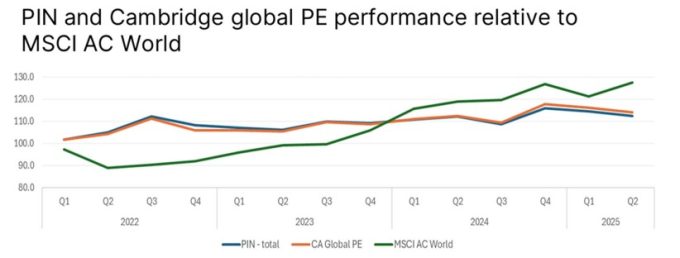
Private equity is a long-term asset class, yet much of Metage’s comments on PIN’s performance – including the chart above – focuses on the brief period since 2022. In our view, this is too short a timeframe to assess private equity returns properly, particularly when you consider that this period has seen sharply higher interest rates, invasion of Ukraine, higher energy costs, higher inflation etc – which created a difficult backdrop for the entire private sector, and many other asset classes.
It is also clear that, until the latter part of 2023, PIN’s performance was ahead of both that of the MSCI AC World and the Cambridge Index. The MSCI index has, over the past couple of years, been driven by a handful of mega cap AI stocks and has pulled ahead. Pantheon’s portfolio likely has some exposure to this theme but not to the same extent. It looks to us as though PIN is tracking the Cambridge Index over this short term period.
Persistent discount
Metage has also continued to question whether Pantheon’s current buyback programme is sufficient to close the discount meaningfully, believing that PIN’s board should articulate a clearer strategy for narrowing the discount and improving shareholder returns. It highlights recent measures brought in by Harbourvest Global Private Equity (HVPE) – it is aiming to return $500m to shareholders in 2026 at a 10% discount to NAV – as a potential way forward.
There is little doubt that, with limited exceptions, funds in the listed private equity sector have attracted some significant and persistent discounts –often unwarranted in our view – which have not been helped by weaker sentiment, higher interest rates and concerns over portfolio valuations. However, while it requires patience and an ability to look through the volatility, private equity has been shown to outperform listed equity over the longer term. In our view, it does not make sense to force funds to liquidate positions – giving up a lot of potential upside on these investments – in order to achieve this scale of discount narrowing as it largely negates the additional return benefits that private equity offers. We are also unconvinced by Metage’s criticism of the effectiveness of PIN’s buyback efforts. Metage cites a discount figure from the end of March above 30%, but the discount has since moved to 27.2%, only marginally wider than that of HVPE, which trades on the tightest discount of the peer group (discounting 3i and the tiny rump of JPEL Private Equity). The discount has narrowed materially, suggesting that buybacks and recent market moves are already having some effect.
