

In April 2026, Alliance Witan, Hargreaves Lansdown, and Vanguard were just three of 19 firms that launched Invest for the Future – a national campaign fronted by “Savvy the squirrel” aimed at encouraging Britons to look beyond cash deposits as a home for their savings. You may have seen a few articles written about it at the time, but the campaign will shortly ramp up again with tv advertising and billboards.
All the evidence suggests that UK investors tend to be either overly reckless – blurring the line between gambling and investment – or overly cautious when it comes to savings. The dangers of the first approach are obvious but both can seriously damage your wealth.
The following chart is taken from annual savings statistics produced by the UK government last September – we should see some updated figures soon – the overwhelming preference for cash ISAs is obvious.
Figure 1: Number of ISAs subscribed to by tax year
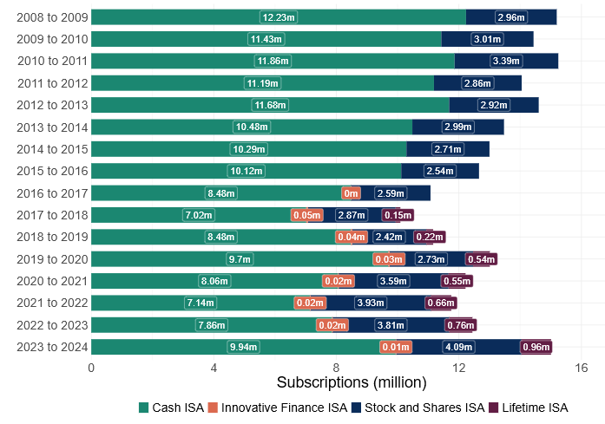
Source: Commentary for Annual savings statistics: September 2025
In periods of higher inflation that we have experienced in recent years, the minimal interest rates savers are receiving has seen the real value of these assets eroded – but this (alongside the woefull allocation to UK equities within UK pension funds) is a contributory factor to the UK’s rapidly shrinking stock market. This environment is starving British businesses of capital, taking away the numerous benefits this provides – creating employment, funding investment to improve productivity and ultimately to grow the nation’s wealth and improve its tax take.
We have run some numbers to illustrate the problem. Say you had invested £1,000 ten years ago (on 1 August 2016) into a cash deposit that earned 1% more than the base rate of interest, and assuming that you reinvested the interest as you went along, by 31 July 2026 you would have £1,342. However, you would have lost money after adjusting for inflation; in 2016 terms, your investment would have been worth just £947 – this is a big difference. Government bonds would have been an even worse investment. The yield on a 10-year gilt was just 0.6% back in 2016, which compares to a subsequent annualised inflation rate of 3.5%.
However, based on the share price total return for the median global investment company (an annualised 11.3% return), you could have turned your £1,000 into a far superior £2,928. Yes, there would have been times during that 10-year period where you might have wondered whether you had made the right decision, but by keeping your nerve, you would have made even more money than if you had bought the UK’s best-selling global index tracker – the Vanguard FTSE Global All Cap Index tracker (which would have returned £2,857). More importantly, perhaps only 22 of 191 trusts with a 10-year track record would have left you in a worse position than the cash ISA.
We are conscious that this marketing campaign is ramping up even as equity markets hit new highs. The nightmare scenario would be to spend serious sums of money getting investors comfortable with investing in equities only for the market to crash, potentially leaving them with a sour taste in their mouths. That problem would be compounded if these investors also panicked and sold out at the bottom of the market. However, it never feels like a good time to begin investing – it feels like we have lurched from crisis to crisis in recent years – yet markets have still made progress. The old adage being that it is ‘time in the market, not timing the market’ that counts.
Equity valuations are distorted by a narrow group of stocks. This is the time where backing a good active manager can make a big difference to your future returns and the investment company sector has plenty to choose from and there is much the industry has to be proud of.
The investment companies sector encompasses a broad range of investment propositions across all types of asset classes. It also boasts many conservatively managed, large, liquid, low-cost companies with track records stretching back decades, which can make ideal long-term investments for first-time investors.
We would suggest that they consider backing more than one – diversification is a good thing – but perhaps the key is to remember this is a long-term investment, panicking at the first sign of trouble often just means you end up selling at the bottom.
The problem is getting that message out there. Some good news is that The Association of Investment Companies has a plan to tackle this. It is partnering with a marketing and advertising agency Gravity Global to develop a campaign to grow the audience for investment companies.
Finally, this needs a collective effort. If you’re reading this, you’re likely more financially literate than most and you probably already understand the importance of finding reliable resources, doing your research and looking at a range or perspectives in coming to your investment decisions. You likely understand the opportunities and have experienced the pitfalls too.
We all need to share this experience with our friends and to tell them about investment companies and their obvious benefits. We’re not saying that you should be making recommendations but, in talking about your experience, this will help demystify investing for others and hopefully help them to dip their toe in the water and begin their investment journey. Hopefully this generates a virtuous circle, and in time, we can all be a bit more ‘Savvy’.
