

In March 2025, we wrote about Japan’s corporate governance transformation through the lens of Katsushika Hokusai’s The Great Wave off Kanagawa. The metaphor felt appropriate. A powerful wave of change was breaking over Japan’s corporate landscape, driven by regulatory reform, pressure from investors and a growing recognition among companies themselves that capital could no longer be left idle and corporate structures could no longer remain unquestioned.
For AVI, this is a particularly familiar story. Our Japanese investment strategy was launched in the wake of Abenomics with an explicit purpose: to capitalise on the opportunity created by Japan’s corporate governance reform. We believed that changes in the way Japanese companies were governed, owned and managed could unlock substantial value, particularly among small and mid-cap companies that were less well understood by the market and where active engagement could have the greatest impact.
More than a decade on, the wave has reshaped the landscape.
Perhaps Hokusai’s Fine Wind, Clear Morning, also known as Red Fuji, is now the more appropriate image. Where The Great Wave captures movement, disruption and the force of change, Fine Wind, Clear Morning offers a different perspective. Mount Fuji stands firm and unmistakable against a clear sky. The turbulence has subsided sufficiently for the landscape to be seen with greater clarity.
That, in our view, is where Japan’s corporate governance reform now stands. The question is no longer whether Japan is changing. It is increasingly clear that it has. The opportunity now lies in understanding what has actually changed, which companies have embraced that change, and where the next generation of value creation will emerge.
From the Great Wave to the Clear Morning
Japan’s corporate governance reform has been one of the most significant structural changes in global equity markets over the last decade.
The introduction of the Stewardship Code in 2014 and the Corporate Governance Code in 2015, the Tokyo Stock Exchange’s focus on the cost of capital and share price, the unwinding of cross-shareholdings, growing pressure to address conglomerate structures and non-core assets, and a more active role for shareholders have collectively changed the expectations placed on Japanese companies.
In the early stages, the reform agenda was primarily about breaking down barriers. Companies were encouraged to reconsider strategic shareholdings. Boards were expected to become more independent and effective. Management teams were challenged to explain how their businesses created value and how they intended to improve returns on capital. Investors, in turn, were given a clearer framework through which to engage with companies.
For active investors, this created an unusually attractive opportunity. Where companies traded at valuations that implied little expectation of improvement, even modest changes in governance, capital allocation or strategic direction could generate substantial upside. AVI recognised a market in which the gap between the quality of many businesses and the quality of their capital allocation was unusually wide. We believed that deep fundamental research, long-term ownership and constructive engagement and activism could help narrow that gap.
A decade later, some of the most obvious manifestations of that opportunity have become increasingly visible. Japan has experienced record levels of share buybacks. Cross-shareholdings have declined. Companies have becomemore willing to return surplus capital. Boards have become more independent.
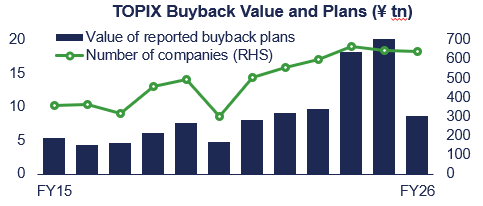
Source: AVI, SMBC. Buyback plans reported as at 30/06/2026.
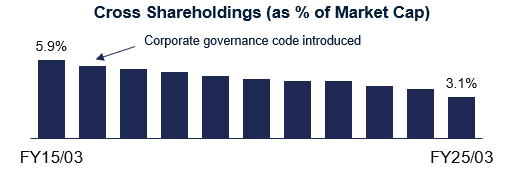
Source: AVI, SMBC, as at 30/06/2026. Note: Value of cross-shareholdings relative to market capitalisation, as at 31/03/2025.
The wave has, in many respects, done what waves do: it has reshaped the shoreline.
From Form to Substance
The next phase of reform is about understanding what this new landscape makes possible, and is increasingly about substance rather than form.
It is relatively straightforward for a company to publish a governance policy, appoint an independent director or announce a share buyback. It is considerably harder to demonstrate that these actions have changed the way a company thinks about capital allocation, portfolio construction and long-term value creation.
Japan’s regulators increasingly recognise this distinction. The Financial Services Agency has explicitly emphasised the need to move “from form to substance” in corporate governance, with greater focus on whether governance arrangements are actually improving corporate value and whether dialogue between companies and investors is genuinely effective.
For investors, this creates a more demanding but potentially more rewarding environment. The question is no longer simply whether a company is responding to the reform agenda, but whether it is doing so in practice rather than in principle, and whether the resulting improvement in corporate value is reflected in its share price.
This distinction is particularly important because the most obvious opportunities created by the first phase of reform are becoming more widely recognised. The challenge now is to identify companies where the initial steps towards better governance and capital allocation are only the beginning of a much broader transformation.
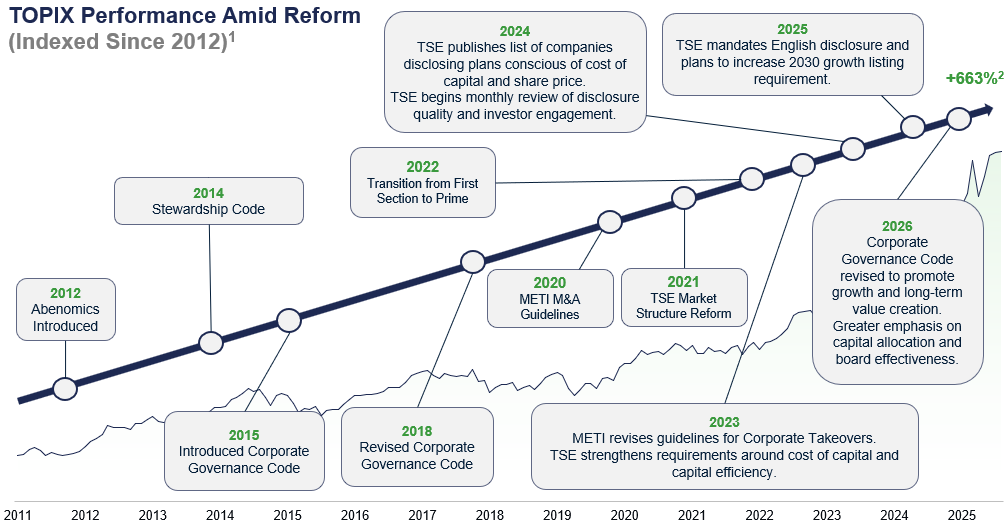
Source: AVI as at 31/07/2026. Note: 1Topix indexed total return since 31/12/2011. 2Total price return for the TOPIX Index since 31/12/2011, assuming dividends reinvested.
2026: A New Milestone
2026 marks the first revision of Japan’s Corporate Governance Code in five years, and represents another important step in the institutionalisation of the reform agenda.
The significance of this revision lies not simply in its individual provisions, but in the fact that the principles underpinning Japan’s governance transformation are becoming increasingly embedded in the expectations of the market itself. Better governance, more effective boards, greater attention to capital allocation and more meaningful engagement between companies and investors are no longer ideas being introduced to Japan’s corporate sector. They are increasingly part of the framework within which Japanese companies are expected to operate.
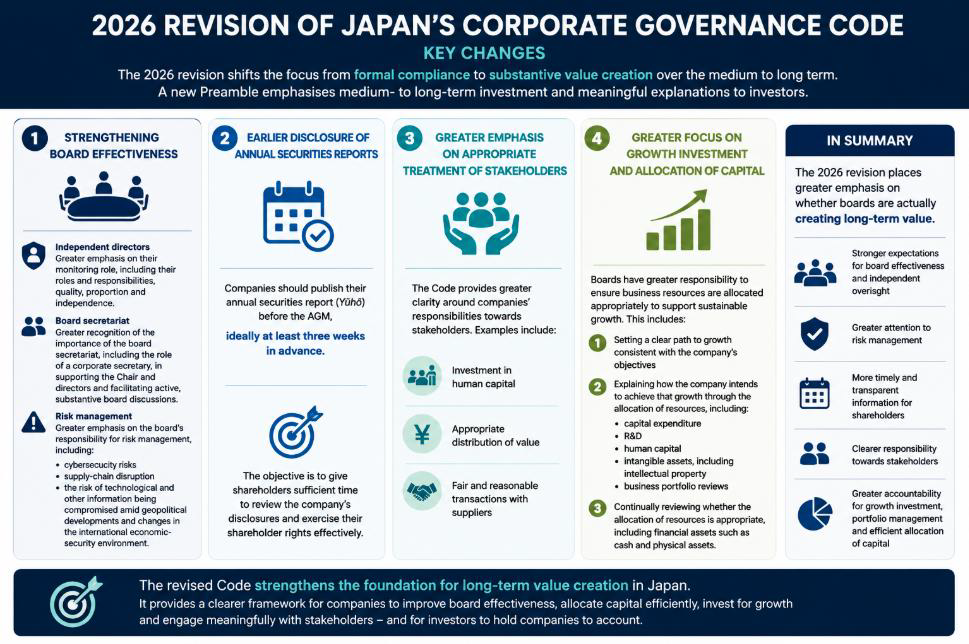
Source: Financial Services Agency of Japan: 04.pdf
This represents a meaningful change in the context for active ownership.
A decade ago, an investor challenging a company to unwind cross-shareholdings, improve board independence or address excess cash could be seen as pushing against the prevailing corporate culture. Today, these issues are increasingly mainstream, particularly among larger companies that have become more accustomed to the expectations of global investors.
The bar has moved and the challenge for active investors is moving with it. The most interesting opportunities are increasingly likely to be found not simply in companies that have begun to respond to governance reform, but in those where the next stage of change remains underappreciated.
This may be a company that has improved its capital allocation but has yet to address the structure of its business portfolio. It may be a company that has strengthened its governance but still has significant scope to improve returns. Or it may be a business where management has recognised the changes required, but where the market has yet to appreciate the scale of the potential transformation.
Recent proposals to amend Japan’s Companies Act have nevertheless prompted concerns among some investors that shareholder rights are beginning to move in the opposite direction. The proposed changes would, among other measures, raise the ownership threshold required to requisition an extraordinary general meeting from 3% to 5% of voting rights and introduce a number of procedural changes intended to reduce the burden on companies responding to shareholder proposals. While some commentators have interpreted these amendments as a retreat from Japan’s reform agenda, we believe that assessment overstates their practical significance. For committed long-term shareholders, the higher ownership threshold is unlikely to represent a meaningful obstacle. If we considered calling an extraordinary general meeting, for example, we would usually already own more than 5% of the company.
More broadly, these amendments bring Japan’s framework closer to that of other developed markets, while shareholder rights would remain comparatively strong by international standards. They may represent a modest recalibration rather than a reversal, and they do not alter our conviction that Japan remains one of the most attractive markets globally for active engagement and governance-led value creation. Indeed, the recent surge in shareholder engagement, private equity activity and strategic M&A suggests that market discipline is strengthening through multiple channels, not solely through the formal exercise of shareholder rights.
The opportunity is becoming more nuanced, and, in our view, more interesting.
A Changing Market Landscape
The evolution of Japan’s governance framework is taking place alongside a broader transformation in the country’s capital markets.
One of the clearest signs of this is the acceleration in M&A and private equity activity. Japan has experienced a growing number of take-private transactions, management buyouts and strategic acquisitions, with financial sponsors increasingly willing to invest in companies where they see opportunities to improve operations, restructure corporate portfolios or deploy underutilised capital.
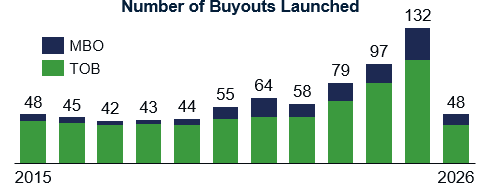
Source: AVI, SMBC, as at 30/06/2026. Note: Includes completed deals and announced deals that are yet to be completed (as at 30/06/2026).
This is an important development in the evolution of governance reform. For many years, the principal mechanism for unlocking value was to encourage listed companies to change from within: to improve governance, unwind cross-shareholdings, dispose of non-core assets or return excess capital. Increasingly, the market itself is providing another mechanism.
Where management teams are unwilling or unable to close the gap between a company’s potential and its market valuation, the prospect of a takeover provides a credible alternative. The threat of a change in ownership can itself become a catalyst for better governance and capital allocation, even when a transaction never ultimately takes place.
The rise of private equity is therefore both a consequence of Japan’s reform agenda and a further force accelerating it. As the barriers to corporate restructuring fall, more capital is being attracted to opportunities that were previously inaccessible. The result is a more dynamic market for corporate control, in which underperforming assets are increasingly likely to attract new owners, new strategies and, ultimately, new capital allocation decisions.
This does not mean that every undervalued company should be taken private. Public markets provide important benefits, and many of the best outcomes for shareholders will come from companies remaining listed while improving their governance, strategy and capital allocation. But the growing willingness of financial and strategic buyers to acquire Japanese businesses has changed the negotiating dynamics. Management teams can no longer assume that a persistent discount to intrinsic value will simply be tolerated indefinitely.
At the same time, the Tokyo Stock Exchange’s planned revision of the TOPIX index methodology represents another important development. The reform, which will take place over two years beginning in October 2026, extends the logic of Japan’s corporate transformation beyond individual companies and into the architecture of the market itself. The Tokyo Stock Exchange are introducing tighter listing and continuation requirements, and an annual review of constituents with a view to streamline the Topix by hundreds of companies. We expect this new wave of pressure, particularly on smaller companies, will make it increasingly difficult for businesses to maintain the status quo without addressing internal weaknesses. This should accelerate strategic change and corporate transformation across the market.
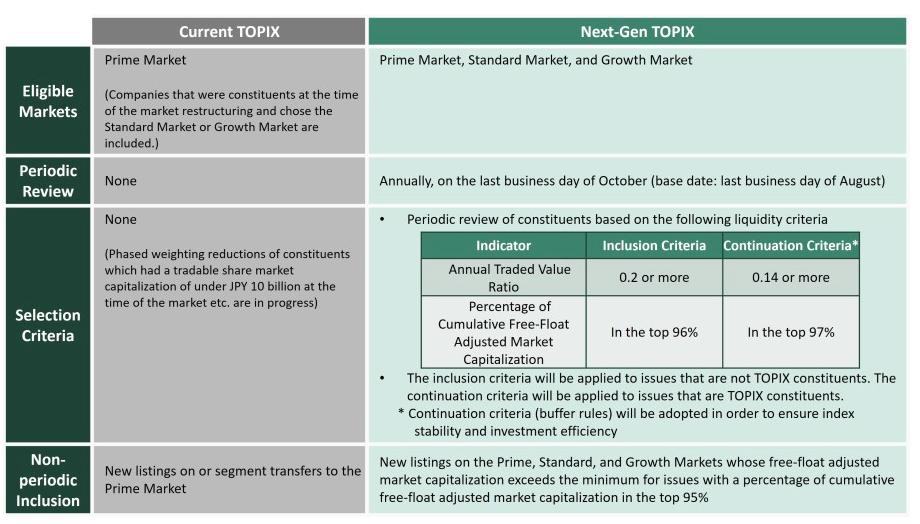
Source: Japan Exchange Group Second stage of revisions | Revisions of TOPIX
The importance of the TOPIX reform goes beyond the mechanics of an index. It is another manifestation of the same broader trend: Japan’s reform agenda is becoming embedded in the mechanisms through which capital itself is allocated.
For companies, the incentives are changing. The ability to demonstrate a compelling equity story, maintain adequate liquidity and communicate clearly how capital is being deployed may become increasingly important. Companies that fail to adapt risk becoming progressively less visible to investors, while those that improve their governance, investor communication and market relevance may benefit from greater attention.
Taken together, the rise in M&A and private equity activity and the reform of TOPIX point to a broader evolution in Japan’s capital markets. The transformation is no longer confined to how individual companies are governed. It is increasingly influencing who owns them, how capital flows between them and which companies receive the attention of investors.
For AVI, this is an important development. We launched our Japanese strategy to capitalise on the governance opportunity created by Abenomics. More than a decade later, the opportunity is evolving into something broader: a structural transformation in the way capital is allocated across Japan’s corporate sector.
The Next Opportunity: From Governance to Capital Allocation
If the first wave of Japan’s corporate governance reform was about unlocking trapped value, the next phase is about what companies do with that value.
This is where governance reform increasingly meets corporate strategy.
What matters now is not simply whether excess cash is returned, but whether capital is being directed towards the highest-return opportunities. It is not simply whether a company sells a non-core asset, but whether the proceeds are reinvested intelligently. It is not simply whether a board becomes more independent, but whether it becomes more effective in challenging management and improving strategic decision-making.
These are more difficult questions than those that defined the earlier phase of reform. They require a deeper understanding of the underlying businesses, competitive dynamics and management teams. They also require investors to distinguish between companies that are merely responding to external pressure and those that are genuinely changing the way they allocate resources.
This is particularly relevant to the small and mid-cap companies in which AVI invests. These businesses are often less well covered by the market and can have complex ownership structures, underutilised balance sheets or portfolios of businesses that have evolved incrementally over many years. Management teams may also have had less exposure to institutional investors and less experience of engaging with shareholders on questions of capital allocation and corporate strategy.
This creates an opportunity for a long-term, engaged investor to play a constructive role.
The most effective engagement is rarely about imposing a predetermined solution. It is about understanding the company in depth, identifying where the greatest opportunities for improvement lie and working with management and the board to develop a credible path towards greater value creation.
Since inception, AVI has built a team with significant management consulting experience for precisely this purpose: to engage with management teams not simply on what needs to change, but on how that change can be implemented.
The objective is not change for its own sake. It is to help companies become better businesses, while ensuring that the benefits of that improvement are ultimately reflected in the value available to all shareholders.
The most interesting engagements today therefore often extend beyond the traditional boundaries of governance and into questions of strategy, capital allocation and long-term competitiveness.
Case Study – Kurabo
Kurabo is a good example of what the next phase of Japan’s governance reform looks like in practice. They are a conglomerate structure with an over-diversified legacy business portfolio, founded in 1888.
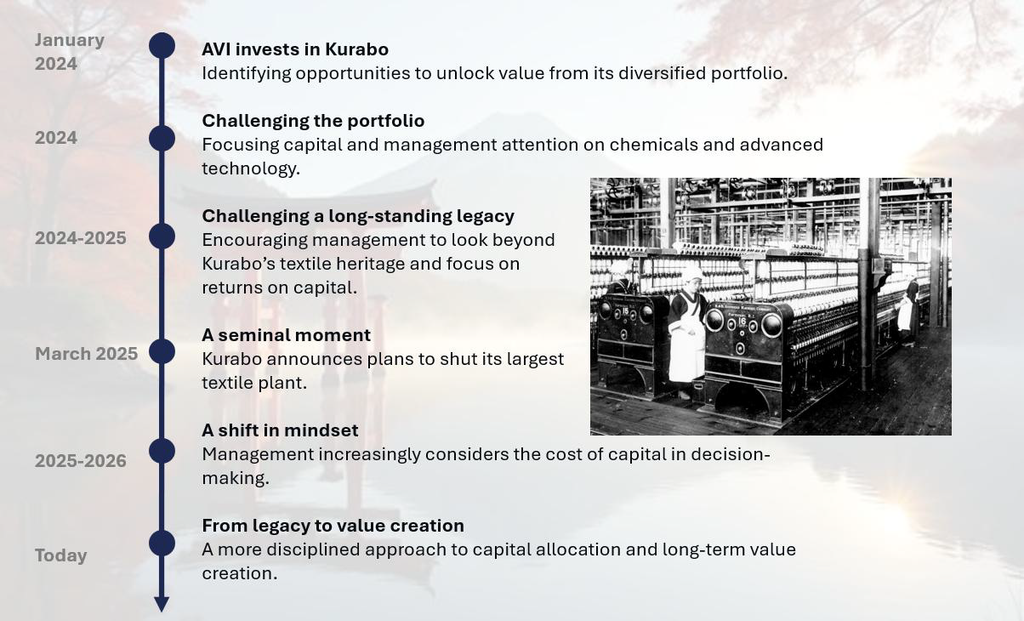
Source: AVI as at 30/06/2026. Image source: www.kurabo.co.jp. Textile plant located in Kurashiki, Okayama.
Kurabo illustrates the opportunity for active investors to help companies move beyond long-established structures and towards a more disciplined allocation of capital, with a greater focus on where the business can create the most value.

Source: www.kurabo.co.jp. Textile Innovation Centre, located in Anjo, Aichi.
Fine Wind, Clear Morning
Hokusai’s Fine Wind, Clear Morning provides a fitting metaphor for this stage of Japan’s transformation.
The mountain itself has not suddenly appeared; it was always there. What has changed is the light in which it can be seen.
There is a similar dynamic at work in Japan’s equity market. The corporate governance reforms of the past decade have not created entirely new companies, nor has everything miraculously happened in the last two years as foreign investors have started to take notice. Rather, they have reshaped the operating environment of existing companies and, increasingly, the lens through which investors evaluate them.
For some companies, the market has already recognised the implications. Excess capital has been returned, governance structures have improved and valuations have been re-rated accordingly. For others, the first steps have been recognised but the full consequences have not yet been appreciated.
Again, there is relevance to Japan’s small and mid-cap market, where information can travel more slowly and where companies can remain underappreciated for longer periods. A change in capital allocation may be visible, while its implications for the future profitability of the business remain underappreciated. A portfolio restructuring may have begun, while the market continues to value the company according to its historical structure. A management team may be increasingly receptive to shareholders, while the potential benefits of that engagement are yet to be reflected in the share price.
These situations require investors to look beyond the immediate catalyst and understand the trajectory of change. The value creation opportunity may not lie in the announcement itself, but in what it makes possible afterwards.
This is where we believe active ownership remains key. Our objective is to identify businesses where the direction of travel is becoming clearer, where management has the capacity and willingness to act, and where the market is still valuing the company primarily on its history rather than its potential.
The wave of governance reform created the conditions for this change. The clear morning reveals where it is beginning to take hold.
The View from Here
Japan’s corporate governance reform is entering a new phase.
The 2026 Corporate Governance Code revision marks another important step in the evolution from formal compliance towards substantive improvement. The planned reform of the TOPIX index demonstrates that the transformation is also extending into the infrastructure of Japan’s capital markets. At the same time, the growing wave of M&A, private equity investment and take-private transactions suggests that the reform agenda is beginning to reshape not only how listed companies are governed, but also who owns them and how capital is allocated across the economy.
For investors, this does not mean that the opportunity created by reform is over. It means the nature of the opportunity is changing. The next generation of opportunities will require more detailed research, deeper engagement and a greater understanding of how individual companies can translate governance improvements into sustainable growth and returns.
In some cases, value will be created by a company transforming itself. In others, it may be unlocked through a strategic transaction, a change in ownership or the separation of businesses that have historically sat together.
This is where we believe the small and mid-cap segment of Japan’s market remains particularly compelling. It is a part of the market where the gap between corporate potential and market recognition can still be substantial, where ownership structures and capital allocation can remain inefficient, and where an engaged shareholder can play a meaningful role in catalysing change.
The wave has brought change to the shore.
The wind is now shifting.
And, in the clear morning that follows, the landscape is becoming easier to see.
For active investors willing to look beyond the obvious, we believe there remains a significant opportunity to identify the companies that will emerge stronger from Japan’s corporate transformation, and to engage with them to help make that transformation happen.
IMPORTANT INFORMATION
This material is issued by Asset Value Investors Limited (“AVI”) which is authorised and regulated by the Financial Conduct Authority (UK). The distribution of this material may be restricted by law and persons into whose possession it comes are required to inform themselves of and comply with any such restrictions. The information in this document is selective and subject to verification, completion and amendments. As such, all information and research material provided herein is subject to change and this document does not purport to provide a complete description of the investments or markets referred to or the performance thereof. No undertaking, representation, warranty or other assurance, express or implied, is or will be made and no responsibility or liability is or will be accepted by or on behalf of AVI as to or in relation to the accuracy or completeness of this document or the information or opinions contained herein and no responsibility or liability is accepted by any of them for the accuracy or sufficiency of any such information. All opinions expressed in this document are subject to change without notice and do not constitute advice and should not be relied upon. The contents of this document are not intended to constitute, and should not be construed as, investment advice. Past performance is not a reliable indicator of future results.
This article was sourced from the AVI website.
