
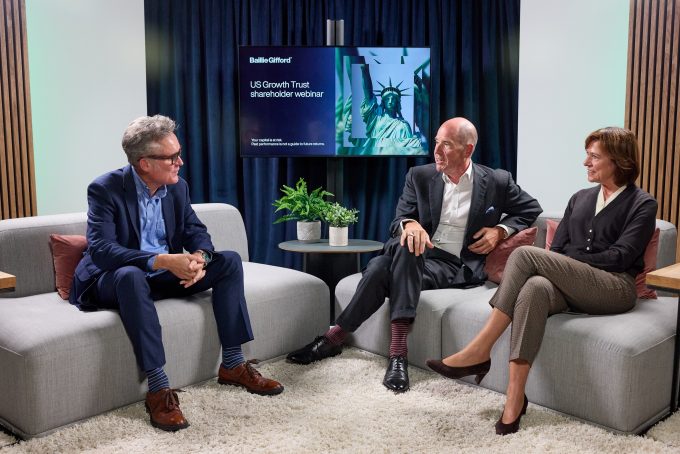
Baillie Gifford US Growth (USA) is urging its 13,000 private investors to vote as soon as they can to protect the investment trust from being taken over by its largest shareholder, Saba Capital.
The £1bn investment company faces its third “existential” challenge from the hostile hedge fund. The US firm owns nearly 30% of the shares and wants to remove its independent board of directors and replace them with three of its nominees.
Speaking on a webinar last week, Baillie Gifford US Growth chair Tom Burnet pleaded with shareholders not to give up or feel their votes are too small to matter.
“The greatest worry is that people don’t express their opinions and they think, ‘oh my, I don’t have a holding that’s terribly big, it’s not terribly important. It doesn’t really matter if I don’t vote, you know, everyone else is going to vote, so it’ll be fine.’ I really don’t think it will be fine unless people get out and vote,” said Burnet (pictured middle above).
“Saba have a big share. We need everybody to make their opinions felt and heard. It’s quite easy to do. We’ve been working closely with all of the platforms and all of the places where you might ry and vote to try and make that as straightforward as possible. And the platforms have been very supportive, but we need people to get out and vote”.
You can watch the webinar here.
Why is the vote important?
Burnet told QuotedData’s Gavin Lumsden, who was presenting the webcast, that if Saba gained control of the board it would likely lead to the removal of Baillie Gifford as fund manager and spell the end of its pioneering approach to picking the best US growth companies.
Under fund managers Gary Robinson and Kirsty Gibson, the US Growth trust has assembled a portfolio of stakes in the most exciting US businesses, whether they are private, unquoted companies or ones that have floated on the stock market. Its top five holdings are SpaceX, artificial intelligence developer Anthropic, AI chip maker Nvidia, digital lender Stripe and e-commerce giant Amazon.
Since launch in March 2018 the trust has generated an underlying investment return of 269.4% to 31 August, beating the 254.5% from the S&P 500 index, although the actual return shareholders received was slightly below the benchmark at 238.8%.
“If you like the strategy, if you like the top decile returns that it’s giving you, if you like the excitement of what’s coming down the track, then you need to vote. It doesn’t take very long and we would be very grateful,” said Burnet.
He added: “Don’t be defeatist. Don’t think it’s a done deal. Obviously, shareholders defeated Saba at the beginning of last year and also last September, last year’s AGM.’
How do I vote?
Most private shareholders hold USA shares on an investment platform or share-dealing website such as Hargreaves Lansdown, Interactive Investor, AJ Bell, Halifax Share Dealing, Barclays Smart Investor, HSBC, Fidelity or Charles Stanley.
You can vote your shares from your online account. If you have not heard from your platform, contact them urgently.
The same applies if you hold your shares through a financial adviser or wealth manager.
“Speak to your wealth manager. Make sure that they are going to vote your shares on your behalf,” said USA’s senior independent director Sue Inglis (pictured above right).
When should I vote?
Now! There is no time to delay and it only takes about five minutes.
Although the AGM in London takes place on 23 October, most votes will be made before the meeting. According to Baillie Gifford’s voting guide, platform deadlines are earlier with some starting as soon as 14 October. Most providers will let you notify them of your voting intentions online with some accepting emails and phone calls.
Of the big platforms, Charles Stanley has the earliest deadline of 16 October, followed by AJ Bell, Halifax and Barclays on 19 October and Hargreaves, Interactive Investor and Fidelity on 20 October.
How many votes does USA need?
Baillie Gifford US Growth needs all the votes it can get. The trust first fended off Saba in February last year when 78% of the trust’s shares were voted. This time turnout needs to be even higher as Saba looks like it has the support of another US hedge fund, Sessa Capital, which has a 7.7% stake.
Urging all shareholders to vote, Inglis said “we don’t want to win by a whisker. If we win by a whisker, we’ll take it. But we really want shareholders to speak very loudly because that should at least give us the confidence boost” and strengthen the board’s position in a future negotiation with Saba, she explained.
Which resolutions should I back?
There are 14 AGM resolutions in total.
The first three are Saba’s resolutions to appoint its non-independent nominees Jason Chen, Thomas McGlade and James Waterlow, Saba’s UK managing director.
The remaining 11 are votes to reappoint the existing board of Burnet, Inglis and their independent co-directors Chris van der Kuyl and Elizabeth Flockhart. There are also other routine measures for the smooth running of the trust such as approving the annual report and re-appointing auditor Ernst & Young.
Burnet and Inglis strongly recommended shareholders instruct their platforms to vote against the three Saba resolutions and vote for the 11 company resolutions.
Who can help me?
Baillie Gifford has hired Georgeson, a shareholder engagement company to set up an email and phone line to help shareholders. Tel: 0207 0197018. Email: [email protected]
What is Saba saying?
Saba claims that US Growth shareholders have “suffered under a board that has repeatedly put Baillie Gifford’s interests first”.
When it put forward its nominees in August, Saba focused on the trust’s severe underperformance in the past five years, highlighting how the the shares had trailed the S&P 500 by 88.4%.
Saba has also said if its nominees are elected, it will urge the new board to offer all shareholders the chance to cash in all their investment at close to net asset value. The shares currently trade at a narrow 2.5% discount to NAV.
Why is Saba wrong?
Burnet said Saba was “cherry picking” the worst performance numbers it could find. The five-year underperformance was caused by a crash in 2022 and 2023 when interest rates and inflation spiked, hurting the shares of the trust’s growth stocks. Saba omitted to say that the three-year performance was much better. US had recovered strongly and in the 36 months up to 31 August, the portfolio had rallied 85.7%, well ahead of the S&P 500’s 65.7%. Shareholders had enjoyed an even more rapid recovery with a total return of 119.3%.
Burnet said the board had challenged the managers over the slump in performance and as a result various changes to portfolio management had been made, such as automatically reviewing the investment cases of stocks that had shot up by 2.5 times. However, he emphasised that USA should be viewed as a long-term investment and that shareholders should accept that its performance would diverge from the index.
What does Saba want?
Earlier this year Saba rejected the board’s offer of an exit at 99.75% of net asset value for it and any other shareholders who wanted to sell. A sale of this kind by an investment company is normally priced at around 98%-99% of NAV so Saba was being offered a good deal. That it dismissed this earlier proposals “brings us back to the idea that we think, inevitably, that they’re interested in controlling the assets for their own benefit, which is, again, why we need shareholders to come out and make their opinions felt and their views heard and vote in the AGM.”
Alan Brierley, an independent analyst at Investec Securities, agreed that Saba’s “rejection of near-NAV exits raises doubts over whether liquidity is the objective or merely the route to control, and it also raises questions over whether Saba is deploying client capital in pursuit of its own commercial gain. Saba’s record across its two US-listed closed-end funds [Saba Capital Income & Opportunities (BRW) and Saba Capital Income & Opportunities (SABA)], which currently trade on discounts of 15.2% and 15.6% respectively, provides a cautionary tale and fundamentally undermines its claim to protect ‘mom-and-pop’ investors from poor governance and persistent discounts.”
In a note to investors last month, he added: “The choice is clear: preserve USA’s distinctive proposition or give Saba influence over its future without knowing what follows. The threat is not merely disruption; it is the risk that the strategy underpinning USA’s long-term value creation could be dismantled just as the recovery gathers pace.”
Richard Stone, chief executive of the Association of Investment Companies, said: “Saba has rejected a generous cash exit offered by the existing board at very close to NAV, so it’s likely that Saba wants to take control of this investment trust and manage it. I urge all shareholders to make their voices heard by voting their shares through their platforms as soon as possible.”
You’ve read the news. Now have your say. Which investment trusts, fund managers and ETFs deserve to win? You decide in the Investors’ Choice Awards 2026. Vote now.
