
A sharper edge for BGUK
Baillie Gifford UK Growth Trust (BGUK) offers a differentiated way to access the UK market through a concentrated portfolio of high-quality growth companies. Its performance has been held back by a prolonged period in which UK growth investing has been out of favour. However, many portfolio companies have continued to make operational progress, while valuations remain depressed relative to their earnings prospects and international peers.
The appointment of James Smith as a third co-manager brings a fresh perspective and is expected to sharpen the focus on portfolio construction, valuation and sell discipline, while preserving BGUK’s long-term growth philosophy. With gearing in place, a strengthened management team and a portfolio of businesses offering substantial long-term growth potential, BGUK appears well positioned to benefit from any recovery in UK growth equities. In the meantime, the management fee has been cut by 20% until April 2029, and the trust’s high-single-digit discount provides an additional source of potential upside if performance and investor sentiment improves.
Focused portfolio of UK growth equities
BGUK aims to achieve capital growth by investing in a concentrated portfolio (35–65 companies) of predominantly UK equities, with the aim of providing a total return in excess of the FTSE All-Share Index.
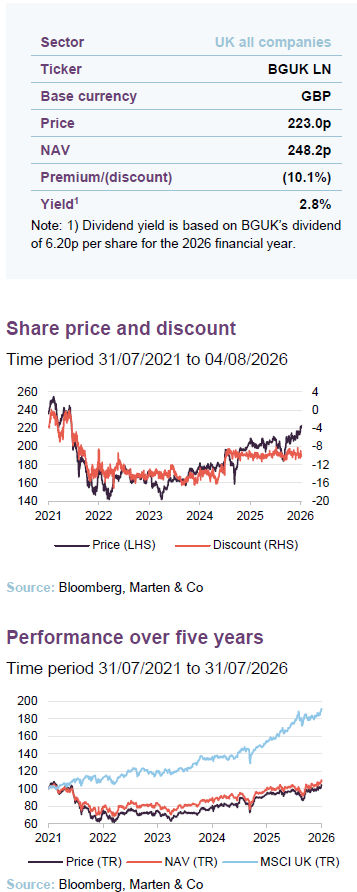
| 12 months ended | Share price TR (%) | NAV total return (%) | MSCI UK TR (%) | MSCI UK Growth TR (%) | MSCI World TR (%) |
|---|---|---|---|---|---|
| 31/07/2022 | (24.4) | (20.4) | 12.8 | 5.1 | 4.2 |
| 31/07/2023 | (0.7) | 4.4 | 6.8 | 5.6 | 8.0 |
| 31/07/2024 | 7.5 | 8.1 | 13.5 | 7.7 | 19.1 |
| 31/07/2025 | 18.5 | 13.2 | 12.7 | 8.8 | 12.8 |
| 31/07/2026 | 8.2 | 6.2 | 23.6 | 6.6 | 18.7 |
Fund profile
Focused UK growth equities portfolio
Further information can be found at Baillie Gifford’s website: www.bailliegifford.com
BGUK aims to deliver capital growth and outperform the FTSE All-Share Index by investing mainly in UK equities. It holds a relatively concentrated portfolio of 35 to 65 companies, most of which are constituents of the FTSE 350, although it may also invest outside the index.
Baillie Gifford has managed BGUK since the end of June 2018. The managers use a conviction-led, stock-picking approach, with position sizes determined by their confidence in each company rather than its index weight. BGUK may also use convertible securities and equity-related derivatives for efficient portfolio management and can invest up to 10% of total assets in unlisted companies, measured at the time of investment.
BGUK’s benchmark is the FTSE All-Share Index, although the portfolio is managed without reference to any index. In this report, we use the MSCI UK Index as a proxy and also compare performance with the MSCI UK Growth and MSCI World indices.
About the managers
Well-resourced investment team.
Baillie Gifford has 175 investors and analysts across 23 teams, most based in Edinburgh. Its partnership structure supports a collegiate investment culture, while portfolio managers retain final responsibility for their portfolios. At 30 June 2026, the firm managed or advised on around £197.4bn of assets, including £6.8bn in UK equities. BGUK is co-managed by Iain McCombie, Milena Mileva and James Smith (see page 17 for brief biographies).
Managers’ view
Sentiment towards growth stocks and the UK market continues to improve
Interest rate cuts are still coming through.
When we last published on BGUK in August 2025, we commented how sentiment towards growth stocks was continuing to improve, which was subsequently reflected in BGUK’s interim results for the six months to 31 October 2025. However, as we discuss in the performance section from page 10 onwards, value stocks have had a resurgence, a function of rising inflation and interest rate expectations as energy costs have ratcheted up following the outbreak of war in Iran. In addition, a swathe of software and platform businesses were hit by the “SaaSpocalypse” earlier this year – see below – which has been a further headwind to the approach.
On the positive side, global capital has continued to shift towards other developed markets, including Europe and the UK, reflecting heightened uncertainty surrounding US government policy and the impact this is having. However, despite growth stocks now delivering superior earnings growth, this has not been reflected in share prices and UK equities, particularly UK growth stocks that continue to trade at a significant discount relative to both historical levels and global peers. The managers believe that this disconnect between earnings growth and share prices cannot persist indefinitely, and have maintained gearing to take advantage of it. Their view is that backing high-quality growth companies while they are out of favour offers better prospective returns than chasing areas whose recent performance has been driven by unusually favourable cyclical conditions. They have therefore viewed share price weakness as an opportunity to add to certain holdings.
AI selloff too indiscriminate
BGUK’s managers believe that the market’s response to AI has been too indiscriminate. Holdings including Autotrader, Rightmove, Experian and Softcat were derated as investors questioned whether AI might undermine their role in their respective industries. The managers accept that these businesses will have to adapt, but argue that AI does not automatically replace the proprietary data, trusted brands, network effects, customer relationships and embedded workflows that underpin their competitive positions. In some cases, AI could make these assets more useful and easier to monetise. The companies are already introducing AI-enabled products, and the managers regard the resulting weakness in their share prices as an opportunity rather than evidence that their investment cases have been broken.
Fundamental philosophy remains intact
The managers recognise that stock selection has not been good enough. A review by the board concluded that the trust has generally identified companies capable of delivering strong earnings growth, but has sometimes paid too high a price or been too slow to sell when valuations became stretched. With James Smith joining as a third co-manager, the intention is to place greater emphasis on portfolio construction, valuation and sell discipline, with turnover expected to increase from historically very low levels. However, BGUK’s long-term growth philosophy remains intact.
Investment approach
Markets are inefficient at pricing long-term growth
Baillie Gifford believes markets often undervalue long-term growth, particularly over periods of five years or more, creating opportunities to outperform. Its investment culture therefore emphasises long-term thinking and holding on to successful companies with strong management and durable business models.
Three-stage team-based approach
Baillie Gifford favours a team-based approach, believing that teams make better decisions than individuals. This is supported by a strong culture of debate and constructive challenge. The firm is organised into a small number of investment teams pursuing different growth strategies. Its UK equities team follows a consistent three-stage process: discovery, debate and decision.
Stage 1 – Discovery: Discovery is the idea-generation stage. Every six weeks, the team holds a prospects meeting to set its research priorities for the next six weeks. From a UK universe of more than 500 stocks, it maintains a priority list of around 200 companies. Portfolio managers and analysts are expected to conduct their own research, helping to maintain accountability for investment decisions. Team members bring early-stage ideas to the prospects meeting for open and constructive discussion. These conversations determine which ideas merit deeper research.
A stock will only be researched in depth if it has a credible long-term growth case.
A stock will only be researched in depth if it has a credible long-term growth case, although the team will still consider other businesses when assessing competitors and industry dynamics. Analysts can draw on external research and colleagues across Baillie Gifford, but are encouraged to pursue ideas that interest them. They are generalists rather than sector specialists, and there is no routine “maintenance research” from a prescribed list of stocks.
‘Debate’ is the most important stage.
Stage 2 – Debate: Debate is the most important stage of the investment process. It centres on a concise investment note, limited to three pages for the UK equities team, to keep the analysis focused and end with a clear recommendation. Supporting material can be added in appendices. Each note is structured around Baillie Gifford’s five-question framework:
- Edge – why is a stock interesting? This focuses on the industry background, company-specific factors, competitive position, and key issues pertinent to the investment case.
- Growth – what will it look like in five years? This focuses on sales, profit margins and capital allocation.
- Sustainability – what, if any, ESG factors are material to the investment case? Consider both opportunities and risks. This focuses on climate impact, sustainable business practices, board structures, and management alignment.
- Valuation – should we own it? This focuses on the company’s valuation, the reasons why a company should trade well, and the likely valuation in five years and beyond.
- Discipline – what would make us sell? This focuses on the key risks and any non-negotiables of the investment case.
Another team member is appointed as a devil’s advocate to challenge assumptions and help strengthen the final recommendation.
Stage 3 – Decision: The team discusses every stock, but the lead managers make the final portfolio decisions. This combines the benefits of team debate with clear individual accountability.
Sell discipline: The managers will sell if they lose confidence in a company’s management, believe its business model is failing, or judge that the market has fully recognised its growth potential.
Asset allocation
Portfolio is radically different to the benchmark.
As at 30 June 2026, BGUK held 36 companies, unchanged in number from 30 June 2025 (the most recently available information when we last published). The industry breakdown in Figure 1 displays the diversity of ideas within the portfolio. Despite its UK all-cap remit, there are large parts of the market that BGUK has no exposure to, which is consistent with a concentrated growth portfolio built without reference to the benchmark.
Figure 1: Industry allocation as at 30 June 2026
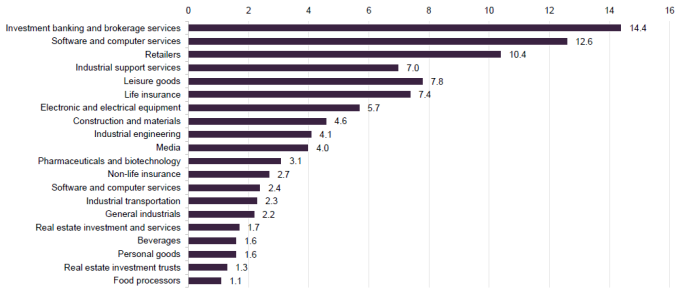
Although BGUK is a long-term, low-turnover portfolio, its sector exposure changes gradually. Since our last report, the largest increases have been in industrial engineering (+2.1 percentage points), investment banking and brokerage services (+1.7 points) and media (+1.3 points). The largest reductions have been in industrial support services (-4.4 points), life insurance (-2.2 points), construction and materials (-1.6 points) and real estate investment and services (-1.2 points). All other changes were one percentage point or less. Reflecting its concentrated, stock-specific approach, BGUK’s active share remains high at 92%, broadly in line with its long-term average.
BGUK’s portfolio differs markedly from the benchmark. It has traditionally traded at a valuation premium, reflecting stronger expected earnings and sales growth, and also retains a pronounced mid-cap bias. This is not a deliberate allocation decision, but the result of bottom-up stock selection and where the managers have found the most attractive opportunities.
Portfolio activity
Reflecting the managers’ low-turnover approach, the number of stocks entering and exiting the portfolio in a given year is likely to be limited. For example, during the year ended 30 April 2026, just three positions were exited in their entirety: FD Technologies, which was acquired by TA Associates in July 2025; FDM Group was exited entirely as the managers felt that the long-term growth case had weakened (strategic growth initiatives had disappointed, particularly attempts to expand overseas and AI has also increased uncertainty around the medium-term outlook for the demand for junior technology consultants and IT staffing services); and Just Group was acquired by Brookfield Wealth Solutions in April 2026. There have been two new additions to the portfolio – Spirax and Greggs – which are discussed below.
Spirax Group – world-class industrial compounder that’s cyclically, rather than structurally, depressed
Figure 2: Spirax share price (GBp)
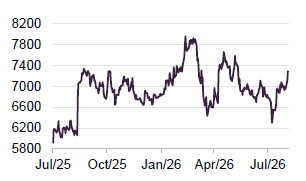
Spirax Group (www.spiraxgroup.com) is a specialist engineering company focused on thermal-energy management and fluid technology. It supplies steam-control systems, electric thermal solutions and precision pumps for demanding industrial processes where reliability, efficiency and technical support are critical. Its network of around 2,000 specialist sales engineers works closely with customers to identify inefficiencies, design tailored systems and improve safety, productivity and energy efficiency. BGUK’s managers believe this creates durable customer relationships, recurring aftermarket revenues, pricing power, high barriers to entry and opportunities to sell additional products over time. Spirax operates in fragmented specialist markets, giving it scope to take share from smaller competitors. It also benefits from structural growth themes including industrial decarbonisation, electrification and biopharmaceutical production.
The shares weakened as demand normalised after unusually strong pandemic-era growth, while customer destocking and subdued industrial activity added further pressure. The market appears to have interpreted this as evidence that Spirax’s historic growth rate may no longer be sustainable. BGUK’s managers disagree, viewing the slowdown as cyclical rather than a sign of weakening competitive advantages or long-term prospects.
They invested following the de-rating, believing that it offered an attractive entry point into a high-quality business. As industrial spending recovers, Spirax should benefit from stronger organic growth, better factory utilisation, margin recovery, continued market-share gains and selective acquisitions. This creates potential for returns from both earnings growth and a recovery in the valuation multiple.
Greggs – a value-led consumer growth business with a meaningful store-opening runway
Greggs (www.greggs.com) is the UK’s largest bakery-led food-on-the-go retailer, with shops across high streets, retail parks, transport hubs, roadside sites and drive-throughs. Its vertically integrated model, under which it manufactures and distributes much of its own food, gives it greater control over quality, availability and costs. Growth is being driven by new shop openings, longer trading hours and expansion into evening and delivery.
Figure 3: Greggs share price (GBp)
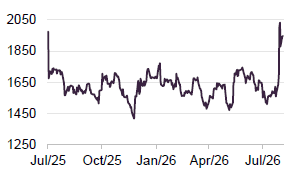
BGUK’s managers believe that Greggs is often mistaken for a mature bakery chain, particularly given slower like-for-like sales growth and recent margin pressure. Weaker consumer spending and rising ingredient, energy and wage costs have been headwinds, but margins have also been depressed by a major investment programme designed to support future growth.
Greggs has invested over £1bn between 2022 and 2026 in manufacturing and distribution capacity. These facilities carry costs before reaching efficient utilisation, but should support a much larger shop estate and higher sales volumes, generating attractive returns as capacity fills. The managers believe Greggs’ brand and value proposition remain its main growth drivers. Vertical integration provides a defensible cost advantage, while recent investment has strengthened its operational moat. As capex moderates, efficiency, cash generation and returns from new shops should improve, supporting earnings growth over the next five years and beyond.
Top 10 holdings
Figure 4: Top 10 holdings as at 30 June 2026
| Holding | Sector | Business | Portfolio weight 30 June 2026 (%) | Portfolio weight 30 June 2025 (%) | Percentage point change |
|---|---|---|---|---|---|
| Games Workshop | Consumer discretionary | Tabletop games manufacturer/retailer | 7.8 | 6.7 | 1.1 |
| AJ Bell | Financials | UK wealth manager | 5.4 | 5.0 | 0.4 |
| Volution Group | Industrials | Ventilation equipment supplier | 4.6 | 6.1 | (1.5) |
| Softcat | Technology | IT reseller and infrastructure solutions | 4.5 | 3.5 | 1.0 |
| Wise | Financials | Online global FX money transfer | 4.1 | 4.7 | (0.6) |
| Howden Joinery | Industrials | Manufacturer/distributor of kitchens to trade | 4.1 | 4.1 | – |
| 4imprint | Communications | Promotional merchandise | 4.1 | 2.6 | 1.5 |
| Renishaw | Industrials | Metrology products | 4.0 | 2.4 | 1.6 |
| Legal & General | Financials | Insurance and investment management | 4.0 | 3.3 | 0.7 |
| Moonpig Group | Consumer discretionary | Online greetings card and gifting platform | 3.7 | 3.2 | 0.5 |
| Total of top five | 26.4 | 28.6 | (2.2) | ||
| Total of top 10 | 46.4 | 48.3 | (1.9) |
Figure 6 shows BGUK’s top 10 holdings as at 30 June 2026 and how these have changed since 30 June 2025 (the most recently available data when we last published). Reflecting the managers’ long-term, low-turnover approach, most of the top 10 portfolio holdings will be familiar to regular followers of BGUK’s portfolio announcements and our research on the trust.
Figure 5: Games Workshop share price (GBp)
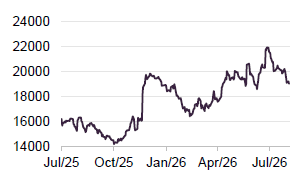
New entrants to the top 10 are 4imprint, Renishaw, Legal & General and Moonpig. Names that have moved out of the top 10 are Autotrader, Experian, St. James’s Place and Just Group. We discuss some of the more interesting developments in the next few pages. Other holdings have been discussed in our previous notes – see page 21 of this note).
Games Workshop (7.8%) – trimmed on the back of strong performance
Games Workshop (www.warhammer.com) is a British manufacturer of products for playing fantasy tabletop games, using figurines that the customers paint themselves, and is best known for its Warhammer and Warhammer 40,000 series of products.
Games Workshop has been trimmed on the back of strong performance. However, BGUK’s managers continue to like the company, highlighting its pricing power, high margins, expanding international footprint and the opportunities it has to monetise the Warhammer intellectual property through licensing and its partnership with Amazon.
AJ Bell (5.4%) – benefitting from a shift towards self-directed retirement investing
Figure 6: AJ Bell share price (GBp)
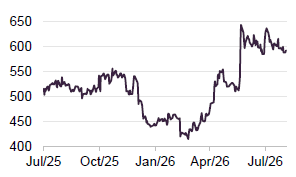
AJ Bell (www.ajbell.co.uk) provides a share dealing platform and related financial services and products to investors, serving both B2B and D2C segments in the UK. It has positioned itself as a low-cost provider and has been growing its market share at a time when some of its peers have struggled to remain competitive.
Like Games Workshop above, AJ Bell is another holding that has been trimmed on the back of a strong performance. BGUK’s managers remain positive on the outlook for the company which, in their view, is likely to be one of the long-term winners from the shift towards self-directed retirement saving, supported by its scale, customer service and competitive pricing.
Volution Group (4.6%) – benefitting from a structural trend to improve air quality
Figure 7: Volution share price (GBp)
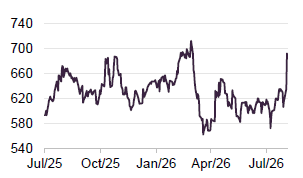
Volution Group (www.volutiongroupplc.com) manufactures and supplies ventilation products and indoor air-quality products, from simple extractor fans to more complex heat recovery solutions. Its primary markets are the UK, Continental Europe and Australasia, where it operates through 17 different brands split across these different regions. As we have discussed in our last two notes, BGUK’s managers see a long-term structural trend of efforts to improve air quality, with demand for Volution’s products benefitting from environmental regulations in building and construction. The managers highlight that Volution’s heat recovery ventilation solutions are already helping customers to meet new energy efficiency building standards. BGUK’s managers have trimmed the position on the back of strong performance, but they remain positive on the company as they believe these structural trends could boost Volution’s organic growth for years come.
Softcat (4.5%) – position added to following AI-related sell off
Figure 8: Softcat share price (GBp)
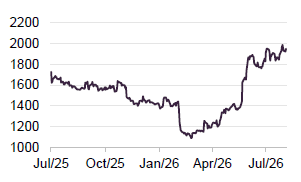
Softcat (www.softcat.com) is a value-added reseller of IT infrastructure (both software and hardware), primarily to SMEs in the UK. It has around 10,200 active customers, including BGUK’s manager, and benefits from the long-term structural trend of growing IT expenditure. As we have discussed previously, Softcat’s rate of staff attrition is very low, which sets it apart from its peers and allows Softcat to foster much more regenerative customer relationships.
Softcat reported 23% growth in gross profit and 27% growth in operating profit in its January half-year results, prompting management to upgrade its full-year profit guidance. Despite this, the shares had been de-rated because investors feared that AI would reduce the need for IT resellers and other channel partners. BGUK’s managers believed those concerns to be misplaced and have added to the position. In their view, AI is making enterprise IT more complicated by adding challenges around cloud architecture, data readiness, governance, compliance and cybersecurity. This should increase the need for Softcat’s advice and its ability to help customers navigate a complex, multi-vendor technology environment.
Wise (4.1%) – taking substantial market share from incumbents
Figure 9: Wise share price (GBp)
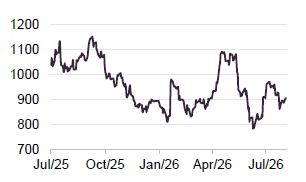
Wise (wise.com) is a London-based foreign exchange transfer business that provides an online platform to send and receive money internationally at low cost. By maintaining local accounts and connecting directly to payment systems in more than 80 countries, Wise can transfer money more quickly and cheaply than the traditional correspondent banks. BGUK’s managers say that as volumes grow, Wise’s unit costs fall, enabling it to reduce prices further and attract additional customers, in a virtuous circle.
BGUK’s managers believe that Wise still has a long runway. Despite processing about £180bn of payments, Wise handles around 5% of consumer cross-border transfers and less than 1% of the SME market. They believe that growth should come from gaining customers, entering additional markets and securing more partnerships with banks that opt to use Wise’s infrastructure rather than their own.
Performance
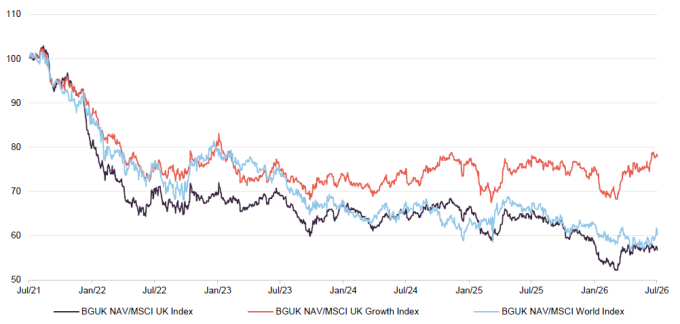
Figure 10: BGUK’s NAV total return relative to various indices, over five years to 31 July 2026
Up-to-date information on BGUK and its peers is available on the QuotedData website.
As discussed in previous notes, there has been a lot of disruption in financial markets since Baillie Gifford took over the management of the trust in June 2018. However, as illustrated in Figure10, rising inflation and interest rate expectations in the latter part of 2021 and the first half of 2022 has had the greatest impact on growth stocks and hence BGUK’s relative NAV and share price performance. This subsequently stabilised, as inflation was brought under control and interest rates receded, but the gap expanded again as inflation and interest rate expectations increased first with Trump’s Liberation Day tariffs and more recently the war in Iran. We retain the view that there is still significant catch-up potential.
Figure 11: Cumulative total return performance over periods ending 31 July 2026
| 3 months (%) | 6 months (%) | YTD (%) | 1 year (%) | 3 years (%) | 5 years (%) | BG tenure1 (%) | 10 years (%) | |
|---|---|---|---|---|---|---|---|---|
| BGUK NAV | 6.4 | 6.0 | 6.4 | 6.2 | 29.9 | 8.0 | 37.0 | 67.6 |
| BGUK share price | 6.3 | 6.3 | 7.8 | 8.2 | 37.8 | 3.5 | 34.7 | 73.1 |
| MSCI UK | 5.2 | 8.5 | 11.8 | 23.6 | 58.1 | 90.4 | 93.5 | 136.5 |
| MSCI UK Growth | 0.9 | 2.6 | 2.3 | 6.6 | 24.9 | 38.7 | 77.5 | 99.4 |
| MSCI World | 5.3 | 10.0 | 10.4 | 18.7 | 59.5 | 79.5 | 168.0 | 242.2 |
Results for the year ended 30 April 2026
For its financial year ended 30 April 2026, BGUK achieved NAV and share price total returns of 15.6% and 18.2% respectively. In comparison, the broader MSCI UK Index returned 26.6% and the MSCI UK Growth Index 10.9%. BGUK’s NAV total was below that of its All-Share benchmark (which BGUK’s annual report says returned 25.2%), largely reflecting BGUK’s lack of exposure to oil & gas, mining and banks. Stock selection was also a negative contributor, with platform and software related businesses derated on fears of disruption from AI, which occurred during the second half of the financial year.
Top positive contributors for the year to 30 April 2026
Figure 12: Top five positive contributors to relative returns
| Stock | Total return (%)1 | Contribution (%) |
|---|---|---|
| Renishaw | 115.9 | 1.7 |
| Just Group | 56.2 | 1.5 |
| Unilever2 | (13.0) | 1.3 |
| Molten Ventures | 111.0 | 1.0 |
| 3i2 | (38.2) | 0.9 |
Figure 12 lists the top five contributors to performance for the year ended 30 April 2026. As noted above, Just Group was acquired during the year. Unilever and 3i feature in the list because both performed poorly during the period, and neither was held within BGUK’s portfolio.
Figure 13: Renishaw share price (GBp)
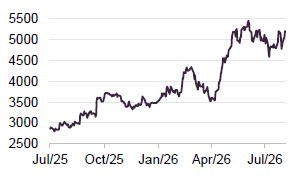
Renishaw is a leading British engineering group specialising in precision measurement, additive manufacturing and analytical instruments. Its products serve industries including aerospace, electronics and healthcare, where it supplies metal 3D-printing and neurosurgical systems. Having performed poorly during BGUK’s FY2025 – its February 2025 interim results missed expectations and the company reacted negatively to Trump’s tariff plans in April 2025 – the company performed strongly in FY2026 as the tariff threat receded and the underlying business proved to be resilient. BGUK’s managers have trimmed the position into this strength, but consider the long-term investment case to remain intact. They cite several structural growth drivers: increasing factory automation; greater precision in semiconductor and aerospace manufacturing; reshoring and localisation of production; and growth in metal additive manufacturing.
Figure 14: Molten Ventures share price (GBp)
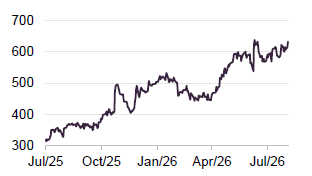
Molten Ventures (moltenventures.com) is a closed-end investment company focused on providing venture capital to UK and European technology companies. It is an early-stage investor, participating in series A fundraising rounds and onwards (these funding rounds generally follow “seed funding”). BGUK’s managers’ rationale for holding Molten Ventures is that the manager has a generally positive track record of growing its NAV and achieving good realisations with its investments. In addition, private companies have been very much out of favour, which has been reflected in Molten’s trading at a significant discount to NAV, despite the vast majority of its core portfolio performing in line with or better than expectations. This view proved to be correct during FY2026, as the operational performance of its biggest investments were strong and its discount to NAV narrowed.
Top detractors for the year to 30 April 2026
Figure 15 lists the top five detractors from for the year ended 30 April 2026. Softcat is discussed in the asset allocation section. With the exception of HSBC, which features as it performed well during the period and was not held by BGUK, all the other large detractors were hit by the “SaaSpocalypse”.
Figure 15: Top five negative contributors to relative returns
| Stock | Total return (%)1 | Contribution (%) |
|---|---|---|
| Autotrader | (40.0) | (3.5) |
| HSBC2 | 115.9 | (2.2) |
| Experian | (26.7) | (1.9) |
| Rightmove | (40.0) | (1.6) |
| Softcat | (15.4) | (1.3) |
Peer group
BGUK sits in the five-member UK All Companies sector, shown in Figures 16 and 17. Although the sector is growth-focused, BGUK has a particularly strong growth bias. Fidelity Special Values and Aurora UK Alpha lean more towards value, while Schroder UK Mid Cap and Mercantile invest further down the market-cap spectrum.
Peer group performance
Please click here to visit QuotedData.com for a live comparison of the UK all companies peer group.
Baillie Gifford took over BGUK’s management at the end of June 2018, following a period of weak relative performance under the previous manager. Parts of the subsequent eight years have been challenging for markets generally and for growth stocks in particular. UK equities have also been out of favour with international investors, with smaller companies particularly affected, which has weighed on the sector’s longer-term performance. BGUK’s pronounced growth bias has left it more exposed than most.
Figure 16: Peer group cumulative NAV total return performance (annualised) to 31 July 2026
| 1 month (%) | 3 months (%) | 6 months (%) | 1 year (%) | 3 years (%) | 5 years (%) | 10 years (%) | |
|---|---|---|---|---|---|---|---|
| BGUK | 3.0 | 6.4 | 5.0 | 6.5 | 9.0 | 1.1 | 4.9 |
| Aurora UK Alpha | 2.2 | 11.3 | (4.6) | 3.7 | 6.6 | 5.5 | 7.8 |
| Fidelity Special Values | 6.6 | 9.0 | 6.1 | 19.9 | 20.0 | 13.4 | 11.1 |
| Mercantile | 2.7 | 4.4 | 5.1 | 11.4 | 12.5 | 1.9 | 6.4 |
| Schroder UK Mid Cap | 8.1 | 5.6 | 0.3 | 7.9 | 10.1 | 2.8 | 6.9 |
| BGUK rank | 3/5 | 3/5 | 3/5 | 4/5 | 4/5 | 5/5 | 5/5 |
| Sector median | 3.0 | 6.4 | 5.0 | 7.9 | 10.1 | 2.8 | 6.9 |
More recently, investors have begun to look beyond the US, aside from the small group of mega-cap technology stocks that has driven much of that market’s performance. The UK has benefitted, led so far by larger companies. Although inflation has recently risen, the broader trend still appears to favour lower interest rates as central banks respond to slowing economies. This should also support growth stocks, and both trends may have further to run.
As Figure 17 shows, BGUK is the smallest trust in the sector by market capitalisation, although it is similar in size to Aurora and Schroder UK Mid Cap. Despite widespread share buybacks, the sector’s average market capitalisation has risen slightly since our last report. BGUK has the sector’s second-widest discount, although it is similar to those of Aurora and Mercantile. It could narrow if growth stocks continue to outperform.
Its ongoing charges are slightly above the peer-group average. However, this average is lowered by Aurora, which charges no base management fee but does levy a performance fee, and Mercantile, whose much larger size provides economies of scale. BGUK’s gearing, measured at the end of June 2026, is above the sector average but not excessive. Like most of its peers, it does not charge a performance fee. BGUK has traditionally offered a relatively low yield, slightly below the sector average, although it is currently modestly above it.
NAV volatility has fallen across the sector since our last note. BGUK has historically had one of the lowest levels of long-term volatility in the peer group, but has slipped down the rankings as volatility among some peers has fallen more quickly.
Figure 17: Peer group comparison – size, ongoing charges, discount, and yield as at 4 August 2026
| Market cap (£m) | Ongoing charges (%) | Perf. fee | Premium / (discount) (%) | Dividend yield (%) | Net gearing (%) | |
|---|---|---|---|---|---|---|
| BGUK | 237 | 0.76 | No | (10.2) | 2.8 | 8 |
| Aurora UK Alpha | 275 | 0.351 | Yes1 | (11.7) | 1.8 | 0 |
| Fidelity Special Values | 1,520 | 0.68 | No | 0.7 | 2.0 | 6 |
| Mercantile | 1,777 | 0.49 | No | (9.7) | 2.9 | 12 |
| Schroder UK Mid Cap | 250 | 0.92 | No | (5.5) | 2.9 | 3 |
| BGUK rank2 | 5/5 | 4/5 | 4/5 | 3/5 | 2/5 | |
| Sector median | 275 | 0.68 | (9.7) | 2.8 | 6 |
Dividend
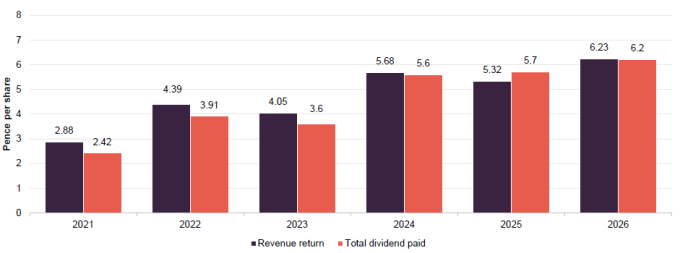
BGUK’s priority is capital growth, with dividends paid to the extent required to maintain its investment trust status. Despite the UK market’s traditionally higher yield, income is therefore likely to make up only a small part of shareholders’ total returns. The trust pays one final dividend each year following approval at the AGM, usually in September. For the year ended 30 April 2026, the board has proposed a final dividend of 6.2p per share, up from 5.7p in 2025. This equates to a yield of 2.8% based on the 223.0p share price at 4 August 2026. Revenue earnings of 6.23p per share mean the dividend is covered.
Revenue earnings have exceeded dividends in recent years, allowing BGUK to build its revenue reserve. At 30 April 2026, this stood at £17.9m, or 16.53p per share, compared with £17.6m, or 13.57p per share, two years earlier. BGUK may also pay dividends from capital profits.
Figure 18: BGUK revenue income and dividend by financial year (ended 30 April)1
Premium/(discount)
Figure 19: BGUK premium/(discount) over five years to end July 2026
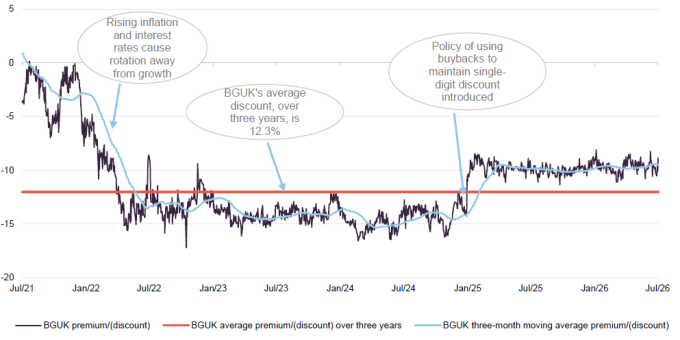
On 28 January 2025, BGUK announced an updated buyback policy whereby share repurchases would be used with the aim of maintaining a single digit discount to the trust’s NAV per share, in normal market conditions. As illustrated in Figure 19, this policy has been very effective with a step in BGUK’s discount since. There has been a marked increase in buybacks since the policy’s introduction. Figure 19 also illustrates that the discount has been less volatile since the policy’s introduction.
In the year prior to the policy’s introduction, BGUK traded at an average discount of 14.5%, and moved with a discount range between 10.9% and 16.6%. Since the policy’s introduction, the average discount has been 9.8%, with the discount moving in a range between 8.1% and 11.3%. As at 4 August 2026, BGUK was trading at a discount of 10.1%.
Structure
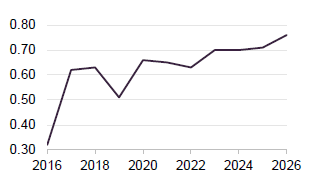
Figure 20: BGUK ongoing charges ratio (%)1
Fees and costs
BGUK’s board has secured a temporary cut in its management fee from 0.50% to 0.40% of NAV, effective from 1 July 2026 until 30 April 2029, the calculation date for the trust’s performance-triggered tender offer. It is then expected to revert to 0.50%, assuming the trust continues following the tender process. There is no performance fee, and the management agreement can be terminated by Baillie Gifford with six months’ notice and by BGUK with three months’ notice. The manager also provides company secretarial and administrative services, all covered by this fee.
The management fee is split 30% to revenue and 70% to capital, reflecting the board’s view of the long-term balance of returns. The ongoing charges ratio for the year to 30 April 2026 was 0.76%, 5bp higher than 0.71% a year earlier, despite a reduction in overall costs, largely due to the impact of share buybacks.
Capital structure and life
BGUK has one class of ordinary share listed on the London Stock Exchange’s premium segment. At 31 July 2026, it had 112,484,853 shares in issue, of which 6,332,402 were held in treasury and 106,152,451 were in general circulation. The trust may borrow, subject to a net gearing limit of 20% of net assets. The board reviews gearing limits periodically to ensure they remain appropriate for market conditions.
BGUK has a significant retail presence on its share register.
BGUK has a strong retail presence within its share register, with major direct-to-consumer platforms accounting for around 25% of the register. Wealth managers and intermediaries represent a further 35%.
BGUK shareholders vote on its continuation every five years at the AGM. The next vote is due in 2029, although an additional vote will be held in 2027. A performance-triggered tender is also planned for 2029 if BGUK’s NAV per share underperforms the All-Share over the five years to 30 April 2029.
BGUK’s year-end is 30 April, its annual results are usually released in June or July (interims in November or December), and its AGMs are usually held in September. BGUK pays one final dividend, after the AGM, if required.
Management team
Iain McCombie joined Baillie Gifford in 1994 and has spent the majority of his career as an investment manager in the UK equity team. He became a partner in 2005. Iain graduated with an MA in Accountancy from the University of Aberdeen, and qualified as a Chartered Accountant.
Milena Mileva joined Baillie Gifford in 2009 and is an investment manager in the UK equity team. She became a partner in 2022. Milena graduated with a BA in Social & Political Sciences from the University of Cambridge in 2007 and an MPhil in Politics from the University of Oxford in 2009.
James Smith joined Baillie Gifford in 2022, and prior to joining the firm, worked as a senior investment manager at ADIA in Abu Dhabi covering UK Equities, having begun his career at Martin Currie in Edinburgh in 2012. James graduated with a BSc (Hons) in Economics from UCL in 2010.
Board
All directors retire and stand for re-election annually.
BGUK’s board comprises five non-executive directors, all considered independent of the investment manager. Newly appointed directors must stand for election at the next AGM, while all directors retire and seek re-election annually. The directors have served for an average of 5.2 years. Andrew Westenberger, chair of the audit committee, is the longest-serving director, with 9.3 years on the board, and is not standing for re-election at September’s AGM. Seema Patterson will become audit chair following his retirement. The directors have no other shared directorships. The company’s articles cap total annual directors’ fees at £250,000. Average fees for individual board roles have increased by 6.7% for the current financial year compared with FY26.
Figure 21: Board member – length of service and shareholdings
| Director | Position | Date of appointment | Length of service (years) | Annual fee (GBP)1 | Shareholding2 | Years of fee invested3 |
|---|---|---|---|---|---|---|
| Neil Rogan | Chairman | 1 January 2024 | 2.6 | 49,200 | 135,607 | 6.1 |
| Andrew Westenberger | Chair of the audit committee | 5 May 2017 | 9.3 | 39,800 | 20,000 | 1.1 |
| Ruary Neill | Senior independent director | 15 November 2018 | 7.7 | 34,300 | 36,707 | 2.4 |
| Cathy Pitt | Director | 5 August 2021 | 5.0 | 32,800 | 21,501 | 1.5 |
| Seema Paterson | Director | 2 January 2025 | 1.6 | 32,800 | 20,000 | 1.4 |
| Average (service length, annual fee, shareholding, years of fee invested) | 5.2 | 37,780 | 46,763 | 2.5 |
Since our last report, three BGUK directors have made significant share purchases. Neil Rogan bought 50,746 shares at 204.0p on 3 December 2025, Catherine Pitt bought 5,014 shares at 198.3p on 5 March 2026, and Seema Paterson bought 10,000 shares at 212.51p on 1 July 2026. All BGUK directors hold shares in the company, and on average their holdings are equivalent to 2.5 years of fees, up from 1.8 years when we last published.
Neil Rogan (chairman) was appointed to BGUK’s board in January 2024 and became chairman on 14 June 2024. He is also chairman of Invesco Asia Trust and a director of JPMorgan Global Growth & Income Trust. Previously, he held investment roles at Touche Remnant, Flemings and Gartmore/Henderson, where he was head of global equities. He has also chaired Murray Income Trust and served as a director of The Scottish Investment Trust.
Andrew Westenberger (chairman of the audit committee) joined BGUK’s board in 2017 and has chaired the audit committee since then. He is chief executive of Hurst Point Group. Previously, he was chief financial officer of Tysers Insurance Brokers and group finance director of Brewin Dolphin Holdings and Evolution Group. He has also served as a non-executive director and trustee of the Chartered Institute for Securities & Investment and held senior finance roles at Barclays Capital and Deutsche Bank. Andrew is a chartered accountant.
Ruary Neill (senior independent director) joined BGUK’s board in 2018 and became senior independent director in 2021. He is also a director of JPMorgan Emerging Markets Investment Trust. Previously, he worked in investment banking at UBS and held roles in Asian equity markets at UBS and Schroder Securities.
Cathy Pitt (director) joined BGUK’s board in 2021. A former consultant partner at the law firm CMS, she has over 20 years’ experience advising boards and asset managers on corporate matters. She is also a non-executive director of Gresham House Energy Storage Fund and the deputy chair of the Association of Investment Companies.
Seema Paterson (director) joined BGUK’s board in 2025. She is chief financial officer and a board director of This Works Products, chairs the audit committee of CQS Natural Resources Growth and Income, and serves on the board of youth employment charity Resurgo Trust. Previously, she worked in mergers and acquisitions at Société Générale and corporate finance at Collins Stewart. Seema is a chartered accountant and will – as mentioned above – take on the role of audit chair for BGUK later this year. Seema will also become a non-executive director of AVI Global Trust Plc with effect from 1 September and chair of its audit committee when the incumbent retires.
SWOT analysis
Figure 22: SWOT analysis for BGUK
| Strengths | Weaknesses |
|---|---|
| BGUK offers a differentiated way of accessing the UK equity market, with exposure to areas such as technology-enabled services, intellectual property, specialist industrials, digital platforms and innovative consumer businesses in contrast to the FTSE All-Share’s relatively heavy exposure to banks, energy companies, miners and mature dividend payers.
BGUK’s portfolio is concentrated and comprises the managers’ highest-conviction ideas. Successful investments can make a meaningful contribution to returns. BGUK benefits from Baillie Gifford’s extensive research resources and growth-investing culture. Its managers are able to look beyond short-term volatility and support companies through periods of investment or temporary uncertainty. UK equities are cheap versus comparable overseas markets, while growth-orientated UK businesses have suffered from relatively weak investor demand. A recovery in sentiment towards UK growth companies could provide a meaningful tailwind. The board has demonstrated a clear prioritising of shareholder interests in pursuit of its single-digit discount control policy, effected through share buybacks, increased emphasis on marketing, working closely with the manager to evolve the investment approach, the additional continuation vote in 2027, and performance triggered tender in 2029. |
BGUK’s focus on growth makes it sensitive to changes in interest rates, inflation expectations and investor risk appetite. When markets favour inexpensive, high-yielding or economically sensitive companies, as it has in recent years, the trust may lag the broader UK market for an extended period.
Although performance has improved from the lows reached during the growth-stock sell-off, the trust has materially underperformed its benchmark over five and 10 years. BGUK has work to do to rebuild confidence in the strategy and attract new investors. While a concentrated portfolio can magnify the managers’ successes the reverse is also true. Disappointing execution, weaker competitive positions or overly optimistic growth assumptions at one or more large holdings can also have a meaningful impact on NAV. BGUK’s focus is on capital growth, and the dividend is a secondary consideration. The trust is therefore unlikely to appeal to investors seeking a high or steadily growing level of income, particularly when compared with many other UK equity investment trusts. Private investments are valued rather than priced continuously in the market. Although the weighting is modest – 2.5% as at 30 April 2026 – valuations can be less transparent and may adjust with a delay when market conditions deteriorate. |
| Opportunities | Threats |
| A renewed allocation to UK equities by domestic pension funds, wealth managers or international investors could disproportionately benefit the sort of differentiated, high-quality companies held by the trust. Takeover activity may also highlight the gap between public-market valuations and the strategic value of UK-listed businesses.
A broadening of market leadership away from the very large US tech names could benefit BGUK, particularly if smaller companies, specialist industrials and domestically listed growth businesses return to favour. Many holdings are exposed to long-term trends that are not wholly dependent on the strength of the UK economy – for example, the digitisation of financial services, growth in software and data, greater energy efficiency, and automation. Several portfolio companies generate significant revenues overseas, giving the trust more global exposure than its UK focus might suggest. BGUK may invest in private companies (within prescribed limits). This gives it access to potentially attractive UK growth businesses before they reach public markets, and allows the managers to maintain relationships with companies across different stages of their development. BGUK is trading at a high-single-digit discount, which has the potential to narrow, particularly if investor confidence in UK growth investing and performance improves from here. |
Growth equities are sensitive to discount rates. If interest rates remain higher for longer, or if bond yields rise again, the market will likely place lower valuations on long-duration growth assets. However, this should tend to reverse out over the longer term.
Although many holdings have international operations, the portfolio retains exposure to UK consumers, housing activity, business investment and financial markets. Weak economic growth, higher taxes or depressed consumer confidence could weigh on earnings and valuations. Takeovers can crystallise value for individual holdings, but the continuing acquisition or overseas relisting of successful UK growth companies would shrink the trust’s investible universe. The lack of new listings could make it progressively more difficult to construct a diversified portfolio of high-quality UK growth equities, although BGUK can increase its exposure to private companies. Growth companies often need to reinvest to fund that growth. Where such investments do not translate into durable earnings or cash generation as expected, their valuations can fall sharply. Continued outflows from UK equity funds and weak demand for investment trusts could keep the shares on a wide discount even if NAV performance improves. This could increase pressure on the board to undertake more aggressive buybacks, corporate action or changes to the investment strategy. |
Bull vs. bear case
Figure 23: Bull vs. bear case for BGUK
| Aspect | Bull case | Bear case |
|---|---|---|
| Performance | If BGUK’s holdings deliver sustained earnings growth that is recognised by the market, a relatively small number of successful investments could make a meaningful contribution to returns. There has been a very recent improvement in performance. | BGUK has had a difficult few years of relative underperformance, largely due to growth investing being out of favour. However, this raises questions over whether the managers’ growth style can outperform in an environment of higher interest rates, less-abundant liquidity and greater emphasis on current cash flows. The concentrated portfolio also increases stock-specific risk. |
| Dividends | BGUK focuses on capital growth, with income being a biproduct of stock selection. However, businesses capable of retaining capital and reinvesting it at high rates of return may create more value over time than mature companies distributing most of their earnings. As portfolio companies grow and become more cash-generative, some may develop the capacity to pay larger dividends without compromising their expansion.
As the annual dividend is purely to maintain BGUK’s investment trust status, the trust has built up a revenue reserve. |
BGUK is unlikely to appeal to investors seeking a high or dependable level of income. Its focus on growth companies means that many holdings retain cash to fund expansion rather than paying substantial dividends.
Dividend growth may therefore lag that of more conventional UK equity income trusts. In difficult economic conditions, some portfolio companies may also reduce or suspend distributions to preserve cash for investment. |
| Outlook | If the outlook for interest rates and bond yields improves materially, BGUK would benefit.
UK equities remain inexpensive relative to many overseas markets, with international investors underweight the UK. A recovery in domestic or international demand for UK assets could lead to a meaningful rerating, particularly for growth companies that have continued to make operational progress. Many holdings are exposed to secular trends rather than purely cyclical growth, meaning they could continue to expand, even if the UK economy remains relatively weak. |
Persistently high interest rates would be a significant headwind to BGUK’s portfolio companies’ valuations.
A weak UK economy could also affect businesses exposed to domestic consumers, housing activity, financial markets and corporate investment. Higher taxation, wage inflation and regulatory costs may place additional pressure on margins. The outlook also depends on portfolio companies executing ambitious growth plans. Expansion into new markets, investment in infrastructure or product development may take longer, cost more or generate lower returns than expected. |
| Discount | BGUK’s board has a policy of using share repurchases to keep BGUK’s discount in single figures. This policy has been very effective since its introduction in January 2025.
Share repurchases at current high-single-digit discounts are NAV-accretive for remaining holders. The current discount could narrow or even move to a premium if sentiment towards UK equities and growth investing improves or if there is an improvement in performance. |
If rising UK inflation leads to a renewed period of underperformance for growth investing, BGUK’s shares could see increased selling pressure, putting the discount control measure under pressure. Poor performance could also have the same effect.
Continued repurchases may also shrink the trust, reduce liquidity and put upward pressure on the ongoing charges ratio as fixed costs are spread across a smaller asset base. |
| Other | Takeover activity could crystallise value within the portfolio. Overseas buyers and private-equity firms may be willing to pay significant premiums for UK businesses whose strategic value is not reflected in their public-market ratings. | The UK-listed growth universe is relatively limited and may shrink further as successful companies are acquired, delist or choose to list overseas. This could make it increasingly difficult to construct a diversified portfolio of high-quality UK growth equities. |
Previous publications
Figure 24: QuotedData’s previously published notes on BGUK
IMPORTANT INFORMATION
This marketing communication has been prepared for Baillie Gifford UK Growth Trust Plc by Marten & Co, which is authorised and regulated by the Financial Conduct Authority (FCA). It constitutes non-independent research as defined under the UK MiFID II regime and the onshored Commission Delegated Regulation (EU) 2017/565.
This communication is intended for use by investment professionals as defined in Article 19(5) of the Financial Services and Markets Act 2000 (Financial Promotion) Order 2005.
Marten & Co is not authorised to provide advice to retail clients. Accordingly, if you are not a professional investor, or are otherwise restricted from receiving this information, you should disregard it.
Charts and data are sourced from Bloomberg unless otherwise stated. Please read the important information at the back of this document. The note does not have regard to the specific investment objectives, financial situation and needs of any specific person who may receive it.
The note has not been prepared in accordance with legal requirements designed to promote the independence of investment research and as such is considered to be a marketing communication. The analysts who prepared this note are not constrained from dealing ahead of it, but in practice, and in accordance with our internal code of good conduct, will refrain from doing so for the period from which they first obtained the information necessary to prepare the note until one month after the note’s publication. Nevertheless, they may have an interest in any of the securities mentioned within this note.
This note has been compiled from publicly available information. This note is not directed at any person in any jurisdiction where (by reason of that person’s nationality, residence or otherwise) the publication or availability of this note is prohibited.
Accuracy of Content: Whilst Marten & Co uses reasonable efforts to obtain information from sources which we believe to be reliable and to ensure that the information in this note is up to date and accurate, we make no representation or warranty that the information contained in this note is accurate, reliable or complete. The information contained in this note is provided by Marten & Co for personal use and information purposes generally. You are solely liable for any use you may make of this information. The information is inherently subject to change without notice and may become outdated. You, therefore, should verify any information obtained from this note before you use it.
No Advice: Nothing contained in this note constitutes or should be construed to constitute investment, legal, tax or other advice.
No Representation or Warranty: No representation, warranty or guarantee of any kind, express or implied is given by Marten & Co in respect of any information contained on this note.
Exclusion of Liability: To the fullest extent allowed by law, Marten & Co shall not be liable for any direct or indirect losses, damages, costs or expenses incurred or suffered by you arising out or in connection with the access to, use of or reliance on any information contained on this note. In no circumstance shall Marten & Co and its employees have any liability for consequential or special damages.
Governing Law and Jurisdiction: These terms and conditions and all matters connected with them, are governed by the laws of England and Wales and shall be subject to the exclusive jurisdiction of the English courts. If you access this note from outside the UK, you are responsible for ensuring compliance with any local laws relating to access.
No information contained in this note shall form the basis of, or be relied upon in connection with, any offer or commitment whatsoever in any jurisdiction.
Investment Performance Information: Please remember that past performance is not necessarily a guide to the future and that the value of shares and the income from them can go down as well as up. Exchange rates may also cause the value of underlying overseas investments to go down as well as up. Marten & Co may write on companies that use gearing in a number of forms that can increase volatility and, in some cases, to a complete loss of an investment.