
Ready for a small-cap reset
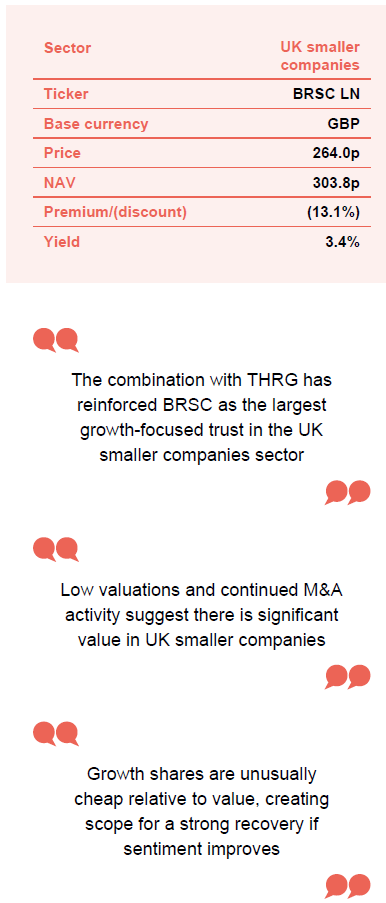
The April 2026 combination with BlackRock Throgmorton reinforced BlackRock Smaller Companies Trust (BRSC) as the largest growth-focused trust in the UK smaller companies sector. It also gave shareholders lower fees, an exit mechanism if performance disappoints and greater scope to invest overseas.
The outlook for UK smaller companies remains difficult, with weak fund flows into the sector and political uncertainty weighing on confidence. However, valuations reflect much of this pessimism, while continued M&A activity suggests corporate buyers see value that public-market investors are missing.
There are signs of improvement, and a new Prime Minister could help reset perceptions of the UK market. Growth shares are unusually cheap relative to value, BRSC trades at a discount, and modest gearing could boost returns if sentiment recovers.
UK smaller companies with a quality-growth focus
BRSC aims to achieve long-term capital growth by investing mainly in smaller UK quoted companies. It focuses on high-quality businesses with strong management teams, good cash generation and robust balance sheets. It is able to invest up to 15% of assets in overseas smaller companies.
At a glance
Share price and discount
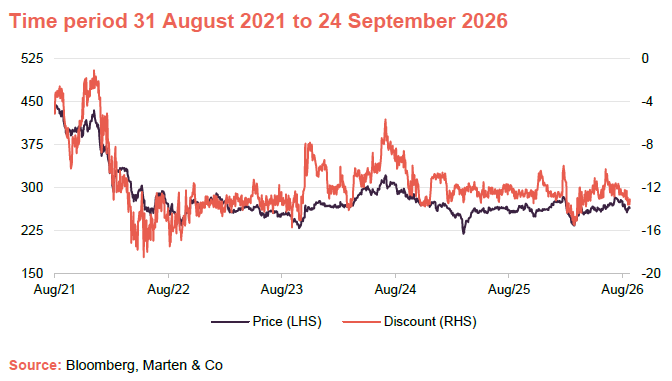
BRSC’s share price fell sharply in 2021-22, but has since made a partial recovery. The discount to net asset value (NAV) also widened substantially during that period and has generally remained in double digits in recent years.
Performance over five years
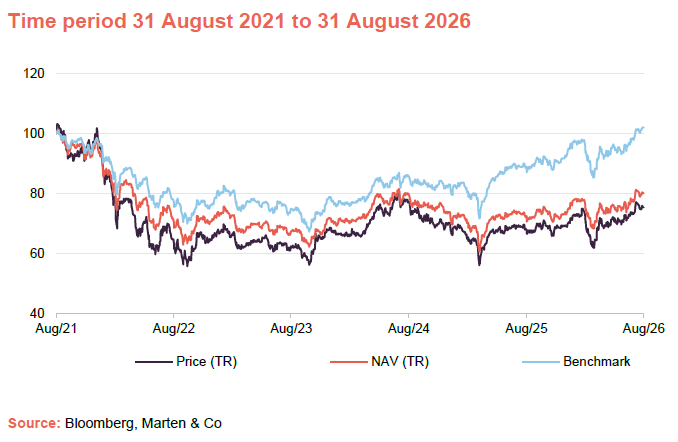
BRSC’s five-year returns remain negative, with both NAV and share price performance behind the benchmark. Gains in 2023-24 were followed by renewed weakness the next year. Performance has since improved, with NAV and share price total returns of 11.0% and 10.7%, respectively, over the year to 31 August 2026, although both trailed the benchmark’s 15.3%.
| Year ended | Share price total return (%) | NAV total return (%) | Deutsche Numis Small Cos plus AIM, ex Inv Cos TR (%) | MSCI UK total return (%) |
|---|---|---|---|---|
| 31/08/2022 | (35.3) | (28.5) | (21.9) | 11.4 |
| 31/08/2023 | (3.9) | (5.8) | (4.1) | 3.4 |
| 31/08/2024 | 23.9 | 18.5 | 14.6 | 17.6 |
| 31/08/2025 | (11.6) | (9.7) | 3.0 | 13.3 |
| 31/08/2026 | 10.7 | 11.0 | 15.3 | 21.7 |
Fund profile
BRSC aims for capital growth through smaller UK listed companies.
BRSC seeks long-term capital growth by investing mainly in smaller UK listed companies. Established in 1906, it adopted its small-cap focus in the early 1990s. The trust gives investors exposure to a less researched market area, where the manager believes active stock selection can identify businesses with strong long-term growth potential.
BRSC is benchmarked against the Deutsche Numis Smaller Companies plus AIM ex-Investment Companies Index. However, the portfolio is built from the bottom up and can differ significantly from the index. Its active share was 77.7% at 31 August. The manager favours quality growth companies with strong management, leading market positions, and sustainable growth and cash generation.
Roland Arnold, who has managed UK smaller-company portfolios since 2006, is the portfolio manager. He is supported by BlackRock’s three-person Emerging Companies team, which conducts its own research and draws on the firm’s wider research, corporate access and sector expertise. Matt Betts contributes ideas for the overseas part of the portfolio.
BRSC may borrow up to 20% of net assets, though the board expects gearing to remain between 0% and 15% in normal markets. Current gearing is around 8%.
Combination with Throgmorton
The combination with THRG cemented BRSC’s position as the largest growth-focused UK smaller companies fund.
BRSC completed its combination with BlackRock Throgmorton (THRG) in April 2026, bringing together two UK smaller-company trusts with similar investment approaches and significant portfolio overlap. We covered the transaction at the time here. The deal increased BRSC’s scale and liquidity, broadened its shareholder base and reinforced its position as the largest growth-focused trust in the sector.
Although many THRG shareholders exited through a tender offer, BRSC acquired around £303m of net assets and issued 20.9m new shares to those who rolled holdings into the enlarged trust.
The merger also reduced management fees and introduced a performance-related tender. If BRSC underperforms its benchmark over a three-year period, shareholders will be offered a 100% tender at a 4% discount to NAV. The first potential tender is in 2029.
Separately, a quarterly dividend announced in October 2025 took effect in March 2026.
The transaction also addressed the position of Saba Capital, the activist US hedge fund that has targeted several UK investment trusts in recent years. Saba elected to tender all its shares and extend its “standstill agreement”, essentially a truce, with the board to June 2030. As the tender was oversubscribed, its shares were scaled back. It has since increased its interest in BRSC and, on 24 July 2026, reported aggregate exposure of 14.2%, mainly through a total return swap.
Ability to go overseas
After the THRG combination, BRSC can now invest overseas.
Following the combination, BRSC can invest up to 15% of its gross assets at the time of acquisition in overseas-listed small-cap stocks. Roland aims to keep this allocation at around 10%, providing flexibility to invest in more dynamic themes. One example is Construction Partners, a civil infrastructure company offering pure US market exposure. However, he stresses that this flexibility alone will not offset the challenges facing the UK market.
Unlike THRG, BRSC cannot short stocks.
Market update – difficult backdrop, but attractive valuations
Roland believes the UK smaller companies market faces a number of challenges.
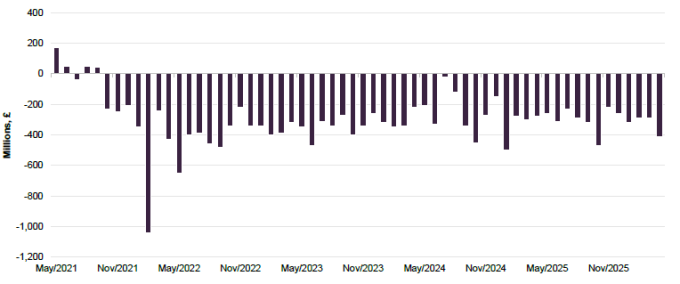
Roland is cautious on the near-term outlook for UK smaller companies, citing structural challenges and the prospect of a difficult autumn Budget, which adds uncertainty around tax, inflation and employment. Investor investment into UK smaller companies remains weak, leaving buybacks and M&A as the main sources of demand. Takeover activity reflects low valuations for corporate and private equity buyers, but cannot indefinitely offset persistent outflows.
Figure 1 shows the scale of active outflows from UK small- and mid-cap funds in recent years, with no inflow since September 2021.
Figure 1: Monthly active UK equity small- and mid-cap fund flows over five years to 30 April 2026
There are encouraging signs of an industrial recovery, particularly from the depressed levels reached in the engineering and capital goods sectors. Roland cautions that data centre and AI infrastructure spending is driving some of this improvement, making the recovery’s reach and durability unclear. However, many companies exposed to these trends have become cheaper despite little change in their long-term prospects.
New government – chance for a reset
New prime minister Andy Burnham could offer a reset.
Roland believes recent negativity around the UK economy reflects political uncertainty rather than economic weakness. He was critical of the Starmer government’s economic performance, but sees scope for a reset under Burnham, who has emphasised growth. The appointment of John Healey as chancellor is also reassuring.
If the government maintains spending discipline, manages its parliamentary party and controls public borrowing, it could support consumers and businesses. This could quickly reverse the current cycle and bring UK smaller companies back into favour.
Roland remains cautious but believes the underlying economy is stronger than sentiment suggests. Productivity is improving after a long period of stagnation, although partly at the expense of employment, while companies and households remain relatively cash rich.
UK smaller companies are cheap in absolute terms, with valuations already reflecting considerable bad news. Growth stocks are particularly depressed relative to value, so a sustained improvement in sentiment could drive a strong recovery.
Asset allocation
As shown in Figure 2, BRSC is overweight industrials and financials, its two largest sector allocations, relative to the benchmark.
Figure 2: BRSC sector allocation as at 31 July 2026
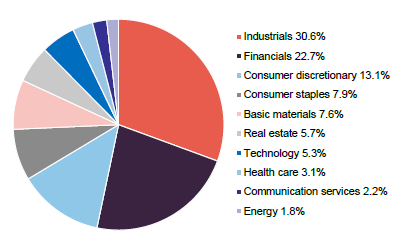
Figure 3: BRSC’s top 10 holdings at 31 July 2026
| Company | (%) |
| Greencore Group | 3.5 |
| Great Portland Estates | 3.2 |
| XPS Pensions | 3.2 |
| Tatton Asset Management | 2.9 |
| Morgan Sindall | 2.7 |
| IntegraFin | 2.6 |
| discoverIE | 2.5 |
| Young’s & Co Brewery | 2.3 |
| SigmaRoc | 2.1 |
| AJ Bell | 2.1 |
| Total top 10 | 27.1 |
BRSC’s portfolio was relatively stable over the past financial year. Roland highlighted two of its top 10 holdings where prospects have improved markedly:
Greencore Group
Figure 4: Greencore Group (GBp)
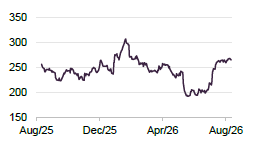
Greencore (www.greencore.com) is a UK and Ireland food producer supplying major retailers and foodservice customers. It endured a difficult period, including a poorly timed US acquisition that was later unwound, alongside cost pressures and weaker domestic margins.
Performance has since improved. A refreshed management team has restored profitability through better pricing, tighter cost control and improved operations, helping margins recover.
Greencore has also benefited from easing input costs and more sensible pricing across food manufacturing. Stronger earnings and growing confidence in the recovery have driven a sharp increase in the valuation, making the shares one of the portfolio’s stronger recent performers.
discoverIE
Figure 5: discoverIE (GBp)
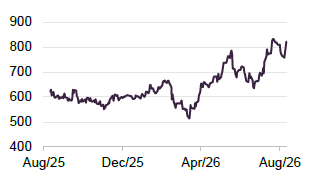
discoverIE (www.discoverieplc.com) designs and manufactures customised electronic components for industrial applications. It focuses on specialist products where technical expertise and close customer relationships create barriers to entry and support attractive margins.
The company was affected by customers reducing the amount of components they held, as they reduced orders after building excess inventories during earlier supply-chain disruption. This lasted longer than expected, weighing on growth and sentiment.
Conditions are now improving, with the order book up around 30%. Roland believes this may signal an early recovery in capital goods. If customer inventories have normalised, stronger underlying demand could support revenue and profitability.
Performance
Figure 6: Cumulative total return performance over periods ending 31 August 2026
| 1 month (%) | 3 months (%) | 6 months (%) | 1 year (%) | 3 years (%) | 5 years (%) | |
|---|---|---|---|---|---|---|
| BRSC NAV | 3.8 | 5.2 | 2.8 | 11.0 | 18.8 | (19.9) |
| BRSC share price | 2.8 | 5.1 | 1.7 | 10.7 | 21.2 | (24.7) |
| Deutsche Numis Smaller Cos plus AIM ex IC | 4.2 | 5.8 | 4.3 | 15.3 | 36.2 | 2.0 |
| MSCI UK | 0.0 | 4.7 | 1.1 | 21.7 | 62.2 | 86.8 |
As Figure 6 shows, BRSC’s recent performance has been encouraging, but it has not yet recovered the ground lost in previous years. Its longer-term shortfall against the benchmark and wider market reflects a difficult period for the manager’s quality-growth style, as value and larger companies have led markets. Growth-focused UK smaller companies have underperformed for an extended period, leaving their valuation gap versus value close to its widest in 20 years.
Roland does not expect this gap to close simply because it is extreme, but believes valuations are becoming more attractive. Many growth companies generate substantial cash flow and, in some cases, offer high dividend yields because their share prices have fallen sharply.
Dividend
Although BRSC’s main objective is capital growth, it has increased its annual dividend every year since 2003, earning AIC Dividend Hero status. In October 2025, it announced a move from semi-annual to quarterly payments for the next financial year, while retaining its progressive dividend policy. The first quarterly payment, due in September 2026, is 2.225p per share, equivalent to a quarter of the previous financial year’s dividend, following July’s five-for-one share split.
Revenue reserves offer flexibility to support dividends when portfolio income is weaker. Earnings have fully covered the dividend every year except 2020, during the Covid pandemic.
Premium/(discount)
Figure 7: BRSC premium/(discount) over five years to 31 August 2026
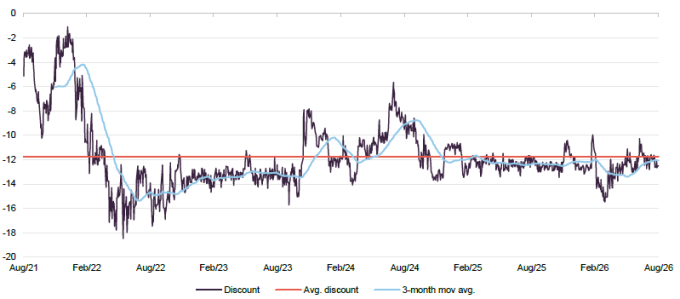
As shown in Figure 7, the discount widened sharply in the first half of 2022 as rising inflation and interest rates put growth investing under pressure. It has generally narrowed gradually since then. Over the 12 months to 31 August 2026, the average discount was 12.5%, ranging from 10.0% to 15.5%.
IMPORTANT INFORMATION
Marten & Co (which is authorised and regulated by the Financial Conduct Authority) was paid to produce this note on BlackRock Smaller Companies Trust Plc.
This note is for information purposes only and is not intended to encourage the reader to deal in the security or securities mentioned within it.
Marten & Co is not authorised to give advice to retail clients. The research does not have regard to the specific investment objectives financial situation and needs of any specific person who may receive it.
The analysts who prepared this note are not constrained from dealing ahead of it but, in practice, and in accordance with our internal code of good conduct, will refrain from doing so for the period from which they first obtained the information necessary to prepare the note until one month after the note’s publication. Nevertheless, they may have an interest in any of the securities mentioned within this note.
This note has been compiled from publicly available information. This note is not directed at any person in any jurisdiction where (by reason of that person’s nationality, residence or otherwise) the publication or availability of this note is prohibited.
Accuracy of Content: Whilst Marten & Co uses reasonable efforts to obtain information from sources which we believe to be reliable and to ensure that the information in this note is up to date and accurate, we make no representation or warranty that the information contained in this note is accurate, reliable or complete. The information contained in this note is provided by Marten & Co for personal use and information purposes generally. You are solely liable for any use you may make of this information. The information is inherently subject to change without notice and may become outdated. You, therefore, should verify any information obtained from this note before you use it.
No Advice: Nothing contained in this note constitutes or should be construed to constitute investment, legal, tax or other advice.
No Representation or Warranty: No representation, warranty or guarantee of any kind, express or implied is given by Marten & Co in respect of any information contained on this note.
Exclusion of Liability: To the fullest extent allowed by law, Marten & Co shall not be liable for any direct or indirect losses, damages, costs or expenses incurred or suffered by you arising out or in connection with the access to, use of or reliance on any information contained on this note. In no circumstance shall Marten & Co and its employees have any liability for consequential or special damages.
Governing Law and Jurisdiction: These terms and conditions and all matters connected with them, are governed by the laws of England and Wales and shall be subject to the exclusive jurisdiction of the English courts. If you access this note from outside the UK, you are responsible for ensuring compliance with any local laws relating to access.
No information contained in this note shall form the basis of, or be relied upon in connection with, any offer or commitment whatsoever in any jurisdiction.
Investment Performance Information: Please remember that past performance is not necessarily a guide to the future and that the value of shares and the income from them can go down as well as up. Exchange rates may also cause the value of underlying overseas investments to go down as well as up. Marten & Co may write on companies that use gearing in a number of forms that can increase volatility and, in some cases, to a complete loss of an investment.