
A deep dive into Caledonia’s funds pool
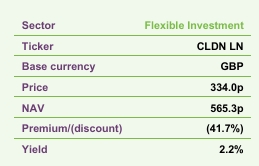
Caledonia Investments (CLDN) hosted a funds spotlight event on 27 January, during which its managers presented in detail on its funds pool. This pool is one of three elements of CLDN’s portfolio; it sits alongside separate pools of investments in public and private companies, and represents around a third of overall assets. The funds pool invests in two markets, North America and Asia. In both cases, the team believes there are structural advantages that make these geographies attractive, particularly when working alongside local managers with relevant skills and knowledge.
This note is the third and final of the reports on the different segments of CLDN’s portfolio. The recent funds event highlighted potential opportunities available in both the North American and Asian markets, and CLDN’s position to access these. In many cases, CLDN is the only investor from outside a fund’s home market. The funds pool has recorded the highest rate of return of CLDN’s three segments over the past ten years, with an average annual return of 13.3% per annum (to 30 September 2025).
Inflation-beating returns
CLDN’s aim is to generate long-term compounding real returns that outperform inflation by 3%-6% over the medium-to-long term, and the FTSE All-Share Index over 10 years.
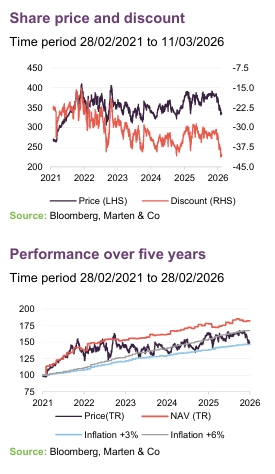
| 12 Months ended | Share price total return (%) | NAV total return (%) | Inflation – CPIH (%) |
|---|---|---|---|
| 28/02/2022 | 31.4 | 37.5 | 5.5 |
| 28/02/2023 | 11.2 | 11.6 | 9.2 |
| 29/02/2024 | (5.8) | 5.1 | 3.2 |
| 28/02/2025 | 18.0 | 10.2 | 4.3 |
| 28/02/2026 | (8.2) | 2.5 | 2.8 |
Company background
Investors may wish to consult the trust’s website at www.caledonia.com
This is the third of three CLDN notes focused on one of the fund’s three strategies. Last April, a note was published about private capital (here), and in September, public companies were covered (here). The focus of this note is the funds pool, following the Funds Spotlight event on 27 January 2026. The trust states that it applies the same strategic approach to each of these segments: identifying and backing companies that it considers to be high-quality and growing.
CLDN buys to hold, has a long-term time horizon, and undertakes extensive due diligence
CLDN’s approach involves investing time in understanding the companies in which it invests, and their return drivers. It buys to hold, has a long-term time horizon, and undertakes due diligence on its investments.
CLDN has a stated objective to grow the real value of its net assets and dividends, while managing investment risk for long-term wealth creation. The company has set a target of generating long-term compounding real returns that outperform inflation by 3%-6% over the medium-to-long term, and the FTSE All-Share index over 10 years.
CLDN has outperformed its performance targets.
Over the past decade, the company has outperformed these targets, generating an overall annualised NAV total return of 9.8% (to 30 September 2025). Few listed investment companies have an explicit objective of growing shareholders’ capital and income in real terms, and fewer have delivered these types of returns on a consistent basis. According to the company, this performance has been supported by CLDN’s focus on a long-term investment horizon and investing when it identifies opportunities, underpinned by the permanent nature of its balance sheet.
As a self-managed trust, CLDN is not required to meet short-term performance objectives or comply with fixed-life fund cycles. According to the managers, the absence of external pressure allows them to focus on longer-term growth opportunities rather than short-term cyclical opportunities.
Funds spotlight
The funds portion of CLDN has a strategic allocation of 25-35% and appears to provide diversification from the other segments of the portfolio.
Asset allocation
Figure 1: Split by geography as at 30 September 2025
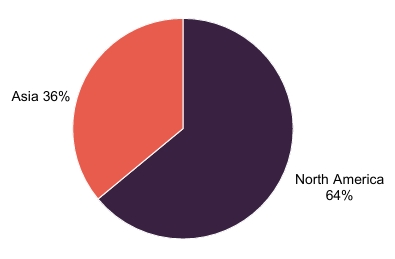
Figure 2: Split by strategy as at 30 September 2025

The funds pool provides exposure to two geographies: North America and Asia, with roughly two-thirds allocated to the former. Within North America, most exposure is to lower mid-market buyout funds, while Asia is split between venture & growth and fund of funds.
Funds strategy
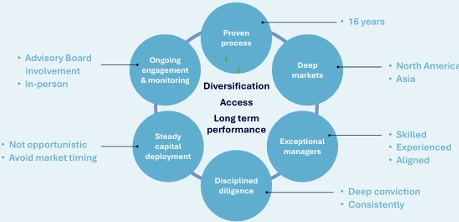
The strategy is focused on partnership, as illustrated in Figure 3, which is taken from the presentation at the recent spotlight event.
CLDN’s funds team has a process based on working with managers it considers exceptional in the markets of North America and Asia. Within the North American allocation, there appears to be a preference for smaller funds, where CLDN states it is aligned with managers motivated to share in the value created. These funds generally invest in small, profitable companies, which in many cases are accessing external finance for the first time.
CLDN is often the only European investor in the funds it holds. Many of the funds ordinarily do not allow investment from outside of their home market, which means CLDN may have access to a distinct opportunity set. The managers say the investments are made on a long-term basis, without reference to market timing.
Figure 3: Partnership-focused
The funds team believe in detailed, on-the-ground research.
Before a new investment is made, members of the team seek to spend time with the fund managers. They look for managers who appear to be skilled and experienced, and whose culture is aligned with CLDN’s. The team considers that it is backing people. The investment thesis is required to be differentiated, robust and disciplined. The fund is expected to offer a track record that is transparent and repeatable; therefore, the team seeks to ensure that it understands what drives underlying results.
Funds team
The funds pool team comprises six members: three for North America, two for Asia and the head of funds.
The funds team comprises six members, with cumulative experience of over 100 years, 66 of which have been at Caledonia. The team is led by Jamie Cayzer-Colvin, head of funds since appointment in 2005. Jamie previously served as chairman of the Henderson Smaller Companies Investment Trust, and has senior management experience.
Each of the segment’s two geographies has its own specific director: Eloise Fox for North America and Min Ong for Asia. Eloise joined Caledonia in 2012, having previously held roles as investment manager at Candover and as a financial due diligence specialist at KPMG. Min joined in 2011, having previously held VP roles at Nomura and Lehman Brothers.
Eloise is supported by Geordie Cox, investment director, and Freddie Buxton, investment executive for North America. Min is supported by Shengying Li, investment executive for Asia. The team also includes a support staff of six.
The funds team say they operate with a long-term, disciplined approach that is consistent with Caledonia’s wider investment philosophy. The team has diverse cultural experience and expertise. Members’ incentives are linked to Caledonia’s NAV under a long-term incentive plan rather than carried interest structures, which the company states aligns them with shareholder outcomes.
Investment process
Figure 4: CLDN’s funds pool investment process
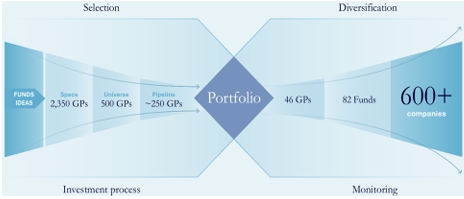
The investment process is illustrated in Figure 4. CLDN, as a limited partner (LP), works with a series of general partners (GPs) that manage funds. The CLDN team has identified 2,350 GPs as potential partners, which it has reduced to 500 considered suitable for CLDN’s investment universe. This is further narrowed to a pipeline of around 250 GPs, on whom research is focused. This research involves time spent on meeting and getting to know the managers.
From this pipeline, CLDN currently invests in 46 GPs across around 82 funds, which in turn hold stakes in more than 600 companies. In most cases, CLDN has a seat on the fund’s advisory board.
Top 10 holdings
Figure 5: 10 largest holdings in funds pool as at 30 September 2025
| Holding | Geography | First invested | Value (£m) |
|---|---|---|---|
| HighVista Strategies | North America | 2013 | 84.6 |
| Axiom Asia funds | Asia | 2012 | 67.5 |
| De Cheng funds | Asia | 2015 | 57.2 |
| Unicorn funds | Asia | 2018 | 37.9 |
| Asia Alternative funds | Asia | 2012 | 33.8 |
| AE Industrial funds | North America | 2018 | 32.2 |
| CenterOak funds | North America | 2015 | 27.8 |
| Stonepeak funds | North America | 2015 | 27.2 |
| Vance Street funds | North America | 2021 | 26.8 |
| Transom funds | North America | 2019 | 25.2 |
When CLDN invests in a GP, it makes a commitment to a fund that is drawn down over the fund’s lifetime. A typical fund life is ten or more years, and the minimum commitment is typically at least $10m. CLDN shares provide retail investors with access to these private businesses.
These ten holdings account for 47.5% of the total capital of the funds pool.
North America
The North American exposure is focused on the US lower mid-market.
The funds pool’s North American allocation focuses on private equity invested in the US lower mid-market. Over the past 14 years, the CLDN team has systematically mapped the market, spending an average of 12 weeks per year in over 30 different cities across the US. The team believes the opportunity set in this space is large, with an estimated 400,000 companies in the US classified as lower midmarket; that is, with an EBITDA of $2m-10m. According to CLDN’s research, there are 1,500 lower mid-market managers investing in the space, of which 400 are considered investable opportunities.
Many of the underlying companies are founder-owner operator led businesses, and a significant proportion of these founder-owners are more than 50 years old. This may contribute to both a founder-owner operator led mindset and a consistent pipeline of succession-driven transactions.
The team states that it favours this portion of the market due to what it perceives as positive dynamics, specifically less competition, a large addressable market, and inefficiencies that may be unlocked. According to the team, it attracts less capital than larger buyout markets, which they believe results in lower entry multiples and more conservative leverage.
The underlying businesses generally appear to have solid fundamentals, but may experience underinvestment due to limited access to capital, which could present opportunities for operational value creation. This is typically achieved through the professionalisation of people, systems and processes, operational improvements that may lead to revenue growth and margin enhancement, and occasionally acquisitions. There are generally multiple post-investment exit opportunities, given the interest of larger private equity funds and the presence of strategic buyers.
CLDN has established its exposure through relationships with specialist managers that have on-the-ground presence in the US. The team has met around 1,000 managers, monitors approximately 400, and conducts due diligence on about 150, resulting in a portfolio of 30 GPs across 45 funds. These funds provide exposure to around 200 companies, which are from four sectors (in descending order of portfolio weighting): industrials, consumer discretionary, healthcare, and technology. Typical commitments range from $25m to $30m per fund.
These managers typically do not market outside of their home state and may therefore be less widely followed. CLDN’s access may provide exposure to more deals, sometimes at lower entry valuations. The CLDN team states that it will only invest in managers that have a track record but before they become too large. According to the team, this approach is intended to align incentives and maintain a continually renewing pipeline.
The underlying investment is in companies in the United States with a local, domestic focus. According to management, these firms deliver essential services and recurring revenues, and may provide compounding value. They include companies involved in heating, ventilation, and air conditioning, car maintenance and lawn care companies – in the case of the latter, the Atlanta-based Turf Masters.
Case study – Turf Masters
Investment in Turf Masters is through CenterOak Partners.
The funds pool team has invested with CenterOak Partners, a Dallas, Texas private equity firm, for 11 years, across three funds. CenterOak first invested in Turf Masters in 2022.
Founded in 2002 in Atlanta, Georgia, Turf Masters has established a regional brand focused on “local service” lawn care, with differentiation through its customer-centric model. The CenterOak investment marked the first time Turf Masters had partnered with an external investor.
The investment thesis focused on professionalising a founder-led platform and accelerating growth through operational changes and expansion. Under CenterOak’s ownership, Turf Masters doubled its customer base and expanded its branch footprint, growing to more than 40 locations.
This was achieved through a combination of organic growth and 19 add-on acquisitions, which appears to have changed the company from a regional operator into a larger national lawn care platform. According to CLDN, the strategy focused on strengthening systems, enhancing management depth, broadening the service offering and integrating acquisitions to improve efficiency and create cross-selling opportunities.
The investment was exited in December 2025 for more than 3x invested capital, representing CenterOak’s fourth exit in two years.
Case study – New Heritage Capital
New Heritage Capital is a US-based private equity firm focused on investing in founder-owned lower-middle-market companies, typically providing growth capital while allowing founders to retain ownership and operational control. The firm states that it partners with entrepreneurs who seek liquidity but wish to remain involved in growing their businesses, often through its “private IPO” structure, which enables founders to realise some value while continuing to participate in future upside. The strategy typically targets companies in sectors such as business services, healthcare, and specialised manufacturing, where the firm believes operational improvements and continued founder involvement may contribute to long-term value creation.
CLDN says this focus on aligned management teams, niche market leaders and long-term growth opportunities is consistent with the characteristics it seeks when selecting private equity managers. The funds team began engaging with New Heritage prior to committing capital, conducting due diligence over an extended period to assess the team, their culture and their investment process. By starting the diligence process early and maintaining an ongoing dialogue with the manager, the team states that it gained confidence in New Heritage’s strategy and alignment with CLDN’s long-term investment approach.
Annualised 16.4% returns over 10-years from North America
The weighted average age of the companies held in the North American funds is 4.3 years, with the exit environment appearing to improve. Overall, these funds have generated positive returns, and the majority of returns across the funds pool are attributed to them. Over three years to 30 September 2025, the annualised return over three years was 2.5% in GBP (8.9% in local currency), over five years was 18.9% (19.8%) and over ten years was 16.4% (15.0%).
Asia
CLDN says the key to the attraction of Asia is the rapidly growing middle class.
The funds team states that the case for investing in Asia is based on long-term structural growth exposure to what it describes as one of the largest and fastest growing regions globally. CLDN specifically invests in two trends identified by the team: the expanding middle class and the region’s increasing role in innovation.
According to CLDN, the proportion of the global middle class in Asia is expected to increase to two thirds by 2030, from half in 2010. Over this period, CLDN states that the proportion of total spending accounted for by the global middle class may increase from 23% to 60%, with 1 billion consumers potentially being added in the coming decade.
CLDN says that Asia is fast becoming the global centre of industrial innovation.
Rising domestic demand, sustained investment in research and development and supportive policy frameworks appear to be contributing to a shift in the centre of gravity in industrial innovation towards Asia.
Across multiple sectors, including electric vehicles, robotics, biotechnology and advanced manufacturing, Asian companies appear to be scaling rapidly and may be setting the pace of technological progress. For example, China now accounts for a significant share of global robotics patents and is increasing its presence in biotech research. India’s economic growth is contributing to the region’s innovation profile, with its economy projected to become the world’s third largest and its industrial base broadening.
As with North America, the Asian team spends considerable time on the ground in the continent. It has identified 850 managers, with 100 potential investment opportunities. This research has resulted in a current portfolio (as at 30 September 2025) of 35 funds run by 15 managers, providing exposure to 385 underlying companies. The majority of this exposure is in the following four sectors (in descending order of weight in the portfolio): healthcare, consumer discretionary, information technology and industrials.
Case studies
The following companies are all currently held by a fund within the funds pool.
JST Group
JST Group is a Chinese e-commerce software as a service (SaaS) company providing digital infrastructure and software solutions to online merchants. As China’s consumer economy continues to expand and evolve, JST enables small and medium-sized enterprises to manage inventory, logistics, payments, and customer engagement across multiple online marketplaces.
CLDN says that JST Group operates at the intersection of two structural trends: the rise of Asia’s middle class and the digitisation of commerce. Rising disposable incomes appear to be associated with higher levels of discretionary spending and online consumption, while merchants may require more sophisticated tools to compete in a fast-moving digital environment. By lowering operational barriers and improving efficiency for sellers, JST may support the scaling of domestic brands that cater to more affluent and digitally engaged consumers.
Moonshot AI
Moonshot AI is a Chinese artificial intelligence company focused on developing large language models and generative AI applications. CLDN says that the company is supported by domestic investment, an engineering talent pool, and a digital ecosystem. Some analysts view Moonshot AI as an example of the country’s and the region’s move toward knowledge-intensive innovation. As China’s middle class grows, rising incomes and increasing online engagement may be contributing to demand for AI-powered services, with Moonshot AI potentially benefitting. Although founded in 2023, the company has reported rapid growth, with a series of fundraising rounds implying a multi-billion-dollar valuation.
Bonchon
Bonchon is a South Korean restaurant chain that has expanded internationally, with its growth coinciding with rising disposable incomes, urbanisation and shifting consumer preferences across Asia. The region’s spending patterns appear to be evolving towards branded dining, convenience, and experiential consumption, which may support scalable food and beverage concepts. Since its launch in 2002, the company has expanded to hundreds of locations in multiple markets, including the United States and major Asian economies such as Thailand, the Philippines and Vietnam.
Momenta
Momenta is a Chinese autonomous driving technology company developing AI-powered software for self-driving and advanced driver assistance systems (ADAS) integrated into vehicles. Momenta provides technology for both mass-production assisted driving and autonomous mobility solutions such as robotaxis.
The company is a participant in China’s industrial innovation sector. Unlike traditional automotive suppliers, CLDN says that Momenta focuses on software that is designed to enhance safety, convenience and efficiency for drivers and future autonomous passengers without building its own vehicles. Its technology is integrated into over 130 vehicle models from automakers including Toyota, General Motors, SAIC-Volkswagen, Mercedes-Benz, and BMW, with deployments in China and international markets.
Annualised 7.9% returns over 10-years from Asia
The weighted average age of the companies in the Asian funds is 5.5 years, which is older than for North America. The short-term environment appears challenging, with constrained IPO-led exit activity, and short-term performance has been -8.1% annualised GBP return over the three years to 30 September 2025 (-2.3% in local currency). However, annualised returns have been 6.2% (6.9% in local currency) over five years and 7.9% (6.8%) over ten years.
Asset allocation – whole portfolio
Figure 6: Split of portfolio by type as at 31 January 2026
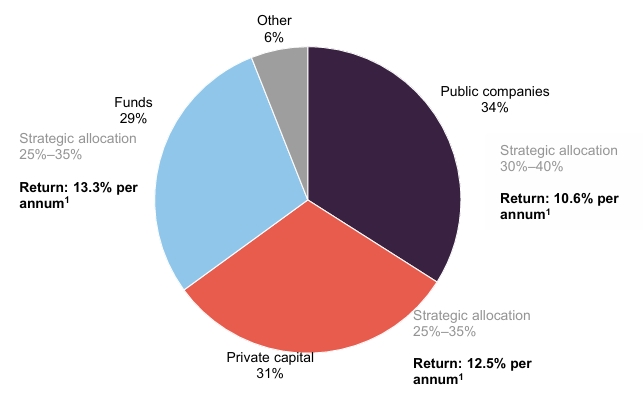
Compared to the last note in September (using data as at 31 August 2025), the proportion of assets in public companies has decreased by 3%, with a small increase in the allocation to private capital.
Figure 7: Split of CLDN portfolio by geography as at 31 January 2026
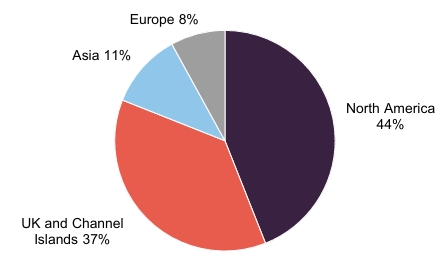
Figure 8: Split of CLDN portfolio by sector as at 31 January 2026
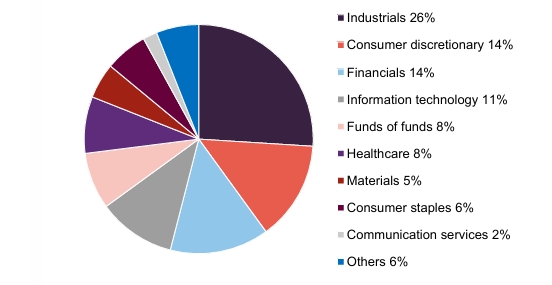
CLDN’s allocation to North America has decreased by 4% since August, while the allocation to the UK has increased by 3%. Within sectors, any changes appear to have been minimal.
Top 10 holdings – whole portfolio
Figure 9: CLDN’s 10 largest holdings as at 31 January 2026
| Business | Value (£m) | % of NAV 31/01/26 | % of NAV 31/08/25 | Change (%) | |
|---|---|---|---|---|---|
| Stonehage Fleming | Family office services | 259.7 | 8.8 | 7.6 | 1.2 |
| Cobepa | Investment company | 193.6 | 6.6 | 6.7 | (0.1) |
| AIR-serv Europe | Forecourt vending | 193.0 | 6.6 | 5.9 | (0.7) |
| Butcombe Group | Pubs, bars and inns | 146.1 | 5.0 | 4.7 | (0.3) |
| Philip Morris | Tobacco & smoke-free products | 90.6 | 3.3 | 3.1 | (0.2) |
| Texas Instruments | Semiconductors | 81.4 | 2.8 | 2.7 | 0.1 |
| Microsoft | Software | 73.5 | 2.5 | 3.2 | (0.7) |
| Axiom Asia funds | Fund of funds | 68.5 | 2.3 | 2.2 | 0.1 |
| HighVista Strategies | Funds of funds | 67.0 | 2.3 | 3.0 | (0.7) |
| Watsco | Ventilation products | 65.6 | 2.2 | 2.1 | 0.1 |
| Total | 1,247.1 | 42.4 | 42.6 |
There has been limited change to CLDN’s top ten holdings since the previous note (which used data as at 31 August 2025). This appears consistent with the stated buy to own philosophy and the long-term, high conviction approach. Watsco was briefly out of the top ten last year, but has re-entered at the expense of Oracle. Oracle is still held, but at a lower position size. The stock had previously experienced a significant rally, and the position was reduced, resulting in a lower allocation.
The fall in technology stocks appears to account for the movement of Microsoft from sixth to seventh position. Philip Morris has entered the top five, with the shares recently reaching an all-time high.
Stonehage Fleming remains the largest holding overall. CLDN says it remains on track to complete the sale of its stake, which equates to 36.7% of the multi-family office. The buyer is the Miami-based Corient Private Wealth, which is expected to pay CLDN £251m when the deal closes later in the first half of 2026. A further £37m is scheduled to be paid in two tranches, six months and a year after completion. Another £9m may be received if Stonehage meets three-year revenue targets under its new owner.
Performance
CLDN aims to outperform the FTSE All-Share Index, and inflation by 3-6%.
CLDN aims to outperform the FTSE All-Share Index and inflation by 3-6%.
CLDN is not benchmarked against an index or peer group. However, the fund has a target of generating long-term compounding real returns that outperform inflation by 3-6% over the medium-to-long term, and the FTSE All-Share Index over 10 years. For the purposes of this report, the HSBC FTSE All-Share Index Fund Class C accumulation units, which seek to track the returns of the FTSE All-Share Index, have been used. As a measure of inflation, UK CPIH, which is the consumer prices index including owner-occupiers’ housing costs, has been used.
CLDN continues to meet both of its objectives, as illustrated in Figures 10 and 11. The level of outperformance over inflation has continued to grow over time, which may be notable given the heightened price rises experienced over much of the past few years. The overall level of outperformance versus UK equities has reduced over the last two years or so, which appears to be due to the strong rally in the UK market.
CLDN’s NAV returns have been strong, while returns to shareholders continue to be affected by the fund’s discount, which remains wide. Further details, including measures the board is taking to reduce the discount, are discussed on page 14-15.
Figure 10: CLDN NAV total return performance relative to HSBC All-Share tracker and UK inflation (CPIH) over 10 years ended 28 February 2026
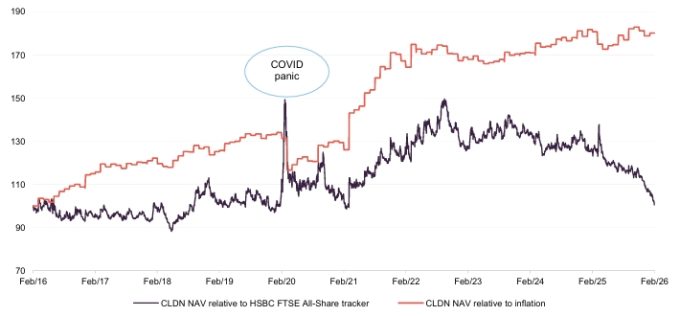
Figure 11: CLDN total returns for periods ending 28 February 2026
| 3 months (%) | 6 months (%) | 1 year (%) | 3 years (%) | 5 years (%) | 10 years (%) | |
|---|---|---|---|---|---|---|
| Share price | (4.3) | 2.3 | (1.5) | 9.4 | 59.9 | 116.5 |
| NAV | (1.6) | 1.2 | 2.5 | 18.7 | 77.6 | 150.9 |
| Inflation (UK CPIH) | (0.1) | 0.6 | 2.8 | 10.6 | 27.4 | 39.3 |
| HSBC FTSE All-Share tracker | 12.3 | 18.7 | 27.3 | 50.7 | 86.4 | 149.6 |
| MSCI ACWI | 3.7 | 12.2 | 16.7 | 60.3 | 84.4 | 267.7 |
| Inflation plus 3% per annum | 0.6 | 2.1 | 5.5 | 20.2 | 46.3 | 84.9 |
| Inflation plus 6% per annum | 1.3 | 3.5 | 8.2 | 30.4 | 67.4 | 143.6 |
Discount
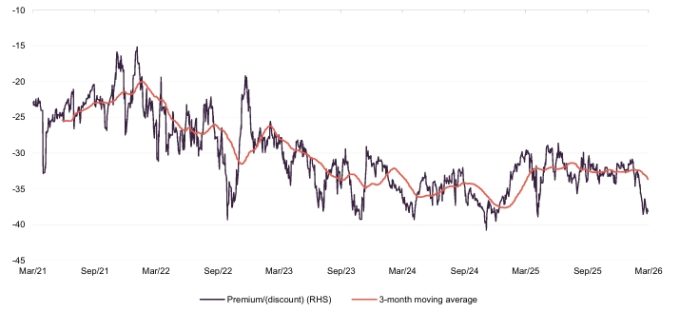
There has been a small improvement in the long-term average discount position since the last note in September. The 12-month average to the end of February has narrowed from 33.6% to 32.6%, with a range of 28.6% to 38.9%. The board and managers believe the discount will narrow over time.
Figure 12: CLDN discount over five years ended 28 February 2026
The board of CLDN has continued to take a number of measures to address the discount. The 10-for-1 stock split in July 2025 and the change to the balance between the interim and final dividends have previously been discussed. By increasing the interim dividend to be closer to 50% of the total, income is more evenly spread during the year.
The ongoing “Rule 9 waiver” under the Takeover Code allows the Cayzer family’s share of the trust to increase above 50% without the family being obliged to make a takeover bid, which permits further share repurchases to be made.
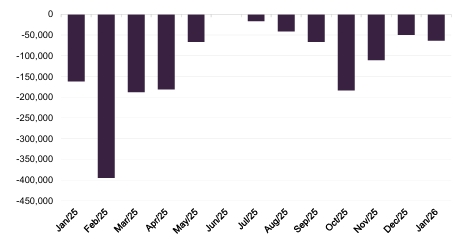
Figure 13: CLDN share buybacks by month
adjusted to ensure comparability.
Regular share repurchases are made, as outlined in Figure 13. This is under the programme mandated by shareholders at the Annual General Meeting in July 2025, which authorises the repurchase of up to 5.09% of the issued share capital. Monthly repurchases were generally slightly smaller at the end of 2025 than the beginning, with a total of 1,458,990 shares repurchased over the year (with post-stock split repurchases adjusted to ensure compatibility). According to the company, this may enhance NAV for shareholders and provide liquidity to those wanting to sell.
Previous publications
Readers seeking further information about CLDN may refer to the previous notes listed below. These can be accessed via the links in Figure 14 or by visiting the website.
Figure 14: QuotedData’s previously published notes on CLDN
| Title | Note type | Date |
|---|---|---|
| Time, well invested | Initiation | 15 July 2024 |
| Addressing the discount | Update | 9 December 2024 |
| Playing the long game | Update | 14 April 2025 |
| Public matters | Update | 18 September 2025 |
Important Information
This marketing communication has been prepared for Caledonia Investments Plc by Marten & Co (which is authorised and regulated by the Financial Conduct Authority) and is non-independent research as defined under Article 36 of the Commission Delegated Regulation (EU) 2017/565 of 25 April 2016 supplementing the Markets in Financial Instruments Directive (MIFID). It is intended for use by investment professionals as defined in article 19 (5) of the Financial Services Act 2000 (Financial Promotion) Order 2005. Marten & Co is not authorised to give advice to retail clients and, if you are not a professional investor, or in any other way are prohibited or restricted from receiving this information, you should disregard it. The note does not have regard to the specific investment objectives, financial situation and needs of any specific person who may receive it.
The note has not been prepared in accordance with legal requirements designed to promote the independence of investment research and as such is considered to be a marketing communication. The analysts who prepared this note are not constrained from dealing ahead of it, but in practice, and in accordance with our internal code of good conduct, will refrain from doing so for the period from which they first obtained the information necessary to prepare the note until one month after the note’s publication. Nevertheless, they may have an interest in any of the securities mentioned within this note.
This note has been compiled from publicly available information. This note is not directed at any person in any jurisdiction where (by reason of that person’s nationality, residence or otherwise) the publication or availability of this note is prohibited
Accuracy of Content: Whilst Marten & Co uses reasonable efforts to obtain information from sources which we believe to be reliable and to ensure that the information in this note is up to date and accurate, we make no representation or warranty that the information contained in this note is accurate, reliable or complete. The information contained in this note is provided by Marten & Co for personal use and information purposes generally. You are solely liable for any use you may make of this information. The information is inherently subject to change without notice and may become outdated. You, therefore, should verify any information obtained from this note before you use it.
No Advice: Nothing contained in this note constitutes or should be construed to constitute investment, legal, tax or other advice.
No Representation or Warranty: No representation, warranty or guarantee of any kind, express or implied is given by Marten & Co in respect of any information contained on this note.
Exclusion of Liability: To the fullest extent allowed by law, Marten & Co shall not be liable for any direct or indirect losses, damages, costs or expenses incurred or suffered by you arising out or in connection with the access to, use of or reliance on any information contained on this note. In no circumstance shall Marten & Co and its employees have any liability for consequential or special damages.
Governing Law and Jurisdiction: These terms and conditions and all matters connected with them, are governed by the laws of England and Wales and shall be subject to the exclusive jurisdiction of the English courts. If you access this note from outside the UK, you are responsible for ensuring compliance with any local laws relating to access.
No information contained in this note shall form the basis of, or be relied upon in connection with, any offer or commitment whatsoever in any jurisdiction.
Investment Performance Information: Please remember that past performance is not necessarily a guide to the future and that the value of shares and the income from them can go down as well as up. Exchange rates may also cause the value of underlying overseas investments to go down as well as up. Marten & Co may write on companies that use gearing in a number of forms that can increase volatility and, in some cases, to a complete loss of an investment.