
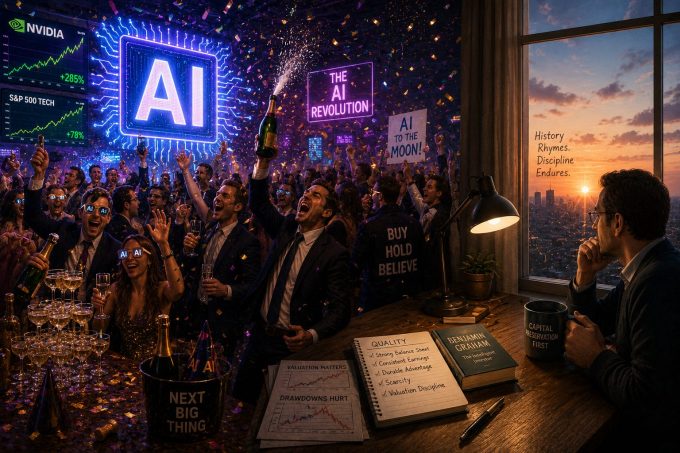
Last week, I attended Troy Asset Management’s annual investment trust seminar. The event clearly has a loyal following, with many investors returning year after year, and the presentations offered some interesting perspectives. As space was limited, I thought I would share some of the key points for those unable to attend.
Long-term capital preservation
For those unfamiliar with Troy, which manages both Personal Assets Trust (PNL) and STS Global Income & Growth Trust (STS), it follows a conservative, long-term investment approach focused on preserving capital while compounding returns. Its first objective is to protect investors’ money; its second is to grow it. The rationale is straightforward: smaller drawdowns allow portfolios to recover more quickly. An investment that falls by 50% must subsequently rise by 100% merely to break even. Given this asymmetry, Troy believes avoiding permanent capital losses is crucial.
Its managers therefore favour businesses with high returns on invested capital, durable profit growth, consistent earnings and scarce assets. They pay relatively little attention to benchmarks and are prepared to build portfolios that look very different from them – for example, PNL’s largest holding at 30 June 2026 was gold bullion (8.4% of the portfolio) and it holds US TIPS (15.9%), UK inflation-linked bonds (14.9%), short-dated gilts (13.7%) and Japanese government bonds (9.5%).
STS is a global equities fund, so you won’t see the bond and gold exposures that feature within PNL, but its portfolio looks very different to your typical global equities fund – for example, information technology accounted for just 8% of STS at the end of June. This distinguishes Troy from managers seeking to maximise returns relative to an index over shorter periods.
Conversely, the team avoids companies with low or no profitability, highly cyclical businesses and excessive leverage. It also wants its portfolios to remain liquid, steering clear of “lobster pots” – stocks that are easy to enter but can only be exited by appointment. The managers are similarly wary of “moonshots”: high-risk propositions whose potential rewards may never materialise.
Unfortunately, in a market dominated by a narrow group of AI-related companies, Troy’s style has been deeply out of favour.
First, an apology
Troy is acutely aware that its investment style has struggled. James Harries, a senior fund manager at Troy and co-manager of STS, began his presentation by apologising to investors for the poor relative performance. However, he and the Troy team offered some interesting perspectives on the current market environment.
AI is eating the US stock market
The dominance of AI-related companies means that the theme is effectively “eating the US stock market”. NVIDIA, now the largest company in the S&P 500, has a market capitalisation equivalent to that of the smallest 212 companies in the index combined.
Other technology companies, including Apple, Microsoft, Amazon and Alphabet, are not far behind. Consequently, the AI trade has significantly distorted the composition and performance of the US market.
Are we in an AI bubble?
Many investors are asking whether AI and technology stocks are in a bubble. Troy’s answer is yes, although it believes the bubble is still in its formation phase. Harries highlighted SpaceX’s valuation of around 130 times earnings, arguing that there is little precedent for this. Meanwhile, approximately $725bn is being spent annually on AI infrastructure. The market currently appears willing to tolerate this expenditure in the hope that today’s leading companies will win the AI race and reap substantial rewards.
The Troy team says that when something cannot continue indefinitely, it eventually stops, which history has shown repeatedly. The current level of capital expenditure does not appear sustainable, and investors are already questioning whether companies will generate sufficient returns to justify it. Troy presented figures comparing peak valuations with subsequent one-year returns that provided some pause for thought. Amazon reached a peak price-to-sales ratio of 147 times before falling 80% over the following year; Cisco peaked at 200 times sales and subsequently declined 86%; Yahoo! at 50 times before falling 97%; JDS Uniphase at 50 times before losing 99%; and Sun Microsystems at 10 times before declining 90%.
Troy also illustrated how memory-chip manufacturers’ earnings have risen vertically as demand has exploded. The team accepts that this may continue for now but stresses that, AI excitement aside, this remains a capital expenditure cycle and will eventually revert. There is also a risk of overbuilding, in which case the current surge could be followed by a prolonged slump in demand.
It is also easy to identify winners with hindsight. In 1999, investors were captivated by internet darlings such as Yahoo!, Ask Jeeves and Pets.com. Google is now the dominant search engine, but during much of the dotcom boom it barely featured in investors’ thinking. The implication is that, while OpenAI, NVIDIA and Anthropic may be today’s market leaders, it is far too early to know which AI businesses will dominate in 2040. As the old saying goes, the second mouse gets the cheese.
Where next?
Troy believes the current environment offers more reasons to be cautious than greedy. It is difficult to identify the long-term winners, but equally hard to spot the eventual losers, as businesses are not always what they initially appear.
Inflation is another reason for caution. The managers argue that markets have endured four inflationary shocks in six years: Covid, Russia’s invasion of Ukraine, tariffs and, most recently, the war in Iran. US inflation was already elevated before the outbreak of hostilities, while the full inflationary effect of such events often arrives with a lag. In that environment, long-dated nominal bonds may offer poor protection for capital.
Although Troy’s style remains out of favour, and the managers acknowledge that performance must improve, they are sticking to their core principles. The market’s concentration in a narrow group of stocks is creating a growing opportunity set among overlooked companies. The challenge is to remain selective and avoid overpaying. Scarcity remains important.
One recent investment is Canadian National Railway, Canada’s largest railway operator. The company has invested heavily in its infrastructure and fleet, but, with several major projects now complete, its 2026 net capital expenditure budget has been reduced to C$2.8bn, around C$500m below previous spending levels. Future investment is expected to focus on technology, automation and AI-driven dispatching rather than significant route expansion.
Another example is Markel, which Troy describes as a patient compounder and a “mini-Berkshire Hathaway”. The family-rooted business has a record of disciplined capital allocation but attracts relatively little analyst coverage. Troy believes it offers meaningful upside alongside strong downside protection.
Gold and the yen
Reflecting its concerns about inflation and financial stability, Troy continues to favour gold, which it has held in its portfolios since 2009. The team notes that central banks have been steadily buying gold since Russia was excluded from much of the international financial system following its invasion of Ukraine. At the same time, debt-to-GDP ratios across the West continue to rise to levels that Troy believes are unsustainable.
However, the team trimmed its gold exposure in January, selling 43 of the 158 bars held in JPMorgan’s vault after concluding that the price had risen too far, too quickly. The timing proved opportune, as the gold price subsequently fell. Troy nevertheless remains bullish over the long term and expects to rebuild the position when valuations are more attractive.
For similar reasons, the team has increased its exposure to the yen, which it regards as a useful hedge against the US dollar and a currency that tends to perform well during periods of market stress.
The managers also warned investors to be wary of initial public offerings, which tend to take place when conditions favour sellers rather than buyers. They pointed to Goldman Sachs floating in 1999, Blackstone in 2007 and Glencore in 2011, near the height of the commodities boom.
The next 20 years will be different
Troy acknowledges that the world is changing rapidly and that the next 20 years may look very different from the previous 40. Given the difficulty of identifying the ultimate winners, the team’s response is to broaden the range of businesses it considers without compromising on quality. Although quality assets are currently being overlooked, the managers take comfort from Bob Farrell’s well-known market rules.
Three are particularly relevant: “There are no new eras – excesses are never permanent”; “Exponentially rapidly rising or falling markets usually go further than you think, but they do not correct by going sideways”; and “Markets are strongest when they are broad and weakest when they narrow to a handful of blue-chip names.”
Against that backdrop, Troy continues to seek good companies with strong competitive positions and the ability to grow earnings over time. Its approach may be out of favour, but the underlying logic still holds up.

“The second mouse gets the cheese”, I like it. Is AI a bubble, yes, logic dictates they all can’t be winners. The best case scenario being, one or two winners because the more winners the more mice nibbling at the cheese. With the amount of money being spent they can’t afford competition. What will probably happen is there won’t be an outright winner and the spoils will be divided between a couple of winners because no one system can cover all situations, one will be good at this and the other good at that, etc.