

For UK investors, Canada has traditionally occupied a slightly awkward position. It is one of the world’s largest developed economies, home to major banks, miners and energy companies, yet it rarely receives much attention as a standalone allocation. More often, Canada is folded into a broader “North American” portfolio dominated by the United States.
However, the ongoing tariff dispute between Canada and the US raises the question of whether this way of viewing the country still makes sense. Relations between the two neighbours have deteriorated sharply in recent days, after trade negotiations were suspended and the US imposed tariffs of 50% on C$27.6bn of Canadian goods from 22 August. Canada responded by announcing matching tariffs on the same value of US imports from 8 September, with rates of 15%, 25% and 50% depending on the product. Steel, dairy, agricultural equipment, electronics and other goods are among the affected sectors.
For Canada, this is not a dispute with just another trading partner. In 2025, 71.7% of all Canadian merchandise exports went to the US. Although that was down from 75.9% a year earlier, it demonstrates just how deeply Canada’s economy depends on access to the US market.
For decades this relationship has been an advantage. Canadian businesses have had the world’s largest economy on their doorstep, and supply chains, infrastructure and labour markets have become increasingly integrated. The risk is whether what once looked like a competitive strength in fact turns out to be dependence – and dependence that a bullying President Trump can exploit.
Not all Canadian exposure is equal
For investment trust investors, Canada crops up in more portfolios than might initially be obvious, due to its inclusion in the “North American” portion of global funds. For example, Invesco Global Equity Income (IGET) has a 5.5% allocation (as at 31 July 2026) and STS Global Income and Growth (STS) 4.8%. Among specifically North American vehicles, North American Income Trust (NAIT) currently has 5% exposure to Canada, with holdings including pipeline and energy company Enbridge, headquartered in Calgary and operating the longest pipeline system on the continent. NAIT’s manager Fran Radano recently described Enbridge as “very much a toll taker, highly contracted, high-quality business”, with roughly three-quarters of the business made up of contracted pipeline infrastructure and the remainder largely regulated utilities.
Indeed, Enbridge is a good illustration of the fact that simply looking at the label “Canada” beside a holding tells investors relatively little about its true exposure to the trade dispute. Its network is an integral part of the North American energy system. Canada supplied 63.4% of US crude oil imports in 2025 and almost all of its imported natural gas, while 90% of Canadian crude oil exports went south of the border.
It is difficult to imagine such relationships being unwound quickly, but recent political rhetoric gives plenty of reason to worry. Investors need to look beyond a company’s listing or headquarters and ask where it produces, where its customers are and how easily those relationships can be replaced.
Oil provides a counterweight
The trade dispute is not the only external force shaping the Canadian investment case. As Canada remains a major energy exporter, movements in the oil price can have a significant bearing on both the economy and its equity market.
That has been particularly relevant this year. The war in Iran sent oil prices sharply higher as disruption around the Strait of Hormuz threatened global supplies, and Canadian oil producers have said that the higher prices encouraged increases in both production and investment.
This provides a counterweight to the damage caused by US tariffs, although higher petrol prices have also reduced Canadian households’ spending power and increased costs for businesses. This helped push headline inflation from 2.3% in 2026 to 3.0% in July.
One dedicated investment trust
UK investors do have a dedicated closed-ended route into Canada, through Canadian General Investments (CGI). The trust, which dates back to 1930 and is listed in both London and Toronto, has investments in companies such as Celestica, Franco-Nevada, Royal Bank of Canada, Canadian Pacific Kansas City, First Quantum Minerals and Bank of Montreal.
Figure 1 shows that the trust’s share price – along with Canadian equities more generally – has reacted very differently to the two main periods of trade tension with the US. When Trump first targeted the country shortly after taking office in early 2025, the shares fell sharply, although they recovered strongly over the remainder of the year. In contrast, the latest escalation in tariffs seems to have barely registered with investors.
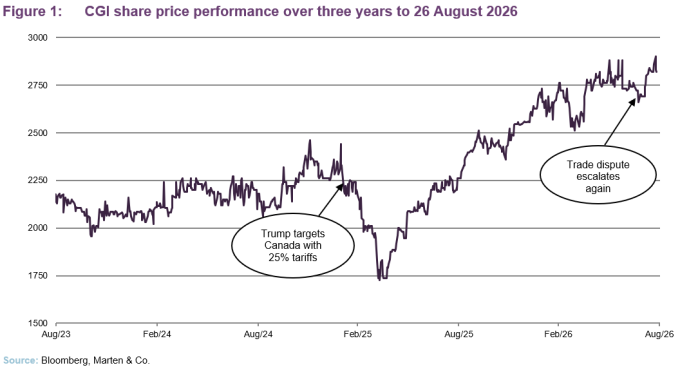
In NAV terms CGI badly lagged its S&P/TSX benchmark over 2025, returning 18.1% versus 31.7% for the index. It put this down to a particularly concentrated index return, with gold and banking stocks accounting for more than 60% of the gain. Longer term returns are much better, with an annualised NAV return over 10 years of 15% versus 12.7% for the index.
CGI’s current portfolio illustrates why the impact of the US trade dispute is not going to be uniform. Holdings such as Canadian Pacific Kansas City and TFI International are closely tied to cross-border trade and economic activity, while miners, energy companies and domestic financials face a different set of risks and opportunities.
Until last year, investors also had access to Middlefield Canadian Income Trust, but shareholders approved its rollover into the Middlefield Canadian Enhanced Income UCITS ETF in October 2025. The resulting active ETF launched with around £80m of assets.
The relatively small number of dedicated Canadian vehicles available to UK investors hints at how Canada has traditionally been treated – less as a standalone market and more as part of a wider North American allocation. The deterioration in relations with the US gives investors a reason to reconsider that approach.
A risk – but potentially also an opportunity
Investors clearly shouldn’t just rush into Canadian equities simply because the country is in the news. There are big risks.
Canadian companies dependent on US exports could face lower demand or squeezed margins. Business investment could be delayed while the trading relationship remains uncertain. Canadian consumers could ultimately face higher prices, and slower economic growth could put pressure on domestic banks and other economically sensitive businesses.
That said, investors currently seem to be shrugging off the dispute. The Toronto S&P/TSX Composite index is currently trading at an all-time high, having gained over 16% so far this year. And it is also perfectly possible that the current trade dispute eventually ends with another agreement and much of the current tension fades – Trump’s tariff battles do have a history of petering out. But even in that scenario, something more fundamental may have changed.
For years, businesses could reasonably assume that close economic integration between Canada and the US would continue to deepen. Now they cannot be quite so sure, which itself changes how investors should analyse Canada.
The most interesting opportunities may be companies that are Canadian without being entirely dependent on Canada. Equally, some companies previously considered relatively safe may deserve greater scrutiny because their economics have relied heavily on frictionless cross-border trade.
Investment trusts are particularly useful in illustrating that difference. A portfolio’s Canadian weighting (much less its “North American” weighting) tells you much less than the individual businesses underneath it. Moreover, UK investors may need to stop treating Canada as simply America’s smaller neighbour and start considering it as a separate investment case in its own right.