
European trusts can be a tough sell. Why would investors bother delving into the sclerotic, slow-growing economies of France or Germany when they can enjoy the excitement of the dynamic US? To paraphrase Bill Clinton, it’s not the economy, stupid.
It is hard to make a case for Europe on economic growth alone. While Eurozone growth has edged up to 1.2%[1], it still consistently falls short of that of the US. However, this has limited relevance for investors. The real opportunity in Europe lies in its diverse, internationally focused corporate sector.
Joe Faraday, manager on the Baillie Gifford European Growth Trust (BGEU), says: “Europe is far better understood and appreciated as a remarkably diverse opportunity set comprising scarce industrial assets, specialised know-how, powerful brands, local champions and a wide range of ownership structures.”
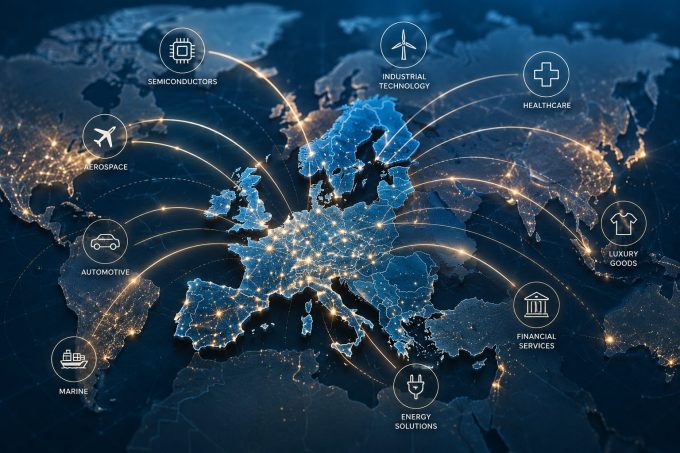
Most of the investment opportunity isn’t in Europe at all. Marcel Stotzel, Fidelity European Trust (FEV) portfolio manager, says: “Two thirds of the revenues of European listed companies in the MSCI Europe ex UK actually come from outside Europe. It’s an export-driven region. There have been a lot of companies that are world class at exporting different things.”
Faraday points to ASML’s near-monopoly in extreme ultraviolet lithography, or Richemont and Moncler’s irreplaceable brands in the luxury industry. Each region of Europe has its own specialist areas. “Northern Europe offers technology platforms and digital infrastructure. Southern Europe provides financials undergoing improvement and consumer franchises with pricing power. Central and eastern Europe hosts fast-growing retailers and banks,” he says.
Its companies are tapped into global trends. While Europe doesn’t have a Silicon Valley equivalent, nor the technology giants that come with that type of ecosystem, it has companies that are participating in the AI revolution. While ASML is the obvious example, Timothy Lewis, manager on the JP Morgan European Growth & Income Trust (JEGI) also highlights Legrand: “This French industrial company makes the physical infrastructure that keeps data centres running. The racks that hold the servers, the units that distribute power to them, the systems that stop them from overheating. It is the plumbing and wiring behind the AI revolution.”
George Cooke, manager on the Montanaro European Smaller Companies Trust (MTE), says: “Europe has world-leading companies. Universities are pumping out global leaders in their fields. The region has a very strong industrial base, with real expertise in areas such as electronic equipment and hardware.”
This diversity makes it an ideal environment for stock pickers, but also leads to real disparity of outcomes. There is a 127% difference in share price terms between the top and bottom trusts in the sector over five years[2]. This makes it more important to back the right manager.
Picking the right manager may be more difficult at a time when market leadership in Europe could shift. While Europe’s strengths have historically been in its international businesses, Stotzel points out domestic sectors have started to revive more recently. “If you look at two of the best performing sectors in Europe over the last few years, they’re both domestic – banks and defence. For the first time in a while, there are nice growth drivers for the one-third of MSCI Europe ex UK that generates revenues inside Europe.”
Fiscal expansion is changing the game. Lewis says: “Europe’s fiscal plans represent a multi-year step up in spending that should keep supporting European growth through to the end of the decade. Every factory built under Europe’s reindustrialisation push, every upgraded port or new data centre, none of it works without getting reliable power to it. A critical part of achieving those goals is that the electrical infrastructure has to be rebuilt and expanded first.”
The trust is taking exposure to this theme through ABB, a Swiss industrial company making circuit breakers, switch gears and grid automation systems. It also has exposure to UniCredit, the Italian bank. “More public spending means more activity, more lending, more fee income. Seeing that coming through in numbers.”
Cooke says the increase in defence spending is a boost for a range of companies across Europe. Equally, the instinct for reshoring in critical sectors is strong. Cooke explains: “People don’t really want all their electronics to be produced out in China anymore. The reshoring trend is very real. European companies do not want China producing their defence components and being totally dependent on them.” He highlights companies such as Kitron, a contract manufacturer of electronic products, which is a key beneficiary of this trend.
The energy transition is also generating domestic opportunities. Europe has struggled with its second fossil fuel crisis in four years and this has galvanised governments to speed up electrification plans. Cooke says there is a need to rebuild energy infrastructure that hasn’t seen investment. That benefits companies such as E.On, which is involved in grid redesign or Spe, a French technical services company.
The recent weak performance of small caps has also been an anomaly. European smaller companies have suffered similar problems to small caps globally, as investors have favoured passive investments and larger companies. The MSCI Europe ex UK has outpaced its small cap equivalent by around 4.5% a year for the past five years[3][4].
Cooke: “Since the COVID period, we’ve seen small caps underperform. For most of their history, small caps traded an average of about 15% premium. Only very occasionally, it dipped to around parity. Today we have small caps at a bigger discount versus the market than they were in the global financial crisis, or in the Eurozone crisis. I don’t think anyone could call the conditions we’re in at the moment a crisis.”
These different forces are seeing performance leadership shift within the sector. For example, after a difficult run of performance, the Baillie Gifford fund has rebounded strongly over the past 12 months. Smaller companies have started to see a tentative revival.
Unlike other regions, where exposure can be homogenous, European trusts vary significantly and there is a breadth of themes. Investors need to back the right stock picker, who can make the most of the region’s myriad opportunities.
[1] https://ec.europa.eu/eurostat/web/products-euro-indicators/w/2-30072026-ap
[2] https://www.theaic.co.uk/aic/find-compare-investment-companies?sec=EUR&sortid=Name&desc=false
[3] https://www.msci.com/documents/10199/183ca3cd-71b2-47ae-8292-6e5e50d710b5
[4] https://www.msci.com/documents/10199/2f4fd77b-8ad5-4453-a63b-48abf1165cc6
