

The best-performing Indian fund is also the cheapest – what is going on?
Here is a table taken from our website on 10 September 2026 showing the four trusts that focus on investing in India ranked buy their one-year NAV returns.
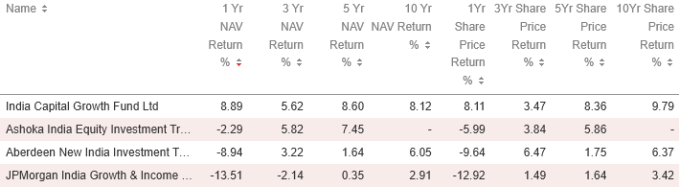
India Capital Growth (IGC) comes out on top over one year, second over three years, and top over five and 10 years.
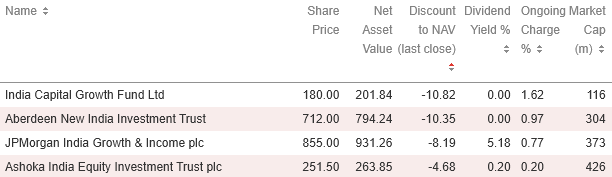
Now here is a table showing the same four trusts ranked by discount – widest on top. Again, India Capital Growth comes out on top.
Not that long ago, India was the place to be for investors. However, after a strong run, its equity markets started to look overvalued and then it became much harder to make progress. This year, Indian stocks have been knocked by the Iran war. Just one India-focused trust has bucked the trend, with positive NAV and share price performance over the past 12 months.
IGC is the smallest of the four Indian trusts, with a market cap of just £116m. That reflects the buybacks that the board has made with the aim of keeping the discount down (over 2.9m shares bought back so far this year), and a string of tender offers in particular. I think the trust was overly aggressive with this. I am not a fan of holding tender offers too frequently as I believe that it undermines the benefits of the closed-end structure and encourages more of a short-term mindset amongst shareholders.
I was pleased then, back in February, when IGC announced plans to drop these in favour of five-yearly performance triggered tender offers. I have said elsewhere that I do not think that these do much to keep day to day discounts narrow but they do at least provide frustrated investors with an exit if things have not been going well for a while.
The board also took the opportunity to introduce a modest dividend – paid out of capital reserves. The trust will declare two dividends per year, each of 1% of NAV – so roughly 2% of NAV in total. At the current discount, that would put it on a yield of about 2.2%.
These two proposals were backed overwhelmingly by shareholders (97% of those voting) at an EGM held in March this year.
Today the discount is 10.8% which feels undeserved to me considering its superior track record relative to its peers. However, there is a good chance that some investors looked at the factsheets and were put off by IGC’s long-term underperformance of its old benchmark.
The board introduced a new benchmark – the MSCI India SMID Index – with effect from 1 January 2026. This feels like a better fit for the portfolio than its previous BSE Mid Cap Index as IGC’s portfolio had over 60% in small-caps, a third in mid-caps, and the balance in cash at the end of July 2026.
Gaurav Narain, the investment adviser, has a big pool of stocks to choose from as there are roughly 5,000 listed Indian companies. However, he and the analyst team have whittled down to a smaller group of high-quality businesses (about 140 in total) that they model and follow closely. From these, a high conviction portfolio of about 35 stocks is selected.
IGC’s stocks are not cheap. At the end of July, the average price/earnings ratio was 29.8x, which compared to 26.8x for the benchmark. However, Guarav believes that these valuations are justified by their superior prospective earnings growth.
India does have big ambitions to grow its economy – Gaurav says it is targeting about 8% GDP growth per annum over the next couple of decades – and the government is spending vast sums on infrastructure to support this. If it can succeed, that should lift per capita incomes, which will boost domestic consumption.
In the short-term, though, there is frustration with a lack of graduate jobs in the economy (which may be compounded by the impact of agentic AI on India’s IT services businesses), and this was a contributory factor in the “Cockroach protests” that secured the resignation of the education minister.
The weak labour market may help cushion the long-term impact of the energy price shock emanating from the Iran war on Indian inflation. Inflation is edging up and was running at 4.4% at the end of July 2026. India was a big importer of Gulf oil and has had to secure alternative supplies.
IGC has little exposure to IT and no exposure to energy, and this has likely helped its performance relative to large-cap focused trusts. Its big exposures are to financials (with four banks in the top 10 holdings), industrials, and consumer discretionary stocks.
The largest position in the portfolio is Skipper. It makes transmission towers and polymer pipes and so is an ideal play on the Indian infrastructure story. The share price has more than doubled year-to-date on the back of strong profit growth but, with a record order book and capacity expansion underway, there could be more to go for.
IGC observes that foreign investors have been taking more of an interest in the country recently. This might have been because they were more optimistic about a resolution to the situation in the Gulf, which still feels some way off to me. Or it might be that investors have decided that India can overcome this hurdle. IGC’s share price and NAV are still below their December 2024 peaks. The discount feels too wide to me.
A version of this article first appeared in Citywire Investment Trust Insider
