
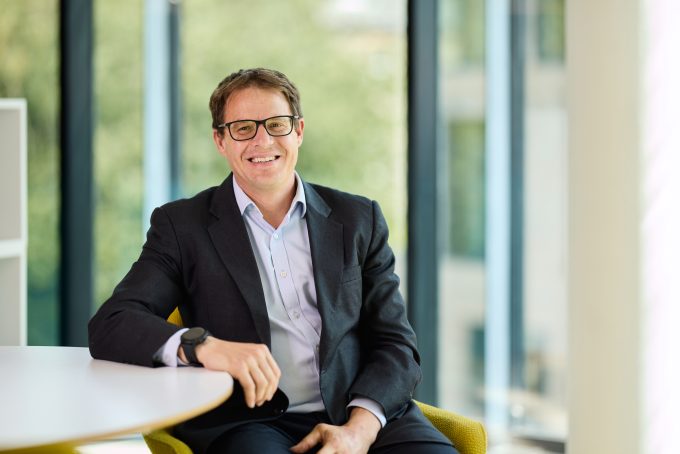
Seven months into his new job as manager of the Baillie Gifford European Growth Trust (BGEU), Joe Faraday is ready to embark on a second phase in his overhaul of the investment trust.
After his promotion to head of Baillie Gifford’s European Equities Team in April, Faraday replaced 31% of the portfolio, swiftly adding banks, defence, energy and telecom stocks in a search for “breadth and diversity” and improved performance.
Now he must decide what to do with his biggest holding in technology company Bending Spoons.
The blessing of Bending Spoons
Following a successful $18.4bn (£13.8bn) flotation on the US Nasdaq tech exchange in the summer, the Italian digital owner-operator accounts for a whopping 16.5% of BGEU’s assets.
For a manager determined to move the trust on from its previously narrower and American definition of ‘growth,’ Faraday plans to rebalance the outsized Bending Spoons once the lock-up agreements restricting him from selling the shares expire towards the year-end.
Not that Faraday is ungrateful for being bequeathed Bending Spoons by Baillie Gifford’s private companies team. The Milan-based company, which specialises in buying and rejuvenating established digital assets such as WeTransfer, Vimeo and Eventbrite, has performed strongly for BGEU.
Despite volatile markets and skittishness over its first results as a public company, Bending Spoons briefly reached a $30bn valuation on 14 October following the announcement of Berkshire Hathaway’s secondary investment into the company. Combined with gains in some of the 21 new stocks Faraday introduced, Bending Spoons’ strong start has also helped rejuvenate returns at BGEU.
He refers to it as a “blessing”, adding he has to “pinch” himself when looking at the trust’s 28% share price rise since his appointment. Over the same period, European stock markets have gained 10%. Gross gearing, or borrowing, of 15% has also supported the short-term rebound.
Faraday says he will retain a meaningful position in Bending Spoons, which he calls a “fascinating business” with an “exciting” future if it can get the “acquisition flywheel going” – the cycle of buying businesses, improving them and reinvesting the cash.
New shape
Reducing the stake gradually will free 10-15%, or £40m-£60m, which the manager will mostly spread across his new holdings. Thinking about where Faraday could re-invest is a good way to get an overview of the reshaped 58-stock portfolio.
With the BGEU board’s approval, Faraday has split the portfolio into three parts:
- “Breakthrough growth” stocks benefiting from technological change, such as Bending Spoons, will account for 20%;
- Durable businesses with “irreplaceable moats” (a hard-to-copy competitive advantage), such as Dutch semiconductor-equipment makers ASM International and ASML, will account for 30%;
- The other half will be reserved for “quiet compounders”, or steady growers, including Deutsche Telekom, Stella Artois brewer AB InBev and insurer and asset manager Allianz.
Faraday has also organised his holdings around seven themes:
- Rearmament, where he added German defence giant Rheinmetall and Portuguese drone maker Tekever, now his biggest private company holding at 5.1%;
- Electrification and the acceleration of investment in grid infrastructure, renewables and flexible power generation, which saw him add a top 10 position in TotalEnergies of France and a smaller holding in Spanish utility Iberdrola;
- Productivity, where he includes Nemetschek, a German software provider serving the architecture, engineering and construction sectors;
- Semiconductors, where he owns ASML and ASM International; he groups Deutsche Telekom alongside them for its role in supplying the infrastructure for the digital econmy;
- Healthcare, where he didn’t add new names as he cut exposure but retained Switzerland’s Roche and Lonza, the contract drug manufacturer;
- Consumer, where he expanded the trust’s Polish holdings by buying CD Projekt, the gaming company behind The Witcher and Cyberpunk 2077;
- ‘Ownership structures’ where he has added several ultra long-term investment companies backed by wealthy families.
TotalEnergies: a global champion
Faraday is a big fan of TotalEnergies, which accounted for 4.7% of the trust’s assets at 30 September, describing it as a “global energy champion” for the way it has built about a quarter of its business in integrated power, which includes renewables, alongside more conventional liquefied natural gas and oil exploration and production.
The numbers are another part of Total’s appeal for Faraday, particularly when oil prices are high:
“At $60 [per barrel] oil, you were getting $8bn of dividends and $8bn of buybacks and $16bn on capital expenditure. The market cap [capitalisation] is $150bn or $160bn, so you’re basically getting a 5% dividend yield and a 5% share buyback programme. That’s at $60 [per barrel], so at 100 bucks my best guess you could have $25bn to $30bn of free cash flow [the cash left after spending on the business] coming out of Total this year [in 2026],” he said.
Growthier banks
His willingness to embrace a wide range of growth stocks is exemplified by Faraday’s push into banks, which at about 10% is the trust’s second biggest sector after information technology.
He dismisses the convention that banks are “value” stocks which don’t belong in a growth portfolio, pointing out that he owns the “growthier banks” in Spain, Greece and Ireland such as Caixa, Piraeus Holdings and AIB Group.
Faraday says his banks’ combination of 8% annual loan growth, cost cutting and share buybacks can easily generate annual earnings growth of 10%, which he is fond of saying “is not a bad number”.
Wider opportunity set
His appreciation of good capital allocation has seen him expand the trust’s holding in family-backed investment firms.
Alongside a longstanding investment in Exor, the Agnelli family holding company behind names including Stellantis, Ferrari and Juventus, he added Sweden’s Investor AB, Groupe Bruxelles Lambert (GBL) and Belguim’s Ackermans & van Haaren
These investment firms provide exposure to industrial, infrastructure and technology businesses, including some private companies, and have “outstanding” track records, says Faraday.
Poland
As a former emerging markets investor, Faraday is excited about Poland’s dynamic and entrepreneurial economy and perplexed as to why the stock market index compiler MSCI hasn’t upgraded it to a “developed market”.
Even so, he is glad Poland is off the radar of many investors, happy to make frequent visits to the country where he recently invested in the “very special” gaming company CD Projekt after meeting its management.
It sits alongside existing Polish holdings in discount grocery chain Dino Polska; Allegro, the ecommerce platform that is Poland’s equivalent to Amazon; and LPP, which he calls the “Inditex of eastern Europe and on into central Asia”.
“It’s lifting up the stone, getting out there meeting a wide range of company types,” he says, comparing Europe’s diversity to the variety of emerging markets.
“You’ve got to go after growth where you can see it in Europe. That is the raison d’être. I might have to hold my nose a little if there’s a degree of risk or it’s slightly dirtier and grubbier growth, but the job is to find growth wherever it exists in Europe.”
BGEU has published half-year results today. We will report on these on Monday.
BGEU annual past performance to 30 September each year
| 2022 | 2023 | 2024 | 2025 | 2026 | |
| Share price | -47.7% | 8.6% | 9.3% | 14.5% | 16.7% |
| NAV | -40.4% | 8.3% | 12.1% | 5.5% | 15.2% |
| FTSE Europe ex-UK index | -15.3% | 20.5% | 20.5% | 15.5% | 14.5% |
Source: Morningstar, FTSE, total return in sterling. Past performance is not a guide to future returns.
This communication was produced and approved in November 2026 and has not been updated subsequently. It represents views held at the time of writing and may not reflect current thinking.
Investments with exposure to overseas securities can be affected by changing stock market conditions and currency exchange rates.
The trust can borrow money to make further investments (sometimes known as “gearing” or “leverage”). The risk is that when this money is repaid by the Trust, the value of the investments may not be enough to cover the borrowing and interest costs, and the Trust will make a loss. If the Trust’s investments fall in value, any invested borrowings will increase the amount of this loss.
This communication does not constitute, and is not subject to the protections afforded to, independent research. Baillie Gifford and its staff may have dealt in the investments concerned. The views expressed are not statements of fact and should not be considered as advice or a recommendation to buy, sell or hold a particular investment.
A key information document is available at bailliegifford.com.
