
A new home for a proven approach
City Natural Resources Growth and Income (CYN) has entered a new chapter following the transfer of its management contract to Tufton Investment Management in September 2026. The move preserves the expertise of longstanding portfolio managers Keith Watson and Robert Crayfourd, while providing access to Tufton’s complementary energy and shipping expertise.
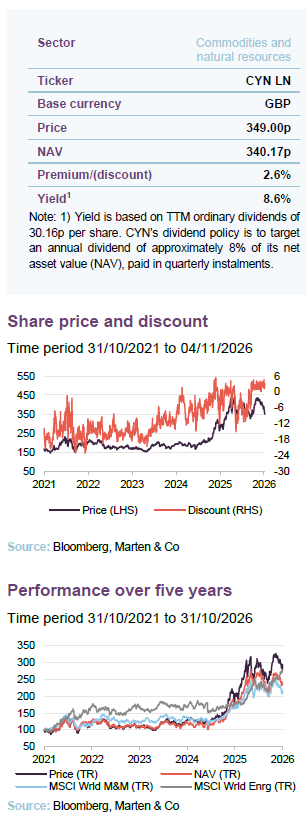
CYN has delivered impressive returns, with its NAV rising 28.8% and its share price 37.2%, both on a total return basis, over the year to 31 October 2026. The managers benefitted from their substantial exposure to precious metals miners before successfully rotating towards energy as relative valuations became more attractive.
Alongside its strong performance, the shareholder-friendly measures introduced in 2025 have attracted shareholders to the share register who understand its proposition and helped narrow CYN’s discount. The shares have recently traded close to NAV and occasionally at a premium, allowing it to issue stock. CYN continues to offer a differentiated combination of specialist natural resources exposure, capital growth potential and substantial income.
Capital growth and income from mining & resources
CYN aims to provide investors with capital growth and income by investing in a portfolio that predominantly comprises mining and resource equities, as well as mining, resource and industrial fixed-interest securities.
| Year ended | Share price TR (%) | NAV total return (%) | MSCI World Metals & Mining TR (%) | MSCI World Energy TR (%) | MSCI World TR (%) |
|---|---|---|---|---|---|
| 31/10/22 | 26.1 | 21.8 | 12.3 | 71.0 | (2.3) |
| 31/10/23 | (14.8) | (9.4) | 8.3 | (2.9) | 4.9 |
| 31/10/24 | 20.7 | 10.4 | 10.9 | 1.3 | 26.9 |
| 31/10/25 | 57.0 | 48.7 | 24.2 | 6.1 | 20.0 |
| 31/10/26 | 37.2 | 28.8 | 24.2 | 56.0 | 10.4 |
Preserving the managers’ expertise
Watson and Crayfourd resumed responsibility for the portfolio in September
City Natural Resources Growth and Income (CYN) transferred its investment management mandate from Manulife | CQS to Tufton Investment Management on 14 September 2026, following the departure of its longstanding portfolio managers, Keith Watson and Robert Crayfourd, from CQS. The board’s decision to follow the managers to Tufton preserves the expertise, investment approach and stock-picking philosophy that have underpinned the trust’s strong long-term performance. Watson and Crayfourd, who have managed CYN since 2013, resumed responsibility for the portfolio in September, bringing an end to a period of uncertainty. The trust was subsequently renamed City Natural Resources Growth and Income, although its ticker (CYN) remains unchanged.
Tufton provides a complementary source of specialist research
Tufton has considerable expertise in energy and shipping, providing a complementary source of specialist research, industry contacts and market intelligence that should enhance the managers’ ability to identify opportunities across the natural resources universe. This is helpful given CYN’s substantial exposure to oil and gas and its growing interest in shipping companies, where Tufton’s established sector knowledge could provide a valuable competitive advantage.
Manager’s view
Outlook for natural resources dominated by geopolitical tensions
CYN’s managers feel that the outlook for natural resources continues to be dominated by geopolitical tensions, particularly the conflict in the Middle East and its impact on global energy supplies. Although some oil shipments through the Strait of Hormuz have resumed, attacks on shipping and energy infrastructure continue to disrupt supply chains.
Of particular concern is the shortage of refined products, notably diesel, where refining margins have risen sharply. The managers believe that these disruptions could prove more persistent than markets anticipate, supporting their sizeable exposure to oil and gas producers. They are also positive on shipping companies, including Frontline and BW LPG, which are benefitting from longer shipping routes, reduced vessel availability and substantially higher freight rates.
Longer-term investment case for gold remains compelling
Precious metals remain a key area of conviction. Although higher energy prices have increased inflationary pressures and pushed up interest rate expectations, creating near-term headwinds for gold, the managers believe that the longer-term investment case remains compelling. High government indebtedness, currency debasement concerns and geopolitical uncertainty underpin demand for gold, while producers continue to benefit from historically elevated margins. The managers favour gold mining equities, which they consider attractively-valued despite their strong performance and inherent volatility. They also believe these companies are better placed to absorb rising energy costs than many industrial miners.
By contrast, the managers remain cautious on copper and other base metals, where demand is more exposed to a slowing global economy, particularly China. Although the expansion of AI data centres provides an additional source of copper demand, they regard its contribution as relatively small compared with traditional uses such as construction and manufacturing. The portfolio therefore remains positioned principally towards precious metals, energy and shipping, with relatively limited exposure to more economically sensitive commodities.
Asset allocation
Diversified portfolio that is biased to mid-caps and producers
As illustrated in Figures 1 and 2, CYN offers investors a broad natural resources exposure. The portfolio has a bias towards mid-cap stocks, but with very little exposure to exploration. CYN’s managers prefer companies that are cash-flow-generative and can sustain themselves through the cycle.
CYN’s portfolio has a bias towards mid-cap stocks and away from explorers.
The names of CYN’s top 10 holdings (see Figure 3) will likely be familiar to regular followers of the trust, reflecting the managers’ long-term low-turnover approach (typically around 50% per annum, but much of this will be trimming stocks which are approaching their target price, and adding to holdings where the managers see a better risk-reward).
Figure 1: Sectoral allocation as at 30 September 20261
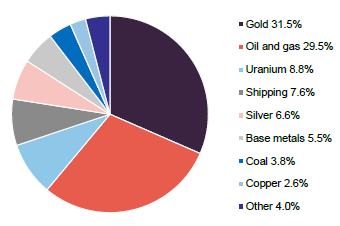
Figure 2: Geographic allocation as at 30 September 20261,2
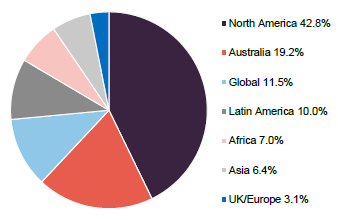
Over the past six months, sectoral allocation changes have been modest: +2.5% for shipping; -2.0% for oil and gas; and -2.4% for uranium. The main geographical allocation changes – reflecting the location of a company’s principal operations – were +4.0% to global; +0.8% to Asia; +1.8% to Australia; -4.9% to Africa; -1.1% to UK/Europe; and -0.7% to Latin America.
Top 10 holdings
Figure 3 shows CYN’s top 10 holdings as at 30 September 2026 and how these have changed over the previous six months. There are five holdings that have moved up into the top 10: PDI Gold, Talon Metals, Ora Banda, West African Resources and Frontline, while Core Natural Resources, Robex Resources, Transocean, Greatland Resources and Equinox Gold have all moved out.
Figure 3: Top 10 holdings as at 30 September 2026
| Holding | Sector | Country | Allocation 30 September 2026 (%) | Allocation 31 March 2026 (%) | Percentage point change |
|---|---|---|---|---|---|
| Tamboran Resources | Oil & gas | Australia | 4.7 | 6.0 | (1.3) |
| NexGen Energy | Uranium | Canada | 4.6 | 5.8 | (1.2) |
| BW LPG | Gas shipping | Global | 4.0 | 3.1 | 0.9 |
| Emerald Resources | Precious metals | Australia | 4.0 | 3.1 | 0.9 |
| Spartan Delta | Oil & gas | Canada | 3.9 | 4.1 | (0.2) |
| PDI Gold1 | Precious metals | West Africa | 3.7 | 3.0 | 0.7 |
| Talon Metals | Base metals | United States | 3.2 | 2.3 | 0.9 |
| Ora Banda | Precious metals | Australia | 2.9 | 2.2 | 0.7 |
| West African Resources | Precious metals | Burkina Faso | 2.8 | 2.5 | 0.3 |
| Frontline | Crude oil shipping | Global | 2.6 | 1.3 | 1.3 |
| Total of top 103 | 36.4 | 36.6 | (0.2) | ||
| Total of top 203 | 59.0 | 58.0 | 1.0 |
Tamboran Resources (4.7%) has reached a significant milestone in developing Australia’s Beetaloo Basin, delivering its first gas into the Northern Territory market in September 2026. The Shenandoah South pilot project is now being commissioned, while further drilling and testing should help establish the commercial potential of the resource. The company also completed its acquisition of Falcon Oil & Gas in May, expanding its position in the basin.
NexGen Energy (4.6%) made an important step towards developing its high-grade Rook I uranium project in Saskatchewan, Canada, when the Canadian Nuclear Safety Commission granted a site preparation and construction licence in March 2026. This substantially reduces regulatory uncertainty and allows the project to progress towards construction. Rook I offers considerable exposure to the longer-term demand outlook for nuclear fuel, although development and financing risks remain.
BW LPG (4.0%), one of the world’s leading liquefied petroleum gas shipping companies, has benefitted from exceptionally strong freight markets as disruption to Middle Eastern shipping routes has tightened vessel availability. Second-quarter 2026 shipping earnings averaged $74,000 per available day, with approximately 92% of third-quarter capacity fixed at an average rate of $88,000 per day. The company declared a $0.95 quarterly dividend.
Emerald Resources (4.0%) continues to generate substantial cash flow from its Okvau gold mine in Cambodia, producing 20,280 ounces during the September quarter. The company has maintained FY2027 production guidance of 100,000–115,000 ounces and is progressing developments at Dingo Range in Australia and Memot in Cambodia. These projects underpin its ambition to become a multi-mine producer of more than 300,000 ounces annually.
Spartan Delta Corp (3.9%), the Canadian oil and gas producer, continues to expand its production base, particularly through its Duvernay assets in Alberta. Second-quarter 2026 production increased 37% year-on-year to 52,818 barrels of oil equivalent per day, prompting an increase in full-year guidance. Its growing liquids exposure is particularly attractive in the current energy market, although natural gas prices remain an important influence on earnings.
PDI Gold (3.7%), formerly Predictive Discovery, has been transformed by its April 2026 merger with Robex Resources. The combination brings together the producing Kiniéro and Nampala gold mines with PDI’s substantial Bankan development project in Guinea. The enlarged group reported total gold ore reserves of 4.8 million ounces in September. Securing the necessary approvals to develop Bankan remains an important next step.
Talon Metals Corp (3.2%) is advancing its Tamarack nickel-copper-cobalt project in Minnesota, which could become a significant domestic source of critical minerals for the US. Recent drilling has delivered encouraging high-grade intersections, while the company has selected the Humboldt Mill in Michigan as its proposed processing location. Environmental assessment work is progressing, but the project remains pre-production and exposed to permitting and financing risks.
Ora Banda Mining (2.9%) is pursuing an ambitious expansion of its Davyhurst gold operations in Western Australia. The company produced 33,305 ounces during the September quarter, although weather disruption and mill downtime pushed up costs. Development of the high-grade Waihi underground mine has commenced, while construction of a new three-million-tonne-per-annum processing plant is progressing. Both are central to its longer-term production growth plans.
West African Resources (2.8%) continues to ramp up production from its Sanbrado and Kiaka gold operations in Burkina Faso. September-quarter output reached a record 127,950 ounces, taking production for the first nine months of 2026 to 360,857 ounces. The company remains on course to achieve its full-year guidance of 430,000–490,000 ounces, although explosives availability at Kiaka remains an operational constraint.
Frontline (2.6%), the crude oil tanker operator, has been a major beneficiary of the disruption to global shipping routes caused by the Middle Eastern conflict. It reported record second-quarter 2026 net profit of $659.2m, with its largest tankers earning average spot rates of $152,700 per day. The company declared a $2.61 quarterly dividend, reflecting exceptionally strong cash generation, although tanker earnings remain highly cyclical.
Performance
As discussed in previous notes, CYN’s managers tactically adjust the allocations to different resource areas depending on their expectations of how these will perform, while expressing them through allocating to their preferred ideas on a bottom-up basis. This process has been successful over the long term, with CYN’s NAV and share price outperforming the commodities indices, and global equities more generally, for most of the longer-term periods of three years and above, often by comfortable margins.
Figure 4: CYN NAV/MSCI World Metals and Mining and CYN NAV/MSCI World Energy Sector – rebased to 100 over 10 years to 31 October 2026
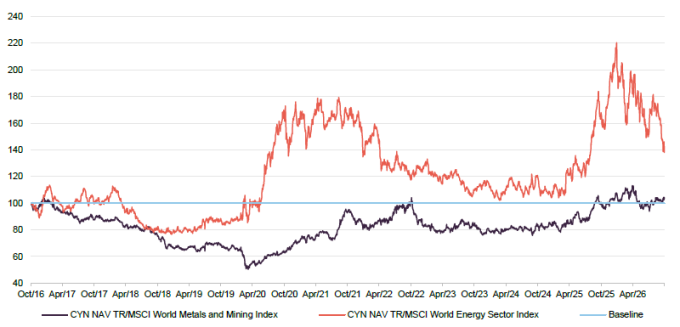
Looking at more recent performance, CYN enjoyed a particularly strong period of performance between March 2025 and March 2026, driven principally by its substantial exposure to precious metals miners, which worked well in an environment characterised by geopolitical uncertainty, concerns over government indebtedness, persistent inflationary pressures and growing demand for gold as a safe-haven asset. CYN’s managers favoured gold mining equities over the physical metal, allowing the trust to capture the operational leverage that rising gold prices can provide to producers’ earnings and cash flows.
Click here for a live comparison of the commodities and natural resources peer group.
This contrasted with a more challenging backdrop for industrial commodities and conventional energy, where the managers maintained a more modest exposure. CYN benefitted as weakness in China’s property market and concerns over global economic growth weighed on demand expectations for base metals, while increasing OPEC production dampened the outlook for oil. Whilst the managers initially actively recycled capital within the gold mining portfolio – taking profits in companies that have rerated strongly and reinvesting in smaller, less well-researched businesses where they see greater upside – from December 2025 through to March 2026, they actively reduced the trust’s exposure to gold and silver miners reflecting the strong performance of these sectors, and increased exposure to energy where they saw more attractive valuations. This timing proved opportune given the impact on the energy price following the outbreak of war in Iran and the subsequent fall in the gold price as the market has factored in higher interest rates.
Figure 5: Cumulative total return performance over periods ending 31 October 20261
| 1 month (%) | 3 months (%) | 6 months (%) | 1 year (%) | 3 years (%) | 5 years (%) | 10 years (%) | |
|---|---|---|---|---|---|---|---|
| CYN NAV | (6.6) | 6.1 | (11.3) | 28.8 | 111.3 | 133.2 | 288.4 |
| CYN share price | (9.2) | 6.1 | (3.9) | 37.2 | 159.9 | 179.1 | 402.4 |
| MSCI World Metals & Mining2 | (8.7) | (0.7) | (4.3) | 24.2 | 71.1 | 108.1 | 272.4 |
| MSCI World Energy Sector2 | 11.8 | 16.2 | 17.0 | 56.0 | 67.6 | 178.4 | 181.4 |
| MSCI World | (1.7) | 1.3 | 6.6 | 10.4 | 68.2 | 72.3 | 225.5 |
Premium/(discount)
Figure 6: CYN Premium/(discount) over five years
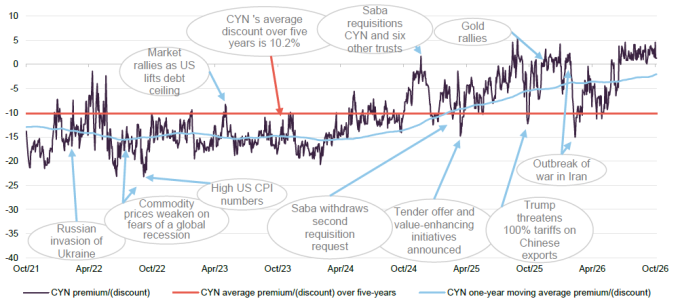
Figure 6 shows that the market responded positively to CYN’s announcement of its 100% tender offer and accompanying value-enhancing measures (including a reduced management fee and enhanced annual dividend noted above) announced in May 2025, albeit with notable volatility as CYN and markets have been impacted by macro events (many commodities are inherently sensitive to these). We think that, volatility aside, CYN has experienced a step change in its discount. Following the 100% tender, CYN has a share register of investors who understand its proposition and its enhanced dividend policy. With CYN recently trading at a premium, the trust has been reissuing stock and growing again.
Over the past 12 months, CYN has traded between a 15.0% discount and a 4.6% premium, with an average discount of 2.1%. As at 4 November 2026, CYN was trading at a discount of 2.6%.
Fund profile
Diversified natural resources exposure
Further information can be found at: https://citynats.com/.
CYN seeks to deliver both capital growth and income from a portfolio focused predominantly on mining and resource equities, complemented by selected mining, resource and industrial fixed income securities. The managers target companies that they believe are undervalued by the market and capable of generating attractive income relative to risk, providing scope for capital appreciation over time. The portfolio has a pronounced mid-cap bias, offering more idiosyncratic exposure than large-cap-focused peers and a meaningfully differentiated profile versus major resource indices and sector ETFs.
Previous publications
Figure 7: QuotedData’s previously published notes on CYN
SWOT analysis
Figure 8: SWOT analysis for CYN
| Strengths | Weaknesses |
|---|---|
| CYN’s peers tend to be large-cap focused, particularly the more diversified funds that offer a broader commodities and natural resources exposure.
CYN, with its distinct mid-cap bias, offers something different. Its managers are able to look further down the market cap scale in search of opportunities in a less-well-researched segment of the market. We view a holding in CYN as complementary to one of the large-cap funds. With a c.8% yield on NAV annually, CYN’s offering is well suited to shareholders who want some capital growth but would also want a significant level of income from their investment. |
CYN could suffer periods when absolute and/or relative performance is difficult, particularly when the growth outlook deteriorates, as commodities tend to be cyclical in nature.
However, the managers tactically adjust the portfolio’s exposure to different areas reflecting their outlook – for example, increasing the allocation to gold and precious metals in times of higher expected inflation and/or greater uncertainty, which can offset this effect. |
| Opportunities | Threats |
| CYN’s managers believe the inflation story has further to run and, if so, its portfolio is positioned to benefit from this. However, the managers have shown themselves to be adept at shifting the trust’s underlying commodity exposures to suit the prevailing macroeconomic conditions and so there will be further opportunities – for example, by moving into more cyclical positions as the growth outlook improves.
Many commodities have exposure to long-term structural growth trends; for example, the need to replace ageing infrastructure (i.e. steel) as well as the electrification of transport, heating and manufacturing (i.e. lithium and copper). |
Individual commodities can experience extended bear markets – often a function of over-investment in capacity when markets are buoyant. However, miners have exhibited much greater capital discipline during the last 15 years and an extended commodity bear market means that there is limited excess capacity in the system such that price risk is primarily to the upside, to the benefit of producers.
There is a risk of allocating to the wrong natural resource sectors when determining a strategic allocation. However, the managers have access to the wider resources of Tufton to help them make these decisions, and upswings in commodity market pricing can persevere, so the managers can be patient and do not always need to catch the first wave to outperform. |
Bull vs bear case
Figure 9: Bull vs bear case for CYN
| Aspect | Bull case | Bear case |
|---|---|---|
| Performance | CYN’s more defensive commodities exposures, particularly precious metals, have performed strongly this year, against a backdrop of higher uncertainty. | Small and mid-cap mining companies, where CYN is focused, tend to be more sensitive to the commodities cycle. This tends to benefit CYN in rising markets, but can hurt disproportionately when they are not. |
| Dividends | CYN targets a dividend of around 8% of NAV annually, paying out of capital as necessary. This is an attractive level for investors who need income from their investments. | Dividend can fluctuate with the NAV. |
| Discount | CYN has recently been trading close to par and has issued stock when it has been trading at a premium to NAV. | If performance starts to lag, this could weigh on CYN’s discount, although the single discount policy, clean register and other shareholder-friendly measures should help keep this in check. |
| Outlook | CYN’s managers believe its defensive allocations, including precious metals, have further to run and are positioning the portfolio accordingly. | CYN’s defensive allocation could lag in a broad commodities bull market, but its managers have shown themselves adept at adjusting to changing circumstances. |
IMPORTANT INFORMATION
This marketing communication has been prepared for City Natural Resources Growth and Income Plc by Marten & Co (which is authorised and regulated by the Financial Conduct Authority) and is non-independent research as defined under Article 36 of the Commission Delegated Regulation (EU) 2017/565 of 25 April 2016 supplementing the Markets in Financial Instruments Directive (MIFID). It is intended for use by investment professionals as defined in article 19 (5) of the Financial Services Act 2000 (Financial Promotion) Order 2005. Marten & Co is not authorised to give advice to retail clients and, if you are not a professional investor, or in any other way are prohibited or restricted from receiving this information, you should disregard it. The note does not have regard to the specific investment objectives, financial situation and needs of any specific person who may receive it.
The note has not been prepared in accordance with legal requirements designed to promote the independence of investment research and as such is considered to be a marketing communication. The analysts who prepared this note are not constrained from dealing ahead of it, but in practice, and in accordance with our internal code of good conduct, will refrain from doing so for the period from which they first obtained the information necessary to prepare the note until one month after the note’s publication. Nevertheless, they may have an interest in any of the securities mentioned within this note.
This note has been compiled from publicly available information. This note is not directed at any person in any jurisdiction where (by reason of that person’s nationality, residence or otherwise) the publication or availability of this note is prohibited.
Accuracy of Content: Whilst Marten & Co uses reasonable efforts to obtain information from sources which we believe to be reliable and to ensure that the information in this note is up to date and accurate, we make no representation or warranty that the information contained in this note is accurate, reliable or complete. The information contained in this note is provided by Marten & Co for personal use and information purposes generally. You are solely liable for any use you may make of this information. The information is inherently subject to change without notice and may become outdated. You, therefore, should verify any information obtained from this note before you use it.
No Advice: Nothing contained in this note constitutes or should be construed to constitute investment, legal, tax or other advice.
No Representation or Warranty: No representation, warranty or guarantee of any kind, express or implied is given by Marten & Co in respect of any information contained on this note.
Exclusion of Liability: To the fullest extent allowed by law, Marten & Co shall not be liable for any direct or indirect losses, damages, costs or expenses incurred or suffered by you arising out or in connection with the access to, use of or reliance on any information contained on this note. In no circumstance shall Marten & Co and its employees have any liability for consequential or special damages.
Governing Law and Jurisdiction: These terms and conditions and all matters connected with them, are governed by the laws of England and Wales and shall be subject to the exclusive jurisdiction of the English courts. If you access this note from outside the UK, you are responsible for ensuring compliance with any local laws relating to access.
No information contained in this note shall form the basis of, or be relied upon in connection with, any offer or commitment whatsoever in any jurisdiction.
Investment Performance Information: Please remember that past performance is not necessarily a guide to the future and that the value of shares and the income from them can go down as well as up. Exchange rates may also cause the value of underlying overseas investments to go down as well as up. Marten & Co may write on companies that use gearing in a number of forms that can increase volatility and, in some cases, to a complete loss of an investment.