
Moving to a new phase
Pantheon Infrastructure (PINT) delivered strong results in 2025, with an NAV total return above its 8-10% target. This was driven by solid operational performance, higher EBITDA and better cash generation. The full-year dividend was increased and fully covered. PINT is now moving from its initial buildout phase to a more mature stage, where cash generation, asset sales and reinvestment are key to returns.
This shift became clearer after year end. The sale of Calpine in January 2026, followed by a partial sale of Intersect, showed PINT’s ability to both create and realise value. These deals highlight the strength of its approach: investing in assets with growth potential and recycling capital into new opportunities as the portfolio develops.
Global high-quality infrastructure with strong ESG credentials
PINT aims to provide access to a globally diversified portfolio of high-quality infrastructure assets, primarily in developed OECD markets, which are expected to generate sustainable attractive returns over the long term. It targets co-investment assets that have strong ESG credentials and underpin the transition to a low-carbon economy.
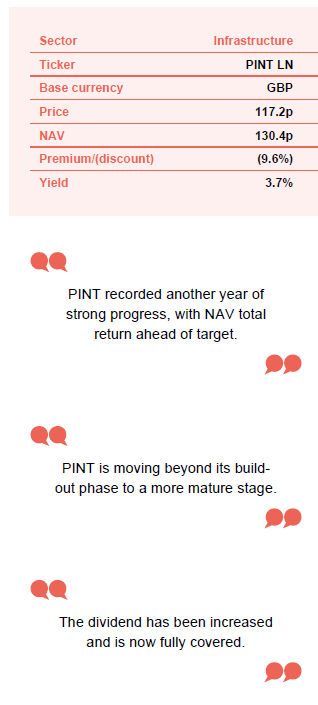
At a glance
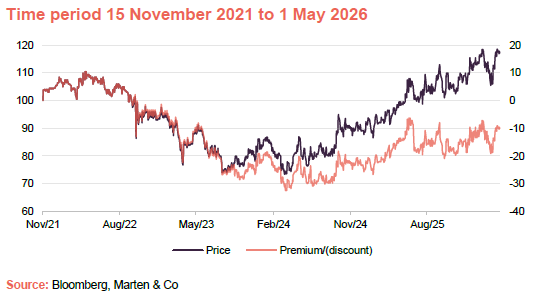
Share price and discount
PINT’s shares fell in the period after launch against a backdrop of rising interest rates. However, the price has rallied strongly since early 2024. As well as reflecting good performance, this has partially been due to the narrowing in the trust’s discount.
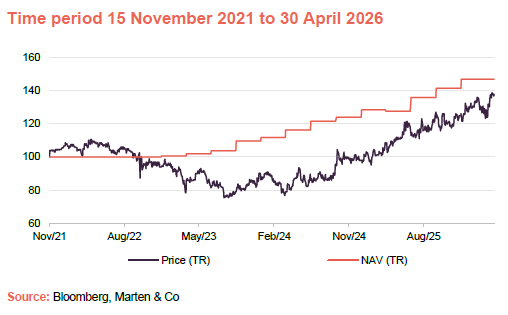
Performance since launch
PINT’s NAV returns have exceeded the pre-IPO target of 8-10% annualised total return, in every year since the portfolio became fully invested.
| Financial year ended | Share price total return (%) | NAV total return (%) | Dividend (pence per share) | Target dividend (pence per share) |
|---|---|---|---|---|
| 31/12/2022 | (10.4) | 0.6 | 2.0 | 2.0 |
| 31/12/2023 | (7.0) | 11.0 | 4.0 | 4.0 |
| 31/12/2024 | 11.5 | 14.9 | 4.2 | 4.2 |
| 31/12/2025 | 26.8 | 10.1 | 4.3 | 4.3 |
The managers’ view
PINT is well positioned to perform despite the current wider backdrop
PINT’s managers believe the fund is well placed to perform despite current economic challenges. While the wider listed infrastructure sector faces ongoing discounts, volatile bond yields and tough exit conditions, PINT argues these issues do not affect the core strengths of infrastructure investing.
The portfolio focuses on high-quality infrastructure assets with stable, contracted or regulated revenues, inflation protection and low debt. The managers see these defensive features as especially valuable in today’s uncertain markets.
PINT’s defensive characteristics are even more valuable in today’s unsettled markets
Operational performance remains strong across the portfolio, with EBITDA growth, better cash generation and improved dividend cover, even before any asset sales. In its earlier years, PINT focused on building its portfolio, but now the investment case is broader, supported by growth in existing assets, exits at good valuations (though timing is not fully in PINT’s control), and reinvestment into new opportunities through Pantheon’s platform.
Exposure to digital infrastructure
PINT has significant investments in digital infrastructure and power and utilities, originally driven by cloud computing growth and now boosted by rising AI demand for data centres and power. The managers note that PINT benefits from long-term contracts with major global technology companies, showing the strategic value of these assets. PINT is not making a direct bet on the tech sector but instead provides access to the essential infrastructure that is supporting trends like higher power use and digitalisation.
The sales of Calpine and Intersect are important here. Calpine was PINT’s first major sale since IPO, and the partial exit from Intersect within months, at a strong premium, shows that value can still be created and realised in targeted parts of the market. This matters not just for the profits gained but also as proof that PINT can recycle capital actively, rather than waiting for value to emerge over the long term.
Almost five years after launch, PINT is fully invested, generating more cash, and starting to demonstrate that it can combine exits and reinvestment with dividend growth. The portfolio remains defensive, while the managers are proving they can deliver a cycle of growth, cash generation, and value realisation.
Asset allocation
The charts below use data from PINT’s Q4 2025 update, showing the portfolio as a percentage of gross asset value.
Figure 1: Portfolio split by geography
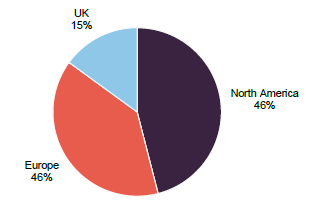
Figure 2: Portfolio split by sector
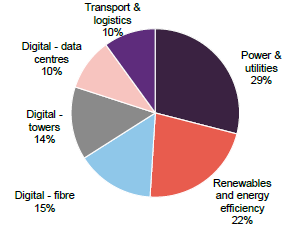
As of 31 December 2025, PINT had £620m invested or committed across 14 assets. Net asset value was £611m, with £5m in cash. The portfolio companies’ business plans were fully funded at the time of PINT’s investment.
PINT also has a £115m revolving credit facility, which was undrawn. The manager has said the facility is unlikely to be used unless there is clear visibility on repayment, possibly supported by more certainty around near-term asset sales.
Figure 3: Portfolio split by revenue type
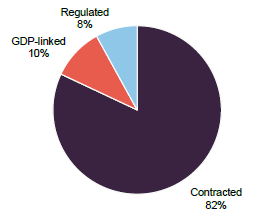
Figure 4: Portfolio split by sponsor
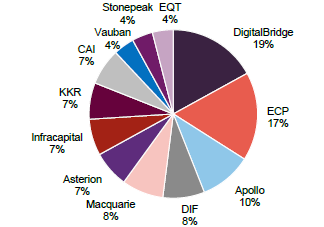
Figure 5: PINT’s portfolio as at 31 December 2025
| Holding | Business | Region | Sponsor | Total investment (£m) | MOIC (x) |
|---|---|---|---|---|---|
| Calpine | Electricity generation | North America | ECP | 107 | 3.0 |
| Primafrio | Transport & logistics | Europe | Apollo | 58 | 1.5 |
| National Gas | Gas utility and metering | UK | Macquarie | 51 | 1.5 |
| Fudura | Renewables and energy efficiency | Europe | DIF | 50 | 1.5 |
| Intersect | Renewables and energy efficiency | North America | CAI | 43 | 1.5 |
| Vantage Data Centers | Data centres | North America | DigitalBridge | 42 | 1.6 |
| National Broadband Ireland | Digital fibre | Europe | Asterion | 42 | 1.4 |
| Zenobe | Renewables and energy efficiency | UK | Infracapital | 41 | 1.3 |
| CyrusOne | Data centres | North America | KKR | 40 | 1.7 |
| Deutsche Funkturm | Digital towers | Europe | DigitalBridge | 37 | 1.3 |
| Delta Fibre | Digital fibre | Europe | Stonepeak | 26 | 1.2 |
| Cartier Energy | District heating | North America | Vauban | 25 | 0.8 |
| Vertical Bridge | Digital towers | North America | DigitalBridge | 24 | 1.1 |
| GlobalConnect | Digital fibre and data centres | Europe | EQT | 22 | 1.2 |
| Total | 608 | 1.5 |
Deutsche Funkturm is the re-branded German arm of GD Towers.
The sale of Calpine to Constellation Energy Corporation was completed in January. PINT received $28.5m in cash and over 325,000 Constellation shares, with half locked until July 2026 and the rest until July 2027.
PINT’s latest NAV used a Constellation share price of $350 as of 31 December 2025. Since then, the price has dropped to $313, which will have reduced the NAV. For every $10 change in Constellation’s share price, NAV moves by about 0.5p per share, so this fall means roughly a 2p reduction in PINT’s NAV.
Intersect
The only new investment since July 2025 is Intersect, a US-based company that develops and runs power infrastructure alongside data centres. PINT invested in September. Intersect stands to benefit from increasing demand for large data centres and higher power needs due to cloud computing and AI growth.
A partial exit occurred when Intersect sold its pipeline of energy and data centre projects to Alphabet in March. PINT still holds a stake in the business, now called IPX Power, which operates the remaining generation assets.
Asset development is expected to proceed as planned, with selected projects retained and progressed. All assets in the portfolio are expected to be sold after the current construction projects are finished.
Performance – strong NAV and share price progress
PINT’s NAV performance has consistently outperformed its peers, with returns exceeding the pre-IPO target each year since the portfolio was fully invested. For the year to 30 April 2026, NAV total return was 15.2%. The share price has also shown strong growth, rising nearly 25% over the past year as the discount narrowed.
Figure 6: Cumulative total return performance over periods ending 30 April 2026
| 6 months (%) | 1 year (%) | 3 years (%) | Since launch (%) | |
|---|---|---|---|---|
| PINT share price | 9.2 | 24.2 | 59.6 | 37.6 |
| PINT NAV | 3.9 | 15.2 | 43.9 | 46.7 |
| Peer group1 NAV median | 2.4 | 7.9 | 26.4 | 27.1 |
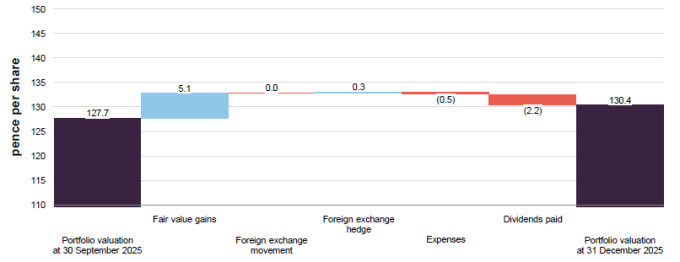
Figure 7 shows the main drivers of returns for the three months to 31 December 2025. Most gains came from growth in underlying EBITDA across the portfolio, with some offset from dividends paid.
Figure 7: PINT NAV bridge for three months ended 31 December 2025
Dividend payments
PINT met its target income return for the year, paying shareholders a total of 4.346p, including a second interim payment of 2.173p on 24 April 2026.
The dividend is now fully covered at 1.1 times for 2025, up from 0.7 times in 2024, showing PINT’s growing maturity. As more assets are sold, dividend coverage is expected to improve further.
The board considers the dividend policy sustainable and says future increases are possible. They remain committed to growing dividends and keeping shareholders informed about future plans.
Premium/(discount)
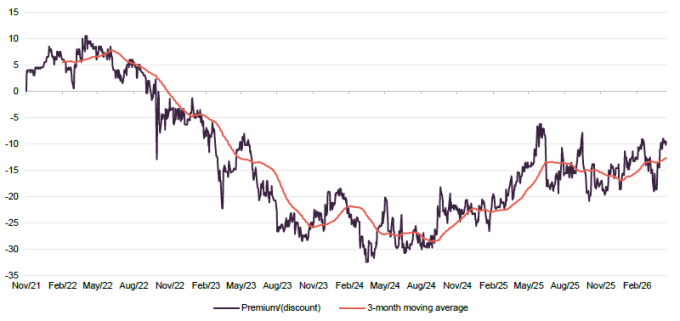
For the 12 months to 30 April 2026, PINT’s discount ranged from 6.3% to 20.9%, averaging 14.4%. This is both a narrower range and a lower average than reported in July, based on data to 30 June 2025.
Figure 8: PINT premium/discount from launch to 30 April 2026
Potential share buybacks
PINT’s discount control mechanism allows the board to use surplus cash from net gains to buy back shares if the discount stays wider than 5% during any financial year.
This becomes important from this year, as the first net gains are expected. When considering buybacks, the board will balance the benefits to shareholders against the potential returns from new investments, and will also consider shareholders’ views. For instance, the Intersect investment delivered a 1.5x return in just three months, showing the potential value of reinvesting over buying back shares.
In the latest annual report, chairman Patrick O’Donnell Bourke confirmed the board’s responsibility to manage the discount. However, he also stated that both the board and investment manager believe new investments offer strong potential, and most shareholders support using capital for opportunities that should boost long-term value.
Fund profile
Pantheon Infrastructure (PINT) aims for annual total returns of 8-10%, combining capital growth and a growing dividend. It invests in equity and related stakes in private infrastructure assets across Western Europe and North America, working alongside other major private asset managers and institutional investors.
PINT gives investors access to a diverse range of high-quality infrastructure assets in developed markets, offering both income and growth with strong protection against downturns and inflation. Its target assets are typically defensive, with features like regulated or contracted cash flows, inflation links, low debt, and strong sustainability standards.
The fund initially focused on digital infrastructure (such as data centres, fibre networks and telecom towers), renewables and energy efficiency (including wind, solar, waste-powered electricity and smart meters), power and utilities (energy transmission, distribution, water and traditional power) and transport and logistics (ports, rail, roads, airports).
The board believes PINT provides stable, predictable cash flows, inflation protection, downside protection and diversification across infrastructure sectors.
SWOT analysis
Figure 9: SWOT analysis for PINT

| Strong NAV performance since launch, underpinned by clear proof-of-concept, with cash generation, realisations and reinvestments driving returns. |
| A progressive dividend policy, including a dividend that is now fully covered by cash flow. |

| PINT is subject to market sentiment towards its sectors and the wider economic environment, particularly interest rate movements. |

| Digital infrastructure and power & utilities investments, originally driven by growth in cloud computing, could continue to benefit additionally from the rise of AI, with its attendant demand for data centres and power. |
| PINT’s discount has continued to narrow in recent months. However, there is still significant potential for it to narrow further. The trust traded at a premium for some time after launch. |
| Although out of PINT’s direct control, further portfolio realisations could follow Calpine and Intersect, at a strong MOIC. |

| Valuation risk due to the nature of the portfolio of unlisted assets. A relatively small change in underlying assumptions can potentially have a meaningful impact on NAV. |
| Potential discount widening, in response to poor performance and/or poorer sentiment towards infrastructure sectors. |
Bull vs bear case
Figure 10: Bull vs bear case for PINT


| Performance | Strong NAV performance since launch in 2021, and returns for shareholders have been boosted by the narrowing discount. This is underpinned by the transition from an initial build-out phase to a more mature stage. | Although PINT’s performance is generally correlated positively to inflation, periods of particularly high inflation and rapid increases in interest rates – as was seen from mid-2022 onwards – can negatively impact returns. |
| Dividends | PINT met its 4.3p target in the most recent financial year. Dividend policy is sustainable, payments are now covered, and future increases are likely. | Increases would potentially cease being sustainable if conditions changed. However, this is less of a risk now than previously, given full coverage. |
| Outlook | PINT is exposed to growing sectors that are crucial for building the economy of the future. This is most clear in AI-driven data centre demand. | AI is a new and rapidly evolving technology where the shape of that evolution is uncertain. We have recently seen more of a pushback against AI as its massive potential has become clearer. |
| Discount | PINT still trades at a discount that could narrow further and potentially move to a premium, as happened for a period after launch. This could come about from inflation and interest rates further subsiding and from beneficial long-term structural growth themes. | The discount could widen significantly due to circumstances beyond PINT’s control, as happened from late 2022. This could be caused by higher interest rates or any news flow perceived as negative for the underlying assets. |
Previous publications
Readers seeking more information on PINT can refer to our previous notes listed in Figure 11.
Figure 11: QuotedData’s previously published notes on PINT
IMPORTANT INFORMATION
Marten & Co (which is authorised and regulated by the Financial Conduct Authority) was paid to produce this note on Pantheon Infrastructure Plc.
This note is for information purposes only and is not intended to encourage the reader to deal in the security or securities mentioned within it. Marten & Co is not authorised to give advice to retail clients. The research does not have regard to the specific investment objectives financial situation and needs of any specific person who may receive it.
The analysts who prepared this note are not constrained from dealing ahead of it but, in practice, and in accordance with our internal code of good conduct, will refrain from doing so for the period from which they first obtained the information necessary to prepare the note until one month after the note’s publication. Nevertheless, they may have an interest in any of the securities mentioned within this note.
This note has been compiled from publicly available information. This note is not directed at any person in any jurisdiction where (by reason of that person’s nationality, residence or otherwise) the publication or availability of this note is prohibited.
Accuracy of Content: Whilst Marten & Co uses reasonable efforts to obtain information from sources which we believe to be reliable and to ensure that the information in this note is up to date and accurate, we make no representation or warranty that the information contained in this note is accurate, reliable or complete. The information contained in this note is provided by Marten & Co for personal use and information purposes generally. You are solely liable for any use you may make of this information. The information is inherently subject to change without notice and may become outdated. You, therefore, should verify any information obtained from this note before you use it.
No Advice: Nothing contained in this note constitutes or should be construed to constitute investment, legal, tax or other advice.
No Representation or Warranty: No representation, warranty or guarantee of any kind, express or implied is given by Marten & Co in respect of any information contained on this note.
Exclusion of Liability: To the fullest extent allowed by law, Marten & Co shall not be liable for any direct or indirect losses, damages, costs or expenses incurred or suffered by you arising out or in connection with the access to, use of or reliance on any information contained on this note. In no circumstance shall Marten & Co and its employees have any liability for consequential or special damages.
Governing Law and Jurisdiction: These terms and conditions and all matters connected with them, are governed by the laws of England and Wales and shall be subject to the exclusive jurisdiction of the English courts. If you access this note from outside the UK, you are responsible for ensuring compliance with any local laws relating to access.
No information contained in this note shall form the basis of, or be relied upon in connection with, any offer or commitment whatsoever in any jurisdiction.
Investment Performance Information: Please remember that past performance is not necessarily a guide to the future and that the value of shares and the income from them can go down as well as up. Exchange rates may also cause the value of underlying overseas investments to go down as well as up. Marten & Co may write on companies that use gearing in a number of forms that can increase volatility and, in some cases, to a complete loss of an investment.