
What a day for Scottish Mortgage (SMT) to report half-year results. With tech shares reeling at a global sell-off in artificial intelligence (AI) companies, Baillie Gifford’s flagship seeker of world-leading growth stocks published impressive numbers for the six months to 30 September but made little direct comment on the current market storm engulfing some of its holdings.
The £15.5bn investment trust made a 31.5% investment return in the half-year period, with shareholders receiving 33.8%, broadly double the 16% gain in the FTSE All-World Index.
The performance left shareholders sitting on handsome gains over one, three, and 10 years but with returns of 40.3%, 140.7% and 412.7% that all beat the benchmark by a wide margin.
However, over five years the trust is still lagging the index, returning just 13.9% after being badly hit in the 2022-23 growth crash. The underling growth in net asset value (NAV) of 27.8% was better but still trailed the FTSE All-World’s 79.3% over that period.
The company emphasised that it was best held by long-term investors who could withstand periodic bouts of intense volatility, such as recent weeks. Shares that have slid 12% in the past month were 0.5% firmer this morning as SMT proudly displayed the achievement of gaining nearly half its six-month return from SpaceX, Anthropic and Moderna.
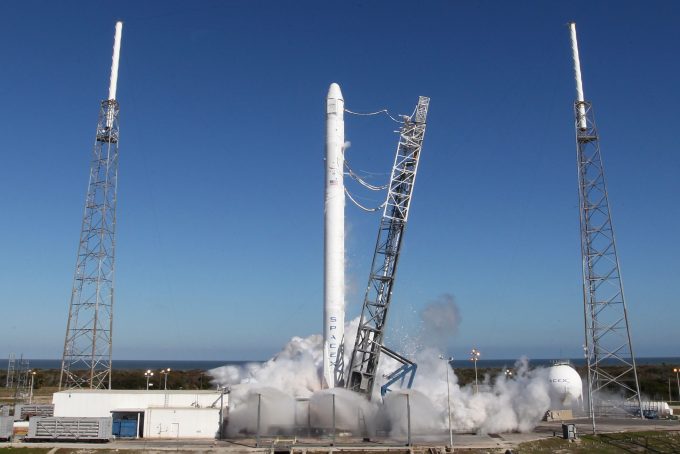
Having backed SpaceX for nearly eight years and holding through its record $1.77trn flotation in June increased SMT’s assets by 8% in the period, generating nearly a quarter of the investment return.
As lock-up agreements have started to expire after the initial public offer, fund managers Tom Slater and Lawrence Burns have reduced the trust’s exposure from a peak 25.7% to 15%, but retain conviction on its prospects.
“As launch costs continue to fall, we expect new business applications to follow Starlink, from connecting mobile phones directly to satellites to providing compute in orbit,” they said.
Anthropic, the AI laboratory hoping to pull off a $1.5trn flotation despite investors’ sudden bearishness, provided a 3.4% return, the third best performer in the period, after more than tripling annualised revenues to $47bn from $14bn in the three months to May. It is a 4% holding for SMT.
“The companies we speak with across the world are clear that they expect to spend more on AI and tell us that spending is earning a positive return. The path will be bumpy, but the long-term direction is clear,” the managers said.
US drug developer Moderna rewarded their patience with a 4.5% boost to the trust’s assets after its shares nearly tripled in a single day in August when its personalised cancer vaccine succeeded in a late-stage melanoma trial, “a decade after work on it began”, they noted.
Returning to the AI theme driving “extraordinary demand for computing power”, the managers said they added to Nvidia, the world’s biggest chip maker whose $4.4trn valuation “looks increasingly modest against the 106% year-on-year revenue growth it reported in August”. The shares slid over 9% yesterday.
The managers disclosed they “took new holdings in SK Hynix, which makes memory for AI chips, and KLA and DISCO, which make the equipment used to inspect and cut chips. With power becoming a binding constraint on the AI build-out, we took holdings in Vistra, a power generator, and EQT, a natural gas producer. At the other end of the stack, Snowflake, Cloudflare and Databricks benefited as companies rebuilt their data and network infrastructure for AI,\” they said.
Three new private companies were also added: “Hadrian uses software and robotics to run automated factories that make precision parts for aerospace and defence. ICON uses robotic 3D printers to build homes and other structures, such as barracks for the US military, cutting time, labour and waste. Chai Discovery builds AI models that design new drugs from scratch, aiming to turn the slow, trial-and-error search for medicines into an engineering problem.”
The board declared an interim dividend of 1.8p per share, up from 1.6p last year, and said it intended to deliver a modest increase for the year as a whole.
Chair Christopher Samuel reminded shareholders to be patient and to consider the long-term picture: “Markets will continue to be affected by geopolitical uncertainty, economic policy and changing investor sentiment. At the same time, technological and scientific advances continue to create opportunities for businesses capable of transforming their industries.
“The board recognises that share prices may fluctuate significantly, sometimes without a corresponding change in a company’s underlying prospects. It is important to distinguish such volatility from the more fundamental risk of permanent loss of capital.”
Our view
David Batchelor, senior analyst at QuotedData, said: “These are exceptional half-year numbers, and show that several of SMT’s long-term bets paid off at once. NAV return of 31.5% was almost twice the 16% from the FTSE All-World, with SpaceX, Moderna, Anthropic and Zipline together making an 18.3% contribution to absolute performance. SpaceX’s flotation was particularly significant, both vindicating the managers’ willingness to hold private businesses for many years and reducing private company exposure from 41.5% to 24.9%. Cutting SpaceX further, from 15.0% of assets at the period end to 11.1% by 4 November, also looks like sensible portfolio management after such a strong run rather than a loss of conviction.
“There is an important caveat, however. These figures run only to the end of September and therefore predate the latest sharp sell-off in AI-related stocks. SMT’s technology exposure rose from 32.1% to 43.7% and the managers added to NVIDIA while buying SK Hynix, KLA and DISCO as part of a broader bet on continued AI infrastructure spending. The recent market nervousness over the scale and prospective returns from that spending will provide a fresh test of those positions, particularly with SMT’s five-year NAV return still well behind its benchmark.”
