

AI has already disrupted software, could the asset management sector be next? Would you let artificial intelligence manage your life savings?
I tuned into the Polar Capital Global Technology team’s webinar yesterday; it was a fascinating watch as usual. As you can see below, the Polar Capital Technology Trust (PCT) retains its top spot over most time periods in the technology sector, with some phenomenal performance (an average of 23.96% a year over 10 years works out as a 757% return, well done you if you held it all the way through).
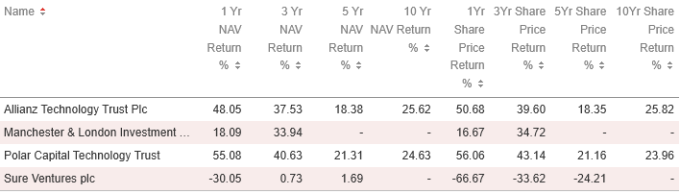
There has been some weakness in the sector recently, particularly on the back of the story published on 14 September that the big US AI players were calling for a slowdown in the development of AI on safety grounds. However, the managers say that there is no intention to rein back on PCT’s AI maximalist stance. They believe that we are still at an early stage in the adoption of AI and that it will transform economies and societies. In the short term, they are confident that the upcoming round of company quarterly results will meet expectations, and suspect that when companies say that they are scaling back on AI development, they are still talking about progressing AI models just not at an ever-accelerating pace.
AGI closer than you think?
The accelerating pace comes from recursive self-improvement – AI models upgrading themselves – a process that the team thinks has already begun and ought to be bringing us closer to artificial general intelligence (AGI). The Polar team suggests that the likes of Anthropic’s Dario Amodei and OpenAI’s Sam Altman feel that we are closer to AGI than they had expected.
More prosaically, the businesses that own the leading models are starting to rake in meaningful revenue, with annualised run rates of about $65bn in July for Anthropic and $40bn for OpenAI, up from just $5.5bn and $1bn, respectively, in December 2024. However, the Polar team is also convinced that these businesses are just scratching the surface of their addressable market.
AI will disrupt a broad swathe of industries
If the managers are correct, AI will disrupt a broad swathe of industries. Earlier this year investors started to price in the potential impact of agentic AI on software and data stocks. This week, Mid Wynd (MWY) joined the ranks of those trusts that are blaming poor performance on the so-called SaaSpocalypse. The Polar team is not too optimistic about the ability of software stocks to recover their previous momentum, which would be bad news for the likes of Finsbury Growth and Income (FGT) and HgCapital Trust (HGT), amongst others.
However, the Polar team warns that there are more SaaSpocalypse-type events coming, as AI demolishes the defensive moats of companies in other sectors.
One of these might be asset management. It was interesting to hear the Polar team talk about the increasing reliance that they are placing on AI tools that scan market news and other data sources. Even with a team of 12, there is way more potentially useful information that can be monitored and analysed, and they say that AI is the only practical way of handling it. When I wrote about Montanaro UK Smaller Companies (MTU) back in May, its manager was saying the same thing. Despite having one of the largest small cap analyst teams in London, Montanaro says it is increasingly using AI tools to help analysts and managers identify investment themes, speed up due diligence, incorporate real-time data, spot accounting issues, and analyse third-party insights.
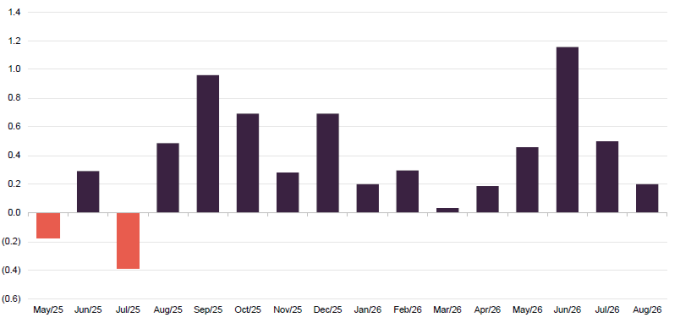
This also reminds me of the approach that BlackRock is using to manage BlackRock American Income (BRAI). Its systematic active equity (SAE) approach, which sifts through a vast array of data to determine useful insights into stocks and the direction of stock prices was described in detail in our initiation note on BRAI. The amazing success of this shows up in this chart which is taken from our latest update note on the trust. It makes a powerful case for SAE.
That got me wondering whether BlackRock would put SAE forward as a potential solution for BlackRock Income and Growth (BRIG), which has just launched a strategic review. As it stands, the trust is sub-scale, and the performance record is disappointing. However, the same could have been said of pre-strategy change BRAI and that is now the best-performing trust in its sector and issuing stock.
BRAI’s investment process does still have a human in the loop, sense checking the AI’s stock suggestions, monitoring risk exposures, and adapting the portfolio to sudden changes in macroeconomic factors. But, increasingly for many managers AI is taking much of the grunt work out of investment analysis, and the Polar team would say that it is only getting better at doing this.
Investment advisers might also have picked up the recent announcement by Charles Schwab of a partnership with Anthropic to develop Claude tools to assist in their business.
I am also conscious that there is much that AI could do to make my job more productive. However, as you may have heard, I’m ducking out before the robots take over 😊.
When I started working in the 1980s, we were still using manual ledgers to record trades and calculate unit trust prices (I even still have the occasional nightmare that I can’t find a paper contract note). I was fortunate to be of the right age to get to grips with new-fangled technology as it came in – spreadsheets were a game changer for example.
I suppose the message is that change is always with us and we must adapt, but I am not sure that I would entrust my pension fund to an AI manager yet.
PS: yes I did spot the AI hallucination (swapping Tower Bridge for London Bridge) in the image, but I think that reinforces why I’m still dubious
