
New focus on total returns
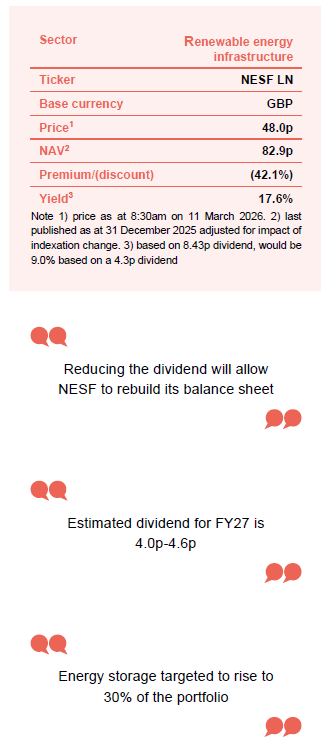
Following its strategic review, NextEnergy Solar Fund’s (NESF’s) board plans to refocus on delivering both income and capital growth, aiming for long-term total returns of 9%-11%. This year’s dividend target of 8.43p will be met, but future dividends will be set at 75% of operating free cashflows after debt and expenses. For the year ending 31 March 2027 (FY27), the estimated dividend range is 4.0p-4.6p.
Lowering the dividend should release around £40m over five years, which will be used to strengthen the balance sheet, with a loan-to-value (LTV) target of 40%-45%, and fund new investments to grow NAV. Plans include upgrading existing solar assets and adding energy storage, with a goal for storage to make up 30% of the portfolio.
NESF has finished its capital recycling programme with the sale of The Grange and South Lowfield solar farms for £46.2m, and will use the proceeds to pay down its revolving credit facility. Further asset sales totalling 120MW, plus the sale of NESF’s private solar fund investment and two co-investments from 2027 onwards, will release more capital.
As we explain in this note, NESF has found itself in a difficult place. No bidders emerged during the strategic review and a wide discount to NAV lowers its enterprise value, which limits its ability to buy back shares under the USS preference share covenant. While asset sales have helped reduce debt, weak demand for mature assets means this is not a quick solution and a managed wind down is not possible. As NESF needs cash, reducing the dividend is seen as the best option. The board and advisers believe this approach, which conserves cash, can deliver the targeted 9%-11% total returns.
At a glance
Share price and discount
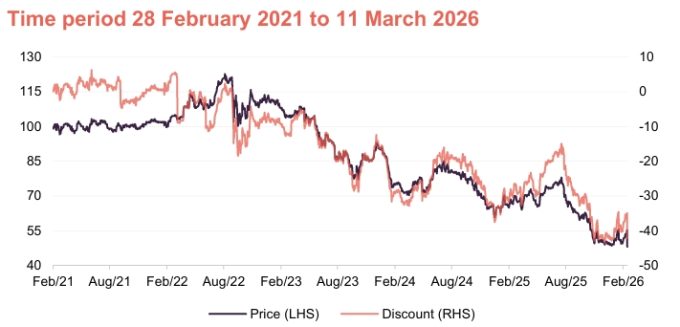
NESF’s share price has been on a downward trend since interest rates started to rise in 2022. Other factors at work were the misleading cost disclosure issue and falling forecast power prices. This has widened the share price discount to net asset value.
Performance over five years
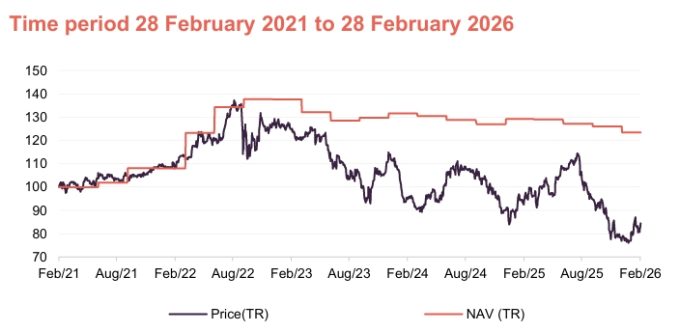
There has been downward pressure on NESF’s NAV since interest rates started to rise in 2022. However, the widening discount means that returns to shareholders have been lower than returns on NAV.
A plan for the future
Reducing the dividend will allow NESF to rebuild its balance sheet
The board has decided that NESF cannot continue as before. Persistent wide discounts, even after interest rates fell and cost disclosure issues were resolved, show that change is needed.
As part of this, NESF will reduce its dividend, but the board believes this will allow the fund to provide attractive long-term returns for shareholders. NESF also plans to rebuild its balance sheet by recycling mature investments.
Managed wind downs have been value destructive
To reach this decision, the board consulted shareholders and independent advisers. It found that managed wind downs have destroyed value, as funds have had to sell assets in a market that prefers new investments. Changing to an operating company was seen as too costly and unlikely to add value. Mergers and acquisitions were not expected to create useful synergies, and no acceptable private buyer emerged. Accessing third-party capital remains a possibility and could add additional value to NESF’s new strategy.
Targeting long-term total returns of 9%–11%
NESF will now focus on delivering both income and capital growth, targeting long-term total returns of 9%-11%. Share buybacks are not possible at the moment due to the USS covenant, but NESF plans to resume buybacks when allowed.
Resetting the dividend
Estimated dividend for FY27 is 4.0p–4.6p
This year’s dividend target of 8.43p will be met. In future, the dividend will be set at 75% of operating free cashflows after debt and operating costs. For the year ending 31 March 2027 (FY27), the estimated dividend is 4.0p–4.6p. Cutting the dividend could free up around £40m over five years.
At the current share price, this lower dividend would mean a yield of 8.3%–9.6% for FY27. NESF has provided guidance (see Figure 1) showing that the dividend may fluctuate rather than grow each year, but there is a good chance it could rise from the FY27 level.
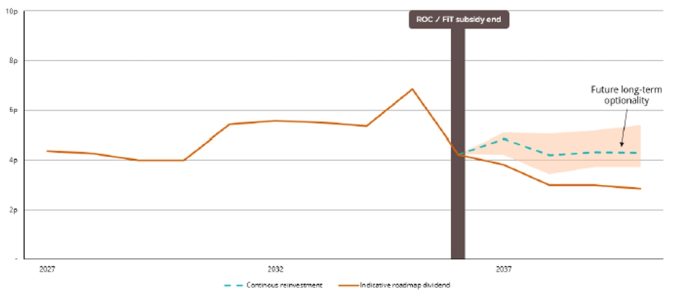
Shareholders should note that without new investments, cash flows and dividends are expected to fall as subsidies end and assets age, which is already reflected in NESF’s NAV. However, Figure 2 suggests the dividend could be maintained if some operational cash flows are reinvested. The chart shows what might happen if 25% of these cash flows are reinvested. The scenario assumes that after the subsidy ends, funds are reinvested back into the portfolio. The scenario is described as conservative.
Figure 1: Indicative long-term ordinary share dividend guidance
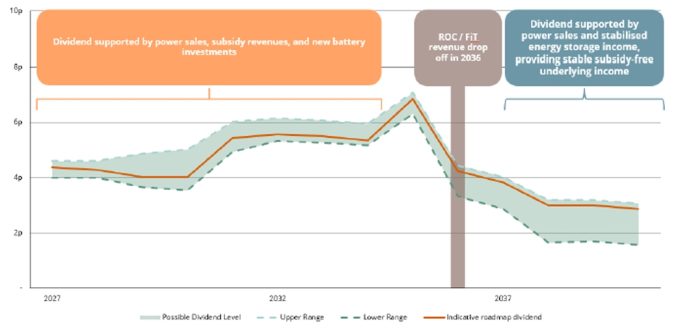
Figure 2: Possible long-term ordinary share dividend path post ROC / FiT subsidy end
Conclusion of the capital recycling programme
£119m freed up by capital recycling programme
On 10 March 2026, NESF announced the sale of its last two solar plants under its capital recycling programme. The Grange and South Lowfield were sold for £46.2m, which will help reduce NESF’s revolving credit facility, standing at £151.9m at the end of December. The sale price was slightly below the NAV carrying value, reducing it by 0.32p. Overall, the programme released £119m, achieved a 1.1x return on invested capital, and added 2.44p to the NAV. NextEnergy Capital’s investment director Stephen Rossiter noted “renewed momentum in the solar M&A market as we move into 2026”.
New capital recycling targets
Further asset sales planned
The board plans to sell up to another 120MW of assets. NESF’s $50m investment in NextEnergy III and two co-investments, totalling about 116MW are expected to be realised from 2027 onwards, this will release more capital.
A stronger balance sheet
The board believes that reducing the dividend and selling assets will help fund new investments and lower NESF’s loan-to-value (LTV) ratio to between 40% and 45%, well below its 50% policy limit.
At December 2025, NESF’s total debt was £509.1m, giving an LTV of 51%. Of this, £200m relates to preference shares, which pay a 4.75% annual dividend until March 2036. After this, holders can convert them into ordinary shares or unlisted B shares, based on 100p per preference share and the NAV per ordinary share at the time. The company can redeem these shares at any time after April 2030.
NESF has £143.7m in long-term debt that amortises and will be repaid over the life of its subsidised assets. The remaining debt is from a £205m revolving credit facility (RCF), renewed in March 2025 at 120 basis points (the equivalent of 1.2%) over SONIA. The RCF matures in June 2026, with options to extend to June 2028.
Significant new investment opportunities
The UK government aims to triple solar capacity to 50GW and quadruple battery storage to 27GW by 2030 to meet rising power needs. Solar is the cheapest renewable energy source, even in the UK, and would also help boost energy security and protection from fossil fuel price spikes, like those caused by the Iranian war. The government’s new contract for difference (CfD) scheme offers predictable, inflation-linked revenue over 20 years, which should help attract private funding.
NextEnergy Capital believes NESF should help direct investor capital into this opportunity. It can use Starlight, its development arm, and Wise Energy, the world’s largest solar-focused asset manager, to reach its goals.
Energy storage targeted to rise to 30% of the portfolio
However, as NESF cannot raise new capital, the company’s latest statement sets out more modest aims. These include improving its portfolio by upgrading existing solar assets with new technology to boost energy output and adding co-located energy storage. NESF plans to increase its exposure to energy storage to 30% of the portfolio, pending shareholder approval at the upcoming AGM.
Co-located storage can optimise generation to align with demand
The board notes that co-located storage can better match generation with demand, create new revenue streams, and improve project economics by making the most of existing grid connections, which remains a major challenge for clean energy expansion. NESF says that investing in two-hour storage could deliver returns of 10%-13% IRR.
Figure 3: The future of NESF’s portfolio
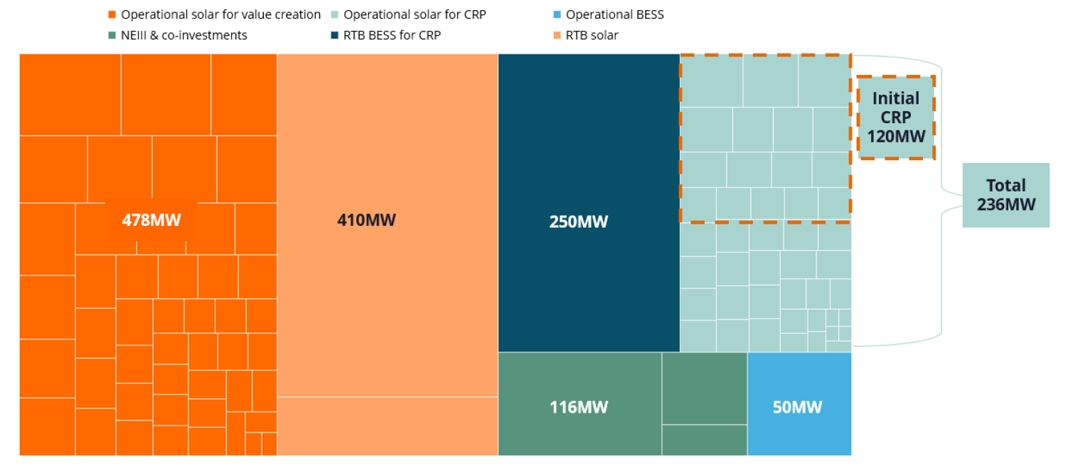
Figure 3 shows how NESF’s portfolio could evolve, with operational solar assets to be retained and enhanced (darker orange), potential for new-build solar (lighter orange), and NextEnergy III and co-investment assets to be realised (dark green). The light green box outlined in orange dashes represents assets for the new recycling programme, with the possibility of expanding this to include more light green assets in future. The current Camilla battery storage asset is shown in blue, while the dark blue box indicates potential new energy storage assets.
A brief history
In April 2023, NESF launched a capital recycling programme, planning to sell five subsidy-free solar plants: Hatherden (which was still at the ready- to-build stage at the time of disposal), Whitecross, Staughton, The Grange, and South Lowfield. Hatherden was sold for £15.2m in November 2023, Whitecross for £27.0m in June 2024, and Staughton for £30m in November 2024.
In May 2025, NESF confirmed its dividend target for the year ending 31 March 2026 at 8.43p, expecting cover of 1.1x-1.3x post-debt amortisation, which was reconfirmed in the latest update.
Fee cut boosts the dividend cover
In June 2025, NESF stated it was exploring strategic options and soon after announced a reduction in management fees, now split 50% between NAV and market cap (previously 100% NAV). This change is expected to save about £0.6m a year and improve dividend cover.
At the August 2025 AGM, 12% of votes cast (7% of shares in issue) supported discontinuation.
In November 2025, the UK government decided to switch subsidy indexation to CPI from April 2026, despite feedback, cutting NESF’s NAV by 2p.
Covenant restricts buybacks
In December 2025, interim results showed NESF breached the enterprise value covenant in its USS preference share agreement (requirement: max 50%, actual: 60.1%). USS approval or waiver is now needed before share buybacks, special dividends, or extra debt.
No shares have been repurchased since April 2025. From March 2023 to then, share capital fell by about 15m shares.
In February 2026, NESF reported a NAV of 84.9p at December 2025 (before the 2p indexation impact), down 31% from its September 2022 peak. This reflects factors such as an increase in the discount rate used for cash flow forecasts from 6.8% to 8.0%.
Figure 4: UK power prices (£/MWh)
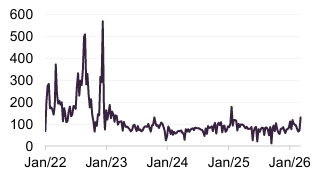
The main reason for the change has been falling power prices. In September 2022, NESF estimated short-term power prices at £139.1/MWh for 2022-2026, equal to £156.8/MWh in today’s terms. By September 2025, the estimate for short-term prices (to 2029) had dropped to £60.7/MWh.
UK power prices are heavily influenced by natural gas prices. Gas peaked in August 2022, reaching about 350p/therm at the end of September 2022, but fell to around 80p/therm by September 2025. After the recent conflict with Iran, gas is now about 125p/therm. If gas supply disruptions continue, power prices could rise again.
Previous publications
Important Information
This marketing communication has been prepared for NextEnergy Solar Fund Limited by Marten & Co (which is authorised and regulated by the Financial Conduct Authority) and is non-independent research as defined under Article 36 of the Commission Delegated Regulation (EU) 2017/565 of 25 April 2016 supplementing the Markets in Financial Instruments Directive (MIFID). It is intended for use by investment professionals as defined in article 19 (5) of the Financial Services Act 2000 (Financial Promotion) Order 2005. Marten & Co is not authorised to give advice to retail clients and, if you are not a professional investor, or in any other way are prohibited or restricted from receiving this information, you should disregard it. The note does not have regard to the specific investment objectives, financial situation and needs of any specific person who may receive it.
The note has not been prepared in accordance with legal requirements designed to promote the independence of investment research and as such is considered to be a marketing communication. The analysts who prepared this note are not constrained from dealing ahead of it, but in practice, and in accordance with our internal code of good conduct, will refrain from doing so for the period from which they first obtained the information necessary to prepare the note until one month after the note’s publication. Nevertheless, they may have an interest in any of the securities mentioned within this note.
This note has been compiled from publicly available information. This note is not directed at any person in any jurisdiction where (by reason of that person’s nationality, residence or otherwise) the publication or availability of this note is prohibited.
Accuracy of Content: Whilst Marten & Co uses reasonable efforts to obtain information from sources which we believe to be reliable and to ensure that the information in this note is up to date and accurate, we make no representation or warranty that the information contained in this note is accurate, reliable or complete. The information contained in this note is provided by Marten & Co for personal use and information purposes generally. You are solely liable for any use you may make of this information. The information is inherently subject to change without notice and may become outdated. You, therefore, should verify any information obtained from this note before you use it.
No Advice: Nothing contained in this note constitutes or should be construed to constitute investment, legal, tax or other advice.
No Representation or Warranty: No representation, warranty or guarantee of any kind, express or implied is given by Marten & Co in respect of any information contained on this note.
Exclusion of Liability: To the fullest extent allowed by law, Marten & Co shall not be liable for any direct or indirect losses, damages, costs or expenses incurred or suffered by you arising out or in connection with the access to, use of or reliance on any information contained on this note. In no circumstance shall Marten & Co and its employees have any liability for consequential or special damages.
Governing Law and Jurisdiction: These terms and conditions and all matters connected with them, are governed by the laws of England and Wales and shall be subject to the exclusive jurisdiction of the English courts. If you access this note from outside the UK, you are responsible for ensuring compliance with any local laws relating to access.
No information contained in this note shall form the basis of, or be relied upon in connection with, any offer or commitment whatsoever in any jurisdiction.
Investment Performance Information: Please remember that past performance is not necessarily a guide to the future and that the value of shares and the income from them can go down as well as up. Exchange rates may also cause the value of underlying overseas investments to go down as well as up. Marten & Co may write on companies that use gearing in a number of forms that can increase volatility and, in some cases, to a complete loss of an investment.