
Set fair for the future
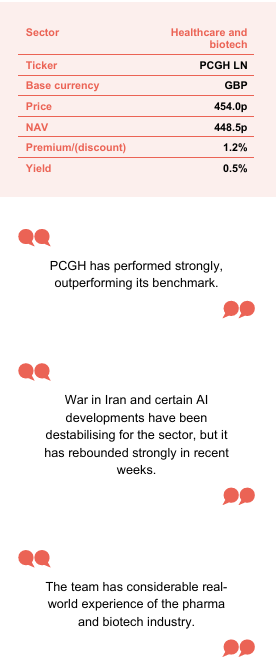
Polar Capital Global Healthcare (PCGH) has delivered strong returns and outperformed its benchmark, despite challenges including concerns over Donald Trump’s policies and strong gains in other sectors like technology. Shareholders showed confidence in the trust by backing its package of measures in November (which we covered in our last note here).
Since our last update, PCGH’s managers have made notable changes to sector weightings, especially by reducing exposure to healthcare equipment. They remain confident in the fundamental long-term strength of the healthcare sector.
Long-term capital growth from healthcare stocks
PCGH aims for long-term capital growth by investing in a wide range of healthcare companies globally. The portfolio covers different regions, healthcare sectors, and company sizes, allowing managers to invest flexibly across the global healthcare market.
At a glance
Share price and discount
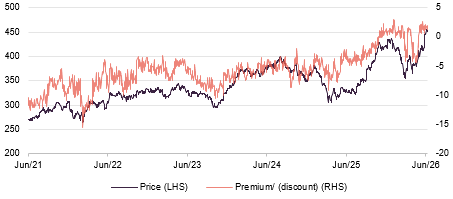
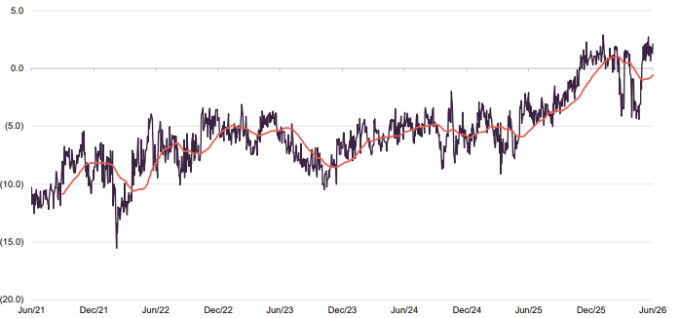
PCGH’s share price has increased significantly over the past five years, and returns over the last 12 months have been notably good. The discount has narrowed significantly, and has turned into a small premium most recently.
Time period 30 June 2021 to 07 July 2026
Performance over five years
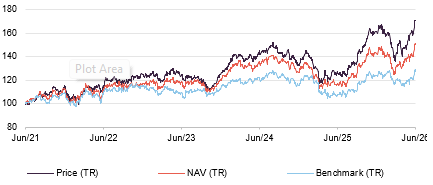
PCGH has delivered strong returns over the five years to 30 June 2026. Its share price total return was 71.3% and NAV total return 50.2%, comfortably ahead of the MSCI ACWI Healthcare index return of 27.6%.
Performance has also been strong over the past year, with the share price up 34.8% and NAV up 29.2%, compared to 19.4% for the benchmark.
Time period 30 June 2021 to 30 June 2026
| 12 months ended | Share price total return (%) | NAV total return (%) | MSCI ACWI Healthcare TR (%) | MSCI ACWI total return (%) |
|---|---|---|---|---|
| 30/06/2022 | 13.5 | 10.4 | 8.2 | (4.1) |
| 30/06/2023 | 10.0 | 7.5 | 1.2 | 12.2 |
| 28/06/2024 | 15.6 | 14.6 | 11.3 | 20.6 |
| 30/06/2025 | (11.8) | (14.5) | (12.3) | 7.6 |
| 30/06/2026 | 34.8 | 29.2 | 19.4 | 28.5 |
Market background – challenges, but the sector outlook remains strong
In our last note in November (which can be read here), we highlighted the long-term growth drivers for global healthcare, especially demographic shifts and rising spending in emerging markets. The PCGH managers continue to believe these trends are strong positives for the sector.
The US regulatory environment
The US regulatory environment under President Trump has been better than expected.
PCGH managers note that US regulation has been more stable than expected. Despite concerns after Donald Trump’s election and Robert Kennedy Jr’s appointment as health secretary, drug approvals continue at the Food and Drug Administration, with 46 approved in 2025. Key agency staff have remained, ensuring continuity. While vaccine uptake in the US has fallen, partly due to Kennedy’s scepticism, vaccines are only a small part of PCGH’s portfolio.
Drug-pricing risk has also lessened over the past year. The Trump administration’s push for “most-favoured-nation” pricing initially raised fears of sharp revenue cuts for US drug companies. However, the first major deal with Pfizer, which agreed to offer these prices to Medicaid and provide discounted drugs through the planned TrumpRx platform, has eased concerns about more aggressive changes. Other firms, including AstraZeneca, have since made similar agreements.
Reasons to be optimistic about the sector
The PCGH managers believe healthcare has strong prospects for several reasons:
Innovation – the sector continues to see strong progress, with 14 new drugs approved by the US Food and Drug Administration by mid-May. This steady flow of new products is vital as healthcare systems face pressure to improve access, efficiency and meet unmet needs. Innovation extends beyond medicines to include new delivery devices, diagnostics and technologies that improve care.
Consolidation – large pharmaceutical and biotech firms are dealing with patent expiries, driving the need for new products and revenue sources. Mergers and acquisitions have remained active in 2026, with several deals at significant premiums. This benefits smaller and mid-sized healthcare companies with valuable assets, especially in biotechnology, where PCGH has a larger exposure.
Rising healthcare utilization – demographic shifts, changing patient behaviour and clearing pandemic backlogs are boosting demand across healthcare services, distribution, equipment and facilities. Companies in these areas should benefit as higher volumes lead to stronger revenue and profit growth.
Easing of US policy concerns – US policy risk has weighed on healthcare valuations, but concerns have eased as the outlook becomes clearer. Medicare drug price negotiations have been more targeted than expected, and policymakers are also focusing on pharmacy benefit managers, not just drug manufacturers. This less severe policy environment could help improve sentiment towards the sector.
Slowing economic growth – healthcare’s defensive nature is appealing if economic growth slows. Demand for medicines, treatments, devices and services is less tied to the economic cycle, so revenues and earnings are likely to remain resilient even if consumer spending or industrial activity weakens.
Short-term challenges
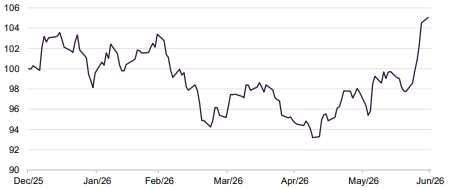
At the start of the year, short-term challenges around artificial intelligence and the Iran war affected sector performance, as shown in Figure 1. However, there has been a strong recovery in recent weeks.
Figure 1: MSCI ACWI Healthcare index year to date in sterling
Artificial intelligence
The release of Claude Desktop caused some concern in parts of the healthcare sector.
PCGH managers noted concerns in the healthcare sector after the release of Claude Desktop in February. The main worry was that advanced AI could reduce demand for outsourced research, data management and trial support by automating tasks within the healthcare services industry.
If AI can handle parts of clinical trial design, patient recruitment or regulatory processes, pharmaceutical and biotech companies may need less support from traditional contract research organisations (CROs). This has changed market sentiment, even though it is still unclear how much these tools will affect complex clinical trials, and any real impact will take time to appear.
CROs remain important for running clinical trials, offering specialist knowledge and global capabilities. While AI may boost productivity and change some workflows, it is uncertain how much it will replace specialist CROs.
This uncertainty led to a drop in sector valuations, with investors more cautious about companies seen as at risk from automation. This affected some of PCGH’s holdings, including ICON (see page 12).
War in the Middle East
War in Iran has been destabilising for the sector, but it has rebounded strongly in recent weeks.
Concerns about Claude Desktop were soon overshadowed by the American/Israeli-led war in Iran that began at the end of February. This conflict directly affected global trade, especially with the closure of the Strait of Hormuz. As a result, there were disruptions to the supply of sulphuric acid – half of the world’s supply passes through the strait – and helium, which is important for MRI machines.
Figure 2: US consumer price index (CPI), year to 31 May 2026
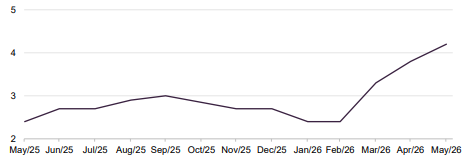
The main risk for the sector is that interest rates may stay higher for longer. As shown in Figure 2, since the war began, US inflation has surged, with May’s CPI at 4.2%, the highest in three years.
Rising inflation and a strong labour market have reduced expectations for interest rate cuts in the US and elsewhere. While most do not expect rates to rise soon, PCGH managers caution that if increases are needed, we could see a repeat of 2022, when higher rates led to falling prices for smaller healthcare companies as investors moved away from growth stocks. However, this is not the consensus view, and the sector has rebounded strongly in recent weeks.
Asset allocation
PCGH’s asset allocation has changed quite significantly since our last note.
PCGH has made notable changes to its sector allocation since November. Pharmaceuticals remain the largest allocation, and the underweight position compared to the benchmark has narrowed to 5.5%.
The fund has increased its weighting in healthcare services, now its second largest overweight sector. The overweight in biotechnology continues, with managers remaining positive about innovation in the field.
Exposure to healthcare equipment has dropped sharply from 24.2% to 7.7%, shifting from a strong overweight to a clear underweight. Managers are concerned about slower growth, fewer new products and high company valuations. They will keep this position under review, as mergers and acquisitions could help some companies and recent share price declines may offer opportunities.
Figure 3: Portfolio by sector as at 31 May 2026
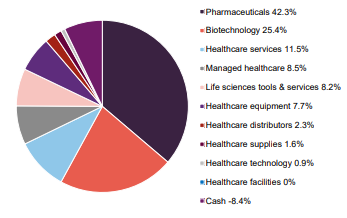
Figure 4: Portfolio sector weights relative to benchmark as at 31 May 2026
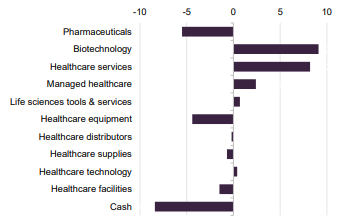
The portfolio’s cash position has shifted from a small net positive to an 8.4% net negative, reflecting PCGH’s current borrowing. This shows the managers’ confidence in the opportunities they see in the wider healthcare sector.
Figure 5: Portfolio by country as at 31 May 2026
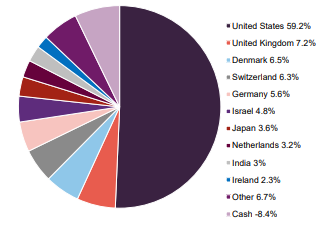
Figure 6: Portfolio country weights relative to benchmark as at 31 May 2026
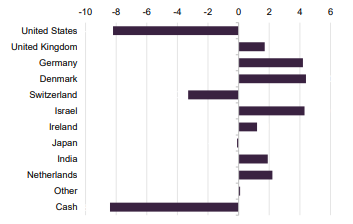
PCGH’s country weightings have changed, but less so than sector weightings, mainly due to individual stock choices rather than broader country views.
The US is still the largest country in the portfolio, though it remains underweight compared to the index. Germany has risen from eighth to fifth in weighting. Denmark has dropped from second to third, but is still the biggest overweight relative to the index.
Top 10 holdings
PCGH’s top 10 holdings have changed notably since November. Roche, UnitedHealth Group, CVS Health, Cigna Corp, Novo Nordisk and Merck are now included, replacing Abbott Laboratories, UCB, Genmab, Sandoz, Exact Sciences and Edwards Lifesciences. These shifts mainly reflect the updated sector allocations. Abbott Laboratories, a healthcare equipment firm, has been replaced by UnitedHealth, CVS Health and Cigna Corp, all in healthcare services. The top 10 now includes six pharmaceuticals companies, up from five before.
Figure 7: PCGH 10 largest holdings as at 31 May 2026
| Stock | Sector | Country | % at 31/05/26 | % at 30/09/25 | % change |
|---|---|---|---|---|---|
| Eli Lilly | Pharmaceuticals | United States | 9.5 | 7.1 | 2.4 |
| Roche | Pharmaceuticals | Switzerland | 6.3 | – | 6.3 |
| UnitedHealth Group | Healthcare services | United States | 6.1 | – | 6.1 |
| AstraZeneca | Pharmaceuticals | United Kingdom | 5.5 | 6.1 | (0.6) |
| Thermo Fisher Scientific | Life sciences tools and services | United States | 4.9 | 3.4 | 1.5 |
| Teva Pharmaceuticals | Pharmaceuticals | Israel | 4.8 | 3.3 | (1.5) |
| CVS Health | Healthcare services | United States | 4.4 | – | 4.4 |
| Cigna Corp | Healthcare services | United States | 3.7 | – | 3.7 |
| Novo Nordisk | Pharmaceuticals | Denmark | 3.6 | 2.3 | 1.3 |
| Merck KGaA | Pharmaceuticals | Germany | 3.4 | – | 3.4 |
| Total | 52.2 |
Figure 8: Roche (CHF)
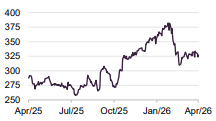
Roche
Roche (roche.com) is a Swiss company focused on medicines and diagnostic tests, with strong positions in pharmaceuticals, cancer, immunology, eye care and diagnostics.
PCGH managers invested in Roche following positive early-stage breast cancer drug data and hopes for more promising pipeline updates.
In the first quarter of 2026, Roche reported 6% sales growth at constant exchange rates. Pharmaceutical sales rose 7% and diagnostics 3%, driven by strong demand for key drugs like Xolair, Phesgo, Hemlibra, Vabysmo and Ocrevus. This helped offset competition from biosimilars and the impact of a strong Swiss franc. However, shares fell earlier this year after disappointing results from a Phase 3 trial of the oral breast cancer drug Giredestrant.
Figure 9: UnitedHealth Group (USD)
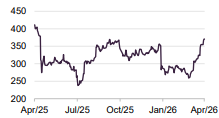
UnitedHealth Group
UnitedHealth Group (unitedhealthgroup.com) is a US healthcare and insurance company operating through UnitedHealthcare (health benefits) and Optum (healthcare services, data, pharmacy, and care delivery). Its addition by PCGH’s managers significantly increased the portfolio’s healthcare services exposure compared to the index.
In the first quarter of 2026, UnitedHealth reported revenues of $111.7bn and operating earnings of $9.0bn. Despite higher medical costs, regulatory scrutiny and concerns about Medicare Advantage, the company remains highly cash generative and resilient.
Figure 10: CVS Health (USD)
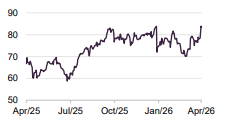
CVS Health
CVS Health (cvshealth.com) is a healthcare company offering pharmacy services, pharmacy benefit management, health insurance, and retail healthcare.
Recent results show improvement in its Aetna health insurance business. CVS reported first-quarter 2026 revenues of $100.4bn, up 6.2% from last year, and raised its full-year outlook after strong performance in Health Care Benefits and Pharmacy & Consumer Wellness. This progress addresses earlier worries about rising medical costs, insurance margins and the challenges of managing its broad healthcare platform.
Figure 11: Cigna Corp (USD)
Cigna Corp
Cigna Corp (thecignagroup.com) is a global health company with two main businesses: Cigna Healthcare, which offers health benefits, and Evernorth Health Services, which provides pharmacy, care, and benefits services.
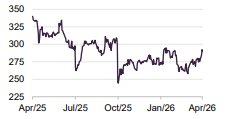
PCGH’s managers see Cigna as good value and note it is working to lower political risks in its pharmacy benefit management business. The market seems to expect cautious earnings for 2026 and 2027.
In the first quarter of 2026, Cigna’s revenues rose 5% to $68.5bn, and adjusted operating income grew to $2.1bn, or $7.79 per share. The company has raised its 2026 outlook for adjusted operating income to at least $30.35 per share, driven by disciplined execution and growth across its platform.
Figure 12: Novo Nordisk (DKK)
Novo Nordisk
Novo Nordisk (novonordisk.com) is a Danish company specialising in treatments for diabetes, obesity and other serious chronic diseases, including GLP-1 therapies.
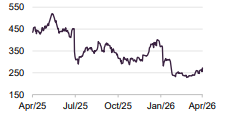
It remains a global leader with products like Ozempic and Wegovy, but investor expectations have risen following strong growth. Recent updates show high demand for obesity treatments, but also highlight challenges such as competition, pricing pressures and the need to increase supply.
Shares have been weak recently, which PCGH managers attribute to disappointing 2026 guidance and underwhelming late-stage obesity data for CagriSema, its injectable therapy for weight loss and type 2 diabetes.
Figure 13: Merck KGaA (EUR)
Merck KGaA
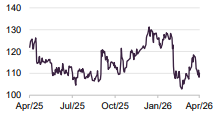
Merck KGaA (merckgroup.com) is a German science and technology company active in life science, healthcare and electronics. Its healthcare division covers medicines for cancer, neurology and immunology, while the wider group provides products for drug discovery and manufacturing, as well as materials for semiconductors and displays.
In the first quarter of 2026, Merck reported net sales of €5.1bn and organic growth of 2.9%. Growth was driven by Process Solutions in life sciences and semiconductor materials, though currency movements were a drag. Merck raised its full-year 2026 outlook, citing stronger life science momentum and steady healthcare performance. However, the company still faces challenges from currency effects and patent issues in parts of its healthcare business.
Performance
Figure 14: PCGH NAV total return performance relative to benchmark to 30 June 2026
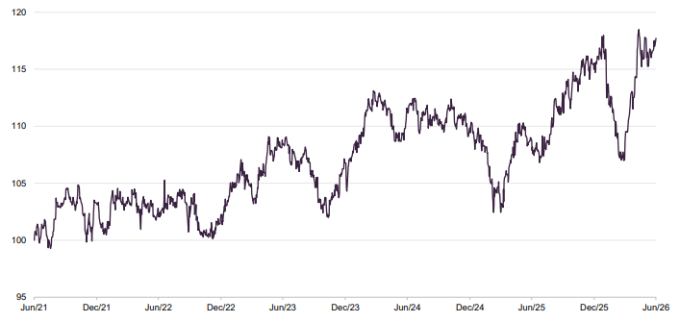
Despite a challenging sector backdrop, PCGH’s managers have delivered returns well ahead of the benchmark over the past five years, as shown in Figure 14.
Figure 15: Total return performance for periods ending 30 June 2026
| 3 months (%) | 6 months (%) | 1 year (%) | 3 years (%) | 5 years (%) | Since 31 July 2019 (%) | |
|---|---|---|---|---|---|---|
| PCGH price | 26.0 | 5.9 | 34.8 | 37.3 | 71.3 | 104.2 |
| PCGH NAV | 18.3 | 5.0 | 29.2 | 26.5 | 50.2 | 84.8 |
| Benchmark | 7.6 | 2.9 | 19.4 | 16.5 | 27.6 | 61.6 |
| MSCI ACWI | 16.7 | 12.8 | 28.5 | 66.7 | 79.3 | 127.2 |
| NASDAQ Biotech | 17.2 | 16.2 | 61.7 | 58.1 | 38.1 | 91.6 |
Over one, three and five years, and since launch, both PCGH’s NAV and share price have outperformed the benchmark, as shown in Figure 15.
Top contributors
Figure 16: Top positive contributors to return relative to benchmark five months to 31 May 2026
| Stock | Average stock weight (%) | Active weight (%) | Stock return (%) | Stock return versus benchmark (%) | Contribution (%) |
|---|---|---|---|---|---|
| Roivant Sciences | 2.52 | 2.52 | 37.93 | 41.16 | 0.92 |
| CVS Health | 4.50 | 3.27 | 16.37 | 19.6 | 0.78 |
| Boston Scientific Corp | 0.00 | (1.29) | (49.43) | (46.21) | 0.77 |
| Centene Corp | 2.56 | 2.30 | 44.55 | 47.78 | 0.72 |
| Abbott Laboratories | 0.00 | (2.21) | (31.04) | (27.81) | 0.72 |
Roivant Sciences (roivant.com) is a biopharma company that develops and sells medicines through its “Vant” model of subsidiaries. Its share price has benefited from clinical and business progress, including positive results in tough-to-treat rheumatoid arthritis. Roivant also reached a $2.25bn global settlement with Moderna over Genevant and Arbutus patent disputes.
Centene Corp (centene.com) is a US healthcare company focused on government-backed health insurance like Medicaid, Medicare and the Health Insurance Marketplace. Its share price rose after a strong start to 2026, with first-quarter revenue up 7% to $49.9bn. This was helped by better Medicaid margins, lower-than-expected medical costs in Medicare and higher premium income.
CVS Healthcare is discussed earlier in the report (see page 9).
Figure 16 shows that the top five positive contributors year-to-date versus the benchmark include two stocks not held by PCGH, which performed poorly. Boston Scientific cut its full-year guidance, while Abbot Laboratories lowered its earnings outlook and reported weaker performance in some areas of its medtech business.
Figure 17: Top negative contributors to return relative to benchmark five months to 31 May 2026
| Stock | Average stock weight (%) | Active weight (%) | Stock return (%) | Stock return versus benchmark (%) | Contribution (%) |
|---|---|---|---|---|---|
| iRhythm Technologies | 2.19 | 2.19 | (35.94) | (32.71) | (0.95) |
| Johnson & Johnson | 0.00 | (6.77) | 9.87 | 13.10 | (0.75) |
| ICON | 0.97 | 0.97 | (25.47) | (22.25) | (0.75) |
| Fresenius SE | 3.07 | 2.79 | (23.99) | (20.77) | (0.60) |
| Merck & Co | 0.00 | (3.49) | 13.40 | 16.62 | (0.50) |
iRhythm Technologies (irhythmtech.com) fell despite ongoing demand for its Zio cardiac monitoring platform. The share price was hit by weaker sentiment towards high-growth healthcare technology and ongoing concerns about regulatory and legal issues with its Zio AT system.
ICON (iconplc.com) was affected by market volatility following the release of Claude Desktop and also announced an internal review into accounting issues, withdrawing its outlook. Although the possible revenue overstatement was small, it hurt investor confidence and added pressure to contract research organisation stocks.
Fresenius SE (fresenius.com) dropped after its 2026 outlook missed market expectations, with core earnings growth below forecasts. Although Kabi and Helios continued to make progress, investor caution remained due to uncertainty over the group’s turnaround, despite improving cash flow and debt reduction.
PCGH underperformed by not holding Johnson & Johnson and Merck & Co, both of which performed strongly. Johnson & Johnson raised its guidance, while Merck & Co benefited from steady demand for Keytruda and confidence in its broader pharmaceutical pipeline, despite ongoing concerns about its reliance on the cancer drug.
Premium/(discount)
Over the 12 months to 30 June 2026, PCGH’s share price ranged from a 5.0% discount to NAV to a 2.9% premium, averaging a 1.1% discount. As of 8 July 2026, PCGH was trading at a 1.2% premium, a rare occurrence among investment trusts in recent years.
The discount narrowed in Q2 and Q3 2025, likely due to anticipation of new five-yearly tender offers. After these offers removed loose shareholders, the discount tightened further. When PCGH moved to a premium at the end of 2025, the board was able to reissue equity. This is a rare achievement for any investment trust recently. A total of 6,073,026 shares were issued between 18 December and 20 April.
Figure 18: PCGH premium/(discount) over five years ended 30 June 2026
The board plans to use share buybacks to help manage discount volatility, aiming to keep the discount within a narrow range.
At each AGM, PCGH shareholders are asked to approve issuing up to 10% of share capital and repurchasing up to 14.99%.
Fund profile
PCGH aims for capital growth by investing in a global mix of healthcare stocks, diversified by region, industry, and investment size.
More information is available on the trust’s website polarcapitalglobalhealthcaretrust.co.uk
Launched in 2010 as Polar Capital Global Healthcare Growth and Income Trust, it initially issued ordinary and subscription shares. All subscription shares were exercised in July 2014, which affected NAV returns for that period.
In June 2017, the trust was restructured and renamed. Around 26.3 million shares were bought back and 27.8 million new shares were issued. The company also issued zero dividend preference shares, maturing in early 2025.
Regular five-yearly exit opportunities
As covered in our November 2025 note, PCGH proposed lower fees, a better structure, and regular five-yearly 100% exit opportunities. These changes received strong shareholder support. At the first five-yearly exit, 27,253,026 shares representing 22.47% of the issued share capital (excluding treasury shares) were validly tendered. The next chance for investors to exit will be in 2030.
The team has considerable real-world experience of the pharma and biotech industry
Polar Capital LLP acts as PCGH’s investment manager and AIFM, with James Douglas and Gareth Powell as lead managers. The team brings significant experience from the pharma and biotech sectors, supporting informed investment decisions.
PCGH measures its performance against the total return of the MSCI ACWI Healthcare Index in sterling.
SWOT analysis
Figure 19: SWOT analysis for PCGH
| Strengths | Weaknesses |
| Strong NAV and share price performance relative to its benchmark, despite a challenging outlook for the sector. | PCGH is in a sector which has recently been out of favour with investors, and there is no guarantee that this will change. |
| The recent shareholder-friendly reforms have been well received, and set the trust up strongly for the long term. | |
| Opportunities | Threats |
| With the sector being out of favour, PCGH holds a number of high-quality companies with undemanding valuations. If sentiment shifts, absolute performance could be very strong. | The sector may remain out of favour, particularly if the wider AI-driven tech rally continues. |
| With the sector being out of favour, PCGH holds a number of high-quality companies with undemanding valuations. If sentiment shifts, absolute performance could be very strong. | The shares trade at a premium, and may revert to a discount in time. |
Bull vs bear case
Figure 20: Bull vs bear case for PCGH
| Bull | Bear | |
| Performance | Both NAV and share price performance have been consistently ahead of the benchmark, illustrating a strong record of stock picking from PCGH’s managers. | The wider healthcare sector’s performance has been disappointing recently, and this could continue if inflation and interest rate expectations increase. |
| Dividends | Shareholders receive a modest dividend, totalling 2.4p in both 2024 and 2025. | The trust is primarily focused on capital returns, so may not be suitable for income investors. |
| Outlook | PCGH invests in an out-of-favour sector where sentiment could turn quickly. If it does, its record of strong stock picking should stand it in good stead. | There may be further developments that keep the sector unloved, from AI disruption to geopolitical developments. |
| Discount | PCGH is currently trading on a small premium. This is a testament to both performance and recent reforms, and could be sustained. | The premium could turn into a discount. The trust has tended to trade on a discount in recent years. |
Previous publications
For more information about PCGH, you can read our earlier notes by selecting them in Figure 21 or visiting our website.
Figure 21: QuotedData’s previously published notes on PCGH
| Title | Note type | Publication date |
|---|---|---|
| Healthy returns and a rosy outlook | Initiation | 5 March 2024 |
| Vital signs are good | Update | 14 November 2024 |
| Recovery Play | Update | 20 August 2025 |
| Decision time | Update | 12 November 2025 |
IMPORTANT INFORMATION
Marten & Co (which is authorised and regulated by the Financial Conduct Authority) was paid to produce this note on Polar Capital Global Healthcare Trust Plc.
This note is for information purposes only and is not intended to encourage the reader to deal in the security or securities mentioned within it.
Marten & Co is not authorised to give advice to retail clients. The research does not have regard to the specific investment objectives financial situation and needs of any specific person who may receive it.
The analysts who prepared this note are not constrained from dealing ahead of it but, in practice, and in accordance with our internal code of good conduct, will refrain from doing so for the period from which they first obtained the information necessary to prepare the note until one month after the note’s publication. Nevertheless, they may have an interest in any of the securities mentioned within this note.
This note has been compiled from publicly available information. This note is not directed at any person in any jurisdiction where (by reason of that person’s nationality, residence or otherwise) the publication or availability of this note is prohibited.
Accuracy of Content: Whilst Marten & Co uses reasonable efforts to obtain information from sources which we believe to be reliable and to ensure that the information in this note is up to date and accurate, we make no representation or warranty that the information contained in this note is accurate, reliable or complete. The information contained in this note is provided by Marten & Co for personal use and information purposes generally. You are solely liable for any use you may make of this information. The information is inherently subject to change without notice and may become outdated. You, therefore, should verify any information obtained from this note before you use it.
No Advice: Nothing contained in this note constitutes or should be construed to constitute investment, legal, tax or other advice.
No Representation or Warranty: No representation, warranty or guarantee of any kind, express or implied is given by Marten & Co in respect of any information contained on this note.
Exclusion of Liability: To the fullest extent allowed by law, Marten & Co shall not be liable for any direct or indirect losses, damages, costs or expenses incurred or suffered by you arising out or in connection with the access to, use of or reliance on any information contained on this note. In no circumstance shall Marten & Co and its employees have any liability for consequential or special damages.
Governing Law and Jurisdiction: These terms and conditions and all matters connected with them, are governed by the laws of England and Wales and shall be subject to the exclusive jurisdiction of the English courts. If you access this note from outside the UK, you are responsible for ensuring compliance with any local laws relating to access.
No information contained in this note shall form the basis of, or be relied upon in connection with, any offer or commitment whatsoever in any jurisdiction.
Investment Performance Information: Please remember that past performance is not necessarily a guide to the future and that the value of shares and the income from them can go down as well as up. Exchange rates may also cause the value of underlying overseas investments to go down as well as up. Marten & Co may write on companies that use gearing in a number of forms that can increase volatility and, in some cases, to a complete loss of an investment.