
‘At the foothills of an AI mountain’
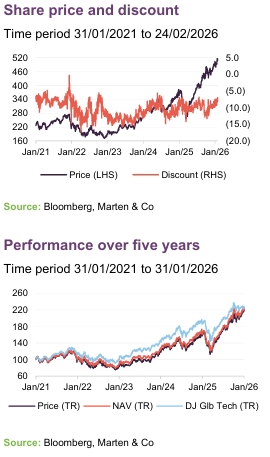
Over the past 12 months, Polar Capital Technology (PCT) has posted NAV total return almost double that of the Dow Jones Global Tech Index. Its manager says the results highlight the payoff from its maximalist strategy in AI. The company has taken comparatively large positions in companies that its manager believes will benefit from bottlenecks in the AI infrastructure supply chain, and sold others that the manager considers to be less favourably positioned.
This appears to have been a factor in its recent returns, with the fund emerging relatively unscathed as markets retrenched at US mega-cap stocks’ enlarged 2026 capex plans. Whilst commentators continue to debate whether the sector is in a bubble, PCT’s manager states that AI is only at the early stages of its development, citing advancements in innovation (such as Alphabet’s Gemini 3 model launch) and the rapid growth in enterprise adoption, which it believes may accelerate with agentic AI.
Global growth from tech portfolio
PCT aims to achieve long-term capital growth by investing in a diversified portfolio of technology companies globally, with diversification across regions and sectors within the overall investment objective to reduce investment risk.
| Year ended | Share price TR (%) | NAV total return (%) | DJ Global Tech TR (%) | MSCI ACWI TR (%) | MSCI UK TR (%) |
|---|---|---|---|---|---|
| 31/01/2022 | 1.9 | 5.8 | 16.3 | 16.0 | 22.7 |
| 31/01/2023 | (18.3) | (15.7) | (13.2) | 0.8 | 9.5 |
| 31/01/2024 | 42.1 | 38.4 | 40.6 | 11.7 | 2.2 |
| 31/01/2025 | 35.2 | 33.2 | 33.7 | 23.7 | 16.0 |
| 31/01/2026 | 36.9 | 34.2 | 18.3 | 11.3 | 23.9 |
Fund profile
More information can be found at the trust’s website: www.polarcapitaltechnologytrust.co.uk
PCT aims to achieve long-term capital growth by investing in a diversified portfolio of technology companies globally, with diversification across regions and sectors. PCT was launched as Henderson Technology Trust in December 1996 and, following a change of manager, became Polar Capital Technology Trust in April 2001.
Hear about the fund
Management arrangements
PCT’s AIFM is Polar Capital LLP and the lead manager assigned to the trust is Ben Rogoff, a partner in Polar Capital LLP. He is supported by a team of 11 technology specialists, including another partner, Nick Evans, and deputy fund manager Alastair Unwin. Polar believes that this is one of the best-resourced teams dedicated to this sector within Europe. In addition to PCT, the team also manages two open-ended funds, Polar Capital Global Technology Fund and the Artificial Intelligence Fund. Collectively, these funds had AUM of $19.5bn at 31 December 2025.
Ben joined the team from Aberdeen in 2003, having started his career in the years leading up to the technology boom. According to Ben, the events surrounding the collapse of the tech bubble have influenced the way in which he manages money. He states that one lesson is that there may be limited permanence in the technology sector, which is engaged in a process of creative disruption. Ben believes that change in the sector is a non-linear process, where companies that were once large can disappear and smaller companies can become larger.
Nick joined the team from Framlington in 2007. Nick is described as having a more bottom-up approach to selecting stocks, whereas Ben is described as having a bias to a top-down stance.
Market overview
Maximalist approach seen PCT prosper from AI supply chain bottlenecks
PCT’s manager Ben Rogoff says that we should expect pace of change in the AI sector to be rapid, as noted in previous reports on the company. According to Ben, adopting an AI “maximalist” approach means that he and his team think differently to other tech fund managers, aiming to identify trades and themes early. An example he cites is PCT’s increasing exposure to power and networking companies from 2024 and to hard disk drive and memory companies in 2025. He says that both were intended to address supply and demand imbalances and bottlenecks in the AI infrastructure rollout, and he believes this theme has a lot further to run across multiple sectors.
Figure 1: Caterpillar
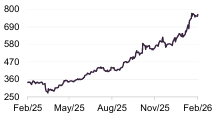
A recent example of PCT’s approach was its investment in construction equipment manufacturer Caterpillar, which is not typically considered a technology company. PCT took a starter position in Caterpillar in October 2025, as it appeared that the company’s industrial generators could provide a solution to a lack of supply of turbines to power data centres. Caterpillar is also active in the copper industry, not as a direct miner, but as a manufacturer of surface and underground mining equipment used to extract copper and other metals such as gold, lithium, and iron ore.
Ben says that the Caterpillar trade “illustrates the bleeding edge of where PCT and the AI investment landscape are”. He describes this as being “an active, active manager”, adding that PCT’s investment process and large, experienced team provide the necessary resources for a high-turnover portfolio.
Active, active
PCT’s manager contends that being an active manager may not be sufficient when investing in AI. According to Ben, the sector is moving at a pace that requires a large team with an understanding of the eco-system, the threats and opportunities, and a high level of conviction in their approach. The manager states that the scope for AI disruption appears to be increasing as new fields are drawn in, and that a degree of risk-taking may be necessary to seek out new frontiers.
AI bull and bear cases are increasingly appearing, and Ben says that an “active, active approach” may result in stocks being removed at the first indication of an AI bear case, potentially to the benefit of companies with perceived AI bull cases. Both scenarios can move a stock into a different range; for example, Caterpillar’s valuation appeared expensive on traditional metrics but, when considering its copper and mining exposure, it appeared less expensive compared to diversified industrials. The manager expects turnover within PCT’s portfolio to remain elevated as the market backdrop remains fluid.
PCT’s recent trades appear to reflect the shift of AI capex from planning stages to implementation, raising questions such as: “how is the infrastructure needed going to keep up with demand?”, “where are bottlenecks being created due to this supply-demand imbalance?”, and “how are solutions going to be found?”
Power remains number one infrastructure bottleneck
According to the manager, the main bottleneck appears to be powering data centres. Goldman Sachs forecasts that global power demand from data centres will increase 50% by 2027 and by as much as 165% by the end of the decade (compared with 2023). There continues to be uncertainty, but PCT’s manager says that their null hypothesis is that capitalism will find a way to resolve the power squeeze, including through imperfect solutions.
Optical networking, which links remote data centres through fibre-optic cables, is one area that PCT’s manager is excited by. Ciena, a PCT holding, recently returned to the S&P 500 index after a 17-year absence. Its shares have almost tripled in the past year, which the manager attributes to increased demand from cloud providers. Details on Ciena and another optical networking holding, Lumentum (whose share price has risen 850% in the last year), are provided on page 13.
Bubble fears grow on capex upgrades
Hyperscaler 2026 capex plans 60% up on 2025
Mega-cap US tech stocks declined at the beginning of February after several leading companies announced increased capital expenditure plans for this year. Quarterly earnings updates provided estimates for the proposed 2026 outlay on data centres and specialist chips from the top four hyperscalers (Alphabet, Amazon, Meta and Microsoft) at $660bn – a 60% rise on 2025 spend and a 165% increase from 2024.
Figure 2: Hyperscaler capex announcements ($bn)
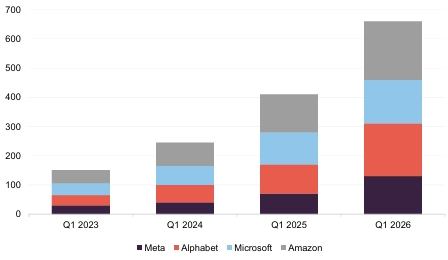
In quarterly earnings updates, Amazon announced that it plans to spend $200bn this year ($50bn more than expected), Alphabet between $175bn and $185bn (against expectations of $115bn), Meta between $115bn and $135bn (above the $110bn expected), and Microsoft around $150bn (based on quarterly capex of $37.5bn). All four said that these large sums were needed to position them for a potential increase in demand related to AI.
Shares in US mega-cap stocks taken a hit
Investors appeared to react negatively to the capex plans, with Microsoft down 19% since the turn of the year and the other three also down. This is illustrated in Figure 3, which shows the Dow Jones Global Technology Index losing momentum. Figure 4 suggests that investors may have moved into other sectors at the expense of tech stocks.
Figure 3: Dow Jones Global Technology Index1
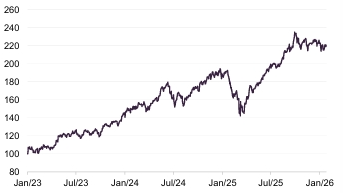
31 January 2023.
Figure 4: Dow Jones Global Technology index relative to MSCI ACWI1
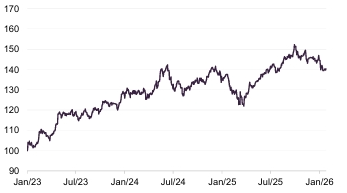
31 January 2023.
This has coincided with the reporting of large annual revenue increases from the megacap tech companies. For example, Meta reported revenue growth of 24% year-on-year in the fourth quarter, Alphabet 18%, Microsoft 17%, and Amazon 12% (with Amazon Web Services up 24% year-on-year).
PCT’s manager believes that data centre financing needs for 2026 can be funded from hyperscaler cashflows and investment grade bond markets, estimating that Alphabet, Amazon, Meta and Microsoft have $700bn of additional capacity based on 1x net debt to 2026 EBITDA and $1.45trn based on 2x. The manager adds that, looking further ahead, combined operating cashflows could reach $1.1trn by 2029 and may help cover future capex requirements.
According to PCT’s manager, the capex numbers reflect capacity constraints across the sector, both currently and incorporating future expectations. It believes these companies are aware of the potential for oversupply and that they intend to proceed cautiously. The manager also believes that increased enterprise demand for AI has accelerated, and may accelerate further with the launch of upgraded Agentic AI models such as the recently released Claude Cowork from Anthropic, and that wider adoption rates are continuing. The manager thinks this more than justifies the increased capex.
Here are some examples of AI adoption among different platforms:
- Weekly average users of OpenAI’s ChatGPT were 900m as of January 2026, up from 300m in mid-2025, while the company had more than 5 million paying business users in August 2025, up from 3 million in June 2025.
- Microsoft processed over 500 trillion tokens (units of data processed by AI models) served by Foundry APIs in 2025, up 7x year-on-year.
- Alphabet processed over 1.3 quadrillion tokens across its AI services in September 2025 (before the launch of Gemini 3, which Alphabet states consistently processes 3x as many daily tokens on average as its predecessor). This was up from a monthly run-rate of 980 trillion tokens in June 2025 and 480 trillion tokens in April 2025. Meanwhile, its Gemini app had more than 750 million monthly average users at the end of December 2025 compared to 450 million in July 2025.
Figure 5: Progression of monthly tokens processed by Alphabet
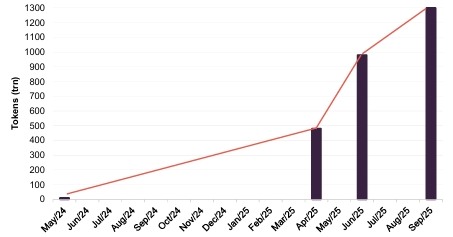
OpenAI ARR increased to $20bn in December
OpenAI’s annual recurring revenue (ARR) increased over 2025 from $6bn in January to more than $20bn in December. Anthropic’s ARR increased from $1.5bn at the start of the year to more than $7bn by October, with market estimates suggesting $9bn by the year end.
OpenAI reached $10bn ARR less than three years after the launch of ChatGPT, and Anthropic is projected to reach the same milestone in four years. This compares to eight years at Google and 10 years at Meta. OpenAI’s revenue projections have increased to $100bn in 2028, up from $86bn previously. Anthropic is projecting $40bn revenue in 2027 and $70bn in 2028.
PCT’s manager believes the launch of Claude Cowork in January may mark the beginning of increased adoption and demand for agentic AI (AI that goes beyond just responding to prompts and queries and moves on to designing and creating systems that can run autonomously to perform tasks and automate workflows) across most sectors, which could lead to increased demand for inference tokens. The manager states that this may be influenced by the potential for productivity gains and earnings growth, referencing a Goldman Sachs estimate of a 10% to 30% earnings per share boost from full AI adoption to most S&P 500 sectors.
The manager contends that some sectors may need to use AI to remain competitive. Coding is cited as an example, where the manager comments that around 30% to 40% of code is now written by AI. Call centres are another example, where the manager believes it is now generally accepted that half of inbound calls should be dealt with by AI. The manager expects use cases to continue to expand across sectors and industries.
Valuations in line with seven-year average
The manager believes that the debate around whether the market has entered a bubble should be considered in this context. Although valuations are elevated, the manager considers them reasonable, with the S&P IT sector trading at around 26 times forward earnings, 1.2 times the wider S&P 500 index, and with NASDAQ trading at around 25 times – in line with its seven-year average. According to the report, most of the performance in recent years appears to have been driven by fundamental growth rather than higher market valuations.
The manager also points out that, unlike previous booms, the IPO market has so far been subdued, although it expects this may change with both OpenAI and Anthropic rumoured to be considering the prospect of an IPO, possibly as early as this year.
Whilst macro uncertainty remains elevated and geopolitical tensions persist, with concerns being raised over the future independence of monetary policy in the US after President Trump announced Kevin Warsh as his nominee for the next Fed chair, PCT’s manager insists that it is unlikely to unsettle the AI growth story.
The US labour market appeared to cool in 2025, which may have helped ease inflationary pressures, with CPI in January below expectations at 2.4%. A further easing of monetary policy may follow in 2026, following the 25bps rate cut in December that lowered the federal funds target range to 3.5% to 3.75% (the lowest level since 2022).
PCT’s manager maintains a strong conviction that the AI bull market has further potential, citing the Fed cutting rates, double-digit earnings growth, and the early stage of AI infrastructure development.
Investment process
PCT’s management team (profiled on page 16) conducts many hundreds of meetings a year with both portfolio and prospective companies. The team uses surveys and communicates with domain experts to cross-reference customer opinions of products, where appropriate.
Identify companies that can earn super-normal profits
The manager selects from a universe of more than 4,000 stocks and aims to construct a diversified portfolio with about 100 stocks in aggregate. These are intended to represent opportunities within the investment themes that the manager has identified and are selected based on price considerations. The team examines the value chain and identifies areas where it may be possible to generate higher-than-average profits and recurring revenue.
According to the manager, the stocks selected for the portfolio are expected to generate 30% to 50% higher growth than the average stock in the benchmark index, and the manager is prepared to pay approximately 20% to 30% more than the benchmark, on average, for this growth.
Valuation is a secondary consideration
According to the manager, there is little merit in first screening for value. Instead, it prefers to consider which companies PCT should have exposure to, and only then determine the price that is acceptable. The team is more likely to screen for improving business fundamentals or for stocks that may have been missed at the periphery of PCT’s investment universe, which may not currently be perceived as tech stocks but could be in the future. The process includes considering the potential downside in a stock. For many of these stocks, missing an earnings forecast may have a significant negative impact on their rating.
PCT’s manager acknowledges that it may miss out on the odd stock as a result but believes that this is an acceptable price to pay for avoiding the worst of the downside.
Sell discipline
The manager states that it is important to maintain investments that are performing well, but also to sell when an investment thesis does not develop as anticipated. According to the manager, fair value may change over time and the potential upside and downside from any position should be reassessed regularly. The team maintains a bull, bear and base case for each stock, assigning a weighted probability to each scenario.
Holdings will be trimmed as they approach the team’s target price. Sometimes Ben may hold onto a small position in a stock that he believes it is important to stay in touch with. The ability to have exposure to this type of opportunity is a feature of PCT’s closed-end structure.
Portfolio construction
PCT aims to manage its risk relative to the benchmark
According to the manager, PCT is managed with a focus on risk. The fund is designed to target 3%+ annual outperformance versus its benchmark after fees on a consistent basis, with a typical active share of 40–50%. The manager states that the fund rarely makes large stock-level allocations, instead seeking to add value by avoiding companies perceived as higher risk (such as mature or early-stage companies) and by identifying secular themes that are considered important, allocating between them where value is believed to be most compelling. As a result, PCT holds around 100 stocks. The manager believes that, while other funds with different risk profiles may perform better over shorter periods, this risk-adjusted and diversified approach could allow PCT to outperform over the medium to longer term.
From time to time, a small number of stocks may account for a significant proportion of the benchmark index. The board permits the manager to take a neutral position in any stock that represents more than 10% of the index (up to a maximum of 20% of the portfolio), but PCT is not permitted to have an overweight exposure to these companies.
PCT is not a closet-tracking fund. According to the manager, if the manager does not favour a company, PCT will have no exposure to it, regardless of its weight within the benchmark (see Figure 10).
Typically, the maximum exposure to a stock is a 3.0%-3.5% active weighting. The portfolio’s active share has ranged from about 30% to just over 50% at maximum.
Investment in emerging markets is permitted, but this is capped at 25% of gross assets. The board has also given the following indicative ranges for PCT’s asset allocation:
- North America up to 85%;
- Europe up to 40%;
- Japan and Asia up to 55%; and
- rest of the world up to 10%.
It has set specific upper exposure limits for certain countries where it believes there may be an elevated risk.
The remit allows investment in unquoted companies, subject to prior board approval and capped at 10% of gross assets. In practice, this option has not been used.
Asset allocation
At the end of January 2026, there were 98 stocks in PCT’s portfolio (compared to 97 six months ago). The portfolio’s active share is near recent highs at 49%, which the manager attributes to larger individual stock positions. The manager states that he is comfortable having zero weightings in index names when he believes that their growth prospects do not merit their inclusion within the portfolio.
Cash and equivalents, which includes puts on the Nasdaq, were 5.0% of the portfolio at the end of January.
Figure 6: Geographic exposure at 31 Jan 2026
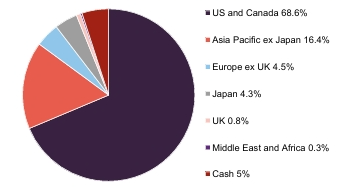
Figure 7: Sector exposure at 31 Jan 2026
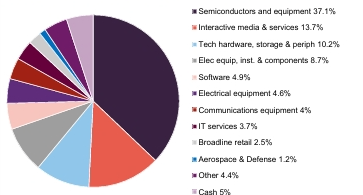
The manager does not seek to add value through geographic asset allocation. PCT’s exposure to the US has decreased over the past six to 12 months, while exposure to Asia Pacific has increased. In Figure 7, the largest change has been an increase in exposure to hardware and storage and a decrease in software. The manager believes that the AI cycle is primarily a hardware rather than a software cycle.
Top 10 holdings
There have been a couple of changes to the constituents of PCT’s top 10 holdings since the previous note, with LAM Research and Samsung entering and Oracle and Cloudflare leaving. According to the manager, Oracle had moved into the top 10 after a position was built based on its sovereign cloud business, but the position has since been exited due to financing concerns. There have also been some notable changes to position sizes, as shown in Figure 8.
Figure 8: Profile of top 10 holdings at 31 January 2026
| Company | Country | Mkt cap ($bn)1 | % of NAV 31/01/26 | % of NAV 31/07/25 | Change(%) |
|---|---|---|---|---|---|
| NVIDIA | US | 4,442 | 9.7 | 12.5 | (2.8) |
| Alphabet | US | 3,698 | 8.8 | 3.3 | 5.5 |
| Taiwan Semiconductor | Taiwan | 1,898 | 5.4 | 4.2 | 1.2 |
| Meta Platforms | US | 1,618 | 4.4 | 6.7 | (2.3) |
| Apple | US | 3,755 | 4.3 | 3.0 | 1.3 |
| Microsoft | US | 2,980 | 4.1 | 8.4 | (4.3) |
| Broadcom | US | 1,542 | 3.8 | 5.6 | (1.8) |
| Advanced Micro Devices | US | 338 | 2.9 | 2.7 | 0.2 |
| Samsung Electronics | South Korea | 701 | 2.8 | 0.0 | 2.8 |
| LAM Research | US | 294 | 2.7 | 0.4 | 2.3 |
| Total | 48.9 |
Figures 9 and 10 show PCT’s largest overweight and underweight exposures relative to the Dow Jones Global Technology Index at 31 December 2025.
Figure 9: 10 largest overweight exposures at 31 December 2025
| Company | Fund (%) | Index (%) | Active (%) |
|---|---|---|---|
| LAM Research | 2.32 | 0.69 | 1.63 |
| Ciena Corp | 1.57 | 0.11 | 1.46 |
| Lumentum Holdings | 1.50 | 0.08 | 1.41 |
| Siemens Energy | 1.33 | – | 1.33 |
| Advanced Micro Devices | 2.40 | 1.13 | 1.28 |
| KLA | 1.79 | 0.52 | 1.27 |
| Seagate Technology | 1.41 | 0.19 | 1.22 |
| Alibaba Group | 1.08 | – | 1.08 |
| Amazon | 1.08 | – | 1.08 |
| Taiwan Semiconductor | 4.89 | 3.84 | 1.05 |
Figure 10: 10 largest underweight exposures at 31 December 2025
| Company | Fund (%) | Index (%) | Active (%) |
|---|---|---|---|
| Apple | 3.48 | 12.97 | (9.50) |
| Microsoft | 5.53 | 11.61 | (6.08) |
| NVIDIA | 10.05 | 14.64 | (4.59) |
| Alphabet | 8.88 | 10.59 | (1.71) |
| ASML Holding | – | 1.36 | (1.36) |
| Meta Platforms | 3.44 | 4.64 | (1.21) |
| Oracle | – | 1.06 | (1.06) |
| Palantir Technologies | 0.34 | 1.31 | (0.97) |
| Salesforce.com | – | 0.81 | (0.81) |
| SAP | 0.09 | 0.81 | (0.71) |
Ben’s views on many of PCT’s largest holdings and over- and underweight exposures have been discussed in previous notes (links to which can be found on page 21). Portfolio developments since the last note include changes involving Alphabet, LAM Research, Ciena and Lumentum Holdings.
Alphabet
Figure 11: Alphabet
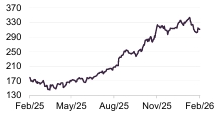
PCT’s underweight position in Alphabet – 171bps at the end of December, but which has been above 400bps in recent times – negatively affected relative performance in 2025, as the company’s share price rose 73.4% over the last 12 months. This increase followed the release of the Gemini 3 model, which has been reported to show improvements in reasoning, speed and multimodal capabilities, and the commercialisation of its custom-made TPUs (tensor processing units) chips at scale for the first time. Alphabet signed a major TPU deal with Anthropic in October and is reportedly in discussions with Meta about a potential multibillion-dollar deal.
PCT increased its exposure to Alphabet at the end of 2025, and an equity call option provided some protection from major relative underperformance. The call options had originally been put in place to hedge the outcome of the Department of Justice’s antitrust case against the company, which was decided in favour of Alphabet and resulted in gains for PCT. The call options also provided a degree of protection on the TPU and Gemini share price reaction; however, PCT has not fully participated in Alphabet’s performance relative to the benchmark.
PCT’s manager says that recent developments have put Alphabet at the front of the AI race and taken some market share from NVIDIA (whose graphics processing units (GPUs) are largely depended on by other foundation model providers) and OpenAI, with the TPU-backed Anthropic making competitive gains. The manager adds that the race is by no means over. The first new AI models trained on NVIDIA Blackwell are expected from OpenAI, Meta and Grok in the first half of 2026.
PCT’s manager says that it may make use of call options on other underweight mega-cap tech names in order to hedge the upside risk, having also used them in Microsoft and Apple.
LAM Research
Figure 12: LAM Research
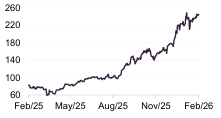
LAM Research was PCT’s largest overweight position at the end of 2025 at 163bps. The company is a global memory chip manufacturer for the semiconductor industry and Ben comments that it has benefited from bottlenecks in the supply of memory chips needed in AI data centres. He adds that this has been particularly acute in DRAM (fast, short-term working memory for a device) and NAND (slower, long-term storage that keeps data even when the power is off), where the company specialises, and this has been reflected in pricing. LAM’s share price has risen 193% over 12 months.
Ciena
Figure 13: Ciena
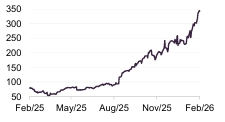
Ciena is an overweight holding in PCT’s portfolio, at 146bps at the end of December. As noted earlier, the manager has high conviction in optical networking as a solution to traditional electrical networking, as power-intensiveness may pose a potential threat to data centre viability. The company reported an acceleration in orders in the second half of last year and subsequently raised its revenue guidance for this year to 24% from 17%, with $5bn of the $6bn revenue guide already in the backlog. Ciena signed its first hyperscaler customer and reported progress in its scale-across applications, which connects data centres over significant distances. Figure 13 shows that Ciena’s share price has increased 326% over the past 12 months.
Lumentum Holdings
Figure 14: Lumentum
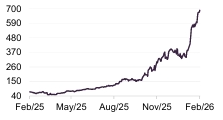
Fellow optical networking company Lumentum has experienced a significant share price increase over the past year, up 850%. At the end of December, it was PCT’s third-largest overweight position at 141bps. The company reported revenue growth of 58% in 2025, and its guidance was above expectations, citing customer demand across its product portfolio. The company also has high exposure to Alphabet, which may benefit it if Alphabet’s recent momentum continues, and has other hyperscaler customers.
Performance
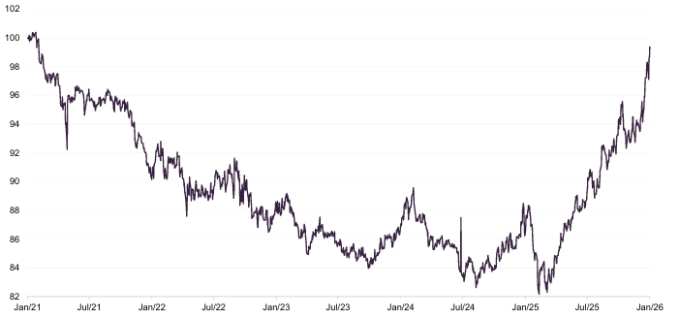
Figure 15: PCT NAV total return relative to benchmark over five years ending 31 January 2026
Visit QuotedData.com for up-to-date information on PCT and its peer group
PCT’s outperformance of its Dow Jones Global Technology benchmark over the past year has resulted in it regaining almost all of the performance it had lost over the five-year period to the end of January 2026. The trust’s AI-focused approach and its scepticism regarding some companies within the group referred to as the Magnificent Seven have been reflected in recent performance.
Figure 16: Cumulative total return performance to 31 January 2026
| 1 month(%) | 3 months (%) | 6 months (%) | 1 year (%) | 3 years (%) | 5 years (%) | |
|---|---|---|---|---|---|---|
| PCT share price | 7.2 | 4.3 | 23.6 | 36.9 | 163.0 | 118.9 |
| PCT NAV | 4.6 | (0.6) | 21.3 | 34.2 | 147.4 | 120.7 |
| Benchmark | (0.2) | (4.5) | 11.5 | 18.3 | 122.5 | 124.7 |
| MSCI ACWI | 0.7 | (0.3) | 9.1 | 11.3 | 53.8 | 79.8 |
| MSCI UK | 3.0 | 6.0 | 13.9 | 23.9 | 46.8 | 97.2 |
Dividend
PCT has not paid dividends historically, given its focus on longer-term capital growth. The board reviews this stance on a periodic basis and states it would declare a dividend if this was needed to maintain the company’s status as an investment trust. Over the years, PCT’s running expenses have exceeded its revenue and therefore the revenue reserve remains negative. To pay a dividend, PCT would need to eliminate its revenue reserve deficit (£158.4m at 31 October 2025).
Premium/discount
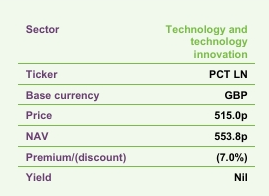
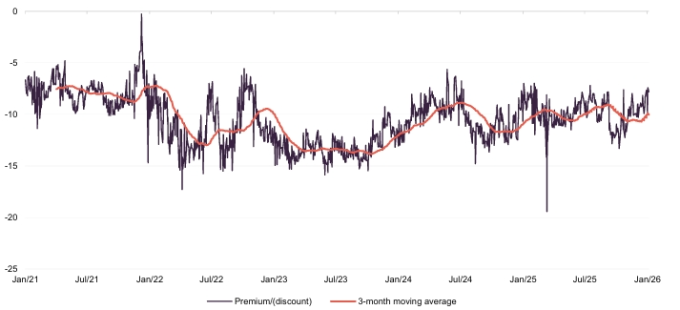
Over the 12 months to 31 January 2026, PCT traded between a discount of 7.0% and 19.4%. The average discount over this period was 9.9%. At 24 February 2026, PCT’s shares were trading at a discount of 7.0%.
Figure 17: Premium/(discount) over five years to end January 2026
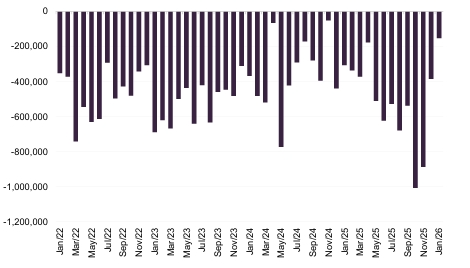
PCT issues and repurchases shares with the stated aim of ensuring that its shares do not trade at excessive premiums or discounts. Shareholders are asked at each AGM to approve the issuance of up to 10% of PCT’s issued share capital and the repurchase of up to 14.99% of its issued share capital. Shares are only issued at a premium to NAV. Shares repurchased may be held in treasury and reissued.
Figure 18: PCT share repurchases since 31 December 2021
Fees and costs
New management fee arrangements came into effect on 1 May 2025. The tiered fee payable is 0.75% on the first £2bn of NAV and 0.6% on amounts above £2bn. There is no performance fee.
The ongoing charges ratio is 0.77%.
Capital structure
PCT has 1,116,103,155 ordinary shares in issue and admitted to trading plus a further 257,046,845 shares held in treasury, as at 24 February 2026. There are no other classes of share capital.
PCT’s financial year end is 30 April and AGMs are usually held in September. PCT has an unlimited life, but at the 2025 AGM, shareholders were asked whether they wanted the fund to continue. Shareholders approved the proposal (98.6% of those voting). The same question will be put to shareholders in 2030 and every five years thereafter.
The use of gearing and derivative instruments is permitted and overseen by the board.
Derivative instruments such as financial futures, options, contracts-for-difference and currency hedges may be used for the purpose of efficient portfolio management. Any leverage resulting from the use of such derivatives will be subject to the restrictions on borrowings. PCT has no long-term borrowings and, at present, no short-term borrowings either.
Management team
Ben Rogoff
Ben is the lead manager of Polar Capital Technology Trust and is a fund manager of the Polar Capital Global Technology Fund and Polar Capital Automation and Artificial Intelligence Fund.
Ben has worked as a technology specialist for 25 years. Prior to joining Polar Capital, he began his career in fund management at CMI, as a global technology analyst. He moved to Aberdeen Fund Managers in 1998, where he spent four years as a senior technology manager. Ben graduated from St Catherine’s College, Oxford in 1995.
Alastair Unwin
Alastair is the deputy manager, having joined Polar Capital in 2019 as a fund manager and senior analyst. Before joining Polar Capital, he co-managed the Arbrook American Equities Fund. Between 2014 and 2018, Alastair launched and then managed the Neptune Global Technology Fund, and managed the Neptune US Opportunities Fund. Prior to Neptune, he was a technology analyst at Herald Investment Management. Alastair has a BA (First Class Honours) in history from Trinity College, Cambridge and is a CFA Charterholder.
Nick Evans
Nick Evans joined Polar Capital in 2007. He has 23 years’ experience as a technology specialist and has been lead manager of the Polar Capital Global Technology Fund since January 2008. He is also a fund manager on the Polar Capital Technology Trust and Polar Capital Automation and Artificial Intelligence Fund.
Prior to joining Polar, Nick was head of technology at AXA Framlington and lead manager of the AXA Framlington Global Technology Fund and the AXA World Fund (AWF) – Global Technology from 2001 to 2007. Both funds were rated five stars by S&P during his tenure. He also spent three years as a Pan-European investment manager and technology analyst at Hill Samuel Asset Management. Nick has a degree in Economics and Business Economics from Hull University, has completed all levels of the ASIP, and is a member of the CFA Institute.
Xuesong Zhao
Xuesong joined Polar Capital in 2012. He has 14 years’ investment experience and is a lead manager of the Polar Capital Artificial Intelligence Fund. He is a partner fund manager on the Polar Capital Technology Trust and Polar Capital Global Technology Fund.
Prior to joining Polar Capital, Xuesong spent four years working as an investment analyst within the emerging markets & Asia team at Aviva Investors, where he was responsible for the technology, media and telecom sectors. Previously, he worked as a quantitative analyst and risk manager for the emerging market debt team at Pictet Asset Management and started his career as a financial engineer at Algorithmics, now owned by IBM, in 2005. Xuesong holds an MSc in Finance from Imperial College of Science & Technology and a BA in Economics from Peking University, and is a CFA Charterholder.
Fatima Iu
Fatima joined Polar Capital in 2006. She has 15 years’ investment experience and is a fund manager on the Polar Capital Technology Fund, Polar Capital Technology Trust and Polar Capital Automation and Artificial Intelligence Fund. Fatima is responsible for the coverage of European Technology, Global Security, Networking, Clean Energy and Medical Technology.
Prior to joining Polar, Fatima spent 18 months working at Citigroup Asset Management with a focus on consumer products and pharmaceuticals. She holds an MSc in Chemistry with Medicinal Chemistry from Imperial College of Science & Technology in London. Fatima is also a CFA Charterholder.
Paul Johnson
Paul joined Polar Capital in 2012. Prior to this, he helped manage a private investment fund between 2010 and 2012. Paul holds a BA in History and Politics and a Masters in History from Keele University. He has passed all three levels of the CFA programme.
Nick Dumas-Williams
Nick joined Polar Capital in 2019 as an analyst on the Polar Capital Technology team. Prior to joining Polar Capital, he worked at Neptune Investment Management as the assistant fund manager on its US Opportunities growth fund. Previously, he worked in academia at the University of Oxford. Nick holds an MChem in Chemistry from the University of Oxford.
Patrick Stuff
After graduating in 2016 from the University of Warwick with a BSc in Economics, Patrick joined Polar Capital as an operations executive, where he provided operational support to all fund management teams at Polar, including the technology team. During this period, he passed all three levels of the CFA program on his first attempt and, after an eight-month secondment to the technology team, joined on a full-time basis in May 2021 as an investment analyst with a focus on small- and mid-cap companies.
Fred Holt
Fred joined Polar Capital in 2023 as an investment analyst in the technology team. Prior to joining Polar Capital, he worked at Janus Henderson Investors as a portfolio analyst on the global technology leaders and sustainable future technologies strategies.
Lina Ghayor
Lina joined Polar Capital in 2023 as an investment analyst in the technology team. Prior to joining Polar Capital, she worked at Exane BNP Paribas as an equity research analyst.
Paddy Drewett
Paddy joined Polar Capital as an operations executive in 2019 from the global markets division of Société Générale. He transferred to the technology team as a data analyst in June 2024 and provides expertise on AI implementation and supports the wider data analysis capabilities of the team. Paddy is a CFA Charterholder.
Adam Gildea
Adam joined Polar Capital in January 2026 as an analyst from Bank of America, where he was an equity research analyst on the European consumer discretionary team. Prior to that he worked in baseball operations and analytics for the Philadelphia Phillies and Los Angeles Dodgers.
Board
PCT’s board comprises six non-executive directors, all of whom are considered to be independent of the manager and do not sit together on other boards. Each of the directors stands for re-election at each AGM. Three members of the board are approaching nine years of service. A programme of recruitment, appointment, and retirement is scheduled to be carried out in 2026 and concluded by the end of 2027.
Figure 19: Board member – length of service and shareholdings
| Director | Position | Date of appointment | Length of service (years) | Annual director’s fee (GBP) | Shareholding |
|---|---|---|---|---|---|
| Catherine Cripps | Chair | September 2021 | 4.3 | 67,200 | 4,810 |
| Tim Cruttenden | Senior independent director | March 2017 | 8.8 | 41,200 | 12,690 |
| Jane Pearce | Chair of the audit committee | September 2021 | 4.3 | 46,000 | 10,970 |
| Charles Park | Director | January 2018 | 8.0 | 37,000 | 18,400 |
| Stephen White | Director | January 2018 | 8.0 | 37,000 | 100,000 |
| Adiba Ighodaro | Director | December 2024 | 1.1 | 37,000 | 2,448 |
Catherine Cripps
Catherine was appointed to the board in September 2021 and became chairman in September 2022. She is a qualified Chartered Accountant with more than 30 years’ experience in senior investment industry roles, including trading, risk management, and investing positions such as investment director and head of research at GAM. Catherine is also a non-executive director of Goldman Sachs International and Goldman Sachs International Bank, where she chairs the risk committees and is a member of the audit committees. She is also a non-executive director of the National Wealth Fund and was previously a non-executive director of CQS Management Limited, where she chaired the remuneration and performance management committees and was a member of the audit committee.
Tim Cruttenden
Tim is currently chief executive officer of VenCap International Plc, having been with that company in various positions since 1994. VenCap invests in venture capital funds in the US, Asia and Europe, with a primary focus on early-stage technology companies. Tim is a non-executive director of Chrysalis Investments Limited.
Jane Pearce
Jane is a non-executive director and Chartered Accountant with over 20 years’ financial markets experience. She has worked as a technology equity analyst and as an equity strategist at investment banks including Lehman Brothers and Nomura International.
Jane is a non-executive director and member of the audit committee of Shires Income Plc and also a non-executive director of Morgan Stanley Bank International Limited, Morgan Stanley & Co International Plc, and Morgan Stanley Investment Management Limited.
Charles Park
Charles has over 25 years of investment experience and was a co-founder of Findlay Park Partners, an investment firm specialising in quoted American equity investments. Prior to this, he was a US fund manager at Hill Samuel Asset Management.
Charles is a non-executive director of North American Income Trust Plc and Evenlode Investments.
Stephen White
Stephen qualified as a Chartered Accountant at PwC before beginning a career in investment management. He has more than 35 years’ investment experience, including as head of European Equities at F&C Asset Management, where he was manager of F&C Eurotrust Plc and deputy manager of The F&C Investment Trust Plc. He also held the role of head of European and US Equities at British Steel Pension Fund.
Stephen is a non-executive director and chairman of Brown Advisory US Smaller Companies Trust Plc. He is also a non-executive director and chairman of the audit committees of BlackRock Frontiers Investment Trust Plc.
Adiba Ighodaro
Adiba is a non-executive director with a background in corporate and commercial law. She has experience in global private markets from over 30 years of working in legal structuring, development finance, private equity investment, and fundraising.
Adiba is currently an independent non-executive director and member of the audit and management engagement committees of ICG Enterprise Trust Plc, and an independent non-executive director, chair of the credit committee and member of the risk committee and the nomination, governance & remuneration committee of Standard Chartered Bank Nigeria Ltd. She is also a non-executive director of MKopa Holdings Ltd.
Previous publications
Readers can access our earlier notes via the links below or on our website.
Figure 20: QuotedData’s previously published notes on PCT
| Title | Note type | Publication date |
|---|---|---|
| Confidence building | Initiation | 12 May 2020 |
| “More to go for” | Update | 15 December 2020 |
| Exciting times | Annual overview | 7 July 2021 |
| Eyes on the prize | Update | 10 May 2022 |
| Jockeying for position | Annual overview | 8 December 2022 |
| Me, myself and AI | Update | 14 June 2023 |
| The AI’s have it | Annual overview | 9 January 2024 |
| AI caramba! | Update | 25 June 2024 |
| AI captain | Annual overview | 16 January 2025 |
| AI of the tiger | Update | 14 August 2025 |
Important Information
Marten & Co (which is authorised and regulated by the Financial Conduct Authority) was paid to produce this note on Polar Capital Technology Trust Plc.
This note is for information purposes only and is not intended to encourage the reader to deal in the security or securities mentioned within it. Marten & Co is not authorised to give advice to retail clients. The research does not have regard to the specific investment objectives financial situation and needs of any specific person who may receive it.
The analysts who prepared this note are not constrained from dealing ahead of it but, in practice, and in accordance with our internal code of good conduct, will refrain from doing so for the period from which they first obtained the information necessary to prepare the note until one month after the note’s publication. Nevertheless, they may have an interest in any of the securities mentioned within this note.
This note has been compiled from publicly available information. This note is not directed at any person in any jurisdiction where (by reason of that person’s nationality, residence or otherwise) the publication or availability of this note is prohibited.
No Advice: Nothing contained in this note constitutes or should be construed to constitute investment, legal, tax or other advice.
Accuracy of Content: Whilst Marten & Co uses reasonable efforts to obtain information from sources which we believe to be reliable and to ensure that the information in this note is up to date and accurate, we make no representation or warranty that the information contained in this note is accurate, reliable or complete. The information contained in this note is provided by Marten & Co for personal use and information purposes generally. You are solely liable for any use you may make of this information. The information is inherently subject to change without notice and may become outdated. You, therefore, should verify any information obtained from this note before you use it.
No Advice: Nothing contained in this note constitutes or should be construed to constitute investment, legal, tax or other advice.
No Representation or Warranty: No representation, warranty or guarantee of any kind, express or implied is given by Marten & Co in respect of any information contained on this note.
Exclusion of Liability: To the fullest extent allowed by law, Marten & Co shall not be liable for any direct or indirect losses, damages, costs or expenses incurred or suffered by you arising out or in connection with the access to, use of or reliance on any information contained on this note. In no circumstance shall Marten & Co and its employees have any liability for consequential or special damages.
Governing Law and Jurisdiction: These terms and conditions and all matters connected with them, are governed by the laws of England and Wales and shall be subject to the exclusive jurisdiction of the English courts. If you access this note from outside the UK, you are responsible for ensuring compliance with any local laws relating to access.
No information contained in this note shall form the basis of, or be relied upon in connection with, any offer or commitment whatsoever in any jurisdiction.
Investment Performance Information: Please remember that past performance is not necessarily a guide to the future and that the value of shares and the income from them can go down as well as up. Exchange rates may also cause the value of underlying overseas investments to go down as well as up. Marten & Co may write on companies that use gearing in a number of forms that can increase volatility and, in some cases, to a complete loss of an investment.