

If you read our recent note on Temple Bar (TMPL), you’ll have seen that we included a section entitled “Compelling UK valuation opportunity”. Below is one of the tables we used to back that up. As you can see, UK stocks are cheap relative to peers, and especially US stocks on a price to earnings (P/E) basis.
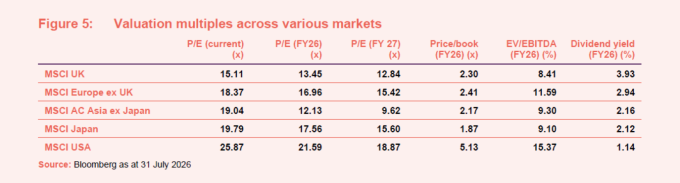
It is true that large UK stocks have had a better time of it recently – the FTSE 100 has outperformed the S&P 500 over the past year, for example – but smaller companies have been lagging. That means that they are relatively cheaper still – the FY26 P/E multiple on the small cap index was 10.5x at the end of July, and the FY27 P/E just 9.2x. More usually, small cap stocks would trade on premium valuations to reflect their superior earnings growth prospects.
The next chart shows the total return on various UK indices over the past 10 years. Large caps come out on top, small cap is not that far behind, but AIM stocks have been very poor. However, history suggests that small cap ought to outperform over the long term, might it be time for UK small cap to play catch up?
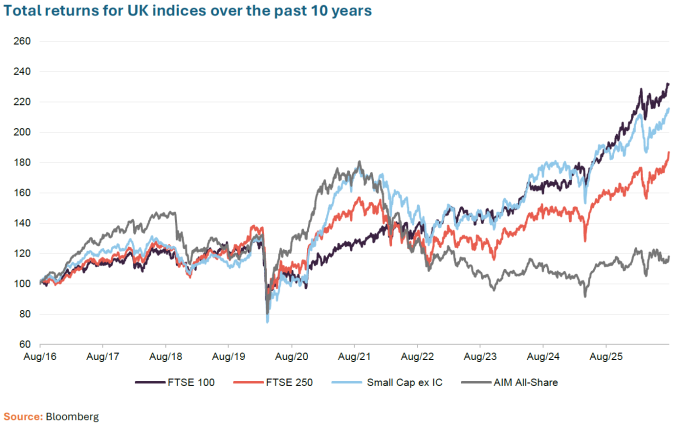
The answer to that depends on a range of factors – will we see a real end to hostilities in the Gulf and a more stable oil price? Will the first Burnham/Healey budget sooth nerves or trigger bond market panic? Will the campaigns that David Batchelor discussed last week encourage investors to look again at UK equities? The jury is out.
But if you were thinking about upping your UK small cap exposure, which trusts would you turn to?
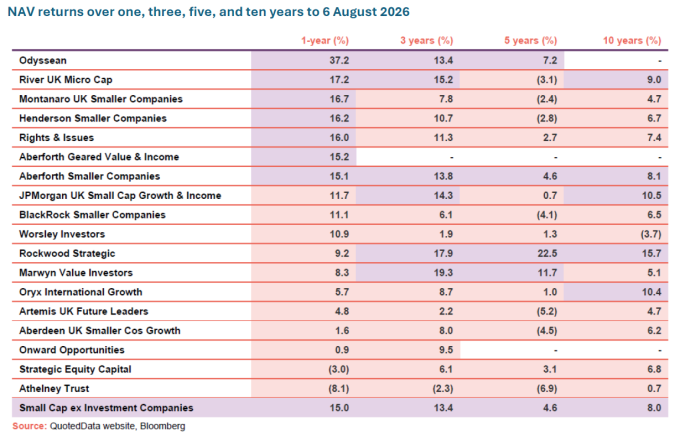
The next table, which is based on data from the website, shows how the sector has performed, in underlying net asset value (NAV) total return terms, over various time periods to 6 August 2026. I have highlighted (in purple) the trusts that have outperformed the Small cap ex Investment Companies Index. Of course, this is not the chosen benchmark for many of these trusts, but even so my comment on this report card would be “could do better”.
Some things stand out for me:
1) Odyssean (OIT) is doing remarkably well. This is a trust that uses “constructive corporate engagement” to add value for investors. It operates with a concentrated portfolio (85% in the top 10 at the end of July 2026). It has been helped by a takeover for Blackline Safety at a level that gives it a 1.8x return on its investment and by a tender offer for NCC funded by the proceeds of its sale of its Escode division. However, OIT’s strong returns largely reflect improvements within these companies.
OIT’s one-year figures contrast with those of Rockwood Strategic (RKW), which follows a similar strategy and had seen a remarkable run of strong performance in earlier years (winning prizes in our Investors’ Choice Awards a couple of years in a row). This illustrates the ‘lumpiness’ of the returns from this approach. At the other end of the table sits another of these trusts – Strategic Equity Capital (SEC), which again has a concentrated portfolio. It has been a casualty of the selloff in software stocks associated with advances in agentic AI.
2) River UK Micro Cap (RMMC) was knocked by the outbreak of the Iran war, as most of these trusts were, but was less affected by the agentic AI selloff than other trusts. George Ensor RMMC’s manager reckoned that this was because the stocks that the trust held were already very cheap.
Generally, microcap companies have been neglected by investors and that is reflected in ratings. Corporate and private equity buyers are taking advantage of the situation – the portfolio has benefitted from a number of bids. However, the manager still believes that there is considerable catch-up potential in valuations.
Currently, the buy case for RMMC is compromised by Ensor’s resignation as manager – he is working out his notice. However, we strongly suspect that the trust will follow him to a new management house.
3) Third in this list is Montanaro UK Smaller Companies (MTU), which has seen a significant improvement in its performance over the past year. Its quality growth approach was out of favour for some years following the upward shift in interest rates that accompanied the post-COVID inflation spike. However, before that period, MTU often ranked at or near the top of performance tables, perhaps this is the start of a more prolonged return to form. It is interesting that other quality growth trusts are still finding life tough going. MTU is being helped by good stock selection.
4) Aberforth Smaller Companies (ASL) deserves a mention as the only trust in the peer group to outperform over every time period. It has a strict value-driven approach which has been serving it well.
5) At the other end of the table, Artemis UK Future Leaders (AFL) has only been managed by Artemis for just over a year. It hasn’t got off to a good start – as we noted here – again it was caught by the agentic AI selloff.
6) The chair of Aberdeen UK Smaller Companies (AUSC) expressed disappointment with its track record when it published results earlier this year. The managers are encouraged by the underlying progress being made by companies within the portfolio and think that this will be recognised eventually.
7) Onward Opportunities (ONWD) has a loyal fan base, which helps keep its discount fairly tight, enabling it to issue shares. It has also moved to trade on the main market of the LSE. But it just reported its first period of underperformance since launch, again the manager laments that businesses are performing well but share prices are not. It is this disconnect that underscores the potential upside in UK small caps.
8) Finally, minnow (£4m market cap) Athelney Trust (ATY) remains disappointing. It isn’t obvious to me why it soldiers on.
