
The road ahead
Chrysalis Investments (CHRY) is now seven years old, with a more mature portfolio. Since our last update, strong performance from Starling and signs of recovery at wefox have boosted NAV. Recent asset sales have provided enough liquidity for CHRY to meet its capital allocation commitments, and Klarna’s IPO increases the chance of further realisations.
Over 16% of CHRY’s shares have been bought back, narrowing the discount, though there is still room for improvement. Some investors have asked for an exit near asset value, while others, encouraged by CHRY’s NAV growth, are interested in new investments. After consulting shareholders, the board is planning the next steps.
Supporting growing businesses
CHRY aims to provide access to returns available from investing in later-stage private companies with long-term growth potential, an investment class that has traditionally been difficult to access for individual investors. CHRY also benefits from the flexibility to continue to support these businesses after they IPO.
At a glance
Share price and discount
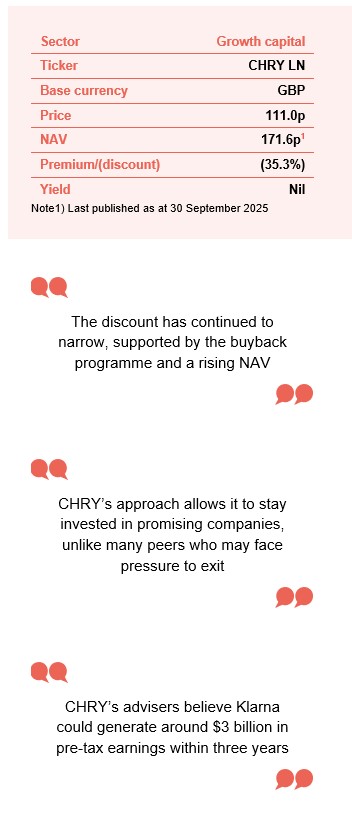
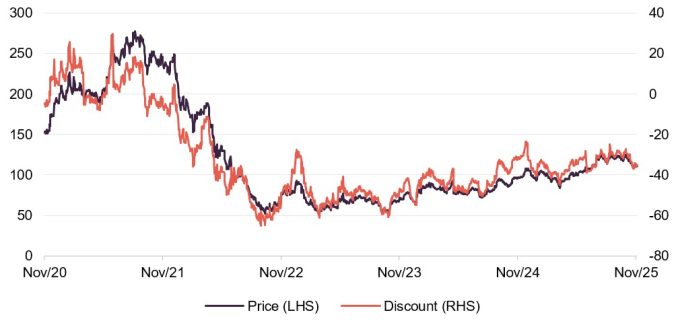
Over the 12 months to 30 November 2025, CHRY’s shares traded at a discount ranging from 45.0% to 23.7%, with an average discount of 33.9%. At the time of publication, the discount stood at 35.3%.
The discount has continued to narrow, supported by the buyback programme and a rising NAV. Since starting on 30 September 2024, CHRY has bought back 96,465,497 shares, equal to 16.2% of its issued share capital.
Time period 30 November 2020 to 3 December 2025
Source: Bloomberg, Marten & Co
Performance over five years
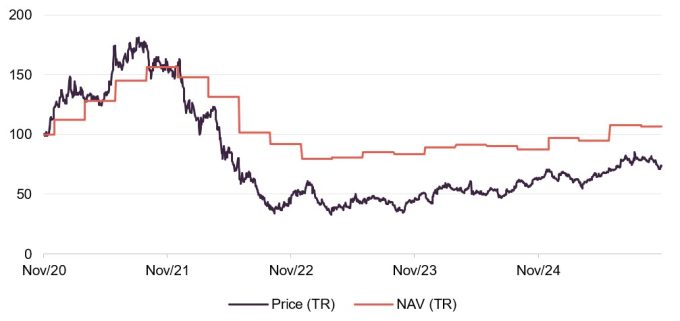
At the end of September 2025, CHRY’s NAV was 171.65p, up 9.6% for the year. The initial drop in Klarna’s share price after its IPO was reflected in this NAV. However, if we account for Klarna’s further decline since then, CHRY’s NAV may have fallen by another 4p.
Time period 30 November 2020 to 30 November 2025
Source: Bloomberg, Marten & Co
| Year ended | Share pricetotal return (%) | NAV total return (%) | MSCI UK total return (%) | NASDAQ total return (%) | S&P 500 total return (%) |
|---|---|---|---|---|---|
| 30/11/2021 | 55.7 | 56.5 | 17.6 | 33.3 | 28.8 |
| 30/11/2022 | (71.3) | (41.3) | 13.9 | (16.5) | 0.8 |
| 30/11/2023 | 1.0 | (8.9) | 2.3 | 26.6 | 7.7 |
| 30/11/2024 | 39.4 | 4.9 | 15.1 | 31.2 | 32.8 |
| 30/11/2025 | 17.1 | 21.5 | 21.4 | 17.7 | 10.5 |
Portfolio
Recent investment activity
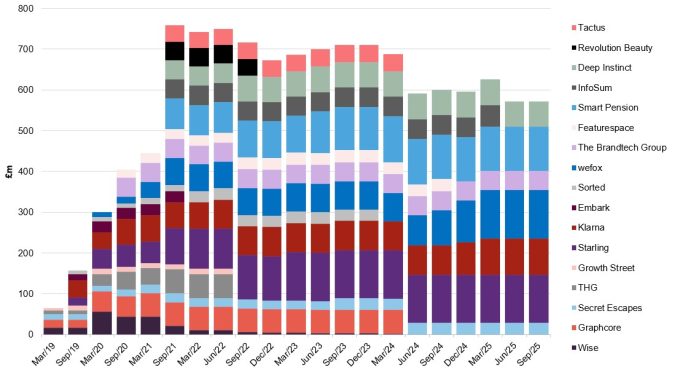
InfoSum was sold to WPP for £49.8m in April 2025, representing a 16.4% premium to CHRY’s December 2024 valuation. However, CHRY had invested £53.3m in total, including £2.4m in early 2025, resulting in a multiple on invested capital (MOIC) of 0.93x. The advisers felt selling InfoSum and using the proceeds for share buybacks offered a better risk-adjusted return than holding onto the investment.
Figure 1: Portfolio progress since launch – amounts invested in companies in the portfolio to end September 2025
Source: Marten & Co
Klarna’s IPO took place on 9 September 2025. Before this, CHRY invested another £8m but chose not to sell any shares during the IPO and is now locked in for six months. Advisers were unwilling to commit to selling at an unknown IPO price and believe Klarna has strong medium-term growth prospects that could drive significant profits. CHRY’s approach allows it to stay invested in promising companies, unlike many peers who may face pressure to exit.
The advisers recently made a small investment in Deep Instinct, under $1m.
Since September, CHRY has repaid £10m of its £70m term loan, reducing the balance to £60m.
The advisers note their recent focus has been on restructuring companies to position them to stand on their own feet and narrowing the portfolio to the most promising investments. This process is ongoing and could lead to further sales of less attractive holdings. While now may be a good time to look for new investment opportunities, this depends on resolving how capital will be allocated in future.
Portfolio as at last quarter end
Figure 2: Portfolio as at 30 September 2025
| Business description | % of portfolio 30 Sep 2025 | Value 30 Sep 2025 £m | Amount invested £m | MOIC (x) | |
|---|---|---|---|---|---|
| Starling | UK challenger bank | 46.4 | 406.6 | 118.3 | 3.4 |
| Smart Pension | Workplace/automatic enrolment pension schemes for SMEs | 14.1 | 123.4 | 108.6 | 1.1 |
| Klarna | Online payments business with buy now pay later option | 13.2 | 115.3 | 87.9 | 1.3 |
| wefox | Europe’s largest digital insurance platform | 10.4 | 91.5 | 119.7 | 0.8 |
| Brandtech | Digital advertising and marketing services | 4.2 | 36.8 | 46.4 | 0.8 |
| Deep Instinct | A US cybersecurity company | 3.0 | 26.7 | 62.2 | 0.4 |
| Secret Escapes | Travel company that helps minimise unsold inventory | 1.8 | 15.7 | 28.0 | 0.6 |
| Featurespace1 | Financial crime risk management using real-time learning | 1.0 | 9.2 | n/a | n/a |
| Wise | Online foreign exchange | 0.4 | 3.1 | 0.7 | 4.4 |
| Sorted | SaaS company with a delivery management platform | 0.0 | 0.3 | n/a | n/a |
| Total investments | 94.5 | 828.6 | 572.2 | 1.4 | |
| Gross cash | 13.5 | 118.1 | |||
| Debt | (8.0) | (70.0) | |||
| Net assets | 100.0 | 876.7 |
Source: CHRY, Marten & Co. Figures may not add up due to rounding. Note 1) This just represents the deferred proceeds from this disposal. Assuming the deferred proceeds are received in full, CHRY will have earned a 3.0x MOIC on Featurespace.
Looking at a couple of these in more detail:
Starling
In May, Starling (starlingbank.com) reported its results for the year ending March 2025. During this period, the bank slowed its growth to address fines for weak client onboarding checks and set aside funds for COVID-era loans. Despite this, revenue rose by 4.7% to £714m. Customer deposits rose by £1.1bn to £12.1bn, with 400,000 new accounts bringing the total to 4.6 million. Fines and provisions reduced profits to £223m from £301m, but this is seen as a one-off impact. To address past issues, Starling has strengthened its management team, hiring a new COO (Joe Gordon) and chief banking officer (Raghu Narula), with CEO Raman Bhatia making eight senior appointments since June 2024.
With legacy problems being resolved, Starling can increase marketing and grow its market share, as well as expand its services. In February, it stopped paying interest on current accounts but launched an “easy-saver” account, initially offering 4% interest, now reduced to 3%.
Starling remains well-capitalised, with £400m in excess capital at the interim stage, which could fund further growth, acquisitions, or even company takeovers. In August, Starling acquired Ember, an accounting and tax software provider for SMEs, to help them comply with HMRC’s “Making Tax Digital” rules from April 2026.
Advisers suggest Starling could enter the US market by acquiring a small bank, given the fragmented US banking sector and its outdated systems. On 4 November, CHRY reported that Starling’s Engine SaaS business secured a 10-year contract with Canadian digital bank Tangerine, Engine’s third customer after Salt Bank in Romania and AMP’s Bank GO in Australia. Advisers see this as a strong endorsement and a sign of Engine’s global potential.
The new contract could generate revenue comparable to Engine’s main rival, Thought Machine, valued at about $2bn. Advisers believe Engine’s end-to-end solutions and reputation put it in a strong position for further growth. Engine is now legally separate from Starling’s UK bank, allowing for a potential split if needed. Given Engine’s growth prospects and the high valuations of fast-growing software firms, advisers see it as a key driver of CHRY’s future NAV growth.
Smart Pension
The advisers say that while the valuation of CHRY’s stake in Smart Pension (smart.co) has been fairly flat in recent quarters, there is a still a lot going on within the company.
Smart Pension reported over 1.5 million members and £6.5bn in assets under management (AUM) in its Master Trust as of March. The company expects more consolidation in the UK pension sector, partly driven by the Pension Schemes Bill. This bill includes a proposed minimum AUM of £25bn for multi-employer defined contribution schemes by 2030. Schemes with at least £10bn by 2030 and a credible plan to reach £25bn by 2035 can qualify for “transition pathway relief”.
This move is pushing smaller schemes to merge, as they are unlikely to meet the threshold on their own and are likely to become takeover targets. As a buyer, Smart Pension is well placed to negotiate favourable deals.
Advisers believe AUM could reach £9bn by year-end, boosted by Smart Pension’s acquisition of Options, up from £2.5bn when CHRY first invested. With ongoing contributions and modest market growth of 2% per year, AUM could reach £18bn by 2030 even without further acquisitions. Gross margins are about 80%, so rising revenue is expected to significantly improve profits.
Smart Pension also owns Keystone, its in-house software business, which helps integrate new business and is already EBITDA positive, offering additional value.
Figure 3: Klarna (USD)

Source: Bloomberg
Klarna
Klarna’s (klarna.com) IPO took place on 2 September 2025 after being delayed from April due to market volatility linked to Trump’s tariff announcements. Priced at $40 per share, Klarna raised $1bn and was valued at about $15bn. Since then, the share price has dropped, partly due to a Q3 loss, and now stands at $30.6, giving a market cap of $11.5bn.
CHRY did not sell any shares at the IPO, and its 4.2m Klarna shares are now under a standard six-month lock-up. The IPO process made it difficult to predict the final price, but the adviser believed Klarna had more growth potential, especially with several new agreements made ahead of the listing.
Alongside existing partnerships with Stripe and ApplePay, Klarna has recently added partners like Worldpay, GooglePay, and JPMorgan Payments. Advisers expect these new partnerships to generate and grow business for the next seven to ten years.
In Q3, Klarna had 114 million active consumers and 850,000 merchants, both up over 30% year-on-year. Gross merchandise value reached $118 billion, a 23% like-for-like increase.
Klarna’s US Fair Financing product, which offers larger loans than its Buy Now, Pay Later service, is growing rapidly. By 30 September 2025, the value of these loans was up 139% year-on-year. However, this growth is currently impacting Klarna’s results, as it must set aside upfront provisions for potential loan losses before recognising income. Klarna is also selling loan packages to Elliott, which allows it to recognise revenue sooner and reduce these provisions, suggesting the impact is temporary.
Extra revenue from these loans should improve profitability, especially as Klarna uses technology and AI to keep costs low. CHRY’s advisers believe Klarna could generate around $3 billion in pre-tax earnings within three years, which could significantly increase its valuation.
Performance
At the end of September 2025, CHRY’s NAV was 171.65p, up 9.6% for the year. The initial drop in Klarna’s share price after its IPO was reflected in this NAV. However, if we account for Klarna’s further share price decline since then, CHRY’s NAV may have fallen by another 4p.
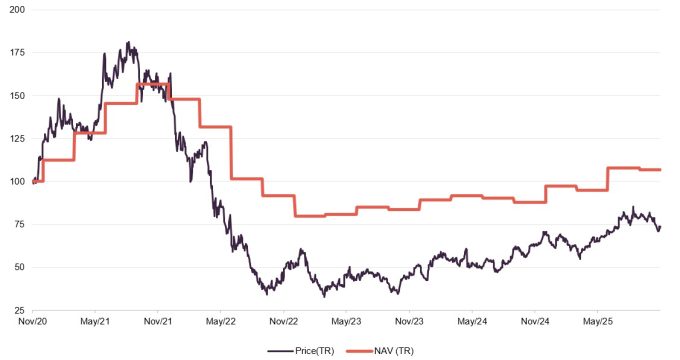
The chart in Figure 4 shows that the sharp rise in NAV during 2020/21 was followed by a similar drop in 2022. This shift reflects the move from the easy-money, low interest rate environment of the COVID period to rising inflation and higher interest rates. The share price fell ahead of the NAV but dropped more than the underlying value.
Figure 4: CHRY NAV and share price total return performance since launch
Source: Morningstar, Marten & Co
It is important to note that five-year performance figures now include most of the recent decline but little of the earlier gains. Excluding this period, the NAV has generally risen since launch. However, the discount, discussed later in this report, continues to hold back share price returns.
Figure 5: Cumulative total returns for periods ending 30 November 2025
| 3 months (%) | 6 months (%) | 1 year (%) | 3 years (%) | 5 years (%) | |
|---|---|---|---|---|---|
| NAV1 | (1.1) | 12.5 | 21.5 | 16.1 | 6.6 |
| Share price | (3.1) | 12.8 | 17.1 | 64.9 | (26.2) |
| MSCI UK | 6.5 | 12.7 | 21.4 | 43.0 | 91.6 |
| NASDAQ | 11.0 | 21.6 | 17.7 | 95.3 | 117.5 |
Source: Bloomberg, Marten & Co. Note 1) NAV based on last published as at 30 September 2025.
As in previous reports, we have included the MSCI UK and NASDAQ as comparators. However, none of these would make an ideal benchmark.
Figure 6: Major contributions to changes in valuation of CHRY’s portfolio since our last note

Source: CHRY, Marten & Co
Figure 6 above shows the notable changes in valuation for each of CHRY’s assets since our last note, which used valuations as at 31 December 2024.
CHRY’s buyback activity led to a slight drop in the fund’s total value, from around £888m to £877m over the first nine months of 2025. However, the NAV per share rose by 9.6%. This increase was mainly due to higher valuations for Starling and wefox, though these gains were partly offset by lower valuations for Brandtech and Klarna. Starling and Klarna have been covered earlier; the following focuses on the other two.
Brandtech
Brandtech (thebrandtechgroup.com) has made progress with its GenAI advertising solutions and plans to add Google’s video generation model to its service. However, lower valuations among listed competitors like WPP have led CHRY to reduce Brandtech’s carrying value.
Advisers note that while advertisers see AI’s potential, many are pausing to assess how to use it, which has slowed demand for Brandtech’s services. Brandtech’s Pencil and Oliver businesses are expected to benefit as confidence in AI advertising grows.
wefox
Last year, wefox (wefox.com) began a major restructuring, starting with its exit from the German market in July. In September, a new CEO, Joachim Müller, was appointed, and in December, wefox sold its Lichtenstein-based insurance carrier to a Swiss consortium led by BERAG. In January 2025, it sold a portfolio of German, Italian, and Swiss contracts to DARAG, followed by the sale of its Italian units to JC Flowers in May.
The business is now focused on developing its asset-light Managing General Agent (MGA) and smart insurance distribution operations, mainly in the Netherlands, Austria, and Switzerland. In July 2025, wefox secured €151m in new funding, with €76m from existing investors as equity and €75m as debt.
CHRY played a key role in the restructuring, gaining more downside protection, a better position in wefox’s capital structure, and a larger stake, which supported the higher valuation. Advisers expect wefox to be profitable in 2025 and see potential for expansion into Germany and the UK.
Premium/(discount)
Over the 12 months to 30 November 2025, CHRY’s shares traded at a discount ranging from 45.0% to 23.7%, with an average discount of 33.9%. At the time of publication, the discount stood at 35.3%.
Figure 7:CHRY premium/(discount) since launch

Source: Bloomberg, Marten & Co
The discount has continued to narrow, supported by the buyback programme and a rising NAV. Since starting on 30 September 2024, CHRY has bought back 96,465,497 shares, equal to 16.2% of its issued share capital.
Figure 8: CHRY share buy backs

Source: Marten & Co (NB data to 30 November 2025)
Fund profile and management arrangements
Investors may wish to consult the fund’s website at chrysalisinvestments.co.uk
CHRY aims to deliver long-term capital growth by investing mainly in shares or similar investments in both private and listed companies. Its strategy centres on supporting fast-growing businesses, whether listed or not.
The company was originally called Merian Chrysalis Investment Company Limited (ticker MERI) but changed its name in December 2020 after Jupiter acquired Merian Global Investors. The advisory team of Nick Williamson and Richard Watts moved over at that time. From 1 April 2024, the team became Chrysalis Investment Partners LLP, which now advises CHRY under a new agreement, with G10 Capital Limited as AIFM. Richard and Nick now focus solely on CHRY’s portfolio, supported by lead analyst Mike Stewart, investment specialist Carmen Azad, legal counsel James Simpson, and head of finance and operations Bekki Whiting.
The debt facility
In September 2024, CHRY secured a two-year £70m loan from Barclays Bank, with an option to increase by £15m. The interest rate is set above SONIA. The loan was drawn immediately and can be repaid after one year without penalty. CHRY has already repaid £10m in recent weeks.
Previous publications
Readers interested in further information about CHRY may wish to read our previous notes listed below. You can read them by clicking on the links in Figure 9 or by visiting our website.
Figure 9: QuotedData’s previously published notes on CHRY
| Title | Note type | Date |
|---|---|---|
| Shepherding its portfolio through the storm | Initiation | 9 September 2022 |
| Putting growing pains behind it | Update | 26 July 2023 |
| Turned a corner | Update | 7 February 2024 |
| Return to form | Update | 27 February 2025 |
Source: Marten & Co
IMPORTANT INFORMATION
Marten & Co (which is authorised and regulated by the Financial Conduct Authority) was paid to produce this note on Chrysalis Investments Limited.
This note is for information purposes only and is not intended to encourage the reader to deal in the security or securities mentioned within it. Marten & Co is not authorised to give advice to retail clients. The research does not have regard to the specific investment objectives financial situation and needs of any specific person who may receive it.
The analysts who prepared this note are not constrained from dealing ahead of it but, in practice, and in accordance with our internal code of good conduct, will refrain from doing so for the period from which they first obtained the information necessary to prepare the note until one month after the note’s publication. Nevertheless, they may have an interest in any of the securities mentioned within this note.
This note has been compiled from publicly available information. This note is not directed at any person in any jurisdiction where (by reason of that person’s nationality, residence or otherwise) the publication or availability of this note is prohibited.
Accuracy of Content: Whilst Marten & Co uses reasonable efforts to obtain information from sources which we believe to be reliable and to ensure that the information in this note is up to date and accurate, we make no representation or warranty that the information contained in this note is accurate, reliable or complete. The information contained in this note is provided by Marten & Co for personal use and information purposes generally. You are solely liable for any use you may make of this information. The information is inherently subject to change without notice and may become outdated. You, therefore, should verify any information obtained from this note before you use it.
No Advice: Nothing contained in this note constitutes or should be construed to constitute investment, legal, tax or other advice.
No Representation or Warranty: No representation, warranty or guarantee of any kind, express or implied is given by Marten & Co in respect of any information contained on this note.
Exclusion of Liability: To the fullest extent allowed by law, Marten & Co shall not be liable for any direct or indirect losses, damages, costs or expenses incurred or suffered by you arising out or in connection with the access to, use of or reliance on any information contained on this note. In no circumstance shall Marten & Co and its employees have any liability for consequential or special damages.
Governing Law and Jurisdiction: These terms and conditions and all matters connected with them, are governed by the laws of England and Wales and shall be subject to the exclusive jurisdiction of the English courts. If you access this note from outside the UK, you are responsible for ensuring compliance with any local laws relating to access.
No information contained in this note shall form the basis of, or be relied upon in connection with, any offer or commitment whatsoever in any jurisdiction.
Investment Performance Information: Please remember that past performance is not necessarily a guide to the future and that the value of shares and the income from them can go down as well as up. Exchange rates may also cause the value of underlying overseas investments to go down as well as up. Marten & Co may write on companies that use gearing in a number of forms that can increase volatility and, in some cases, to a complete loss of an investment.