
“Market mispricing AI risk”
During global market uncertainty, Lindsell Train Investment Trust (LTI) and its manager, Lindsell Train Limited (LTL), have generally performed well as investors look for stable cash flows. Some holdings, especially in consumer staples, have been defensive during recent periods of market volatility linked to the Iran war. However, concerns about the impact of artificial intelligence (AI) on software and data businesses have negatively affected both LTI and LTL.
This has been most noticeable with portfolio company RELX. LTL believes the market has got its assessment of RELX wrong, arguing that in sectors like legal and financial, high regulatory barriers and the cost of errors make their datasets essential for AI tools to work successfully. Reflecting this, LTI took advantage of market weakness to start building a position in US credit scoring firm FICO in February, which was already held within LTL’s Global strategy.
Although LTL’s funds under management (FUM) have continued to decline, it has launched a new $200m international equities strategy, funded by its large cash reserves and a long-term client.
Maximise returns over the long-term
LTI’s goal is to maximise long-term total returns and protect shareholders’ capital. It holds a focused portfolio of leading global companies with strong returns on equity, as well as investments in Lindsell Train-managed funds and the unlisted shares of its investment manager, Lindsell Train Limited.
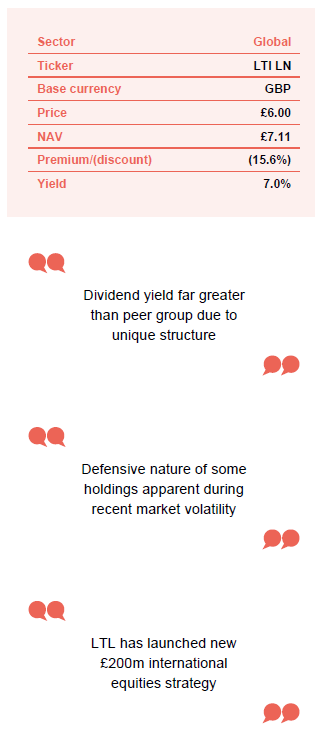
At a glance
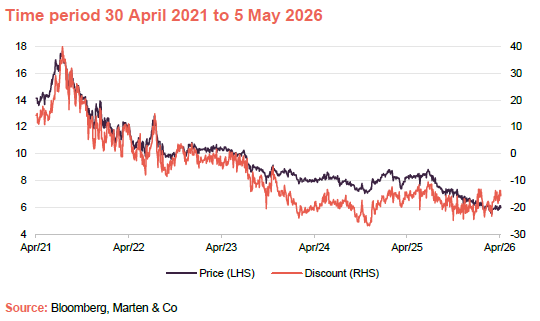
Share price and discount
LTL’s quality-focused investment approach has been out of favour and has contributed to LTI’s wide discount to net asset value (NAV).
LTI’s discount has ranged from 10.4% to 24.7%, averaging 17.5% over the 12 months to 30 April 2026. At the time of publishing, the discount had narrowed to 15.6%.
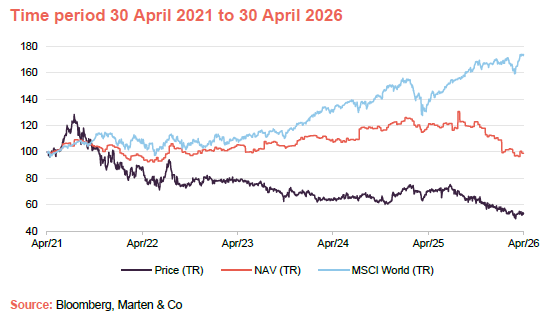
Performance over five years
LTI’s NAV has dropped sharply over the past year, contributing to a marked underperformance of the MSCI World Index over five years (although it is hard to compare LTI directly with benchmarks because of its unique investment approach and focused portfolio). This recent performance was mainly due to a further fall in funds under management at LTL and negative sentiment towards its software holdings, which were affected by concerns about AI disruption.
| Year ended | Share price total return (%) | NAV total return (%) | MSCI World Index total return (%) |
|---|---|---|---|
| 30/04/2022 | (11.5) | (4.2) | 6.4 |
| 30/04/2023 | (10.9) | 10.1 | 3.1 |
| 30/04/2024 | (19.5) | 1.8 | 18.8 |
| 30/04/2025 | 10.7 | 12.2 | 5.1 |
| 30/04/2026 | (23.6) | (17.7) | 27.0 |
Fund profile
Concentrated portfolio of 13 global equity stocks plus Lindsell Train funds
Lindsell Train Investment Trust (LTI) aims to deliver long-term total returns while preserving the real value of capital. It invests in a focused portfolio of 13 global “heritage” companies, alongside selected Lindsell Train funds, and holds a stake in its manager, Lindsell Train Limited (LTL). Management fees for LTL-managed funds are rebated to LTI to prevent double charging of fees.
As of March 2026, global equities made up 62.4% of NAV, with indirect exposure to 49 holdings. The trust is benchmarked against the MSCI World Index (in sterling) but is managed independently, with an active share near 100%. Launched in 2001, LTI is listed on the premium segment of the London Stock Exchange. The board acts as the company’s AIFM and receives no remuneration for this role.
Investment approach
LTL invests in a small number of high-quality companies for the long term, believing that a focused approach reduces risk better than broad diversification. These companies usually have strong competitive advantages and long histories, with LTI’s direct equity holdings averaging about 147 years old.
Symbiotic relationship with LTL
LTI and LTL have a close relationship, with LTI providing seed capital to help launch new funds and benefiting from their growth. LTI’s initial £66,000 investment in LTL grew to £28.2m by March 2026. This represented 48% of NAV in 2021, but fell to 19.8% by March 2026 due to weaker performance and lower assets under management.
Market backdrop
War in Iran has heightened global geopolitical uncertainty
Global market uncertainty has increased due to the war in Iran, which has raised geopolitical tensions and disrupted the global economic recovery. Growth forecasts have been cut following the energy price shock and rising inflation, with central banks pausing rate cuts as higher interest rates look set to continue.
Investors are also considering how artificial intelligence (AI) could transform industries, trying to identify winners and those at risk. Markets are now more volatile and event-driven, with inflation, oil prices, interest rates, and geopolitics all weighing on sentiment. This uncertainty, from both geopolitics and AI, has had a significant impact on LTI and LTL’s portfolios, which we examine here.
Geopolitical tension
Defensive stocks back in focus
The war in Iran and wider Middle East instability has renewed interest in defensive stocks. Energy, defence, aerospace, and some commodity stocks have seen strong gains, while other safe haven sectors like banking have also benefited. LTL’s consumer staples exposure has been relatively resilient. In LTI’s portfolio, Unilever rose by double digits before news of its food business sale in March. Mondelez and AG Barr also saw gains after the conflict began.
All four companies have a history of steady, growing revenues and are expected to keep delivering reliable returns. During the last period of major market volatility in early 2025, when tariff uncertainty and DeepSeek launched its large language model (LLM), LTI and LTL’s portfolios performed relatively well compared to tech-heavy indices like the S&P 500 and NASDAQ. This is shown in Figure 1, which compares LTI’s NAV return to the MSCI World Index.
Figure 1: LTI NAV total return relative to the MSCI World Index1

The benefits of its defensive positioning were less noticeable after the war in Iran began this year, as several of LTL’s data businesses were affected by the broader software sell-off.
Software sell-off
Data businesses suffered large sell-off
After Anthropic launched industry-specific plugins for Claude Cowork in January, aimed at sectors like legal and finance, there was a wave of broad selling in data and digital platform companies. This was driven by concerns that AI could soon commoditise provision altogether or at least reduce their future growth prospects. Several LTI and LTL holdings, including London Stock Exchange Group (LSEG) and RELX, have been affected by this trend.
LTL believes the market underestimates the long-term value of the datasets that new AI models need. In areas like legal, risk, financial, and medical, mistakes are costly and much of the data is protected by physical and regulatory barriers, keeping it out of reach for large language models. This means trusted, accurate, high-quality data should stay valuable even as AI use grows.
Figure 2: RELX (GBP)

RELX, which serves the global scientific, legal, and insurance sectors, already offers AI-enabled workflow tools. LTL argues that, as new AI applications emerge, the real value will go to those who own the key datasets, not just the AI models.
Both RELX and LSEG have strong data advantages. RELX, for example, holds over 100 billion legal documents and counting, most of which are proprietary. LTL estimates this legal data is only 1%-2% of a law firm’s costs but is essential and is not an obvious area for cost savings.
LTL believes investors have been too pessimistic about the long-term earnings of these data businesses, creating a buying opportunity. As a result, LTI has recently bought shares in US credit-scoring firm FICO.
Investment process
Investment universe of 150 companies
LTL has a small universe of up to around 150 companies that it considers to be suitable for its strategy. It focuses on established businesses with steady earnings, strong pricing power or intellectual property, low capital needs, and consistently high returns. Since launching in 2001, LTL has held a concentrated portfolio, which has averaged 15 holdings and currently comprises 13.
Most investments are in these broad sectors: consumer branded goods; internet, media and software; and financials and networks.
Bottom-up approach without reference to benchmark
The portfolio is built on a bottom-up basis, without considering benchmarks. Each company is thoroughly analysed, often over several years, including meetings with management and detailed industry research, before entering the portfolio.
LTL values companies using several methods. While it does not use standard discounted cash flow models, its approach still focuses on long-term sustainability of returns of a company. Companies judged to offer the best value are chosen for the portfolio, based on their expected returns.
ESG integration
Signatory of UN Principles for Responsible Investment
LTI’s manager is committed to responsible investment and is a signatory to the United Nations Principles for Responsible Investment, the UK Stewardship Code, and the Net Zero Asset Managers initiative. The manager engages with portfolio companies on ESG issues, especially climate change, and tracks carbon emissions, carbon footprint, and intensity to monitor exposure to climate-related risks.
LTL believes companies with strong ESG practices are more resilient and likely to deliver better long-term returns. ESG analysis is fully integrated into the investment process, covering environmental, social, and governance factors, as well as cyber security, data use, human rights, anti-corruption, and reputational risks.
If ESG factors are expected to affect long-term prospects, these are reflected in valuation assumptions and influence decisions to buy, hold, or sell investments.
ESG factors influence portfolio decisions
LTL avoids capital-intensive sectors like energy, commodities, and mining, including coal, oil, and gas, as well as industries seen as socially harmful or at risk of regulation or litigation, such as tobacco, gambling, and arms manufacturing.
Active engagement with company management on ESG and stewardship is central to the strategy. While generally supportive, LTL will challenge portfolio company management decisions when it disagrees with their actions.
Investment policy and restrictions
LTI can invest worldwide in a wide range of financial assets, including both listed and unlisted shares, bonds, funds, and cash, without sector or geographic limits. No single holding can exceed 15% of gross assets. Up to 25% can be invested in LTL-managed funds with board approval, and LTI may keep holdings in LTL for long-term growth. The company does not seek control of other businesses and will not allocate more than 15% of gross assets to other closed-ended investment funds.
Exits
Low single-digit portfolio turnover rate
LTL has a low portfolio turnover rate, with LTI’s rate even lower. Investments are usually held long term, reflecting the manager’s confidence in the value of owning high-quality businesses over time.
Positions are only reduced or sold for strong reasons, such as when a share price rises above its fundamental value or if the company’s competitive edge is reduced.
Long-term holding avoids transaction fees
This long-term approach helps keep transaction costs low, which the manager sees as a drag on returns, but requires patience and discipline to ignore short-term market movements. Exits can also be prompted by better opportunities elsewhere, with the manager usually having two or three carefully reviewed alternatives ready.
Asset allocation
At 31 March 2026, over 60% of LTI’s portfolio was in global equities, with LTL making up nearly 20%. More than a third of underlying portfolio revenue came from the US, a quarter from Europe, and just over a fifth from the UK.
Figure 3: Breakdown of LTI’s portfolio at 31 March 2026

Figure 4: LTI portfolio by location of underlying revenue at 30 Sept 20251

Figure 5: LTI holdings at 31 March 2026
| Stock/holding | Sector | As at 31/03/26 (%) | As at 30/09/25 (%) | Change(%) |
|---|---|---|---|---|
| Lindsell Train Limited (LTL) | Unlisted security | 19.8 | 24.4 | (4.6) |
| London Stock Exchange Group | Financials | 14.4 | 11.3 | 3.1 |
| Lindsell Train North American Equity Fund | LTL managed fund | 13.5 | 12.2 | 1.3 |
| Nintendo | Communication services | 11.1 | 14.0 | (2.9) |
| RELX | Industrials | 6.4 | 7.4 | (1.0) |
| A.G. Barr | Consumer staples | 4.7 | 4.0 | 0.7 |
| Unilever | Consumer staples | 4.6 | 5.0 | (0.4) |
| Diageo | Consumer staples | 4.2 | 4.4 | (0.2) |
| Thermo Fisher Scientific | Healthcare | 3.2 | 2.5 | 0.7 |
| Mondelez International | Consumer staples | 3.0 | 3.3 | (0.3) |
| Universal Music Group | Communication services | 2.6 | 3.1 | (0.5) |
| Heineken | Consumer staples | 2.4 | 2.1 | 0.3 |
| PayPal | Financials | 2.2 | 2.6 | (0.4) |
| Finsbury Growth & Income Trust Plc | Financials | 2.1 | 2.1 | 0.0 |
| Laurent-Perrier | Consumer staples | 2.0 | 1.7 | 0.3 |
| FICO | Financials | 1.7 | – | 1.7 |
| Cash & equivalent | – | 2.1 | 0.2 | 1.9 |
We have discussed many of LTI’s holdings in earlier notes (see page 19 for links). Here, we highlight some important events among portfolio companies and provide an update on LTL.
Universal Music Group (UMG)
Figure 6: UMG (EUR)

LTL’s investment case for UMG, first outlined at the end of 2023, remains unchanged. The manager’s view that the Euronext Amsterdam-listed company was significantly undervalued has been supported by a £48bn takeover bid from Pershing Square Capital Management. The proposed deal, announced this month, values UMG shares at €25, well above their previous closing price of €17.05.
If completed, UMG shareholders will receive €9.4bn in cash and 0.77 new UMG shares. UMG would merge with Pershing Square SPARC Holdings and list on the New York stock exchange. The deal includes buying back and cancelling 17% of UMG shares, while keeping its investment grade balance sheet. A new dividend policy may also be introduced.
UMG’s shares have struggled since their 2021 listing, partly due to concerns about Bolloré Group’s 18% stake and delays to UMG’s planned US listing, under-use of its balance sheet, and concerns about AI deepfakes affecting music industry revenues have weighed on performance.
The LTL team believes that while AI can create large amounts of music-like content, it does not reduce the value of established, in-demand catalogues. UMG owns about a third of the world’s recorded music, ahead of Sony and Warner, giving it strong bargaining power with streaming platforms like Spotify.
Currently, streaming platforms pay based on a simple share of listening, but this model is expected to improve. Future arrangements could include minimum payments or fixed values tied to the value of catalogues, giving UMG more leverage to make platforms absorb higher content costs or increase their subscription prices. These changes may take time as UMG must agree terms with multiple partners, but the manager says the direction of travel is positive.
Unilever
Figure 7: Unilever (GBP)

Unilever, a long-term holding for LTL and a long-time constituent of LTI’s portfolio, recently agreed to sell its food business to McCormick, forming a $66bn company with $20bn in annual revenues. Under the cash-and-stock deal, Unilever shareholders will own 65% of the new group, while McCormick will hold 35%. Unilever will also receive $15.7bn in cash. The deal uses a Reverse Morris Trust structure, helping Unilever reduce tax on the sale by keeping a majority stake.
The deal, expected to complete by mid-2027 pending McCormick shareholder approval, will shift Unilever’s focus to beauty and personal care, which is a larger and faster-growing part of its business. Unilever has been moving away from food for years, including spinning off its Magnum ice cream business last year.
Unilever’s share price fell sharply after news of the McCormick deal in March. LTI had already reduced its holding before this drop. The manager believes the attraction of Unilever’s household and personal care brands has increased pressure to sell its food business, which has weighed on the share price rather than concerns about the deal itself.
FICO
Figure 8: FICO (USD)

LTI used funds from the sale of Unilever’s Magnum ice cream business to build a 2% holding in US-listed credit scoring company FICO in February. FICO has been part of LTL’s global equity portfolio since 2022, and the manager increased the position after a drop in FICO’s share price due to concerns over the impact of AI.
FICO operates two main businesses: credit scores and software. LTL highlights that FICO’s growth has mainly come from its ability to raise prices, with more room to do so after years of undercharging. The scores business still has strong growth potential, with chances to increase prices, adjust its charging model, and capture more of the value chain. The software arm’s move to a cloud-based platform has also opened up more opportunities to sell its risk and fraud prevention services.
LTL believes concerns about AI disrupting FICO are overstated, due to the sensitivity and protection given to the underlying data, which should limit the impact of new technology on its core business.
Diageo
Figure 9: Diageo (GBP)

Diageo recently announced it will halve its dividend. New chief executive Dave Lewis said this move aims to strengthen the company’s balance sheet and support long-term growth. Lewis, appointed earlier this year to turn around the struggling business, made the decision after a sharp fall in Diageo’s share price since its 2021 peak. The company, which owns leading premium spirit brands, declared an interim dividend of 20 cents per share, down from 40.5 cents. Looking ahead, Diageo plans to pay out 30-50% of earnings, with a minimum annual dividend of 50 cents.
LTL supports the dividend cut if it helps protect the balance sheet and avoids the need to sell valuable assets. While the reduction is disappointing, LTL believes Diageo’s core strengths – strong brands, solid market positions, and growth prospects in markets like India – remain intact.
Diageo’s share price has also been hit by US tariffs, as many of its products are imported from Mexico and Canada. There are also concerns about declining alcohol consumption, but the manager notes that the data tells a more complex story.
LTL
LTI’s results continue to be shaped by its largest holding, LTL, which made up 19.8% of the portfolio at March 2026, down from 24.5% six months earlier. LTL has seen significant investor withdrawals in recent years, with its funds under management dropping to £9.8bn in September 2025 from a peak of £24.3bn in July 2021. Annual management fees make up almost 99% of total revenues, and 80% of net profits are paid out as dividends to shareholders, so LTL’s contribution to LTI’s revenues remains significant.
A positive step against this backdrop of falling FUM is the launch of a new international strategy (EAFE), focused on developed markets outside the US. This adds to LTL’s four existing strategies covering global, UK, Japan, and North American equities. LTL had considered offering this strategy for some time, but says that current market valuations and higher demand for international equities made now a compelling time to launch this product.
A longstanding client provided investment to get the strategy off of the ground, which along with funding from LTL’s balance sheet, has allowed it to launch with over $200m in assets. James Bullock and Ben van Leeuwen will co-manage the strategy (see page 16 for profiles).
Performance
It is hard to compare LTI directly with benchmarks or global peers because of its unique investment approach and the concentrated nature of its portfolio. Figure 10 shows LTI’s NAV has dropped sharply over the past year, underperforming both its peer group and the MSCI World Index. This was mainly due to a further fall in FUM at LTL and negative sentiment towards its software holdings, which were affected by concerns about AI disruption.
Figure 10: LTI NAV total return performance relative to benchmark and peer group1

Despite weak five-year performance, LTI’s 10-year NAV total return remains above both its peer group and benchmark, as shown in Figure 11. This reflects strong results from LTL in earlier years.
Figure 11: Cumulative total return performance over periods ending 30 April 2026
| 6 months (%) | 1 year (%) | 3 years (%) | 5 years (%) | 10 years (%) | |
|---|---|---|---|---|---|
| LTI share price | (14.6) | (23.6) | (31.9) | (46.3) | 43.2 |
| LTI NAV | (19.3) | (17.7) | (6.0) | (0.9) | 262.2 |
| MSCI World Index | 3.3 | 27.0 | 58.6 | 73.9 | 254.9 |
| Peer group average NAV | 1.4 | 20.9 | 44.8 | 67.6 | 241.1 |
Peer group analysis
Figure 12: Peer group comparative data as at 5 May 2026
| Premium / (discount) (%) | Dividend yield (%) | Ongoing charge (%) | Market cap (£m) | |
|---|---|---|---|---|
| Lindsell Train | (15.6) | 7.0 | 0.80 | 120 |
| Alliance Witan | (5.5) | 2.2 | 0.47 | 4,823 |
| AVI Global Trust | (8.4) | 1.8 | 0.85 | 1,024 |
| Bankers | (7.7) | 2.0 | 0.51 | 1,313 |
| Brunner | (8.3) | 1.7 | 0.61 | 644 |
| F&C | (8.1) | 1.3 | 0.45 | 6,115 |
| Mid Wynd | (1.7) | 1.1 | 0.64 | 211 |
| Monks | (5.4) | 0.0 | 0.43 | 2,447 |
| Scottish Mortgage | 3.5 | 0.3 | 0.31 | 15,568 |
| Sector median | (6.5) | 1.9 | 0.56 | 3,585 |
| LTI rank | 9/9 | 1/9 | 8/9 | 9/9 |
Up-to-date information on LTI and its peers is available on our website
LTI is part of the AIC‘s Global sector, which includes nine companies. LTI trades at the widest discount in its peer group and offers a much higher dividend yield than the group median, mainly due to its unique structure and income from LTL. Its ongoing charges ratio is also the highest in the group, reflecting its smaller size, but overall charges remain reasonable.
Figure 13: Peer group cumulative NAV total return data as at 30 April 2026
| 6 months | 1 year | 3 years | 5 years | 10 years | |
|---|---|---|---|---|---|
| Lindsell Train | (19.3) | (17.7) | (6.0) | (0.9) | 262.2 |
| Alliance Witan | 0.2 | 14.2 | 36.5 | 71.9 | 190.7 |
| AVI Global Trust | 1.4 | 13.1 | 40.7 | 88.6 | 205.1 |
| Bankers | 3.7 | 27.5 | 44.3 | 68.4 | 204.3 |
| Brunner | 5.1 | 22.0 | 42.5 | 98.0 | 214.5 |
| F&C | 3.6 | 24.9 | 55.8 | 94.4 | 242.2 |
| Mid Wynd | (8.3) | 1.4 | 8.3 | 24.3 | 143.4 |
| Monks | 0.2 | 29.3 | 52.2 | 49.1 | 254.3 |
| Scottish Mortgage | 5.2 | 35.2 | 78.3 | 46.3 | 474.0 |
| Sector median | 1.4 | 20.9 | 44.8 | 67.6 | 241.1 |
| AGT rank | 9/9 | 9/9 | 9/9 | 9/9 | 2/9 |
Dividend
Figure 14: LTI dividend history

LTI’s dividend is mainly supported by income from LTL, which makes up about 72% of its total revenue. As LTL’s funds under management keep falling, there is growing pressure on LTI’s dividend. For 2025, the dividend was £42 per share, down 18.4% from 2024. If LTL’s funds under management continue to fall, LTI’s future dividends could drop further unless the board uses revenue reserves, which seems unlikely.
Premium/(discount)
LTI’s discount ranged from 10.4% to 24.7%, averaging 17.5% over the 12 months to 30 April 2026. At the time of publishing, the discount had narrowed to 15.6%. LTL’s quality-focused investment approach has been out of favour, contributing to LTI’s wider discount, along with the ongoing decline in FUM at LTL.
The board believes share buybacks would not effectively reduce the discount. Funding buybacks would require selling quoted investments, which would increase LTL’s weighting in LTI’s portfolio and raise the expense ratio for remaining shareholders.
Figure 15: LTI discount over five years

Fees and costs
Investment management fee of 0.6% of the lower of market cap or NAV
Lindsell Train Limited receives an annual fee of 0.6%, based on the lower of adjusted market capitalisation or adjusted NAV. For the year to 31 March 2025, the manager was paid £819,000, down from £976,000 in 2024.
The manager can earn a performance fee of 10% on any positive performance above the benchmark each year. This is based on the lower of the NAV or average market price, including dividends, compared with the benchmark’s total return. The fee is only paid if the annual change is positive and beats the benchmark. No performance fee has been paid since 2021.
For the year ended 31 March 2025, LTI’s ongoing charges ratio was 0.80%, down from 0.83% in 2024.
Capital structure
LTI has a straightforward capital structure with only one type of ordinary share. Its shares are listed on the main market of the London Stock Exchange. As of 5 May 2026, there were 20,000,000 shares in issue, with none held in treasury.
Gearing
LTI can borrow up to 50% of its NAV but currently does not use borrowing to boost returns. This is partly due to the size and risk of its unlisted investment in LTL.
Financial calendar
The trust’s financial year ends on 31 March. Annual results are released in June, with interim results in December. The AGM is usually in September, and the annual dividend is typically paid in August.
Major shareholders
Figure 16: Major shareholders as at 5 May 2026

Management team
LTL is led by co-founders Michael Lindsell and Nick Train, who started the business in 2000. The investment team now has four portfolio managers, following promotions in March 2026.
Michael Lindsell
Michael co-founded LTL in 2000 and is the chief executive. He manages Japanese equity portfolios and co-manages global equity portfolios. With over 40 years’ investment management experience, he previously led GT Management’s global and international funds. After GT was acquired by Invesco in 1998, he became head of the combined global product team. Michael holds a Zoology degree from the University of Bristol.
Nick Train
Nick co-founded LTL and serves as chairman. He manages UK equity portfolios and co-manages global equity portfolios. With over 40 years’ investment management experience, he was previously head of global equities at M&G Investment Management and spent 17 years at GT Management. Nick holds a degree in Modern History from the University of Oxford.
James Bullock
James joined Lindsell Train in 2010 and has co-managed global equity portfolios since 2015. He also manages the North American Equity Fund. James holds a Master’s in physics from Oxford and a doctorate in zoology from Cambridge.
Madeline Wright
Madeline joined Lindsell Train in 2012 and became portfolio manager for the UK Equities fund this year. She has a degree in English Language and Literature from Oxford and spent a semester at Yale as a visiting student. After graduating, she studied in Japan for a year and became fluent in Japanese.
Alexander Windsor-Clive
Alexander joined Lindsell Train in 2016 and became portfolio manager of North American equities this year. He holds a History degree from the University of Bristol.
Ben van Leeuwen
Ben joined Lindsell Train in 2019 and is now portfolio manager of the new international equities fund. He holds an English Language and Literature degree from the University of Oxford.
Board
LTI’s board has six non-executive directors, all independent except for Michael Lindsell. Director fees are capped at £200,000 per year, with current fees well below this limit.
All directors retire and stand for re-election each year. Normally, no non-executive director, including the chairman, serves more than nine years, unless an extension is considered beneficial for the company or shareholders.
All LTI directors hold personal investments in the trust, helping align their interests with shareholders.
Figure 17: Directors
| Director | Role | Date of appointment | Length of service (years) | Annual fee (£) | Shareholding1 |
|---|---|---|---|---|---|
| Roger Lambert | Chair | 23/09/2022 | 3.5 | 43,000 | 5,000 |
| David MacLellan | Chair of the audit committee | 30/08/2023 | 2.6 | 36,000 | 7,500 |
| Nicholas Allan | Non-executive director | 18/09/2018 | 7.5 | 29,000 | 15,000 |
| Helena Vinnicombe | Senior independent director | 23/09/2022 | 3.5 | 29,000 | 2,300 |
| Sian Hansen | Non-executive director | 04/06/2025 | 0.8 | 29,000 | 1,400 |
| Michael Lindsell | Non-independent director | 13/07/2006 | 19.7 | – | 1,333,884 |
Roger Lambert (chair)
Roger Lambert became chair of the board in January 2024. He has 40 years’ experience in investment banking, mainly at JPMorgan Cazenove, advising companies in consumer and financial services, and has worked in corporate finance, public equity, and on company boards. He was previously a non-executive director at Young & Co’s Brewery Plc, serving as senior independent director and chair of the audit committee. Roger is currently chair of trustees at the Imperial War Graves Endowment Fund, governor and chair of the finance and estates committee at King’s Schools, Taunton, and a trustee of both the Wykeham Crown & Manor Trust and the Hestercombe Gardens Trust. He holds an MA in History from Oxford University.
David MacLellan (chair of the audit committee)
David MacLellan chairs the audit committee. He is founder and chair of RJD Partners and also chairs the audit committees at J&J Denholm Limited and Aquila European Renewables Plc, as well as being chairman of Custodian Property Income REIT Plc. Previously, he was a director of several public and private companies, including John Laing Infrastructure Fund, where he was chairman. David is a former council member of the British Venture Capital Association and a member of the Institute of Chartered Accountants of Scotland. He holds a Bachelor of Commerce from the University of Edinburgh.
Nicholas Allan (non-executive director)
Nicholas Allan chairs the nomination committee. He brings extensive investment management experience as a founder of Boyer Allan Investment Management and joint fund manager of the Boyer Allan Pacific Fund Inc. Earlier, he held roles at UK merchant bank Kleinwort Benson in London, Boston, New York, Tokyo and Hong Kong during the 1980s and 90s, where he set up a pan-Asian securities business and led the global emerging markets securities area. Nicholas holds an MA in Natural Sciences from Cambridge University.
Helena Vinnicombe (senior independent director)
Helena Vinnicombe joined the board in 2022. She sits on the advisory committee for M&G Charifund, Charibond and Charity Multi-Asset fund, and is a non-executive director at Lowland Investment Company plc, where she is also on the audit and remuneration committees. Helena provides independent investment advice to clients with long-term goals, mainly charities and family trusts. She was previously a director at Smith & Williamson, specialising in private client investment management. Helena is also a trustee and chair of the investment committee at NESTA, and a trustee for The Child Health Research CIO. She holds an MA in Modern Languages from Cambridge University.
Sian Hansen (non-executive director)
Sian Hansen joined the board in 2025. She has experience in investment banking and policy development, and holds several nonexecutive board roles, including at Worldwide Healthcare Trust Plc. Sian completed her term on the JP Morgan Multi Asset Growth and Income Plc board in March 2024 and served on the Pacific Assets Trust Plc board from 2016 to 2025. She was chief operating officer at CT Group, a global consultancy, until October 2023. Earlier, she was executive director at the Legatum Institute and managing director at Policy Exchange, a leading UK policy think tank.
SWOT analysis
Figure 18: SWOT analysis for LTI
| Strengths | Weaknesses |
|---|---|
| Focused investment strategy targeting durable, cash-generative businesses | Extremely concentrated portfolio offers limited diversification |
| LTI’s differentiated investment approach offers a way of diversifying investors’ portfolios | LTI’s returns can deviate markedly from those of peers and global indices |
| Opportunities | Threats |
| Investment approach could return to favour, especially if volatility persists | Focused portfolio brings stock-specific risk |
| AI commoditises data provision, negatively impacting LTI stocks |
Bull vs. bear case
Figure 19: Bull vs. bear case for LTI
| Aspect | Bull case | Bear case |
|---|---|---|
| Performance | Performance trend reverses and investment approach is widely recognised | Momentum-driven stocks continue to drive indices, to the detriment of LTI returns |
| Dividends | LTI’s dividend yield is by far the highest of the peer group | Dividend falls as revenue income it receives from LTL continues to dwindle |
| Outlook | Quality, growth investing comes back into favour | Elevated macroeconomic risks and uncertainty over impact of AI make the outlook hard to predict |
| Discount | LTI’s discount narrows as enduring quality of portfolio companies acknowledged | Underperformance of peers and indices over past five years creates further selling pressure |
Previous publications
To read our previous notes on LTI – click on the links in Figure 20 or visit our website.
Figure 20: Previous publications
| Title | Note type | Publication date |
|---|---|---|
| Form is temporary, class is permanent | Initiation | 13 March 2025 |
| Durability in times of volatility | Update | 24 September 2025 |
IMPORTANT INFORMATION
Marten & Co (which is authorised and regulated by the Financial Conduct Authority) was paid to produce this note on Lindsell Train Investment Trust Plc.
This note is for information purposes only and is not intended to encourage the reader to deal in the security or securities mentioned within it. Marten & Co is not authorised to give advice to retail clients. The research does not have regard to the specific investment objectives financial situation and needs of any specific person who may receive it.
The analysts who prepared this note are not constrained from dealing ahead of it but, in practice, and in accordance with our internal code of good conduct, will refrain from doing so for the period from which they first obtained the information necessary to prepare the note until one month after the note’s publication. Nevertheless, they may have an interest in any of the securities mentioned within this note.
This note has been compiled from publicly available information. This note is not directed at any person in any jurisdiction where (by reason of that person’s nationality, residence or otherwise) the publication or availability of this note is prohibited.
Accuracy of Content: Whilst Marten & Co uses reasonable efforts to obtain information from sources which we believe to be reliable and to ensure that the information in this note is up to date and accurate, we make no representation or warranty that the information contained in this note is accurate, reliable or complete. The information contained in this note is provided by Marten & Co for personal use and information purposes generally. You are solely liable for any use you may make of this information. The information is inherently subject to change without notice and may become outdated. You, therefore, should verify any information obtained from this note before you use it.
No Advice: Nothing contained in this note constitutes or should be construed to constitute investment, legal, tax or other advice.
No Representation or Warranty: No representation, warranty or guarantee of any kind, express or implied is given by Marten & Co in respect of any information contained on this note.
Exclusion of Liability: To the fullest extent allowed by law, Marten & Co shall not be liable for any direct or indirect losses, damages, costs or expenses incurred or suffered by you arising out or in connection with the access to, use of or reliance on any information contained on this note. In no circumstance shall Marten & Co and its employees have any liability for consequential or special damages.
Governing Law and Jurisdiction: These terms and conditions and all matters connected with them, are governed by the laws of England and Wales and shall be subject to the exclusive jurisdiction of the English courts. If you access this note from outside the UK, you are responsible for ensuring compliance with any local laws relating to access.
No information contained in this note shall form the basis of, or be relied upon in connection with, any offer or commitment whatsoever in any jurisdiction.
Investment Performance Information: Please remember that past performance is not necessarily a guide to the future and that the value of shares and the income from them can go down as well as up. Exchange rates may also cause the value of underlying overseas investments to go down as well as up. Marten & Co may write on companies that use gearing in a number of forms that can increase volatility and, in some cases, to a complete loss of an investment.