
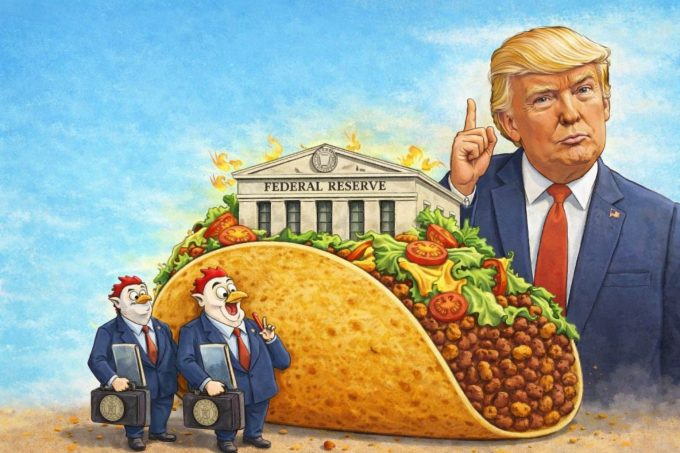
President Trump’s attacks on the independence of the Federal Reserve – the US central bank – have ratcheted up significantly in recent weeks. For the past year (and indeed during much of his first term) Trump has made no secret of his frustration that the chairman, Jerome Powell (who Trump himself originally nominated) has not been sufficiently aggressive in cutting interest rates. With midterm elections now 10 months away, and a number of Republican Congressmen retiring rather than risk being dragged down by an unpopular president, Trump is clearly desperate to give the economy a boost.
It is in this context that, last weekend, Powell released a video statement in which he revealed that the Department of Justice had issued subpoenas and threatened a criminal indictment against him concerning the renovation of the Fed’s buildings. Powell was clear that he saw this move as a naked political attack in retaliation for the Fed’s reticence to lower rates further. Trump himself has denied any knowledge of the actions of the DoJ, but readers can make up the own minds about how credible that denial is. For good measure, he has said Powell must be “either crooked or incompetent”.
A term that has gained prominence in recent months (to the extent of having its own Wikipedia page!) is TACO, standing for Trump Always Chickens Out. This refers to the idea that Trump talks a big game but, when the going gets tough, backs off sufficiently to allow time for markets to rebound and negotiations to proceed – exemplified by his “Liberation Day” tariff announcements in April being paused and then slashed.
The market’s hope is that the president’s attacks on the Fed will follow a similar pattern. However, he is aware of this reputation (and indeed the acronym, which he calls “nasty”) and at some point, it feels inevitable that he is going to follow through on his threats, consequences be damned. If that happens in this case, we could be in for a very bumpy 2026 and beyond.
Indeed, whatever happens with Powell, it may just be a matter of time before Trump gets his way. The current chairman’s term ends in May, and it seems a safe bet that the president will appoint a more pliant replacement – some have even suggested that the point of this attack is to intimidate Powell’s successor. So, what would happen if the US cut interest rates aggressively later this year, by more than the economic data would justify? Within the world of investment companies, who would be the winners and losers?
The immediate market reaction would likely include a steepening of the yield curve (longer term interest rates would rise faster than short term rates, implying higher inflation in the future). Short rates could collapse under political pressure, but longer-dated yields would rise to compensate for renewed inflation risk and a lack of confidence in the Fed’s independence. The result could be a mirror of the pre-Global Financial Crisis conditions of 2006: a credit boom fuelled by financial deregulation and cheap money. Indeed, such a boom before the US midterm elections in November would seem to be the explicit aim of the president, who has also recently called for a “one year cap on credit card interest rates of 10%”.
Such booms are, however, inevitably followed by busts once reality reasserts itself. And even before such a reversal, we should expect rising US inflation expectations and a weaker dollar. All this would drive investors towards defensive assets. Therefore, gold and other precious metals – already on something of a tear for the past two years – could rally further. Amongst trusts, the likes of Golden Prospect Precious Metals (GPM), CQS Natural Resources Growth and Income (CYN) and BlackRock World Mining (BRWM) should benefit, be that from NAV performance, a narrowing of their discounts (or move to a premium) or both.
Funds investing in infrastructure are also generally viewed as defensive holdings, and their contracts are often inflation-linked. Therefore, such an environment should also be positive for the likes of Ecofin Global Utilities and Infrastructure (EGL) and Pantheon Infrastructure (PINT). EGL focuses on listed utilities and infrastructure companies worldwide, providing a liquid way to gain inflation-sensitive, income-generating exposure to essential service providers. PINT also offers diversified exposure to global infrastructure assets, with inflation-linked revenues and long-term contractual cash flows that tend to perform well in periods of rising prices and economic uncertainty.
In contrast, US debt funds and bond ETFs could find this backdrop considerably tougher. Rising inflation expectations and a steeper yield curve would weigh on long-duration bond portfolios, while concerns over policy credibility might dent confidence in Treasuries as a safe haven. Inflation-linked or short-duration debt funds might be better placed, but the asset class as a whole would likely lag more defensive real-asset investments.
Within equities, we would be likely to see a move away from US-focused funds, as other developed markets appeared more attractive on a relative basis – both due to lower inflation expectations and concerns about the independence of the central bank and other state institutions. As an indicator of how unusual recent events have been, 11 senior figures within the central banking community, including the heads of the European Central Bank, Bank of England, and Bank of Canada, have released a statement declaring “full solidarity” with Powell, and underlining the importance of independent interest rate decisions.
Recent years have generally been characterised by outperformance of the US equity market, driven by its dominant technology sector. However, 2025 was a rare instance of the US market underperforming both UK and global equities, and it would be reasonable to think that this new divergence could repeat. Indeed, bond giant Pimco’s chief investment officer has suggested that investors will likely switch assets away from the US. In future years, investors might be better off holding a truly global fund like AVI Global Trust (AGT) than one focused more narrowly on the US.
That also suggests a weak dollar, which has often been associated with outperformance in emerging markets. Last year, Fidelity Emerging Markets (FEML) topped the global emerging performance table with a NAV return of 52%, about 30 percentage points more than the best-performing global trust, which was Scottish Mortgage. Could FEML be in for another bumper year?
Markets have long learned to tune out political theatre, but if Trump’s pressure finally bends the Fed to his will, the consequences could prove far more enduring than the headlines. A loss of central bank independence would ripple across bond markets, currencies, and investor sentiment worldwide. It could also call into doubt the long-term sustainability of the US’s “exorbitant privilege”, where the country enjoys a unique economic advantage due to the dollar’s status as the world’s dominant reserve and trading currency. In that environment, owning assets tied to real value – infrastructure, commodities, and inflation-linked income – may be a prudent response.