
Delivering on its promises
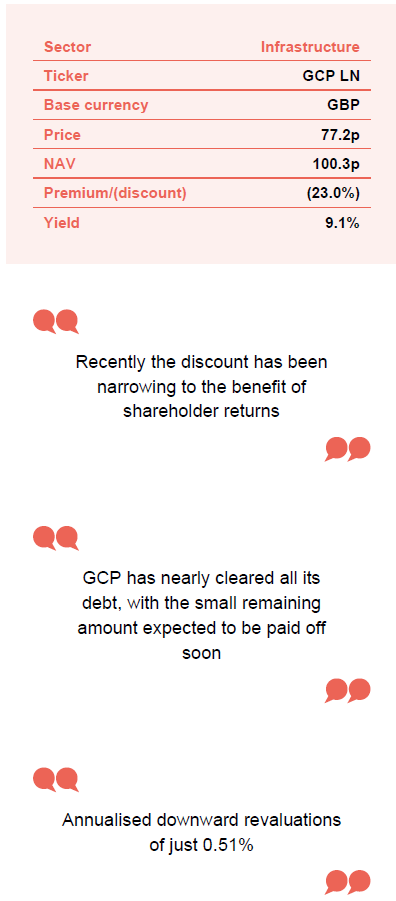
GCP Infrastructure (GCP) is now over 15 years old. Investors who joined at IPO have already received back their full investment through dividends. The NAV has stayed fairly stable, and from launch to December 2025, GCP delivered a total NAV return of 187%. Despite this strong record, GCP’s shares have traded at a wide discount to NAV for several years, which has pushed the dividend yield up to 9.1%.
For the past two years, GCP has been selling assets to cut debt, fund share buybacks, and improve its risk/reward profile. A recent deal, if completed, will repay £47.5m of loans secured against social housing, bringing total repayments to about £128m towards a £150m target. GCP has nearly cleared all its debt, with the small remaining amount expected to be paid off soon. The company has also bought back £24m of shares, nearly halfway to its £50m target. Its adviser, Gravis Capital Management, has identified a further £200m pipeline of possible asset sales.
Public-sector-backed, long-term cashflows
GCP aims to provide shareholders with sustained, long-term distributions and to preserve capital by generating exposure primarily to UK infrastructure debt or similar assets with predictable long-term cashflows.
At a glance
Share price and discount
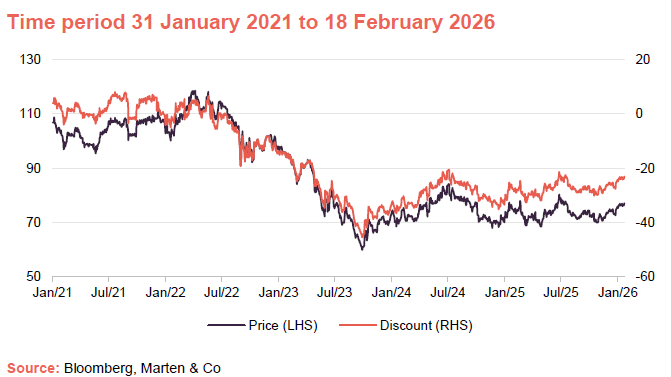
Progress with disposals and buybacks under the capital allocation programme should have contributed to a reduction in GCP’s share price discount to net asset value (NAV) as should cuts to interest rates over the last few quarters and the – albeit partial – resolution to the cost disclosure issue. However, we do not believe that these positives are yet fully reflected in the discount, which should continue to narrow from here.
Performance over five years
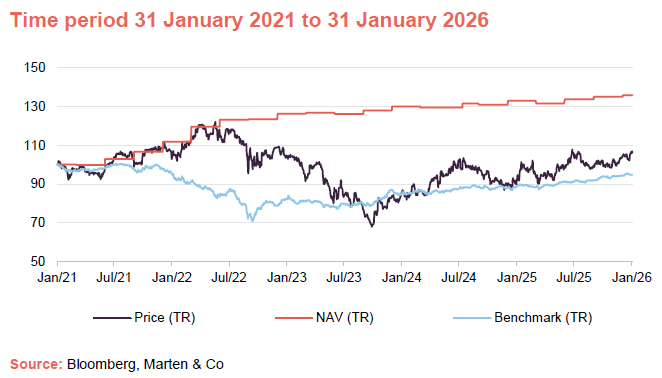
GCP continues to deliver steady progress in its NAV total return and has delivered returns well-ahead of sterling corporate bonds over the past five years.
For shareholders, the main problem has been the widening of the discount that occurred over 2022. Fortunately, more recently the discount has been narrowing again to the benefit of shareholder returns.
| Year ended | Share price total return (%) | NAV total return (%) | Earnings1 per share (pence) | Adjusted2 EPS (pence) | Dividend per share (pence) |
|---|---|---|---|---|---|
| 30/09/2021 | (7.9) | 7.2 | 7.08 | 7.90 | 7.0 |
| 30/09/2022 | 3.8 | 15.8 | 15.88 | 8.33 | 7.0 |
| 30/09/2023 | (25.2) | 3.7 | 3.50 | 8.58 | 7.0 |
| 30/09/2024 | 28.2 | 2.2 | 2.25 | 7.09 | 7.0 |
| 30/09/2025 | 0.9 | 3.1 | 2.15 | 6.73 | 7.0 |
Source: Bloomberg, GCP, Marten & Co. Note 1) EPS figures taken from 30 September each year. Note 2) As disclosed by the company
Company profile – regular, sustainable, long-term income
More information is available on the trust’s website
GCP Infrastructure Investments Limited (GCP) is a Jersey-based investment company listed on the London Stock Exchange. GCP aims to deliver regular, long-term income and protect investors’ capital by lending mainly at fixed rates to organisations with UK public-sector-backed income. The company seeks inflation protection where possible.
GCP’s portfolio is spread across various infrastructure sectors, including renewable energy projects (with income from subsidies and power sales), PFI/PPP assets (with revenue based on asset availability), and specialist supported social housing (where local authorities rent adapted homes for people with special needs).
Gravis Capital Management Limited (Gravis) acts as GCP’s investment adviser, led by CEO Philip Kent. The board is targeting a total dividend of 7.0p per share for the year ending 30 September 2026.
In December 2023, GCP introduced a new capital allocation policy focused on reducing debt, improving risk-adjusted returns, and returning capital to shareholders through share buybacks.
Opportunities to provide an attractive dividend yield from a relatively low risk portfolio
As GCP’s capital allocation policy develops, its main aim remains to offer an attractive dividend yield from a low-risk portfolio. The infrastructure sector is less sensitive to economic cycles, as it provides essential services. This leads to steady and reliable cash flows that are less linked to wider market movements. GCP focuses on debt investments, which sit higher in the capital structure than equity and offer extra protection. Since launch, annualised downward revaluations of GCP’s investments have averaged just 0.51%. This figure would likely be even lower without the impact of ultra-low interest rates. GCP’s loans are secured against assets, improving recovery rates if defaults occur.
With higher interest rates, GCP can more easily meet its target returns while lowering risk. The investment adviser is working to improve the risk profile by making the portfolio more debt-focused, reducing valuation volatility, and aiming to exit the supported living sector and reduce equity-like exposures, rather than chasing ever-higher returns.
The current focus is on reducing GCP’s discount, as buying back shares now offers a better risk-adjusted return than making new investments. However, this may change as conditions shift. GCP has a wide range of potential opportunities, and when the returns are attractive, most investors will likely support new investments.
Governments facing budget constraints need private sector help to replace ageing infrastructure, meet decarbonisation targets, and digitalise economies. GCP is well positioned to contribute to these efforts.
Market backdrop
Interest rates
UK interest rates have dropped since July 2025, as shown in Figure 1. Recent budget measures have eased concerns about government finances. The Bank of England cut its base rate to 3.75% in December 2025, and with four out of nine Monetary Policy Committee members recently voting for a further cut to 3.5%, another reduction could happen soon..
Figure 1: Shift in UK yield curve since end July 2025

Source: Bloomberg
For GCP, changes in medium-to-long-term interest rates are more significant. As of December 2025, the portfolio had an average life of 11 years and a weighted average yield of 8%.
Inflation
UK inflation has eased but recently the CPI has stayed between 3.0% and 4.0%. Many economists expect inflation to drop sharply in the coming months, which could support more interest rate cuts. At the end of December 2025, 49% of GCP’s portfolio had some form of inflation protection offers some defence if inflation remains higher than expected. Figure 14 on page 10 shows how GCP’s NAV could change with different inflation assumptions.
Figure 2: UK inflation – CPI and RPI

Source: ONS, Marten & Co
UK infrastructure plan
In June 2025, the UK government announced a 10-year strategy for economic, housing, and social infrastructure, with £725bn of planned government funding. The plan also aims to attract additional private investment to make the most of public funds. While the figures and timelines may be optimistic, the strategy highlights the need for more UK infrastructure investment and shows the government cannot fund this alone.
Cost disclosures
Misleading cost disclosure, which contributed to GCP’s discount, has been partly addressed. The FCA’s new rules on consumer composite investments should make it easier for investors to assess investment companies. However, MiFID regulations still require wealth managers to provide customers with misleading information, and the FCA is reviewing this. Gravis played a key role in pushing for cost disclosure reform.
Asset allocation
As of 31 December 2025, GCP’s portfolio held 47 investments, down from 48 at the end of June. The average annual yield for the year was 8.0%, up slightly from 7.9%. The portfolio’s weighted average life remained at 11 years.
Figure 3: Split of the portfolio at 31 December 2025

Source: GCP Infrastructure Investments
Since the end of June 2025, exposure to PPP/PFI has increased by 2 percentage points. Biomass, gas peaking, hydro-electric, and supported living have each risen by 1 percentage point. In contrast, Solar has fallen by 3 percentage points, while onshore wind and anaerobic digestion are both down by 1 percentage point.
Figure 4: Sector allocation at 31 December 2025

Source: GCP Infrastructure Investments
Figure 5: Security allocation at 31 December 2025

Source: GCP Infrastructure Investments
Since June 2025, GCP’s equity exposure has dropped from 5% to 4% of the portfolio. This reduction was a goal of the capital recycling programme, which also aimed to lower exposure to social housing. The recently announced contract exchange marks significant progress towards this.
Figure 6: GCP sources of income as at 31 December 2025

Source: GCP Infrastructure Investments
Top 10 investments
Figure 7: GCP’s 10 largest investments as at 31 December 2025
| % of total assets 31/12/25 | Cashflow type | Project type | |
|---|---|---|---|
| Cardale PFI | 14.3 | Unitary charge | PFI/PPP (18 underlying assets) |
| Gravis Solar 1 | 9.2 | ROC/FiT | Commercial solar |
| GCP Programme Funding S14 | 5.7 | ROC/RHI/Merchant | Biomass |
| GCP Programme Funding S10 | 5.5 | Lease | Supported Living |
| GCP Bridge Holdings | 5.3 | ROC/PPA | PPE – Energy-from-waste / Energy efficiency |
| GCP Biomass 2 | 4.7 | ROC/PPA | Biomass |
| GCP Social Housing 1 B | 4.4 | Lease | Supported living |
| Gravis Asset Holdings H | 3.9 | ROC/RHI | Onshore wind |
| GCP Green Energy 1 | 3.7 | ROC/PPA | Commercial solar/onshore wind |
| GCP Rooftop Solar Finance | 3.6 | FiT | Rooftop solar |
Source: GCP Infrastructure Investment
We have long recognised that simply listing GCP’s holdings gives limited insight into the portfolio’s underlying features. To help with this, GCP has launched an investor portal called Carapace, where registered users can explore the portfolio in more detail. Interested readers can request access through GCP’s website.
Figure 8: Top 10 revenue counterparties as at 30 September 2025
| Firm | % of total portfolio |
|---|---|
| Ecotricity Limited | 10 |
| Npower Limited | 7 |
| Viridian Energy Supply | 7 |
| Statkraft Markets GmbH | 6 |
| Bespoke Supportive Tenancies Limited | 6 |
| Good Energy Limited | 4 |
| Gloucestershire County Council | 4 |
| Engie Power Limited | 4 |
| Power NI Energy Limited | 4 |
| Smartestenergy Limited | 3 |
Source: GCP Infrastructure Investments
Figure 9: Top 10 project service providers as at 30 September 2025
| Firm | % of total portfolio |
|---|---|
| WPO UK Services Limited | 19 |
| PSH Operations Limited | 13 |
| Solar Maintenance Services Limited | 10 |
| A Shade Greener Maintenance | 10 |
| Vestas Celtic Wind Technology Limited | 7 |
| Cobalt Energy Limited | 5 |
| Veolia ES (UK) Limited | 5 |
| Urbaser Limited | 4 |
| Gloucestershire County Council | 4 |
| Burmeister and Wain | 3 |
Source: GCP Infrastructure Investments
Recent investment activity
GCP made no new investments in its 2025 financial year but provided £24.7m in follow-on funding to existing borrowers. By mid-December, at the time of the annual report, GCP had added a further £1.7m in follow-on investments.
Figure 10: Outflows (investments) 12 months to end September 2025

Source: Gravis Capital Partners
Figure 11: Inflows (repayments) 12 months to end September 2025

Source: Gravis Capital Partners
Reflecting progress in its capital recycling programme, GCP saw inflows well above outflows. In FY25, GCP received £48.5m from scheduled principal repayments and an additional £27.7m from unscheduled prepayments of principal. After the period end and up to mid-December, GCP received a further £4.4m in cash inflows.
The recent deal in supported housing
On 2 February 2026, GCP announced that some borrowers had agreed to sell properties leased to registered providers of supported social housing. If these sales complete, they will repay £47.5m of loans and provide £43m in immediate cash, after accounting for deferred amounts.
The sale matches the valuation of these loans in GCP’s end September 2025 NAV. The loans being repaid cover most of GCP Programme Funding 1 Ltd Series 1, GCP Social Housing 1 Ltd D, and two thirds of GCP Social Housing 1 Ltd B. About a third of the loans in this vehicle relate to accommodation leased to MySpace, which was not part of the sale.
Further sales from this part of the portfolio are expected later in the year.
Capital recycling
The investment adviser has identified a strong pipeline of potential asset sales that will reshape the portfolio and release capital for the capital recycling programme. As of 30 September 2025 (before the latest deal), the pipeline included two portfolios of supported living assets (33 and 55 properties), a large onshore wind farm, operational and ready-to-build solar assets, gas-to-grid anaerobic digestion plants, and an equity stake in a biomass plant. There are also opportunities to refinance ground-mounted solar projects and a biomass project.
If all planned sales go ahead, the average loan life in the portfolio would fall from 11 to eight years, while the average annual yield would rise from 8.0% to 8.3%.
Conservative assumptions
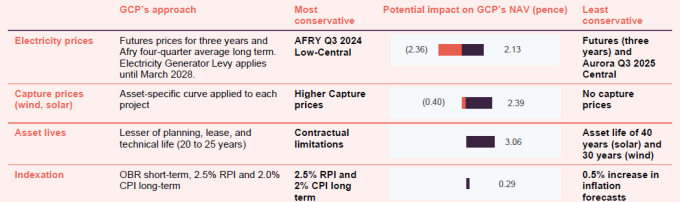
Figure 12 shows the main assumptions behind the cash flow forecasts for the company’s renewable assets and compares them to those seen in the wider market. GCP’s investment adviser usually takes a cautious approach, while the chart also shows more optimistic assumptions that others might use.
If GCP used the most conservative assumptions across all categories, the NAV at the end of September would have been 98.64p instead of 101.40p. Using the least conservative assumptions would have increased the NAV to 109.27p.
Figure 12: Valuation assumptions as at 30 September 2025
Source: GCP Infrastructure Investments
Sensitivities
The investment adviser includes a sensitivity analysis for its forecast cash flows. Figures 13 and 14 show how changes in power prices and inflation affect its base case.
Sensitivity to power prices has decreased further. In January 2025, a 10% drop in prices would have reduced NAV by 9.1p. By August 2025, this fell to 4.7p, and it is now 4.0p.
Figure 13: Impact of change in forecast electricity prices

Source: GCP Infrastructure Investments
Figure 14: NAV impact associated with a movement in inflation

Source: GCP Infrastructure Investments
Performance
GCP continues to show steady growth in its NAV total return. As in previous reports, we compare GCP’s returns to sterling corporate bonds, which share some similar risks. Figure 16 shows GCP has outperformed these bonds over the past five years. The main issue for shareholders has been the wider discount seen in 2022, but this has started to narrow again, improving shareholder returns.
Figure 15: GCP NAV total return

Source: Bloomberg, Marten & Co
Figure 16: GCP NAV total return performance relative to sterling corporate bond performance

Source: Bloomberg, Marten & Co
Figure 17: Cumulative total return performance over periods ending 31 December 2025
| 3 months (%) | 6 months(%) | 1 year(%) | 3 years (%) | 5 years (%) | |
|---|---|---|---|---|---|
| GCP share price | 5.2 | 6.0 | 15.5 | (4.0) | 2.5 |
| GCP NAV | 0.0 | 1.0 | 1.5 | 6.9 | 34.9 |
| Sterling corporate bonds | 2.8 | 3.6 | 7.1 | 19.6 | (6.6) |
Source: Bloomberg, Marten & Co
Drivers of recent performance
Financial year ended 30 September 2025
Figures 18 and 19 show the factors affecting GCP’s performance over the 12-month period ended 30 September 2025.
Figure 18: Positive factors affecting FY2025 performance
| Impact (£m) | Impact (pence) | |
|---|---|---|
| Inflation forecast | 6.8 | 0.81 |
| O&M budget update | 3.1 | 0.37 |
| Ofgem audits resolved | 2.5 | 0.30 |
| Other | 3.7 | 0.44 |
| Total | 16.1 | 1.92 |
Source: GCP Infrastructure Investments
The main boost to NAV return came from higher inflation forecasts. Cost savings in GCP’s operations and maintenance also contributed. Additionally, a long-running issue over subsidy entitlements for some solar projects, previously under Ofgem review, has now been resolved.
Figure 19: Negative factors affecting FY2025 performance
| Impact (£m) | Impact (pence) | |
|---|---|---|
| Revaluation of AD portfolio | (38.1) | (4.55) |
| Lower than forecast renewable generation | (15.0) | (1.79) |
| Discount rates | (6.7) | (0.80) |
| Reassessment of likely curtailment of output at Northern Irish wind assets | (3.4) | (0.41) |
| Power price move | (2.0) | (0.24) |
| Other | (1.1) | (0.13) |
| Total | (66.3) | (7.92) |
Source: GCP Infrastructure Investments
On the downside, NAV fell due to a reduced long-term availability forecast for a group of anaerobic digestion plants. Despite efforts to make the portfolio less sensitive to power prices and output, generation was lower than expected during this period. In addition, rising gilt yields in Q4 2024 contributed to the decision to increase discount rates.
Factors affecting GCP’s Q4 2025 performance
In Q4 2025, the main factor affecting the NAV was another drop in power price forecasts, reducing the NAV by 0.5p. This ongoing challenge for renewable energy companies was less severe for GCP, which is encouraging. Actual generation helped boost the NAV. The only other notable negative was a 0.53p reduction after the UK government decided to change how subsidies are calculated, switching from RPI to CPI. There was strong opposition to this, and we are concerned this could increase the cost of financing UK infrastructure, as investors may add a risk premium to contracts
Up-to-date information on GCP and its peers is available on the QuotedData website
Peer group
GCP is part of the AIC‘s infrastructure sector. Its main peer is Sequoia Economic Infrastructure, which also focuses on infrastructure debt but has a wider view of what counts as infrastructure. As in previous reports, we include some details on the renewable energy sector, since GCP’s assets are mainly in this area.
Figure 20: GCP peer group comparisons
| Discount (%) | Yield (%) | Market cap (£m) | NAV 1-year (%) | NAV 3-years (%) | NAV 5 years (%) | |
|---|---|---|---|---|---|---|
| GCP | (23.0) | 9.1 | 643 | 2.1 | 2.5 | 6.3 |
| Sequoia Economic Infrastructure | (11.9) | 8.4 | 1,224 | 5.6 | 7.1 | 5.1 |
| Median of other infrastructure peers | (18.5) | 3.8 | 804 | 12.1 | 8.0 | 8.3 |
| Median of renewable energy sector | (40.1) | 11.3 | 293 | (2.5) | (2.1) | 5.2 |
Source: QuotedData website as at 19 February 2026
GCP’s five-year returns are solid compared to its direct and renewable energy peers, with its debt portfolio showing more stability than the equity portfolios of other renewable energy companies. Sequoia has less exposure to renewables than GCP.
Quarterly dividend
Dividends are paid quarterly, and shareholders can choose to receive them in shares instead of cash. For the new financial year, GCP is keeping its target dividend unchanged at 7.0p, the same as the past four years.
Premium/(discount)
Over the 12 months to 31 December 2025, GCP’s shares traded at an average discount of 28.1%, ranging from 21.3% to 35.1%. At the time of writing, the discount was 23.0%. The discount widened mainly due to rising interest rates aimed at controlling inflation, and further selling by funds of funds and wealth managers, influenced by cost disclosure rules discussed earlier. More recently, asset sales, share buybacks, interest rate cuts, and some progress on the cost disclosure issue should have helped narrow the discount. However, we do not believe these factors have fully addressed the issue. The positives are not yet fully reflected in the discount, which is expected to keep narrowing.
As part of its capital recycling programme, GCP bought back £22.8m of shares in the financial year ending 30 September 2025. Since then, over 3 million more shares have been repurchased. In total, 34,610,234 shares have been bought back since the programme began.
Figure 21: GCP discount over five years ending 31 January 2026

Source: Bloomberg, Marten & Co
Structure
Fees and costs
The investment adviser charges an annual fee of 0.9% of the NAV excluding cash, calculated and paid quarterly in arrears. There is no performance fee. The adviser can also receive an arrangement fee of up to 1% of the cost of each new investment, charged to borrowers rather than the company. If any arrangement fee negotiated exceeds 1%, the excess goes to the company. The adviser also receives an annual fee of £70,000 (adjusted for RPI), which was £92,000 for the 2025 financial year, for acting as AIFM. The advisory agreement can be ended by either party with 24 months’ written notice.
Capital structure and life
As of 18 February 2026, GCP has 884,797,669 ordinary shares outstanding, of which 51,595,253 are held in treasury. The number of shares with voting rights is 833,202,416.
GCP has no fixed end date and does not hold regular continuation votes. Its financial year ends on 30 September, and AGMs take place in February.
Gearing
Structural gearing of investments is allowed up to 20% of NAV after new debt is drawn. However, GCP has focused on reducing debt and had net gearing of only 1.2% at the end of December 2025
Board
The GCP board has six non-executive, independent directors. In the past year, Heather Bestwick and Ian Brown joined the board, replacing Julia Chapman and Michael Gray.
Figure 22: Board members, fees, and shareholdings
| Director | Role | Date appointed | Length of service (years) | Annual fee£’000s | Shareholding |
|---|---|---|---|---|---|
| Andrew Didham | Chairman and chair of nomination committee | 17/12/2021 | 4.2 | 99 | 176,414 |
| Heather Bestwick | Senior independent director | 29/04/2025 | 0.8 | 55 | |
| Steven Wilderspin | Chair of the audit and risk committee | 10/02/2021 | 5.0 | 76 | 15,000 |
| Dawn Crichard | Chair of the management engagement committee and chair of the ESG committee | 16/09/2019 | 4.4 | 76 | 94,472 |
| Alex Yew | Chair of the investment committee | 01/11/2022 | 3.3 | 73 | 100,000 |
| Ian Brown | Non-executive director | 13/02/2025 | 1.0 | 51 | 46,116 |
Source: Marten & Co
Andrew Didham (chairman)
Andrew Didham, a UK resident, is a Fellow of the Institute of Chartered Accountants in England and Wales. A senior executive director with extensive board‑level experience in the Rothschild Banking group, Andrew was group finance director for 16 years and a member of the group management of the worldwide Rothschild business, comprising investment banking, wealth management, asset management and merchant banking activities. He serves on the boards of IG Group Holdings Plc and Shawbrook Group Plc as a non‑executive director and audit committee chairman. Within Rothschild, he remains an executive vice chairman, presently on a part-time basis. Formerly, he served as a non-executive director of Charles Stanley Plc and Jardine Lloyd Thompson Group Plc and, prior to joining Rothschild & Co, he was a partner in the London office of KPMG with responsibility for the audit of a number of global financial institutions and assignments for various government and regulatory authorities.
Heather Bestwick (senior independent director)
Heather Bestwick, a Jersey resident, is a qualified solicitor with over 30 years’ experience in the financial services sector. Since 2014, she has acted as an independent non-executive director of a number of investment funds and corporate services providers.
Heather is currently a non-executive director on the boards of EPE Special Opportunities Limited, an AIM listed company, and Rathbones Investment Management International Limited, the Jersey subsidiary of Rathbones Group Plc. She qualified as a solicitor with Norton Rose in London and worked in their London and Greek offices for eight years, specialising in shipping finance. Heather subsequently joined global offshore law firm Walkers in the Cayman Islands, qualifying as a Cayman Islands attorney and notary public, and became a partner in 2003. She moved to Jersey in 2007 to become a managing partner in the Walkers Jersey office, following which she served for three years as deputy chief executive and technical director of Jersey Finance Limited.
Steven Wilderspin (chair of the audit and risk committee)
Steven Wilderspin, a Jersey resident, is a Fellow of the Institute of Chartered Accountants of England & Wales. Since 2007, he has acted as an independent director on a number of public and private investment funds and commercial companies.
Steven is a non‑executive director of Henderson Far East Income Limited, a non-executive director and chair of the audit and risk committee of HarbourVest Global Private Equity Limited, and a non-executive director of Phoenix Spree Deutschland Limited. Prior to 2007, he was a director at Maples Finance Jersey, with responsibility for their fund administration and fiduciary business. Steven began his career at PwC in London in 1990.
Dawn Crichard (chair of the management engagement committee)
Dawn Crichard, a Jersey resident, is a Fellow of the Institute of Chartered Accountants of England and Wales with over 25 years’ experience in senior chief financial officer and financial director positions. Having qualified with Deloitte, she moved into the commercial sector and was chief financial officer of a large private construction group for 12 years. Dawn then worked with both private and listed clients in the hedge fund division of State Street. Following this, she was appointed as chief financial officer for Bathroom Brands Plc, and was later head of finance at a substantial multinational family office, including establishing and overseeing high-value private expert funds. Her broad accounting and commercial experience includes establishing new group head offices, mergers, acquisitions, refinancing and restructuring.
Alex Yew (chair of the investment committee)
Alex Yew, a UK resident, has more than 25 years of experience as a lawyer, banker and investor. He is a qualified solicitor in Singapore, England and Wales. Alex currently holds a number of non-executive roles in infrastructure, energy, and energy transition. Prior to this, he was a senior adviser and a senior managing director at John Laing, an international investor in infrastructure and energy assets. Alex worked at John Laing for more than 14 years, during which time he held leadership positions in project finance, new markets, strategy, and partnerships, and was regional head of the European and Latin American businesses. He was also a member of the senior leadership team and the investment committee. Prior to John Laing, Alex was a director in the infrastructure advisory team at CIBC World Markets in London. He was also a banker and lawyer in Southeast Asia before he moved to the UK.
Ian Brown (non-executive director)
Ian Brown, a UK resident, is a banker and investor with over 35 years’ experience. He is currently the head of banking and investments at the UK National Wealth Fund (formerly the UK Infrastructure Bank) where he sits on the Fund’s executive, valuation, risk, and investment committees. In August 2025, Ian accepted a temporary appointment as interim CEO of the UK National Wealth Fund until Oliver Holbourn was permanently appointed on 1 November 2025. Before this role, he was head of private markets at LGPS Central, where he was responsible for the establishment and investment of a number of infrastructure, private equity and private credit funds of funds. Prior to LGPS Central, Ian held senior leadership roles at Lloyds Banking Group and was a member of Lloyds’ credit committee for 14 years. He joined Lloyds from UBS, where he was a managing director in the leveraged and acquisition finance business.
SWOT and bull vs. bear analysis
Figure 23: SWOT analysis
| Strengths | Weaknesses |
|---|---|
| Diversified portfolio across a range of infrastructure subsectors and borrowers | Relatively illiquid portfolio |
| Public-sector backed cashflows | Historically, GCP has exhibited more sensitivity to factors such as power prices than might be expected of a debt fund |
| Low gearing | Need to tackle persistent wide discount is preventing it from making new investments |
| Responds positively to higher inflation | |
| Conservative valuation assumptions | |
| Opportunities | Threats |
| Discount narrowing potential | Rising UK interest rates |
| Government needs private capital to fund infrastructure | While discount persists, vulnerable to activist investors |
Source: Marten & Co
Figure 24: Bull versus bear case
| Bull | Bear | |
|---|---|---|
| Performance | Despite the odd setback, NAV has been relatively stable since launch | NAV returns have been on the low side in recent years, dragging down long-term averages |
| Dividends | Dividend looks increasingly reliable and headline yield is very attractive | Dividend cut in 2020 |
| Outlook | Should be set fair if it can continue to deliver on its capital recycling programme | Still some sensitivity to falling power prices |
| Discount | Discount appears to be on narrowing trend and there is more to go for | If confidence in UK economy and government finances worsened, discount could widen again |
Source: Marten & Co
Previous publications
Readers interested in further information about GCP may wish to read our previous notes.
Figure 25: QuotedData’s previously published notes on GCP
Source: Marten & Co
IMPORTANT INFORMATION
Marten & Co (which is authorised and regulated by the Financial Conduct Authority) was paid to produce this note on GCP Infrastructure Investments Limited.
This note is for information purposes only and is not intended to encourage the reader to deal in the security or securities mentioned within it. Marten & Co is not authorised to give advice to retail clients. The research does not have regard to the specific investment objectives financial situation and needs of any specific person who may receive it.
The analysts who prepared this note are not constrained from dealing ahead of it but, in practice, and in accordance with our internal code of good conduct, will refrain from doing so for the period from which they first obtained the information necessary to prepare the note until one month after the note’s publication. Nevertheless, they may have an interest in any of the securities mentioned within this note.
This note has been compiled from publicly available information. This note is not directed at any person in any jurisdiction where (by reason of that person’s nationality, residence or otherwise) the publication or availability of this note is prohibited.
Accuracy of Content: Whilst Marten & Co uses reasonable efforts to obtain information from sources which we believe to be reliable and to ensure that the information in this note is up to date and accurate, we make no representation or warranty that the information contained in this note is accurate, reliable or complete. The information contained in this note is provided by Marten & Co for personal use and information purposes generally. You are solely liable for any use you may make of this information. The information is inherently subject to change without notice and may become outdated. You, therefore, should verify any information obtained from this note before you use it.
No Advice: Nothing contained in this note constitutes or should be construed to constitute investment, legal, tax or other advice.
No Representation or Warranty: No representation, warranty or guarantee of any kind, express or implied is given by Marten & Co in respect of any information contained on this note.
Exclusion of Liability: To the fullest extent allowed by law, Marten & Co shall not be liable for any direct or indirect losses, damages, costs or expenses incurred or suffered by you arising out or in connection with the access to, use of or reliance on any information contained on this note. In no circumstance shall Marten & Co and its employees have any liability for consequential or special damages.
Governing Law and Jurisdiction: These terms and conditions and all matters connected with them, are governed by the laws of England and Wales and shall be subject to the exclusive jurisdiction of the English courts. If you access this note from outside the UK, you are responsible for ensuring compliance with any local laws relating to access.
No information contained in this note shall form the basis of, or be relied upon in connection with, any offer or commitment whatsoever in any jurisdiction.
Investment Performance Information: Please remember that past performance is not necessarily a guide to the future and that the value of shares and the income from them can go down as well as up. Exchange rates may also cause the value of underlying overseas investments to go down as well as up. Marten & Co may write on companies that use gearing in a number of forms that can increase volatility and, in some cases, to a complete loss of an investment.