
On the right side of AI
The rapid progress of AI has raised legitimate concerns over the durability of parts of the software sector, weighing on several private equity trusts with exposure to the sector. We believe this to be overdone in the case of Oakley Capital Investments (OCI), which appears well positioned to benefit from the next phase of AI adoption.
OCI’s portfolio is concentrated in businesses whose competitive advantage is supported by proprietary data, specialist information and deep domain expertise. For companies such as vLex, IU Group and TechInsights, the manager believes AI is more likely to be an accelerant than a disruptor, increasing underlying value. At the same time, OCI is also building direct exposure to AI-native businesses through its partnership with Touring Capital.
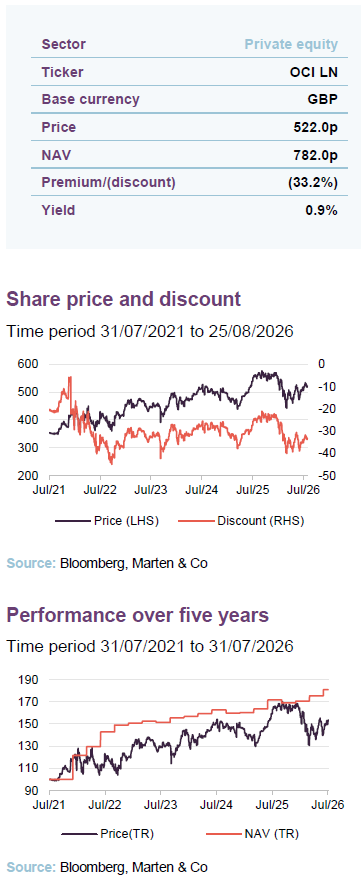
Portfolio fundamentals remain robust, with a 6.0% NAV total return in H1 2026 (80% of portfolio performance was driven by earnings growth), despite a challenging macro and geopolitical backdrop. We believe resilient earnings growth, continued capital deployment, AI-related value creation, and ongoing buybacks provide a compelling basis for a narrowing of the discount, which has widened to 33.2%.
Consistent long-term returns from private equity
OCI aims to deliver consistent long-term returns above the FTSE All-Share Index by providing exposure to private equity, where value is driven by market growth, consolidation and performance improvement.
| Year ended | Share price TR (%) | NAV total return (%) | LPX Europe TR (%) | MSCI UK TR (%) | MSCI World TR (%) |
|---|---|---|---|---|---|
| 31/07/2022 | 23.3 | 42.9 | (21.3) | 12.0 | 3.9 |
| 31/07/2023 | 4.4 | 6.0 | (5.5) | 6.8 | 8.0 |
| 31/07/2024 | 19.2 | 7.5 | 21.1 | 13.5 | 19.1 |
| 31/07/2025 | 6.3 | 5.5 | 2.6 | 12.7 | 12.8 |
| 31/07/2026 | (5.8) | 5.4 | (6.9) | 23.6 | 18.7 |
About OCI
OCI gives shareholders access to private equity investments made by Oakley Capital (Oakley), which focuses on high-growth European companies with enterprise values of €100m-€1bn+. Oakley has delivered strong returns, with NAV and share price growth of around 90% and 110%, respectively, over the five years to end-2025.
Performance has been driven by earnings growth, with average portfolio EBITDA increasing 11% in 2025, following 15% in 2024.
Partnering with business founders in four key sectors – technology, consumer, education and business services
Oakley takes controlling stakes in companies across four sectors: technology, consumer, education, and business services. It targets businesses that it considers to be benefitting from structural trends including digital complexity, AI adoption, regulation, outsourcing, and rising demand for quality education.
Oakley primarily partners with founders, with 77% of investments being founder-led. This provides proprietary deal flow, with 72% of investments being completed without a competitive auction, helping avoid inflated entry valuations. Founders and management have also invested more than €250m alongside Oakley, aligning interests.
First through the door
Oakley is often the first institutional investor in its portfolio companies, combining capital with operational expertise to accelerate growth. Its control positions enable value creation through bolt-on acquisitions (more than 350 completed), management enhancement, business transformation and greater use of recurring revenues. An in-house portfolio team provides support across areas including capital markets, data analytics, AI, talent and sustainability analytics.
Sharing ideas in areas such as AI
OCI also has exposure to Oakley’s Touring Fund, which invests in AI-enabled software businesses at the Series B and C stages. Insights from these investments are shared across the wider portfolio, helping identify new growth opportunities.
OCI’s NAV grew 6% in 2025 (3% excluding foreign exchange), reflecting Oakley’s conservative valuation approach and relatively young portfolio. Around 35% of year-end NAV was invested over the past two years, with these newer investments expected to deliver stronger EBITDA growth and valuation uplifts as they mature.
Market backdrop
Software business models under the microscope
AI’s rapid progress, which has seen the capability of reasoning models and AI agents improve materially with every new iteration, has put the strength of software companies’ business models under the microscope – heightened by the launch of Anthropic’s Claude Cowork in early 2026. Enterprise software companies have created value by digitising business processes and embedding themselves within customers’ daily workflows. Increasingly, however, AI models can navigate those workflows directly, completing complex tasks autonomously. As a result, investors are questioning whether some application-layer software risks are becoming commoditised.
Software performance has become increasingly polarised. Businesses whose competitive advantage rests primarily on workflow automation face growing doubts over long-term pricing power. By contrast, companies possessing proprietary datasets, specialist intellectual property or deeply-embedded domain expertise appear strengthened. OCI’s manager argues that AI increases enterprise data reliance rather than replacing it, and therefore is enhancing the value of these businesses. This distinction is yet to be properly reflected in public markets, but the manager believes it should start to be so once their “AI accelerant” characteristics are monetised.
Software sector polarised, with the value of proprietary data, specialist info or market expertise enhanced by AI
Much of OCI’s software exposure, which makes up about 20% of the wider portfolio, possess a competitive advantage from proprietary content, specialist information or vertical market expertise. The manager says that these characteristics are becoming increasingly valuable in an AI-enabled world.
vLex
Portfolio company vLex provides a good example. LegalTech valuations were hit hard in the aftermath of the Claude release earlier this year because, at first glance, legal research appears the type of activity that generative AI might easily disrupt. Instead, OCI’s manager insists, AI has strengthened the competitive position of businesses possessing the deepest proprietary legal datasets.
AI transformed vLex’s proprietary dataset into powerful competitive moat
vLex’s legal library exceeds one billion documents, helped by the acquisition of Fastcase in 2022. Under Oakley’s stewardship, the company launched Vincent AI, an AI-powered legal workflow platform built upon that proprietary content. The value proposition does not lie in the underlying large language model, but in the unique corpus of structured legal information supporting it. Lawyers use Vincent AI to prepare cases faster, generate comprehensive arguments, and test multiple legal strategies for different jurisdictions. Today, the company serves the majority of the Am Law 100 (a ranking of the largest law firms in America). AI transformed vLex’s proprietary dataset from a valuable database into a powerful competitive moat. The company’s subsequent sale to Clio at a US$1bn valuation demonstrated the strategic value attached to combining proprietary information with AI-enabled workflows.
IU Group
AI being deployed to improve educational outcomes
A similar dynamic is evident elsewhere across OCI’s portfolio. At IU Group, AI is being deployed to improve educational outcomes through personalised learning support, student engagement and operational efficiency, complementing rather than replacing the educational experience. Education remains fundamentally dependent upon trusted content, accreditation and human interaction, with AI acting as an enhancer rather than a substitute.
IU launched AI-powered learning companion Syntea in April 2022, which has become one of the most advanced AI-driven learning platforms and companions in the university space, combining adaptive learning, personalised tutoring, instant feedback, progress tracking, and an intuitive user experience. Its latest advanced version recognises students’ work environments, preferences, and study objectives and aims to guide the student in a multimodal, multi-agent setup through to successful course completion. It has proven to increase both study retention and study progress.
TechInsights
As investment in AI infrastructure has accelerated, demand for semiconductor intelligence has increased
TechInsights represents another beneficiary of this shift. The company provides highly specialised semiconductor intelligence through reverse engineering and technical analysis of advanced chips. As investment in AI infrastructure accelerates, demand for independent semiconductor intelligence has strengthened accordingly. Here the value resides not in an AI application itself, but in highly specialised information that becomes increasingly valuable as technological complexity rises.
As AI continues to evolve, competitive advantage is likely to accrue less to businesses controlling the user interface and increasingly to those owning unique data, trusted content and deeply embedded domain expertise.
Viewed through this lens, OCI’s portfolio appears well positioned. Many of OCI’s investments already possess the characteristics that AI makes more valuable – proprietary datasets, specialist intellectual property, regulated content and enduring customer relationships. The principal risk facing parts of the software sector is not that AI becomes more capable, but that applications become interchangeable. By contrast, businesses controlling the underlying information may become more valuable as AI adoption accelerates. OCI’s investment strategy appears positioned on the right side of that divide.
Tapping into AI expertise across the portfolio
Touring Capital invests in native AI businesses
These portfolio developments have been complemented with dedicated investment in AI-native businesses through its partnership with Touring Capital, a Silicon Valley venture capital manager established to back AI-powered software companies, in which OCI is its largest LP. Investments including CuspAI, which applies AI to accelerate materials discovery, and Parasail, which is developing infrastructure for AI-native cloud computing, provide OCI with exposure to the frontier of AI innovation.
Portfolio company CuspAI has seen its value quintuple in less than a year
CuspAI applies generative AI and computational chemistry to search for materials with particular properties, with applications including semiconductors, batteries and carbon capture. It raised $450m in a Series B in July 2026 at a $2.6bn valuation. Existing investors including Touring Capital (which originally invested in June 2024) participated alongside new backers such as Bezos Expeditions, Kleiner Perkins, NEA, AMD Ventures and the UK’s Sovereign AI Venture Fund. This latest round represented a 5x increase in valuation from a previous financing round in September 2025.
Oakley’s AI Lab supports portfolio companies in applying AI
Oakley is also embedding AI across its own investment platform. It has recently established AI Lab, which is intended to support portfolio companies in identifying practical AI applications, while the company has set up AI forums for portfolio companies involving industry participants including Nvidia, Google and Anthropic.
Management is simultaneously developing AI-powered tools to enhance internal operations including deal origination and market intelligence, which it says should improve decision-making throughout the investment process.
Asset allocation
At 30 June 2026, OCI had net assets of £1,289m. It had £81m of cash and £74m undrawn credit facilities. At the end of 2025, the underlying portfolio was valued at an average EV/EBITDA ratio of 16.3x (in line with 2024); the EBITDA growth on the portfolio over 2025 was 11% on average; and the net debt/EBITDA ratio was 4.1x (Oakley points out that the industry average is about 5-6x).
Figure 1: Look-through geographic split of portfolio at 30 June 2026
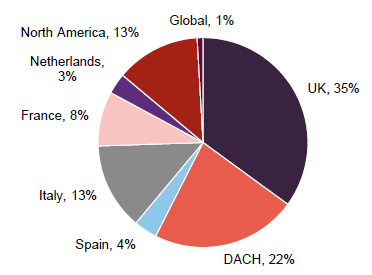
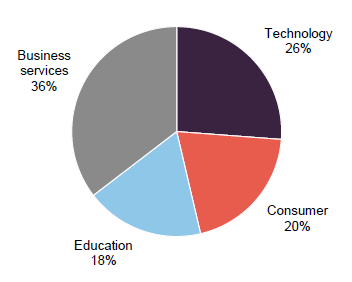
Figure 2: Look-through sector split of private equity funds and direct investment portfolio at 30 June 2026
Funds
Figure 3: OCI by fund at 31 December 2025
| Total size m | Year launched | Overall gross money multiple | Overall gross IRR | OCI commitment €m | OCI outstanding commitment £m | |
|---|---|---|---|---|---|---|
| Fund III | €800 | 2016 | 4.0x | 50% | 326 | 24 |
| Fund IV | €1,460 | 2019 | 2.2x | 24% | 400 | 79 |
| Origin I | €458 | 2021 | 2.0x | 28% | 129 | 15 |
| Fund V | €2,851 | 2022 | 800 | 318 | ||
| Fund VI | €4,500 | 2025 | 500 | 387 | ||
| PROfounders III | €77 | 2022 | 30 | 16 | ||
| Touring | $255 | 2023 | 98 | 26 | ||
| Origin II | €791 | 2023 | 190 | 128 | ||
| Total | 992 |
Figure 3 provides detail on OCI’s commitments by fund – both the original commitment and the amount outstanding at end December 2025, and (where appropriate) the realised returns generated. As at 30 June 2026, OCI’s outstanding commitments had reduced to £940m. The board believes that about £300m of this is not likely to be drawn. The balance should be deployed over the course of the next five years.
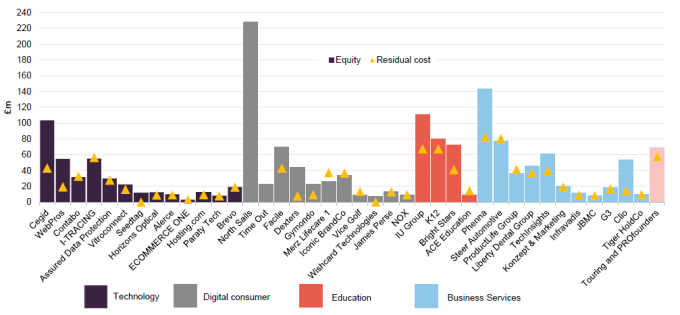
Figure 4: Portfolio split by company as at 31 December 2025
Recent new transactions
Oakley had an extremely busy end to 2025 (which we covered in our previous note). It has been a much quieter 2026 so far. Here, we profile its most recent deals.
Groupe Senef
Oakley announced in March that Origin II had agreed to invest in Groupe Senef, a French provider of cloud-based vertical software solutions for people-intensive services businesses. OCI’s look-through contribution amounted to around £9m.
Founded in 2010 by Momar Mbaye and Tariq Hamadouch, Senef develops mission-critical software for sectors including commercial cleaning, home care, security and hospitality. Its software supports around 2,000 customers, providing solutions across back-office administration, workforce management, payroll, compliance and invoicing. These highly regulated, labour-intensive industries are increasingly adopting modern software platforms and AI-driven automation to improve operational efficiency.
Oakley will support Senef’s next phase of growth through continued investment in product innovation, including AI capabilities, while pursuing selective acquisitions to expand its product offering and market reach. The business will continue to be led by its founders, with former TotalMobile CEO Jim Darragh joining the board as part of the transaction. The investment further strengthens Oakley’s presence in the French software market, following previous investments including Brevo and I-Tracing.
XTEL
Oakley announced in May that Fund VI had agreed to acquire a majority stake in XTEL, a leading provider of revenue management and trade promotion software for consumer packaged goods (CPG) companies. OCI’s look-through contribution via Fund VI is anticipated to be up to £33m.
XTEL’s software enables food, beverage and household goods companies to plan, manage and optimise trade promotions with retailers by analysing complex sales, pricing, customer and financial data. The company serves more than 400 global brands, including Unilever, PepsiCo and Johnson & Johnson, supporting over €350bn of annual trade spend. It operates in an estimated $11bn CPG software market, benefitting from structural growth drivers including retailer consolidation, increasing data availability and growing adoption of AI-driven decision-making. XTEL has delivered approximately a 40% CAGR over the past three years.
Oakley will support XTEL’s continued international expansion, particularly in Latin America and Asia-Pacific, alongside investment in AI capabilities, product development, sales and M&A. The company will continue to be led by CEO Rob Mullen, who has overseen its transition to a SaaS platform and its recent organic and acquisitive growth.
Performance
Figure 5: OCI performance over the five years ended 31 July 2026
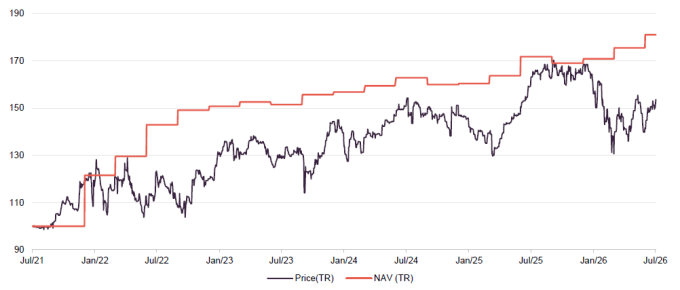
OCI’s share price has been volatile this year, with the Iran war hitting investor sentiment towards private equity exit landscape and the indiscriminate agentic-AI-related software sell-off weighing on valuations. Last year, OCI’s shares performed strongly following the so-called “Liberation Day” in April 2025 as activity in private equity markets picked up and the pace of exits grew.
Figure 6: Cumulative performance over various time periods ended 31 July 2026
| 3 months (%) | 6 months (%) | 1 year (%) | 3 years (%) | 5 years (%) | |
|---|---|---|---|---|---|
| Share price | 8.8 | (1.5) | (5.8) | 19.4 | 53.6 |
| NAV | 3.2 | 6.0 | 5.4 | 19.5 | 81.0 |
| Peer group share price median | 3.4 | (2.7) | 1.2 | 19.1 | 42.8 |
| Peer group NAV median | 0.8 | 1.6 | 1.6 | 12.5 | 41.9 |
| LPX Europe1 | 4.6 | (5.8) | (6.9) | 15.7 | (13.9) |
| MSCI UK | 5.2 | 9.1 | 23.6 | 58.1 | 89.0 |
| MSCI World | 5.3 | 10.3 | 18.7 | 59.5 | 79.0 |
Trading update for six months ended 30 June 2026
6% NAV total return in H1 2026
The company delivered a NAV total return of 6.0% (44p), or 6.5% (48p) excluding the impact of foreign exchange, while total shareholder return was -16%, reflecting discount widening during the first quarter. The NAV uplift was underpinned by continued strong portfolio fundamentals, with 80% of portfolio performance driven by sustained earnings growth and the remaining 20% by valuation multiple expansion, demonstrating the resilience and increasing maturity of the portfolio despite macroeconomic and geopolitical uncertainty.
The largest contributors to performance were Phenna, North Sails, TechInsights and Exaforce, supported by broad-based value creation across the portfolio and successful buy-and-build strategies, particularly within business services.
OCI made look-through investments of £43m during the period, comprising £19m of new platform investments (including Senef, GB1 and Infinity) and £24m of follow-on investments (including K&M, ProductLife Group and ECOMMERCE ONE) to support continued growth across the portfolio.
OCI’s look-through share of proceeds from exits and refinancings totalled £10m during the period. The company also continued to deploy capital through its share buyback programme, repurchasing and cancelling 1.9m shares for £9.4m, enhancing NAV per share by 2.9p, while ending the period with £155m of available liquidity and approximately £640m of investment commitments expected to be drawn over the next five years.
Premium/discount
29.1% average discount over 12 months
Over the 12 months ended 31 July 2026, OCI’s share price discount to NAV ranged between 40.1% and 21.1%, averaging 29.1%. At the time of publishing, the discount was 33.2%.
As mentioned previously in this note, OCI’s share price has been negatively impacted by market weakness over concerns about the disruptive impacts of AI and the conflict in the Middle East. This has seen OCI’s discount widen from 22.5% at the start of the year.
Figure 7: OCI discount over five years ended 31 July 2026
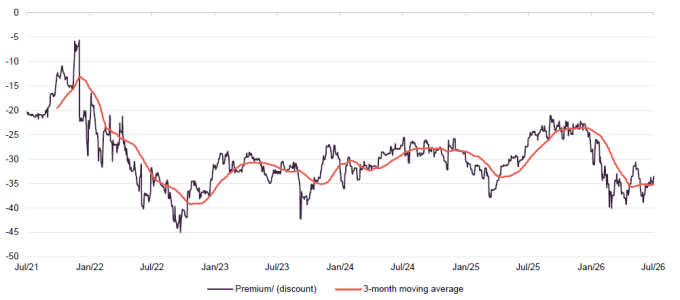
OCI last paid a dividend in April 2025, with the board stating that it believes shareholders would be better served if the funds used to pay the dividend were used for share buybacks instead. It committed to a share buyback programme of at least £20m per annum, and repurchased and cancelled £50m shares in 2025. In the first six months of 2026 it has acquired and cancelled 1.9m shares for an aggregate £9.4m.
SWOT and bull vs. bear analysis
Figure 8: SWOT analysis
| Strengths | Weaknesses |
|---|---|
| Manager’s long-term track record and differentiated investment sourcing. | Weak sentiment to the private equity sector could undermine the buy case for OCI. |
| Robust portfolio earnings growth. | Exposure to software companies perceived to be under threat from AI. |
| Opportunities | Threats |
| Deployment into attractive vintages with lower valuations caused by heightened uncertainty. | The threat of AI to the software sector proves founded, to the detriment of valuations. |
| An improving exit environment. | The exit landscape remains challenged for an extended period of time. |
Figure 9: Bull versus bear case
| Bull | Bear | |
|---|---|---|
| Performance | Strong NAV growth driven by operational improvements, disciplined acquisitions and a differentiated sourcing model. Proven track record of realisations above carrying value supports valuation credibility. | NAV growth slows if portfolio earnings weaken or exit markets remain constrained. Valuations may prove optimistic if market multiples contract further. |
| Dividends | The shift from a nominal dividend to systematic share buybacks should be more accretive to NAV per share while the shares trade at a significant discount. | The removal of the dividend narrows the trust’s appeal to income-focused investors and increases reliance on capital appreciation. If the discount remains wide despite buybacks, shareholders may question whether capital is being deployed in the most effective way. |
| Outlook | Structural growth sectors, an experienced manager and significant dry powder position the portfolio to benefit as deal activity and exits recover. | Higher interest rates, macroeconomic uncertainty and subdued M&A activity could delay exits, suppress valuations and weigh on NAV growth. |
| Discount | A sustained record of NAV growth, successful exits and shareholder-friendly capital allocation could drive a narrowing of the discount. | The discount could remain persistently wide if investor sentiment towards listed private equity remains weak, regardless of underlying portfolio performance. |
Previous publications
You can read these notes by clicking the links or visiting our website, quoteddata.com.
Figure 10: QuotedData’s previously published notes on OCI
| Title | Note type | Date |
|---|---|---|
| The best-performing UK-listed private equity fund | Initiation | 4 April 2023 |
| Walking the walk | Update | 15 December 2023 |
| Getting down to business | Update | 2 April 2024 |
| In a class of its own | Update | 19 September 2024 |
| Primed for future NAV growth | Update | 28 March 2025 |
| Southern Europe strategy plays to strengths | Update | 12 February 2026 |
IMPORTANT INFORMATION
This marketing communication has been prepared for Oakley Capital Investments Limited by Marten & Co, which is authorised and regulated by the Financial Conduct Authority (FCA). It constitutes non-independent research as defined under the UK MiFID II regime and the onshored Commission Delegated Regulation (EU) 2017/565.
This communication is intended for use by investment professionals as defined in Article 19(5) of the Financial Services and Markets Act 2000 (Financial Promotion) Order 2005. Marten & Co is not authorised to provide advice to retail clients. Accordingly, if you are not a professional investor, or are otherwise restricted from receiving this information, you should disregard it. The note does not have regard to the specific investment objectives, financial situation and needs of any specific person who may receive it.
The note has not been prepared in accordance with legal requirements designed to promote the independence of investment research and as such is considered to be a marketing communication. The analysts who prepared this note are not constrained from dealing ahead of it, but in practice, and in accordance with our internal code of good conduct, will refrain from doing so for the period from which they first obtained the information necessary to prepare the note until one month after the note’s publication. Nevertheless, they may have an interest in any of the securities mentioned within this note.
This note has been compiled from publicly available information. This note is not directed at any person in any jurisdiction where (by reason of that person’s nationality, residence or otherwise) the publication or availability of this note is prohibited.
Accuracy of Content: Whilst Marten & Co uses reasonable efforts to obtain information from sources which we believe to be reliable and to ensure that the information in this note is up to date and accurate, we make no representation or warranty that the information contained in this note is accurate, reliable or complete. The information contained in this note is provided by Marten & Co for personal use and information purposes generally. You are solely liable for any use you may make of this information. The information is inherently subject to change without notice and may become outdated. You, therefore, should verify any information obtained from this note before you use it.
No Advice: Nothing contained in this note constitutes or should be construed to constitute investment, legal, tax or other advice.
No Representation or Warranty: No representation, warranty or guarantee of any kind, express or implied is given by Marten & Co in respect of any information contained on this note.
Exclusion of Liability: To the fullest extent allowed by law, Marten & Co shall not be liable for any direct or indirect losses, damages, costs or expenses incurred or suffered by you arising out or in connection with the access to, use of or reliance on any information contained on this note. In no circumstance shall Marten & Co and its employees have any liability for consequential or special damages.
Governing Law and Jurisdiction: These terms and conditions and all matters connected with them, are governed by the laws of England and Wales and shall be subject to the exclusive jurisdiction of the English courts. If you access this note from outside the UK, you are responsible for ensuring compliance with any local laws relating to access.
No information contained in this note shall form the basis of, or be relied upon in connection with, any offer or commitment whatsoever in any jurisdiction.
Investment Performance Information: Please remember that past performance is not necessarily a guide to the future and that the value of shares and the income from them can go down as well as up. Exchange rates may also cause the value of underlying overseas investments to go down as well as up. Marten & Co may write on companies that use gearing in a number of forms that can increase volatility and, in some cases, to a complete loss of an investment.