
“Southern Europe leverages Oakley’s strengths”
Oakley Capital experienced a flurry of investment activity in Southern Europe at the end of 2025. This note focuses on the region, a geography Oakley views as under-digitalised with low private equity penetration rates, where it also believes it has strengths it can leverage.
The sale in June last year of Spanish legal tech business vLex provides an example of Oakley’s activities in the region. After investing in vLex in 2022, Oakley supported the development of its AI platform and facilitated its move into the US, before it was acquired for $1bn. This acquisition made vLex one of a limited number of Spanish tech start-ups to reach unicorn status. Oakley reported a gross return in excess of 6x (money multiple) and an IRR >80% from the transaction.
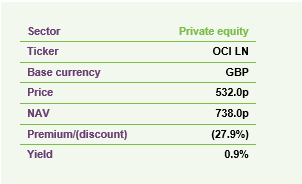
Oakley Capital Investments (OCI) provides its shareholders with access to private equity opportunities sourced by its manager Oakley. The European private market has been showing signs of a recovery, and OCI’s 27.9% discount may be considered attractive by some investors.
Consistent long-term returns from private equity
OCI aims to provide shareholders with consistent long-term returns in excess of the FTSE All-Share Index by providing exposure to private equity returns, where value can be created through market growth, consolidation, and performance improvement.
Share price and discount
Time period 31/01/2021 to 10/02/2026
Performance over five years
Time period 31/01/2021 to 31/01/2026
| Year ended | Share price TR (%) | NAV total return (%) | LPX Europe TR (%) | MSCI UK TR (%) | MSCI World TR (%) |
|---|---|---|---|---|---|
| 31/01/2022 | 46.0 | 34.9 | 17.0 | 22.7 | 19.4 |
| 31/01/2023 | 9.0 | 24.0 | (15.9) | 9.7 | 0.2 |
| 31/01/2024 | 3.2 | 4.0 | 8.9 | 1.9 | 16.8 |
| 31/01/2025 | 4.6 | 2.3 | 16.8 | 17.6 | 23.0 |
| 31/01/2026 | 10.9 | 6.5 | (5.3) | 22.3 | 9.1 |
Source: Bloomberg, Marten & Co
About OCI
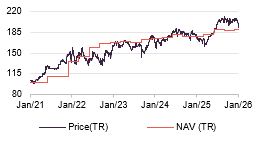
OCI gives its shareholders access to private equity investments made by Oakley Capital (Oakley). Oakley focuses on medium sized (€100m – €1bn plus enterprise value) private companies in Europe that are experiencing growth. Oakley has recorded NAV and share price returns of about 90% and 110% respectively over the five years to the end of 2025.
This appears to be a reflection of the EBITDA growth that Oakley says that it helps to drive within the portfolio. In the first half of 2025 this averaged 13%, compared to 15% in 2024.
Four key sectors – technology, digital consumer, education, and business services
Oakley takes controlling stakes in companies that operate in one of four sectors: technology, digital consumer, education, and business services. These companies are selected based on their exposure to trends such as growing global demand for quality education, business shift to the cloud, consumer shift to digital search and online spending, increased regulation, and outsourcing.
Partnering with business founders
Oakley comments that it seeks to partner with business founders, supporting leaders who are running businesses that it believes have the potential for value creation, through structures that are intended to align with Oakley’s goals (77% of all Oakley’s deals have been founder-led). According to Oakley, founders sometimes introduce the firm to new opportunities, and some founders have contributed their own money to Oakley funds, with more than €350m contributed to date.
First through the door
Oakley observes that it is often the first outside institution to provide capital to these businesses. It also provides expertise to assist them in professionalising in addition to the capital to support their growth.
Uncontested deals
71% of the deals that Oakley completes are uncontested. According to Oakley, the entry multiple is not influenced by a competitive process, but instead reflects the trust that the founder appears to place in Oakley and the view that founders may prioritise cultural fit and chemistry over price.
Leveraging new technology
Typically, Oakley takes a controlling stake, which gives it the ability to apply its value creation strategies. These can include M&A, where Oakley has assisted its portfolio companies in completing over 350 bolt-on acquisitions, enabling businesses to add scale and expand into new verticals and regions; talent acquisition, where Oakley assists founders in recruiting and retaining management to support their growth plans; and business transformation, for example helping a company shift its business model to recurring revenues, which can bring greater cash flow visibility and may be associated with a higher valuation.
Oakley’s Portfolio Team provides assistance to founders and their management teams in executing value creation initiatives and supporting other priorities. For example, the Capital Markets team may assist portfolio companies in diversifying their sources of funding or hedging against interest rate risk, while Oakley’s head of data & analytics supports management teams in identifying, planning, and implementing data and AI initiatives.
Oakley’s Touring Fund, in which OCI has invested, is investing in software companies that use AI, providing early-stage growth capital to revenue-generating businesses, typically at Series B and C funding rounds. Oakley says that insights gained through these investments are shared across the portfolio. Its investment team and portfolio companies also have access to Touring’s expertise and insight to inform decision making.
Oakley comments that OCI’s NAV growth of 6% in 2025 (or 3% before the impact of FX) reflects its conservative valuations and a younger portfolio. Oakley has invested the equivalent of 35% of the year-end NAV over the last two years. According to Oakley, these additions to the portfolio are expected to deliver EBITDA growth as they mature and become contributors to OCI’s performance, with valuation uplifts typically accelerating through the duration of an Oakley investment.
The Southern European opportunity
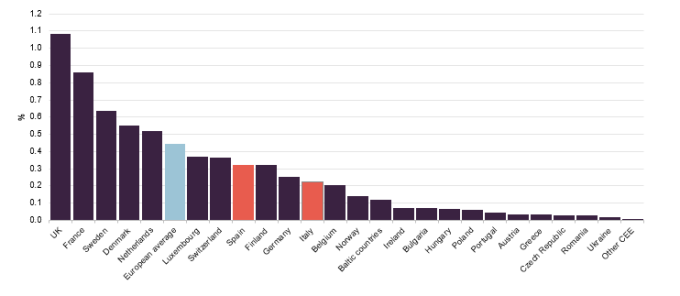
Several deals towards the end of 2025 illustrate the opportunity that Oakley sees in Southern Europe, where investments account for around 24% of OCI’s NAV (excluding direct investments, Touring Capital and PROfounders investments). Oakley’s stated focus in this region is on Spain and Italy, where there are relatively low penetration rates by private equity firms (as shown in Figure 1), which the company believes provides opportunities to be the first institutional investor in private companies. It adds that the region may also present a digitalisation opportunity, with some sectors and consumer behaviours less developed compared to other parts of Europe.
Figure 1: Private equity penetration (% of GDP) across Europe
Source: IMF, World Economic Outlook Database, Invest Europe, EDC
The manager says that there is a growing openness among businesses in the region to partner with sponsors that meet certain criteria. It adds that Oakley’s experience in building Oakley’s platforms, for example through the use of buy-and-build strategies and technology enhancements, and its track record in expanding businesses internationally, have attracted interest from entrepreneurs in the region. Furthermore, Oakley’s local expertise, supported by teams operating from offices in Madrid and Milan, is also values, in its view. Oakley’s track record in the region includes Facile, idealista, Seedtag and vLex (the latter two are covered in detail below).
Spain – a hotbed of technology entrepreneurs
Oakley considers Spain a hotbed of tech entrepreneurs
Oakley says that Spain has a significant number of technology entrepreneurs seeking backing to expand internationally. According to Oakley, outside of the UK, Spain has the largest number of start-up hubs in Europe, as well as an extensive network of founder-led, family businesses, which the firm believes provides a wide range of off-market opportunities.
Oakley is invested in seven companies in Spain, where it is seeking to benefit from characteristics such as the country’s status as a gateway to the Americas, a large cohort of tech engineers, which may be influenced by high investment by technology companies, a network of business schools, and what Oakley identifies as low private equity penetration compared to other countries.
At the end of December 2025, around 15% of OCI’s NAV was exposed to Spanish businesses. All these investments share several characteristics: they are founder-led businesses, and Oakley has applied similar strategies to attempt to accelerate growth, such as internationalisation, particularly into the US and strategic M&A (Seedtag and vLex). In the case of Grupo Primavera (enterprise resource planning – now part of Cegid) and Alerce (logistics SaaS), Oakley has supported both companies in expanding through a ‘buy-and-build’ strategy.
Paraty Tech
New investment in Paraty Tech
In December, Oakley invested in Paraty through Fund VI and is expected to support the company’s international expansion. Paraty is a hotel demand generation platform that was founded in 2012 by siblings Gina and Franz Matheis. The company provides a platform enabling hotels to manage direct reservations, pricing, and availability through their own online and offline direct channels, bypassing reliance on Google search and online travel agencies that charge commissions. Its cloud-based demand generation platform is used by independent hotels, hotel chains, and mid-market properties across Iberia, with a growing presence in Latin America and the US.
Oakley will work with Paraty’s team to support international expansion and the pursuit of strategic acquisitions in the fragmented travel tech sector, with the aim of creating a larger company with a broader product offering.
OCI’s look-through share of Oakley’s purchase of Paraty was approximately £8m.
vLex
Partial exit in vLex nets >80% IRR
Oakley’s investment in legal technology company vLex, led by founder Lluis Faus, resulted in the sale of the business to Clio last year, with a valuation of $1bn.
Oakley, which invested in the company in September 2022, supported the establishment of a market presence in the US through the acquisition of Fastcase. – which it says contributed to vLex becoming one of the largest owners of legal data globally. Oakley also supported the development of the AI platform, Vincent. This platform uses vLex’s legal data pool (comprising one billion legal documents across more than 100 countries) as the foundation of an AI-powered legal workflow platform that can construct legal arguments backed by a list of sources and legal references.
Lawyers use Vincent to prepare cases, generate arguments, and test multiple legal strategies for different jurisdictions. According to the company, it serves the majority of the Am Law 100 (a ranking of the largest law firms in America).
In June 2025, Oakley sold its holding in vLex from its Origin I Fund. Oakley expects the transaction to deliver gross returns of more than six times. OCI’s look-through share of proceeds, excluding the underlying shares in Clio, was around £30m.
As part of the transaction, Origin I partially reinvested in the combined business and Origin II separately invested to participate in potential future growth. Oakley believes that cross- and up-selling opportunities may exist for the combined integrated platform, which has brought together front-end legal work (vLex) and back-end services such as billing, client intake solutions and case management (Clio), creating a single platform for customers in the legal industry.
Seedtag
Oakley’s track record in scaling up Spanish tech businesses and expanding into new markets, including the US, also includes its work at Seedtag, a company in contextual advertising that provides brands and agencies with targeted digital advertising without cookies.
Oakley originally invested in Seedtag in 2021, backing co-founders Jorge Poyatos and Albert Nieto, both former Google employees who wanted to change digital advertising. Oakley supported Seedtag’s launch into North America and oversaw the acquisition of KMTX (previously Keymantics) in France. Oakley sold part of its stake in Seedtag in 2022, reporting a strong return. The company has since expanded further into the US, which is the world’s largest advertising market, with additional M&A activity.
NOX Group
New investment in leading padel equipment brand NOX
Away from the tech sector, Oakley invested in padel equipment brand NOX in October via Origin II. Oakley partnered with founder Jesús Ballvé and GPF Partners, which together will retain a significant minority stake in the business.
NOX was founded in 2008 in Barcelona and has become a global supplier of padel rackets used by both recreational and professional players worldwide. The company sells more than 400,000 rackets annually across more than 80 countries, accounting for 11% of total global sales. Over the past four years, NOX has reported a 50%+ revenue CAGR.
Padel is estimated to be growing at approximately 25% per year globally. Oakley comments that this growth is being influenced by factors such as accessibility, global appeal, alignment with fitness trends, and the ability to attract players of various ages. The increase in new court construction and the number of tennis clubs converting their courts to padel also appears to support this trend.
Oakley says that it will support NOX in expanding the brand internationally, with a particular focus on the US and Asian markets, as well as expanding into the pickleball segment, which has been growing rapidly. On a look-through basis, OCI’s share of the deal is £9m.
Other Spanish businesses
Other Spanish businesses in the underlying portfolio include Alerce, a SaaS logistics business; Horizons Optical, a provider of medical software used to manufacture premium glass lenses; and Grupo Primavera, now part of Cegid, a leading provider of cloud-based management solutions.
Italy – digitalisation and consolidation opportunities
Opportunity to invest in digitalisation of Italian industries
Italy features many “analogue” industries, including financial services, that Oakley believes require digitalisation but appear to lack sufficient capital. As in Spain, a large majority of businesses are fully managed by family (67% versus 26% in France and 10% in the UK). Oakley is targeting investments in companies that are seeking to help industries evolve. Often these are highly fragmented industries that may offer consolidation opportunities, such as insurance services.
Join Business Management Consulting (JBMC)
JBMC states that it aims to deliver operational improvement, IT project management, digital transformation, data and other tech-enabled projects for banks, insurance firms and payment companies across Italy.
Demand for digital transition specialists, such as JBMC, within the financial sector appears to be increasing as more companies move away from legacy systems. Over the past five years, JBMC has grown revenue at a CAGR of over 20%, which is higher than the broader market. Its client base is largely described as “blue-chip”, with a 95% revenue retention rate. Oakley backed JBMC founder and CEO Giovanni Brandani and his team in June 2025, and subsequently assisted in the recruitment of industry specialists Massimo Tosato (ex-Schroders) and Carlo Enrico (ex-Mastercard) as special advisers to support JBMC’s growth plans.
The €1.2bn Italian financial services consulting market appears to be highly fragmented, which may provide several M&A opportunities. Oakley also plans to support growth by investing in new business origination and expanding capabilities, particularly in data, AI and risk & compliance.
Tiger HoldCo
In late 2025, Oakley launched Tiger HoldCo, an insurance services platform that is intended to focus on Southern Europe and seek to consolidate companies in the commercial specialty insurance services market. The sector in Southern Europe is estimated to be worth over €40bn and is described as highly fragmented, with hundreds of thousands of companies.
Tiger HoldCo will be led by Enrico Vanin as CEO, who most recently served as chief innovation officer at AON, and has also held senior positions at KPMG across EMEA and Asia Pacific.
Tiger HoldCo operates across managed general agent (MGA), agent, and broker channels. The company is expected to focus on enhancing digital capabilities and utilising industry expertise to professionalise businesses. Oakley states that it has prepared a pipeline of acquisition targets.
The Southern European consolidation strategy followed the acquisition of Konzept & Marketing (K&M) in Germany, which has a similar remit but is focused on the DACH region. According to Oakley, these two platform strategies show the firm’s ability to attract industry veterans with experience, deal networks and expertise to create their own business – in the case of K&M, this is Joachim Mϋller (ex-Allianz) alongside Burkhard Keese (ex-Lloyds of London).
Tiger HoldCo’s first acquisition was ONHC, which is a provider of private healthcare insurance services in Italy.
ONHC
In October, Oakley announced it was investing in ONHC alongside founder and CEO Filippo Ceppellini and his management team, who will continue to lead the company. Founded in 2007, ONHC offers services including consulting, product development, intermediation, underwriting, and third-party administration. Oakley believes that ONHC could benefit from a shift in healthcare spend in Italy towards the private sector and an underinsured population.
Through support of the Tiger HoldCo platform, ONHC’s strategy for its next phase of growth appears to involve expanding its client base and broadening its service offering through strategic M&A in Italy’s fragmented market for healthcare insurance services.
Other Italian companies
Other Italian companies in the underlying portfolio include Facile, a leading price comparison website; Alessi, a high-end design business focused on homeware; and Fornasetti, a luxury home decor brand.
Asset allocation
At 30 June 2025, OCI had net assets of £1,275m. The net value of the individual fund investments plus the direct investments totalled £1,339m and OCI had cash of £108m (plus £6m in trade and other receivables) offset by £178m of drawings on the revolving credit facility and other working capital.
At 30 June 2025, the underlying portfolio was valued at an average EV/EBITDA ratio of 16.3x, which was similar to the ratio at end December 2024. The EBITDA growth on the portfolio over 2025 was 13% on average, and the net debt/EBITDA ratio was 4.2x. Oakley says that the industry average is about 5-6x.
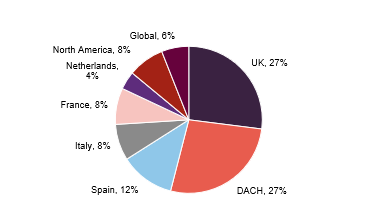
Figure 2: Geographic split of portfolio at 30 June 2025
Source: OCI, Marten & Co
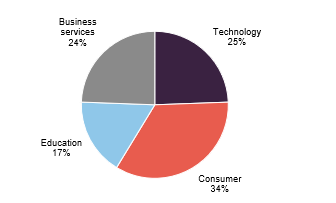
Figure 3: Sector split of private equity funds and direct investment portfolio at 30 June 2025
Source: OCI, Marten & Co
Funds
Figure 4: OCI by fund at 30 June 2025
| Total size m | Year launched | Realised gross money multiple | Realised gross IRR | OCI commitment €m | OCI outstanding commitment £m | |
|---|---|---|---|---|---|---|
| Fund II | €524 | 2013 | 3.1x | 59% | 190 | 10 |
| Fund III | €800 | 2016 | 6.4x | 64% | 326 | 32 |
| Fund IV | €1,460 | 2019 | 3.4x | 44% | 400 | 78 |
| Origin I | €458 | 2021 | 129 | 24 | ||
| Fund V | €2,851 | 2022 | 800 | 312 | ||
| Fund VI | €4,500 | 2025 | 500 | 417 | ||
| PROfounders III | €77 | 2022 | 30 | 17 | ||
| Touring | $255 | 2023 | $100 | 28 | ||
| Origin II | €791 | 2023 | 190 | 153 | ||
| Total | 1,070 |
Figure 4 provides detail on OCI’s commitments by fund – both the original commitment and the amount outstanding at end June 2025, and – where appropriate – the realised returns generated. As at 31 December 2025, OCI’s outstanding commitments had reduced to £992m. The board believes that about £300m of this is not likely to be drawn. The balance may be deployed over the course of the next five years.
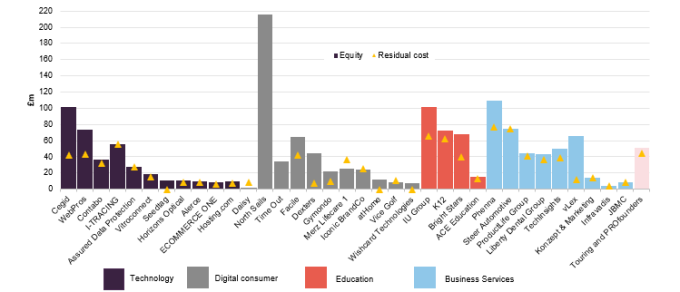
Figure 5: Portfolio split by company as at 30 June 2025
Source: OCI, Marten & Co
Within the pre-existing portfolio, OCI participated in Time Out’s £8m equity placing in December 2025 with an investment of around £3m, reflecting its 38% equity interest, alongside other major institutional investors. OCI’s board also agreed to the extension of its £8m loan to Time Out by a year to June 2027. In compensation, OCI will receive an increase in the margin from 8% to 12% above SONIA.
At 31 December 2025, OCI held £95m of cash and had access to an undrawn credit facility totalling £96m. OCI refinanced its credit facility in April 2025, agreeing to a new £325m facility (a £100m increase) with a five-year maturity.
Recent new transactions
Oakley completed several transactions at the end of 2025, bringing OCI’s total look-through investments for the year to £197m – £96m allocated to new investments and £82m to follow-on investments. OCI also received realisations of £92m. Some of these transactions were covered earlier in this note. The following section outlines other recently announced deals.
Global Loan Agency Services (GLAS)
In early January 2026, Oakley announced the acquisition of a majority stake in GLAS, a global provider of loan administration and bond trustee services, through Fund VI. Oakley made the investment alongside La Caisse (formerly CDPQ), which has acquired a minority position, as well as Levine Leichtman Capital Partners, which will retain a small stake. OCI’s look-through share of the purchase up to £55m.
GLAS will continue to be led by CEO and founder Mia Drennan and her existing executive management team. Oakley is expected to support GLAS in efforts to accelerate growth through international expansion, M&A and the continued development of the company’s technology and AI offering.
GLAS provides a range of administration and trustee services for the credit markets, overseeing the lifecycle administration of debt instruments, including transaction execution, interest determination, cash flow coordination and stakeholder communications.
It has more than 450 employees across 16 offices in Europe, America, APAC and the Middle East, and services a portfolio of over $750bn across its platform. The global private credit market which GLAS serves is estimated to exceed $2.4trn in AUM, and is projected to surpass $4.5trn by 2030.
Brevo
Oakley announced in December that it had acquired a co-controlling stake in Brevo, a global customer engagement software platform, alongside General Atlantic.
Founded in Paris in 2012 by Armand Thiberge, Brevo provides a multichannel Customer Relationship Management (CRM) software suite to businesses of various sizes worldwide. The company operates in a market estimated to be worth around €6bn annually, as businesses appear to be increasingly seeking to automate their marketing to support lead generation and customer engagement. The company reports that it has expanded into a global platform, delivering over 20% annual revenue growth, with 99% of its revenue recurring. It serves more than 500,000 customers across over 180 countries, with operations in nine offices worldwide. Oakley says that it will support continued investments in AI, growth in the United States, and an expanded M&A strategy.
Armand and the Brevo management team made a reinvestment in the business as part of the deal, with OCI’s look-through contribution via Fund VI anticipated to be £22m.
Athena Racing
Oakley Capital Origin Fund II bought a stake in sailing franchise Athena Racing, which was founded and is led by Sir Ben Ainslie, in December. The investment in the British America’s Cup team follows the creation of the America’s Cup Partnership that will govern the sailing competition and aims to enhance its commercial appeal and investability.
Oakley says that its investment in Athena reflects its belief in the enduring appeal and growth potential of premium sports properties, and that the new partnership may enable Athena to pursue a multi-cycle strategy across future America’s Cup contests, with longer-term sponsorship deals, R&D investment, and talent acquisition. Oakley plans to support Athena by accelerating commercial partnerships, expanding brand visibility, and scaling operations.
OCI’s look-through share of the investment is anticipated to be up to £13m once fully funded.
Low Tides
Also in December, Oakley announced that Fund VI was investing in Low Tides Holdings, a partnership entity with US global luxury clothing and lifestyle brand James Perse.
Oakley is expected to assist the business, which was founded in California in the 1990s and has over 60 stores globally and an online presence, in expanding its global presence and marketing strategies. OCI’s look-through investment is anticipated to be c.£13m.
Recent disposals
atHome
Aside from the vLex realisation (detailed on page 6), Oakley has also recently disposed of its holding in atHome. It announced in October that Fund III had sold its stake in atHome, a property and automotive marketplace in Luxembourg, to Apax Partners. OCI’s look-through share of proceeds was around £16m, which represents an increase compared to the June 2025 book value.
Oakley originally acquired atHome in 2017 as part of a carve-out from REA Group, which included the Italian portal Casa.it. Oakley partnered with the incumbent management team to support the newly independent business and its subsequent development. In 2020, Casa.it was sold to EQT while atHome was sold to Mayfair Equity Partners, with Oakley retaining a minority stake. Following completion of the transaction, Fund III’s investment in atHome and Casa.it delivered gross returns of 2.3x and a 23% IRR.
Performance
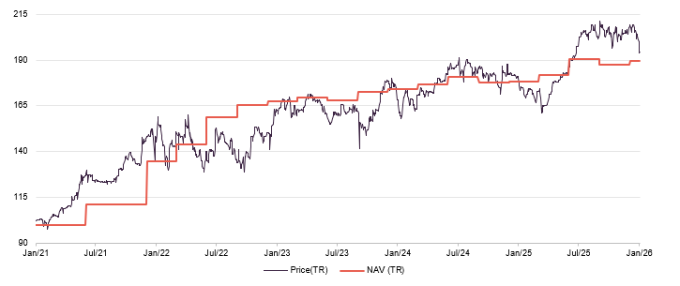
Figure 6: OCI performance over the five years ended 31 January 2026
Source: Bloomberg, Marten & Co
OCI’s share price has increased since “Liberation Day” in April 2025, when global markets declined following President Trump’s tariff threats. These threats were subsequently reduced, and activity in private equity markets appeared to increase, with the pace of exits rising. As mentioned earlier, Oakley has been deploying OCI’s capital into new opportunities, which it expects to generate returns in the future.
Figure 7: Cumulative performance over various time periods ended 31 January 2026
| 3 months(%) | 6 months(%) | 1 year(%) | 3 years(%) | 5 years(%) | |
|---|---|---|---|---|---|
| Share price | (5.0) | (3.6) | 10.9 | 19.8 | 90.8 |
| NAV | 1.1 | (0.5) | 6.5 | 13.3 | 89.6 |
| Peer group share price median | 3.2 | 4.7 | 12.3 | 32.6 | 61.8 |
| Peer group NAV median | 0.0 | 0.0 | 2.5 | 9.4 | 60.6 |
| LPX Europe1 | (3.2) | (1.8) | (5.3) | 20.4 | 18.5 |
| MSCI UK | 6.0 | 13.9 | 22.3 | 46.6 | 97.2 |
| MSCI World | (0.9) | 7.9 | 9.1 | 56.7 | 87.4 |
Trading update for year ended 31 December 2025
On 28 January, OCI published a trading update for the year ended 31 December 2025. The company reported a NAV total return of 6% (45p) or 3% (23p) excluding the impact of foreign exchange, and a total shareholder return of 15%. The full year total NAV return includes 45p of net valuation gains, the majority of which (around 90%) were attributed by the company to earnings growth rather than multiple expansion.
The largest contributors to performance were vLex (now Clio), Phenna, TechInsights, North Sails and Bright Stars, while the decline in the share price of publicly listed Time Out Group offset these contributions.
In total, OCI made look-through investments of £197m, equivalent to 16% of yearend NAV. This included £96m of new platform deals (including Paraty Tech and Brevo); follow-on investments totalling £82m (including M&A by Infravadis, K&M and Affinitas); and venture investments of £19m (including Netradyne and Daloopa).
According to the manager, these investments have significant value creation potential as growth plans are executed and they mature operationally. The manager believes this could start to be reflected in OCI’s NAV over time.
OCI’s look-through share of proceeds from exits and refinancings during the year totalled £92m, comprising £57m of realisations (atHome and the partial sale of vLex) and £35m of refinancings (including WebPros, Dexters and ECOMMERCE ONE).
Premium/discount
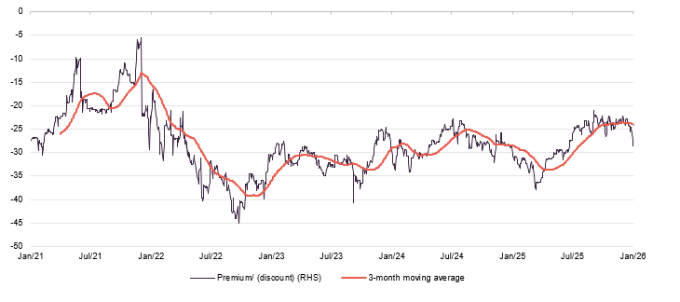
Over the 12 months ended 31 December 2025, OCI’s share price discount to NAV ranged between 37.9% and 21.1%, averaging 27.9%. At the time of publishing, the discount was 27.9%.
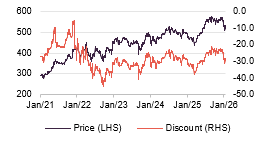
OCI’s discount narrowed from its 12-month low point in April 2025 (around the time of “Liberation Day”) coinciding with an uptick in activity in private equity markets following a period of reduced activity. There is potential for activity to increase further across the European market. OCI’s shares may have also benefitted from its listing moving from the Specialist Fund Segment to the Main Market of the LSE in August 2025. The move has broadened the range of investor platforms that permit dealing in OCI’s shares, and may have had a positive impact on demand.
The board announced last year that the dividend paid in April 2025 would be the last for the time being, stating that it believed shareholders would be better served if the funds used to pay the dividend were used for share buybacks instead. It committed to a share buyback programme of at least £20m per annum, around 2.2% of OCI’s current market cap. The company repurchased and cancelled £50m shares in 2025.
Figure 8: OCI discount over five years ended 31 January 2026
Source: Bloomberg, Marten & Co
Previous publications
You can read these notes by clicking the links or visiting our website, quoteddata.com.
| Title | Note type | Date |
|---|---|---|
| The best-performing UK-listed private equity fund | Initiation | 4 April 2023 |
| Walking the walk | Update | 15 December 2023 |
| Getting down to business | Update | 2 April 2024 |
| In a class of its own | Update | 19 September 2024 |
| Primed for future NAV growth | Update | 28 March 2025 |
IMPORTANT INFORMATION
Marten & Co (which is authorised and regulated by the Financial Conduct Authority) was paid to produce this note on Oakley Capital Investments Limited.
This note is for information purposes only and is not intended to encourage the reader to deal in the security or securities mentioned within it. Marten & Co is not authorised to give advice to retail clients. The research does not have regard to the specific investment objectives financial situation and needs of any specific person who may receive it.
The analysts who prepared this note are not constrained from dealing ahead of it but, in practice, and in accordance with our internal code of good conduct, will refrain from doing so for the period from which they first obtained the information necessary to prepare the note until one month after the note’s publication. Nevertheless, they may have an interest in any of the securities mentioned within this note.
This note has been compiled from publicly available information. This note is not directed at any person in any jurisdiction where (by reason of that person’s nationality, residence or otherwise) the publication or availability of this note is prohibited.
Accuracy of Content: Whilst Marten & Co uses reasonable efforts to obtain information from sources which we believe to be reliable and to ensure that the information in this note is up to date and accurate, we make no representation or warranty that the information contained in this note is accurate, reliable or complete. The information contained in this note is provided by Marten & Co for personal use and information purposes generally. You are solely liable for any use you may make of this information. The information is inherently subject to change without notice and may become outdated. You, therefore, should verify any information obtained from this note before you use it.
No Advice: Nothing contained in this note constitutes or should be construed to constitute investment, legal, tax or other advice.
No Representation or Warranty: No representation, warranty or guarantee of any kind, express or implied is given by Marten & Co in respect of any information contained on this note.
Exclusion of Liability: To the fullest extent allowed by law, Marten & Co shall not be liable for any direct or indirect losses, damages, costs or expenses incurred or suffered by you arising out or in connection with the access to, use of or reliance on any information contained on this note. In no circumstance shall Marten & Co and its employees have any liability for consequential or special damages.
Governing Law and Jurisdiction: These terms and conditions and all matters connected with them, are governed by the laws of England and Wales and shall be subject to the exclusive jurisdiction of the English courts. If you access this note from outside the UK, you are responsible for ensuring compliance with any local laws relating to access.
No information contained in this note shall form the basis of, or be relied upon in connection with, any offer or commitment whatsoever in any jurisdiction.
Investment Performance Information: Please remember that past performance is not necessarily a guide to the future and that the value of shares and the income from them can go down as well as up. Exchange rates may also cause the value of underlying overseas investments to go down as well as up. Marten & Co may write on companies that use gearing in a number of forms that can increase volatility and, in some cases, to a complete loss of an investment.