
Stronger together
BlackRock Throgmorton (THRG) and BlackRock Smaller Companies Trust (BRSC) have published proposals to combine the two trusts, with the aim of creating a larger, more liquid, and lower-cost entity. The intention is for the enlarged trust to be co-managed by BRSC’s Roland Arnold and THRG’s Dan Whitestone, who both have significant experience in the UK smaller companies sector. The boards of both trusts believe the combination will provide a platform for future growth.
The two portfolios already have a good degree of alignment, with 75% overlap of stocks, which should make for a relatively smooth transition. A reduction in the management fee is expected to contribute to a lower ongoing charges ratio of almost 20bps to 0.63%, which should make it one of the most competitive in its peer group.
The proposal includes other initiatives, such as a performance-related tender offer every three years, and would also result in Saba being removed from the register.
Portfolio of UK small- and mid-cap companies
THRG aims to provide shareholders with capital growth and total return by investing primarily in UK smaller and mid-cap companies traded on the London Stock Exchange.
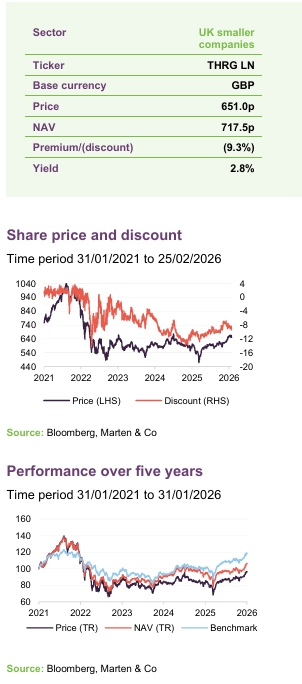
| Year ended | THRG share price total return (%) | THRG NAV total return (%) | BRSC share price total return (%) | BRSC NAV total return (%) | Deutsche Numis Sm Co.s +AIM, ex IC TR (%) |
|---|---|---|---|---|---|
| 31/01/2022 | 11.7 | 12.5 | 12.8 | 16.4 | 11.6 |
| 31/01/2023 | (22.8) | (20.2) | (21.4) | (16.0) | (12.4) |
| 31/01/2024 | (1.4) | 2.2 | (1.1) | (2.4) | (3.3) |
| 31/01/2025 | 0.7 | 4.3 | 5.1 | 2.4 | 7.8 |
| 31/01/2026 | 12.5 | 11.1 | 4.1 | 6.2 | 16.1 |
The merger proposal
On 20 February 2026, the boards of both BlackRock Throgmorton (THRG) and BlackRock Smaller Companies (BRSC) announced proposals to merge the two UK smaller companies trusts. The plan is for BRSC, which is slightly larger, to absorb THRG through the voluntary winding-up of the latter, with new shares issued to THRG investors that elect to roll their investment into BRSC. Shareholders in both trusts will also have the option to realise a proportion of their shareholding in cash.
This note examines the details of the proposal, the potential outcomes for the new enlarged company, and some factors that shareholders may wish to consider before voting on the plans.
Rationale
Both THRG and BRSC has outperformed their benchmark over the longer term
The proposal followed a review by THRG’s board, which was focused on driving long-term value after a period of weaker performance that occurred after interest rates increased in 2022 and appeared to reduce investor interest in growth and UK investment strategies. Prior to this period, both THRG and BRSC had a track record of outperforming the Deutsche Numis Smaller Companies plus AIM (excluding Investment Companies) benchmark, as shown in Figure 1.
Figure 1: THRG and BRSC 10-year NAV total return performance versus benchmark1 to 31 January 2026 (rebased to 100)
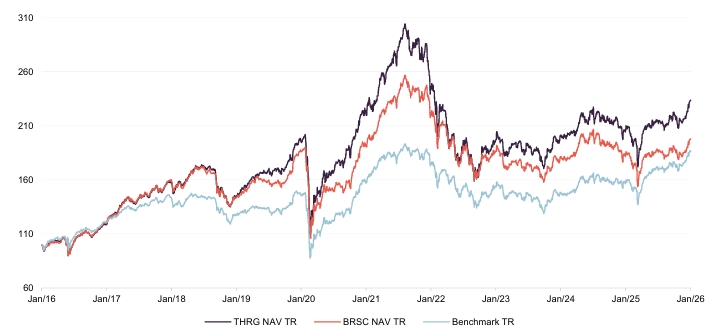
Over 10 years to the end of January 2026, THRG and BRSC delivered NAV total returns of 129% and 97% respectively, compared to the benchmark’s 86%.
Enlarged entity expected to have net assets of £780m
Combining the two trusts, which the managers say have comparable investment approaches and a significant level of portfolio overlap, would create an enlarged entity with net assets of around £780m (assuming full take-up of the respective cash exits – more detail on page 5). The rationale is that this should help to improve liquidity in shares from the current level of both companies and could give the enlarged trust more flexibility in controlling its discount – which has averaged 9.7% for THRG and 12.3% for BRSC over the past 12 months.
Long-term prospects
As mentioned, the UK smaller companies sector has faced headwinds over the last few years. UK companies have derated and this has impacted the short-term performance of both trusts. However, both companies believe the sector continues to display robust fundamentals and good long-term growth prospects.
With valuations at historically low levels and several potential cyclical and structural factors showing signs of emerging, including easing interest rates and ongoing corporate and private equity interest in the UK market, the enlarged company may be in a position to benefit from any change in sentiment towards UK smaller companies.
To be co-managed by Roland Arnold and Dan Whitestone
As stated on the front page, the combined company will be co-managed by BRSC’s manager, Roland Arnold, and THRG’s Dan Whitestone. This arrangement is intended to provide continuity for both sets of shareholders and to bring together two managers who are experienced in managing UK smaller companies funds.
Roland, who has 20 years’ experience investing in UK small- and mid-cap companies, will have the final decision over positioning in the portfolio of the enlarged company. Dan, a fund manager with a track record and experience in investing in UK listed small- and mid-cap companies as well as emerging companies across international developed markets, will support Roland through ongoing stock and industry level research.
Progressive dividend to be paid quarterly
The enlarged company’s dividend policy is expected to build on the track record delivered by BRSC, which has increased its annual dividend every year since 2003 and has achieved AIC “Dividend Hero” status. Dividends are proposed to be paid on a quarterly basis, rather than the current bi-annual payment.
It is intended that THRG board members Angela Lane and Louise Nash will be appointed as non-executive directors of the enlarged BRSC, bringing the board to seven members.
75% overlap in portfolios
Revision to investment policy
Consistent with the existing mandates of both companies, the enlarged trust will seek to achieve long-term capital growth through investing predominantly in UK small- and mid-cap companies. It is envisaged that there will be no major realignment of the portfolio, with 75% overlap of stocks between THRG and BRSC. The focus will continue to be on investing in companies that the manager believes have quality growth characteristics, such as management teams perceived as strong, leading market positions, pricing power, robust balance sheets, healthy margins, strong earnings growth and high levels of cash conversion.
Figure 2: THRG’s top 10 holdings at 31 December 2025
| Company | (%) |
|---|---|
| XPS Pensions | 3.5 |
| Serco Group | 3.2 |
| Rosebank Industries | 3.1 |
| Morgan Sindall | 3.0 |
| Boku | 2.9 |
| Tatton Asset Management | 2.8 |
| Great Portland Estates | 2.6 |
| IntegraFin | 2.5 |
| Ig Group Holdings | 2.4 |
| Hochschild Mining | 2.4 |
| Total top 10 | 28.4 |
Figure 3: BRSC’s top 10 holdings at 31 December 2025
| Company | (%) |
|---|---|
| Serco Group | 3.0 |
| XPS Pensions | 3.0 |
| IntegraFin | 2.9 |
| Great Portland Estates | 2.8 |
| Boku | 2.7 |
| GreenCore Group | 2.7 |
| Tatton Asset Management | 2.6 |
| Morgan Sindall | 2.6 |
| Sigmaroc | 2.2 |
| Pollen Street Group | 2.0 |
| Total of top 10 | 26.5 |
There are a couple of revisions as a result of the merger, however:
- The managers will not be able to make use of short selling stocks, a feature of THRG’s investment policy that has had limited use in recent years.
- The managers will have the ability to invest up to 15% of the portfolio in non-UK listed smaller companies (in line with THRG’s current investment policy). This will be led by Dan and focused on accessing opportunities not available in the UK (for example, in technology) that, according to management, could boost returns without increasing volatility.
No short selling, but 15% can be invested in overseas
The managers are expected to be able to make use of gearing, which under normal operating conditions is envisaged to be within a range of 0% and 15% of net assets and subject to a maximum level of 20% at the time of investment.
Deal mechanics
Cash exit facility for both sets of shareholders
The structure of the merger involves a s110 reconstruction and members’ voluntary winding up of THRG. Under the proposals, new BRSC shares will be issued to THRG shareholders based on the ratio of the formula asset values (NAV less costs) of the two trusts. The proposals include the provision of a cash exit facility for both THRG and BRSC shareholders who choose it, priced at a 1% discount to NAV, and capped at 38% of THRG’s and 28% of BRSC’s issued share capital. To fund the cash option, pools will be created comprising assets to be realised and turned into cash, which is expected to take up to eight weeks.
Saba to fully exits positions
The structure allows Saba Capital, which holds around 17.8% of THRG and 10.4% of BRSC, to fully exit its positions, for which it has given an irrevocable undertaking to do so. A standstill agreement between Saba and BRSC that is currently in place, which prevents Saba from putting forward proposals or requisitioning a general meeting, will be extended to 30 June 2030 for the enlarged BRSC.
Several other shareholder-related initiatives are proposed, including:
- a performance-related 100% tender offer every three years if the company underperforms its benchmark in that period, with the first (were it to be triggered) in 2029. This would be at a 4% discount to NAV (less costs);
- reduced management fees – the management fee payable to BlackRock would be equal to 0.5% on the first £500m of NAV, 0.475% on NAV between £500m and £750m, and 0.45% on NAV greater than £750m. This would be a reduction for both trusts; and
- the removal of the performance fee for THRG shareholders.
Reduced management fee expected to contribute to a lowering of the OCR to 0.63%
Greater cost efficiencies through scale, together with the revised management fee arrangements, are estimated to produce an ongoing charges ratio of around 0.63%. This compares with BRSC’s ongoing charges ratio of 0.8% and THRG’s average ongoing charges ratio of 0.82% (over the five years to 30 November 2025, including performance fees). This would represent the lowest ongoing charges ratio among the AIC’s UK Smaller Companies sector that does not charge a performance fee.
BlackRock has stated it will contribute to the costs of the merger by waiving its management fee for six months, which equates to around £1.9m.
Shareholders of both trusts will have the opportunity to vote on the merger at meetings scheduled for 26 March 2026 (BRSC) and 30 March 2026 (THRG), with the resolutions requiring at least 75% of votes cast in favour.
Previous publications
You can read our previous publications on THRG by clicking the links in the table.
Figure 4: QuotedData’s previously published notes on THRG
| Title | Note type | Publication date |
|---|---|---|
| Vision, execution and adaptability | Initiation | 11 September 2018 |
| Throg’s shorts shine | Update | 16 January 2019 |
| Impressive run continues | Annual overview | 18 July 2019 |
| Look past the short-term noise | Update | 17 December 2019 |
| Separating the wheat from the chaff | Annual overview | 10 June 2020 |
| Infectious enthusiasm | Update | 14 December 2020 |
| Confidence rewarded | Annual overview | 29 September 2021 |
| Powering on | Update | 17 December 2021 |
| The strong have only gotten cheaper | Annual overview | 29 November 2022 |
| Growth in all things | Update | 22 November 2023 |
| Throgmorton’s fuse is lit | Flash update | 20 March 2024 |
| Get it while the price is good | Annual overview | 11 June 2024 |
| More bang for your buck | Update | 16 April 2025 |
Important Information
Marten & Co (which is authorised and regulated by the Financial Conduct Authority) was paid to produce this note on BlackRock Throgmorton Trust Plc.
This note is for information purposes only and is not intended to encourage the reader to deal in the security or securities mentioned within it. Marten & Co is not authorised to give advice to retail clients. The research does not have regard to the specific investment objectives financial situation and needs of any specific person who may receive it.
The analysts who prepared this note are not constrained from dealing ahead of it but, in practice, and in accordance with our internal code of good conduct, will refrain from doing so for the period from which they first obtained the information necessary to prepare the note until one month after the note’s publication. Nevertheless, they may have an interest in any of the securities mentioned within this note.
This note has been compiled from publicly available information. This note is not directed at any person in any jurisdiction where (by reason of that person’s nationality, residence or otherwise) the publication or availability of this note is prohibited.
Accuracy of Content: Whilst Marten & Co uses reasonable efforts to obtain information from sources which we believe to be reliable and to ensure that the information in this note is up to date and accurate, we make no representation or warranty that the information contained in this note is accurate, reliable or complete. The information contained in this note is provided by Marten & Co for personal use and information purposes generally. You are solely liable for any use you may make of this information. The information is inherently subject to change without notice and may become outdated. You, therefore, should verify any information obtained from this note before you use it.
No Advice: Nothing contained in this note constitutes or should be construed to constitute investment, legal, tax or other advice.
No Representation or Warranty: No representation, warranty or guarantee of any kind, express or implied is given by Marten & Co in respect of any information contained on this note.
Exclusion of Liability: To the fullest extent allowed by law, Marten & Co shall not be liable for any direct or indirect losses, damages, costs or expenses incurred or suffered by you arising out or in connection with the access to, use of or reliance on any information contained on this note. In no circumstance shall Marten & Co and its employees have any liability for consequential or special damages.
Governing Law and Jurisdiction: These terms and conditions and all matters connected with them, are governed by the laws of England and Wales and shall be subject to the exclusive jurisdiction of the English courts. If you access this note from outside the UK, you are responsible for ensuring compliance with any local laws relating to access.
No information contained in this note shall form the basis of, or be relied upon in connection with, any offer or commitment whatsoever in any jurisdiction.
Investment Performance Information: Please remember that past performance is not necessarily a guide to the future and that the value of shares and the income from them can go down as well as up. Exchange rates may also cause the value of underlying overseas investments to go down as well as up. Marten & Co may write on companies that use gearing in a number of forms that can increase volatility and, in some cases, to a complete loss of an investment.