
Some welcome improvements
India Capital Growth Fund (IGC) is asking shareholders to approve plans to swap its biennial redemption facility with five-yearly performance- related tender offers. This will make it easier for the adviser to take a long-term view when evaluating investments.
At the same time, the board is proposing to introduce an enhanced dividend policy. IGC will pay out around 2% of NAV as a dividend initially and then look to grow the dividend over time, if circumstances permit. For those shareholders who would prefer to compound their returns rather than receive income, a dividend reinvestment plan will allow them to reinvest their dividends automatically.
We are supportive of both proposals and would encourage shareholders to vote to approve them at the EGM scheduled for 25 March 2026.
Lastly, the board has replaced IGC’s performance benchmark with the MSCI India SMID (small- and mid-cap) Index, which is more representative of IGC’s portfolio than the BSE Mid Cap Index. This change does not need shareholder approval and has already been implemented with effect from 1 January 2026.
Mid- and small-cap listed investments in India
IGC aims to provide long-term capital appreciation by investing in companies based in India. The company’s investments are predominantly in listed mid- and-small-cap Indian companies.
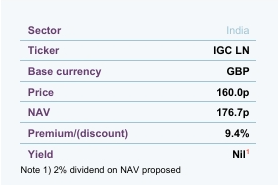
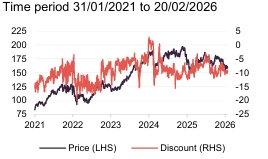
Share price and discount
Performance over five years
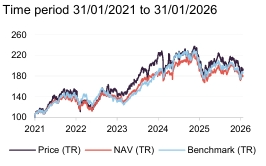
| 12 months ended | Share price TR (%) | NAV total return (%) | MSCI India SMID TR (%) | BSE Mid Cap TR (%) |
|---|---|---|---|---|
| 31/01/2022 | 46.7 | 32.6 | 40.4 | 37.1 |
| 31/01/2023 | (3.9) | 0.2 | (6.2) | 0.9 |
| 31/01/2024 | 58.8 | 40.3 | 45.3 | 51.9 |
| 31/01/2025 | (7.9) | 5.4 | 6.5 | 9.9 |
| 31/01/2026 | (9.6) | (11.4) | (13.0) | (9.4) |
Fund profile
More information is available on the fund’s website
India Capital Growth Fund (IGC) is designed to give investors access to a portfolio of high quality but mispriced small- (sub $4bn) and mid-cap ($4bn to $11.5bn) Indian companies.
India is a fast-growing economy and is on track to become the world’s third largest. There are over 5,000 listed companies to choose from. IGC draws its portfolio from a subset of about 140 of these that the adviser believes possess sound management practices and business models. Stocks are selected based on the adviser’s assessment of their valuation upside and how they will fit into a focused but diversified portfolio.
IGC has been managed by Gaurav Narain since November 2011. The management company was acquired by what is now River Global Investors in 2023. Gaurav and the rest of the team are based in Mumbai.
A better benchmark
For many years, IGC has benchmarked its performance against the BSE Mid Cap Index. However, index weightings do not influence Gaurav’s stock selection.
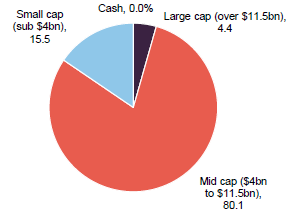
At the end of January 2026, there were 34 stocks in IGC’s portfolio, and the majority of those were small cap stocks. However, the market cap distribution of the BSE Mid Cap Index is very different and that makes it less useful as a performance comparator.
Figure 1: Breakdown of IGC’s portfolio as at 31 January 2026
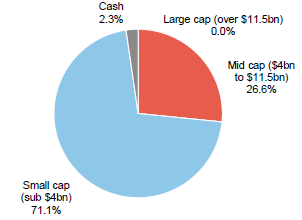
Figure 2: Breakdown of BSE Mid Cap as at 31 January 2026
IGC has adopted MSCI India SMID Index as its new performance benchmark
IGC’s board has decided to replace the BSE Mid Cap index with the MSCI India SMID Index, with effect from 1 January 2026.
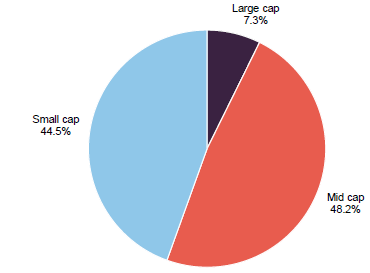
At the end of January 2026, the new benchmark had 571 constituents and covered about 28% of Indian market’s free-float-adjusted market cap. Figure 3 shows the market cap breakdown of the new benchmark. It is clear that it is a better fit for IGC’s portfolio than its former benchmark, but it may be important to remember that IGC still has more of a bias to small cap stocks than its new benchmark does.
Figure 3: Breakdown of MSCI India SMID as at 31 January 2026
Freedom to think long term
New five-yearly performance-related tender offers
IGC’s board is proposing that the biennial redemption opportunities, the last of which was provided in November–December 2025, be replaced with five-yearly performance-related tender offers. Under the new structure, shareholders would be offered a tender for up to 25% of the company’s issued share capital and at a price close to net asset value after accounting for the cost of implementing the tender.
The first potential tender would be triggered if IGC’s NAV total returns (before any impact from Indian capital gains taxes) are lower than the return on the new benchmark over the five-year period that started on 1 January 2026 and ends on 31 December 2030.
Share buybacks will continue as normal
If triggered, the first tender would take place around the time of IGC’s AGM in 2031. In the meantime, IGC’s board intends to continue using share buybacks as one tool to help manage its discount.
We think this makes a lot of sense. Part of the attraction of running a portfolio in a closed-end structure is the ability it gives managers to take a long-term view of investments. This is particularly important when it comes to investing in less-liquid small- and mid-cap stocks. However, the previous biennial redemption opportunities were undermining this advantage and constraining the freedom of the adviser to invest in the best-available opportunities.
We have long been wary of overly frequent exit opportunities. Our fear is that these encourage investors to focus on the short-term – on the upside from discount-narrowing rather than the much greater potential for NAV appreciation, for example – and to see the company as a source of liquidity in periods of market volatility.
By contrast, we believe the new tender offers will encourage investors evaluate the adviser’s returns over a market cycle and think about the potential for the strategy and the adviser over the coming five years.
Now with income
A significant proportion of investors in UK-listed investment companies want a yield from their investments and the board would like to make it easier for them to include IGC in their portfolios.
Indian companies are not in aggregate big dividend payers. The dividend yield on the MSCI India Index at the end of January was just 1.2% and for the MSCI India SMID Index it was even lower at 0.8%. Unsurprisingly then, for both the year ended 31 December 2024 and the six-month period ended 30 June 2025, IGC made a revenue loss. IGC’s current policy is not to pay dividends.
However, one of IGC’s peers has already introduced an enhanced dividend and IGC’s board would like to do the same. It is not required to ask shareholders to approve this change but, nevertheless, it is putting the proposal to a vote.
A new policy to pay out about 2% of NAV as a dividend each year
The plan would be to pay out about 2% of NAV as a dividend in the first year, in two semi-annual instalments of about 1% of NAV. The intention is to grow the dividend over time, circumstances permitting.
Recognising that not all shareholders would want the dividend, IGC would also introduce a dividend reinvestment plan (DRIP), which would reinvest dividends into shares acquired on the secondary market (creating another source of demand for IGC’s stock).
The first of these dividends would be declared in September 2026, paid in October, and would be based on the NAV at 30 June.
We are in favour of using an enhanced dividend policy to broaden the appeal of the company. We like that the 2% of NAV target is not too aggressive and that provision is being made for investors who would rather focus on capital gains. We would support this proposal.
Your vote counts
IGC is asking shareholders to approve the new performance-related tender offers and the dividend policy at an EGM scheduled for 10am on 25 March 2026. If you are a shareholder, it is important to make your voice heard.
The proposals are being incorporated into a Special Resolution, which needs to be backed by 75% of those voting to pass.
Interactive webinar
Elisabeth Scott (IGC’s chair) and Gaurav Narain (the adviser) are making themselves available to answer investors’ questions via a webinar that will be held at 11am on 4 March 2026. You can register for this via this link.
Important Information
This marketing communication has been prepared for India Capital Growth Fund Limited by Marten & Co (which is authorised and regulated by the Financial Conduct Authority) and is non-independent research as defined under Article 36 of the Commission Delegated Regulation (EU) 2017/565 of 25 April 2016 supplementing the Markets in Financial Instruments Directive (MIFID). It is intended for use by investment professionals as defined in article 19 (5) of the Financial Services Act 2000 (Financial Promotion) Order 2005. Marten & Co is not authorised to give advice to retail clients and, if you are not a professional investor, or in any other way are prohibited or restricted from receiving this information, you should disregard it. The note does not have regard to the specific investment objectives, financial situation and needs of any specific person who may receive it.
The note has not been prepared in accordance with legal requirements designed to promote the independence of investment research and as such is considered to be a marketing communication. The analysts who prepared this note are not constrained from dealing ahead of it, but in practice, and in accordance with our internal code of good conduct, will refrain from doing so for the period from which they first obtained the information necessary to prepare the note until one month after the note’s publication. Nevertheless, they may have an interest in any of the securities mentioned within this note.
This note has been compiled from publicly available information. This note is not directed at any person in any jurisdiction where (by reason of that person’s nationality, residence or otherwise) the publication or availability of this note is prohibited.
Accuracy of Content: Whilst Marten & Co uses reasonable efforts to obtain information from sources which we believe to be reliable and to ensure that the information in this note is up to date and accurate, we make no representation or warranty that the information contained in this note is accurate, reliable or complete. The information contained in this note is provided by Marten & Co for personal use and information purposes generally. You are solely liable for any use you may make of this information. The information is inherently subject to change without notice and may become outdated. You, therefore, should verify any information obtained from this note before you use it.
No Advice: Nothing contained in this note constitutes or should be construed to constitute investment, legal, tax or other advice.
No Representation or Warranty: No representation, warranty or guarantee of any kind, express or implied is given by Marten & Co in respect of any information contained on this note.
Exclusion of Liability: To the fullest extent allowed by law, Marten & Co shall not be liable for any direct or indirect losses, damages, costs or expenses incurred or suffered by you arising out or in connection with the access to, use of or reliance on any information contained on this note. In no circumstance shall Marten & Co and its employees have any liability for consequential or special damages.
Governing Law and Jurisdiction: These terms and conditions and all matters connected with them, are governed by the laws of England and Wales and shall be subject to the exclusive jurisdiction of the English courts. If you access this note from outside the UK, you are responsible for ensuring compliance with any local laws relating to access.
No information contained in this note shall form the basis of, or be relied upon in connection with, any offer or commitment whatsoever in any jurisdiction.
Investment Performance Information: Please remember that past performance is not necessarily a guide to the future and that the value of shares and the income from them can go down as well as up. Exchange rates may also cause the value of underlying overseas investments to go down as well as up. Marten & Co may write on companies that use gearing in a number of forms that can increase volatility and, in some cases, to a complete loss of an investment.