
Some welcome improvements
India Capital Growth Fund (IGC) is asking shareholders to approve replacing its biennial (every other year) redemption facility with five-yearly performance-based tender offers. This change aims to help the adviser take a longer-term approach to investments.
The board also plans to introduce a new dividend policy, paying out about 2% of NAV as a dividend, with the aim to grow this over time if possible. Shareholders who prefer to reinvest rather than receive income can use a dividend reinvestment plan.
We support both proposals and encourage shareholders to vote in favour at the EGM on 25 March 2026.
The board has also changed IGC’s performance benchmark to the MSCI India SMID Index, which better reflects IGC’s portfolio than the previous BSE Mid Cap Index. This change took effect from 1 January 2026 and does not require shareholder approval.
Mid- and small-cap listed investments in India
IGC aims to provide long-term capital appreciation by investing in companies based in India. The company’s investments are predominantly in listed mid- and-small-cap Indian companies.
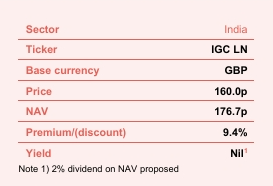
At a glance
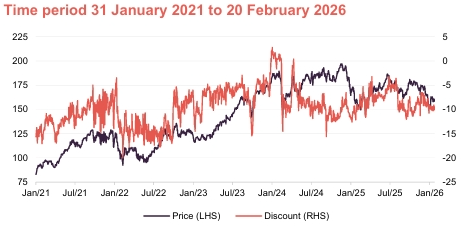
Share price and discount
Performance over five years
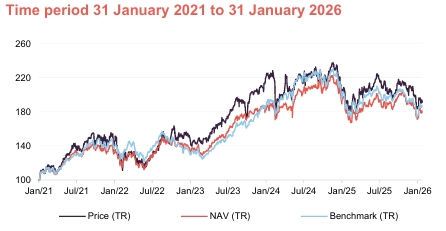
| Year ended | Share price total return (%) | NAV total return (%) | MSCI India SMID total return (%) | BSE Mid Cap total return (%) |
|---|---|---|---|---|
| 31/01/2022 | 46.7 | 32.6 | 40.4 | 37.1 |
| 31/01/2023 | (3.9) | 0.2 | (6.2) | 0.9 |
| 31/01/2024 | 58.8 | 40.3 | 45.3 | 51.9 |
| 31/01/2025 | (7.9) | 5.4 | 6.5 | 9.9 |
| 31/01/2026 | (9.6) | (11.4) | (13.0) | (9.4) |
Fund profile
More information is available on the fund’s website
India Capital Growth Fund (IGC) offers investors access to a portfolio of high-quality but undervalued small- and mid-cap Indian companies, with market values below $11.5bn. India’s economy is growing quickly and is set to become the world’s third largest. It has over 5,000 listed companies to choose from but IGC selects stocks from around 140 companies identified by the adviser as having strong management and business models. The focus is on valuation potential and building a diversified portfolio.
Gaurav Narain has managed IGC since November 2011. The management company became part of River Global Investors in 2023. Gaurav and his team are based in Mumbai.
A better benchmark
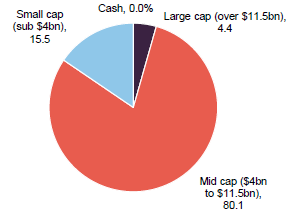
For many years, IGC has measured its performance against the BSE Mid Cap Index, though Gaurav’s stock choices are not influenced by index weightings. As of January 2026, IGC held 34 stocks, mostly small caps. However, the BSE Mid Cap Index has a very different market cap mix, making it less relevant for evaluating IGC’s performance.
Figure 1: Breakdown of IGC’s portfolio as at 31 January 2026
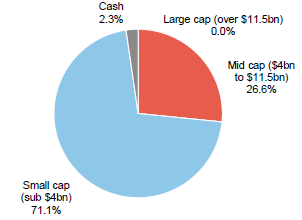
Figure 2: Breakdown of BSE Mid Cap as at 31 January 2026
IGC has adopted MSCI India SMID Index as its new performance benchmark
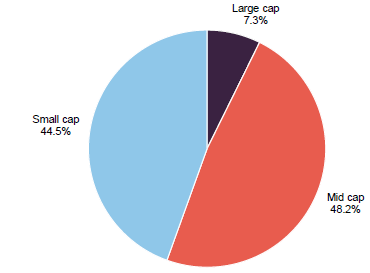
To better reflect IGC’s portfolio, the board replaced the BSE Mid Cap with the MSCI India SMID Index as IGC’s benchmark from 1 January 2026. At the end of January 2026, this new benchmark included 571 stocks and represented about 28% of India’s free-float-adjusted market cap. Figure 3 shows the market cap breakdown of the new benchmark, which is a better match for IGC’s portfolio. However, the portfolio still has a greater focus on small cap stocks compared to its new benchmark, even though this bias is less than with the previous benchmark.
Figure 3: Breakdown of MSCI India SMID as at 31 January 2026
Freedom to think long term
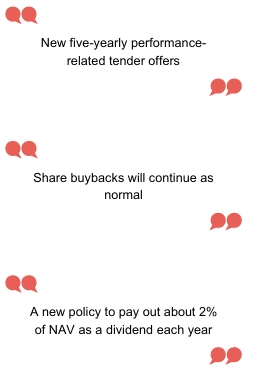
New five-yearly performance-related tender offers
IGC’s board is proposing to replace the biennial redemption opportunities, last offered in November–December 2025, with performance-related tender offers every five years. Under this plan, shareholders could tender up to 25% of the company’s shares at a price close to net asset value, after deducting the cost of the tender.
Share buybacks will continue as normal
If approved by shareholders, the first tender will only take place if IGC’s NAV total returns (before Indian capital gains taxes) are lower than the new benchmark return over the five-year period from 1 January 2026 to 31 December 2030. If this happens, the tender will be held around IGC’s AGM in 2031. Meanwhile, the board will continue using share buybacks to help manage the share price discount.
We support this move. A closed-end structure allows managers to take a long-term approach, which is especially important when investing in less-liquid small- and mid-cap stocks. The previous biennial redemption opportunities limited this advantage and restricted the adviser’s ability to invest in the best opportunities.
We have always been cautious about frequent exit options, as they can encourage short-term thinking and lead investors to focus on discount narrowing rather than long-term NAV growth, or to use the company as a source of cash during market volatility.
We believe the new tender offers will prompt investors to assess the adviser’s returns over a full market cycle and consider the strategy’s and adviser’s potential over the next five years.
Now with income
Many investors in UK-listed investment companies look for income, and the board wants to make it easier for them to include IGC in their portfolios. However, Indian companies generally pay low dividends. At the end of January, the MSCI India Index had a dividend yield of just 1.2%, and the MSCI India SMID Index was even lower at 0.8%. As a result, IGC made a revenue loss for both the year ended 31 December 2024 and the six months to 30 June 2025, and currently does not pay dividends.
A new policy to pay out about 2% of NAV as a dividend each year
One of IGC’s peers has already introduced an enhanced dividend, and IGC’s board now plans to do the same. Although not required, the board will put this proposal to a shareholder vote. The plan is to pay out about 2% of NAV as a dividend in the first year, split into two payments of about 1% each. The aim is to increase the dividend over time if conditions allow.
For shareholders who prefer not to receive cash dividends, IGC will offer a dividend reinvestment plan (DRIP), which will automatically reinvest dividends into IGC shares bought on the market, creating extra demand for the stock. The first dividend would be declared in September 2026, paid in October, based on the NAV at 30 June.
We support the proposal for the enhanced dividend policy, as the 2% target is reasonable and the DRIP option suits investors focused on capital growth.
Your vote counts
IGC is asking shareholders to approve new performance-related tender offers and a dividend policy at an EGM at 10am on 25 March 2026. If you are a shareholder, your vote matters. These proposals form part of a Special Resolution, which requires support from 75% of those voting to pass.
Interactive webinar
Elisabeth Scott (IGC’s chair) and Gaurav Narain (the adviser) will answer investor questions in a webinar at 11am on 4 March 2026. You can register for this via this link.
Important Information
Marten & Co (which is authorised and regulated by the Financial Conduct Authority) was paid to produce this note on India Capital Growth Fund Limited.
This note is for information purposes only and is not intended to encourage the reader to deal in the security or securities mentioned within it. Marten & Co is not authorised to give advice to retail clients. The research does not have regard to the specific investment objectives financial situation and needs of any specific person who may receive it.
The analysts who prepared this note are not constrained from dealing ahead of it but, in practice, and in accordance with our internal code of good conduct, will refrain from doing so for the period from which they first obtained the information necessary to prepare the note until one month after the note’s publication. Nevertheless, they may have an interest in any of the securities mentioned within this note.
This note has been compiled from publicly available information. This note is not directed at any person in any jurisdiction where (by reason of that person’s nationality, residence or otherwise) the publication or availability of this note is prohibited.
Accuracy of Content: Whilst Marten & Co uses reasonable efforts to obtain information from sources which we believe to be reliable and to ensure that the information in this note is up to date and accurate, we make no representation or warranty that the information contained in this note is accurate, reliable or complete. The information contained in this note is provided by Marten & Co for personal use and information purposes generally. You are solely liable for any use you may make of this information. The information is inherently subject to change without notice and may become outdated. You, therefore, should verify any information obtained from this note before you use it.
No Advice: Nothing contained in this note constitutes or should be construed to constitute investment, legal, tax or other advice.
No Representation or Warranty: No representation, warranty or guarantee of any kind, express or implied is given by Marten & Co in respect of any information contained on this note.
Exclusion of Liability: To the fullest extent allowed by law, Marten & Co shall not be liable for any direct or indirect losses, damages, costs or expenses incurred or suffered by you arising out or in connection with the access to, use of or reliance on any information contained on this note. In no circumstance shall Marten & Co and its employees have any liability for consequential or special damages.
Governing Law and Jurisdiction: These terms and conditions and all matters connected with them, are governed by the laws of England and Wales and shall be subject to the exclusive jurisdiction of the English courts. If you access this note from outside the UK, you are responsible for ensuring compliance with any local laws relating to access.
No information contained in this note shall form the basis of, or be relied upon in connection with, any offer or commitment whatsoever in any jurisdiction.
Investment Performance Information: Please remember that past performance is not necessarily a guide to the future and that the value of shares and the income from them can go down as well as up. Exchange rates may also cause the value of underlying overseas investments to go down as well as up. Marten & Co may write on companies that use gearing in a number of forms that can increase volatility and, in some cases, to a complete loss of an investment.