
On the grid, on the money
Ageing infrastructure across the developed world in need of upgrading, coupled with rapidly increasing demand for power to fuel the Artificial Intelligence (AI) revolution, mean there are huge changes currently taking place within energy markets. Ecofin Global Utilities and Infrastructure Trust (EGL) stands to benefit. In addition, Jean-Hugues de Lamaze, who is approaching his 10th anniversary of managing the fund since its launch in 2016, has proved adept at navigating an ever-evolving landscape to the benefit of EGL shareholders.
EGL is focused on investing in utilities, power networks, environmental services and, as a diversifier, transportation infrastructure. Through this mix, Jean-Hugues has delivered strong recent performance, with both NAV and share price one-year returns being well ahead of the relevant global utilities and infrastructure indices, as well as wider equity indices. The trust’s discount has also narrowed this year.
Developed markets utilities and other economic infrastructure exposure
EGL seeks to provide a high, secure dividend yield and to realise long‐term growth, while taking care to preserve shareholders’ capital. It invests principally in the equity of utility and infrastructure companies in Europe, North America, and other developed OECD countries.
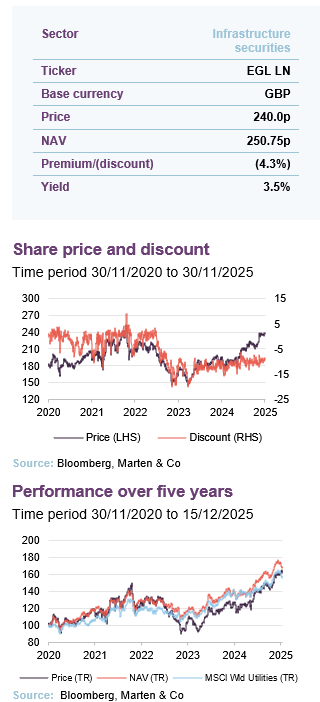
| Year ended | Share price TR (%) | NAV total return (%) | MSCI World Utilities TR (%) | S&P Global Infra TR (%) | MSCI World TR (%) |
|---|---|---|---|---|---|
| 30/11/2021 | 10.8 | 16.8 | 5.0 | 8.6 | 23.2 |
| 30/11/2022 | 13.9 | 12.3 | 15.6 | 20.8 | (0.5) |
| 30/11/2023 | (17.1) | (11.0) | (6.7) | (5.3) | 7.5 |
| 30/11/2024 | 20.9 | 20.8 | 25.4 | 24.2 | 27.3 |
| 30/11/2025 | 27.9 | 24.1 | 15.9 | 13.1 | 12.9 |
Source: Bloomberg, Marten & Co
Market backdrop
Falling inflation and interest rates are positive for the sector.
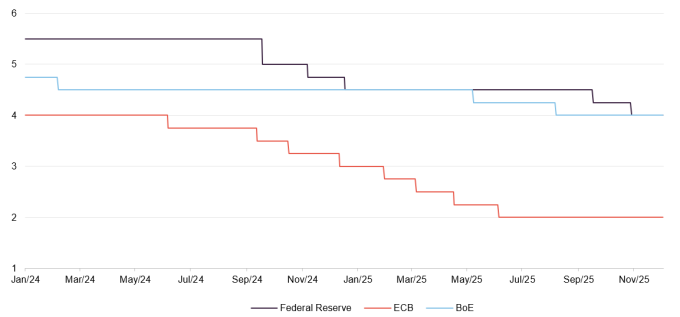
The utilities and wider economic infrastructure sector suffered significantly during the period of rising inflation and interest rates that began at the end of 2021. Simply put, investors were able to get a good return lower down the risk spectrum by holding cash or government bonds, making the sector relatively less attractive in comparison. However, more recently both prices and rates have declined. Figure 1 shows the extent to which developed markets interest rates have come down since the beginning of 2024.
Figure 1: US (Federal Reserve), eurozone (ECB) and UK (BoE) benchmark interest rates since January 2024
Source: Bloomberg, Marten & Co
With these falling rates, money has come back into the sector, as the dependable income streams of the likes of EGL once again look attractive to investors.
There have also been other favourable factors for EGL and the wider sector this year. Firstly, the initial fears sparked by the election of Donald Trump to a second term as US President have not been fully realised. Much of US energy policy is decided by the states, where the likes of California governor Gavin Newson defines himself against Trump. And even many Republican states, such as Texas, remain committed to the energy transition due to their favourable climate and the positive impact on jobs and growth.
Figure 2 illustrates the extent to which positive momentum has returned to the sector, with both the relevant European and US utilities indices rising strongly this year.
Figure 2: STOXX Europe 600 Utilities Index vs S&P 500 Utilities Index, rebased
Source: Bloomberg, Marten & Co
As Figure 2 shows, returns have been particularly strong in Europe, notably towards the end of this year. In general, European names still trade on lower valuations than their US peers, but the gap has narrowed. Overall, the sector is seeing an improved earnings outlook while still trading on an attractive valuation.
Invest in the grid
Energy infrastructure is outdated and requires significant investment.
A major investment opportunity identified by Jean-Hugues is the expansion of the power grid. There is a deep need for capital expenditure, with western countries still living with a significant level of outdated energy infrastructure, often dating from the 1950s and 1960s. Governments are belatedly waking up to the fact, with massive infrastructure packages announced in the US through the Inflation Reduction Act (admittedly under the previous president) and in Germany with the €500bn Special Fund for Infrastructure and Climate Neutrality.
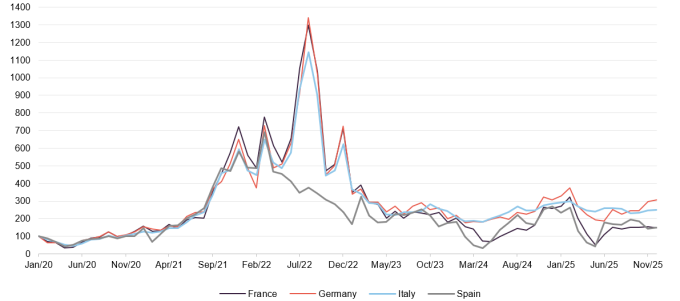
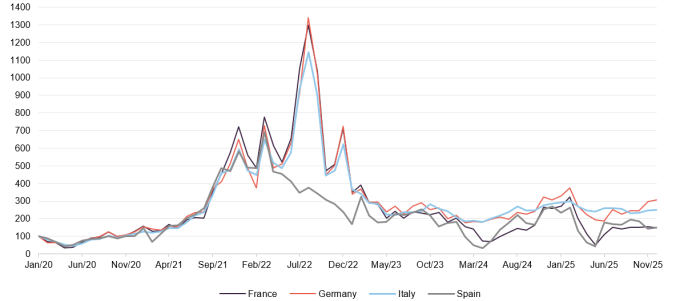
New generation capacity needs to be connected to the grid and the shift away from baseload to intermittent generation requires a more robust grid architecture. The increase in power supply is being driven in large part by demand. Figure 3 shows wholesale electricity prices in the four largest mainland European countries in the past five years.
Figure 3: European wholesale electricity prices, selected countries, rebased, euros per megawatt hour
Source: European Network of Transmission System Operators for Electricity
Clearly, there was a very pronounced spike in the aftermath of Russia’s invasion of Ukraine. The chart also hints at some difference between countries. However, beyond these factors, the chart clearly illustrates the significant increases in price in recent years, accompanied by significant volatility. The need for more – and more-resilient – capacity is clear.
The developed world is entering a period of rapidly-increasing power consumption, after many years when demand held steady or even fell. For example, the UK is consuming less electricity than 25 years ago, largely due to efficiency gains with lighting, heating, etc, but these gains have in many cases reached their natural limit. Jean-Hugues cites a recent study by NextEra Energy, the American energy company, that forecasts a 40% increase in power consumption in the US in the coming years, and 50% in Europe and the UK.
This increased demand is happening in the context of a concerted effort by governments to decarbonise the power grid. The UK is committed to transitioning to net zero – that is total emissions will be no more than removals from the atmosphere – by 2050. The National Energy System Operator (NESO) recently reported that the major constraint on delivering net zero is grid capacity, and talked of the importance of “clearing the Gridlock”, whereby existing infrastructure lacks the capacity to accommodate new power sources.
There are a number of different drivers of this increased demand, most notably the AI and cloud computing revolutions, principally to power the data centres that stand behind the technology. Electric vehicles – though the take-up has been slower than expected – are adding to demand, as is the more general trend towards electrification driven by decarbonisation. Overall, this increase will put huge pressure on the grid.
Some of this extra demand will be met by nuclear. For example, the Three Mile Island nuclear plant in Pennsylvania, which shut down in 2019, is being brought back online exclusively to provide power to Microsoft data centres. However, the lack of investment in the nuclear sector in most countries in recent years means there will be a lag of 10 years or more before meaningful extra capacity becomes available.
Despite this new demand-supply dynamic, power prices have declined recently, from the record-setting highs they hit in the aftermath of Russia’s invasion of Ukraine, as natural gas prices – a key driver of wholesale electricity costs – have normalised. However, volatile spot prices are often not relevant to the types of companies in EGL’s investable universe, which benefit from very long-term fixed contracts. Fully 80% of the revenues of European utilities are contracted – compared to less than 40% in 2008 – and the likes of NextEra enter into contracts of 20 to 40 years duration, generally at very attractive prices. In this way the business models of utilities companies are being steadily derisked – something which Jean-Hugues believes is missed by many investors.
The UK
Improving and still cheap
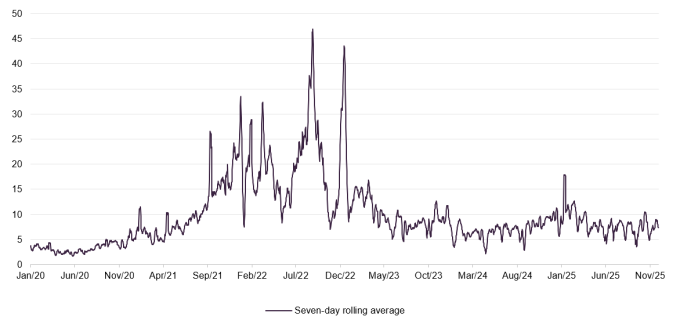
Figure 4: System Price of electricity, Great Britain, pence per kilowatt hour, seven-day rolling average
Source: Office for National Statistics
Just as in other developed markets, the UK is forecast to see a substantial increase in electricity demand in the coming years. The increase, and volatile nature, of electricity prices has mirrored that seen in many European countries, as shown in Figure 4.
The UK has led the world in phasing out the use of coal.
In some areas the country has led the way in the energy transition. For example, it has completely phased out coal from its energy mix, with the closure of the last coal-fired plant last year. Jean-Hugues describes the UK as currently offering the most attractive grid for investment, and indeed the second-largest holding in the EGL portfolio is the UK’s National Grid (see page 9).
The UK has some markedly improved companies trading at steep discounts. For example, SSE (another top-10 holding for EGL, see page 9) stands on a cheap valuation multiple, but in November raised £2bn through a share placement at a premium to its market price, indicating returning investor confidence.
The regulatory position is the UK is also generally favourable. This includes the water industry, after the publication of the Independent Water Commission report in July made a number of recommendations for a “reset” in regulation and planning. This should lead to a more stable long-term environment, replacing the current five-year price-review cycle. As such, Jean-Hugues has recently added a water company to the portfolio for the first time in many years in buying a small holding of Pennon, though he cautions that it is likely to be the only purchase in the sector.
Nonetheless, we recently had a reminder of the regulatory risk in the broader sector with the Department of Net Zero and Energy Security announcement of a consultation on changing the inflation calculation used in the renewables obligation and feed-in-tariffs schemes. This seems likely to result in a switch from the retail prices index (RPI) measure to the lower consumer prices index (CPI), with an inevitably negative impact on the net asset values of the affected companies. This looks to be a very short-sighted move from a government that will continue to need substantial help in the energy transition from private capital, which values stability and strong contracts. A new “UK premium” is a possible result, but certainly something the government will want to avoid.
Portfolio – Asset allocation
North America has reverted to EGL’s largest geographic weighting.
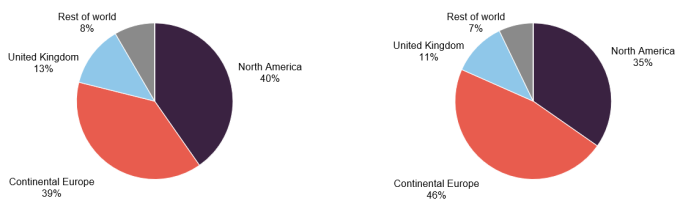
Figures 5 and 6 compare the geographic allocation of EGL’s portfolio against the position when we wrote our last note earlier in the year. The long-term trend has been for the North American weighting to be reduced in favour of Europe. Jean-Hugues has confirmed that this remains the case, but in the six months here, the reverse has been true, with North America reverting to being the largest allocation, albeit only slightly. The fact that some of the headwinds of a second Donald Trump presidency have not proven as damaging as first feared is part of the explanation here.
Jean-Hugues has described his starting point for EGL as being an equal allocation between the North America and Europe, to avoid concentration risk and ensure exposure to all the key themes, and this is certainly reflected in the portfolio at present.
Figure 5: Geographic allocation as at 31 October 2025
Figure 6: Geographic allocation as at 31 May 2025
Source: Ecofin Global Utilities and Infrastructure Trust
Source: Ecofin Global Utilities and Infrastructure Trust
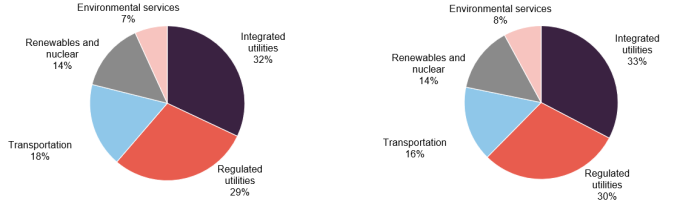
Figures 7 and 8 show the change in sector allocation since our last note. Overall change has been minimal, with a small increase in transportation offset by falls in integrated utilities, regulated utilities and environmental services. Within transport, Jean-Hugues is particularly positive on airports and toll roads exposure, as a diversifier from data centres. This is exemplified by the holding of Vinci, which has exposure to both. These are long-duration businesses, and although there are periodic threats from the French government to tax toll road operators, these invariably come to nothing, due to the rock-solid contracts in the industry.
Figure 7: Sectoral allocation as at 31 October 2025
Figure 8: Sectoral allocation as at 31 May 2025
Source: Ecofin Global Utilities and Infrastructure Trust
Source: Ecofin Global Utilities and Infrastructure Trust
Top 10 holdings
Figure 9: Top 10 holdings as at 31 October 2025
| Holding | Sector | Country | Allocation 31 October 2025 (%) | Allocation 31 May 2025 (%) | Percentage point change |
|---|---|---|---|---|---|
| Constellation Energy | Nuclear | US | 4.2 | 3.4 | (0.8) |
| National Grid | Networks/Regulated | UK | 4.1 | 4.7 | (0.6) |
| NextEra Energy | Integrated utilities | US | 3.7 | 3.0 | 0.7 |
| ENAV | Transportation | Italy | 3.7 | 3.8 | (0.1) |
| Enel | Integrated utilities | Italy | 3.6 | 4.3 | (0.7) |
| Xcel Energy | Integrated utilities | US | 3.6 | 2.3 | 1.3 |
| Iberdrola | Integrated utilities | Spain | 3.4 | 3.0 | 0.4 |
| E.ON | Integrated utilities | Germany | 3.4 | 5.3 | (1.9) |
| Vinci | Transportation infrastructure | France | 3.3 | 4.6 | (1.3) |
| SSE | Integrated utilities | UK | 3.3 | 3.5 | (0.2) |
| Total of top 10 | 36.3 | 41.1 | (4.8) |
Source: Ecofin Global Utilities and Infrastructure Trust, Marten & Co
Since our last note in June (using data up to 31 May 2025) there has been a fair amount of change to the top 10 holdings list. Constellation Energy has risen from tenth largest holding to first, on the back of a strong run from the shares. E.ON has fallen from first to eighth despite a modest rise in the share price, as Jean-Hugues trimmed the position. National Grid remains the second-largest holding, and clearly a very important one, considering the attraction of investing in the grid as outlined earlier in the note.
National Grid
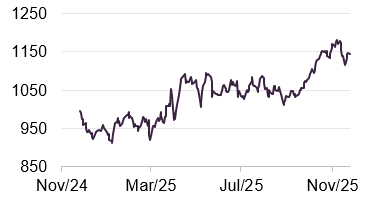
Figure 10: National Grid (GBP)
Source: Bloomberg
National Grid (www.nationalgrid.com) owns and maintains the high-voltage transmission network across England and Wales – transporting power from generators to major substations – and operates the regional distribution networks that deliver electricity to homes and businesses in the Midlands, South West England and South Wales. Alongside its UK operations, it owns extensive businesses in the United States, primarily in New York and Massachusetts. Through National Grid USA, the company manages electricity transmission and distribution networks and also operates gas distribution networks. Two-thirds of the company’s overall current capital expenditure is in the US.
Jean-Hugues describes this UK/US split as a big part of the investment case for National Grid. It allows for exposure to the UK grid, with some protection against regulation, given that regulators know the company can shift further resources across the pond. Although the shares have performed strongly in recent months, given the markedly higher valuations in the US, Jean-Hugues believes that they would trade 50% higher if they were listed there.
The company has recently sharpened its focus on electricity infrastructure, selling a majority stake in its UK gas transmission business and reinvesting proceeds into grid modernisation and interconnectors. It continues to invest heavily in grid upgrades, digitalisation and cross-border connections.
New additions to the top 10
There are three new names in the portfolio’s top 10: NextEra Energy, Xcel Energy and Iberdrola. All are preexisting holdings that have risen higher up the list, due either to further buying or market moves, or a combination of the two.
NextEra Energy
Figure 11: NextEra Energy (USD)
Source: Bloomberg
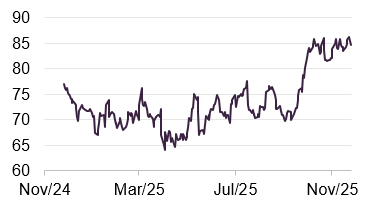
NextEra Energy (www.nexteraenergy.com) is a US group whose performance is anchored by Florida Power & Light, America’s largest regulated utility. Population growth and rising electrification in the state support steady demand, allowing the company to pursue a substantial capital programme across transmission and distribution infrastructure. This regulated core generates predictable earnings and cash flow, which in turn underpins the group’s wider investment activities.
NextEra is also one of the world’s largest developers of wind, solar and storage, through its Energy Resources division. The business has added further contracted capacity recently, although the pace of construction has been impacted by supply-chain conditions. Even so, the company still has a multi-gigawatt development pipeline.
Previously the largest holding in EGL for a long period, Jean-Hugues trimmed the position around a year ago on concerns about the agenda of the incoming President Trump, and risks to NextEra’s future tax credits. However, these threats turned out to be not as great as feared. Although the shares traded sideways for most of 2025, they have enjoyed a rally towards the end of the year.
Xcel Energy
Figure 12: Xcel Energy (USD)
Source: Bloomberg
Xcel Energy (www.excelenergy.com) is a major US regulated utility based in Minnesota, providing electricity and natural gas across eight Midwestern and Western states. It serves around four million electricity customers and 2.2m natural-gas customers, and its geographically diverse operations provide a broad base of regulated earnings and a stable revenue profile.
Xcel has committed to delivering 100% carbon-free electricity by 2050 and aims to achieve an 80% reduction in carbon emissions by 2035 relative to 2005 levels. Its long-term capital plan allocates substantial investment towards renewable generation, grid modernisation and energy storage, positioning it among the leading US utilities in the energy transition.
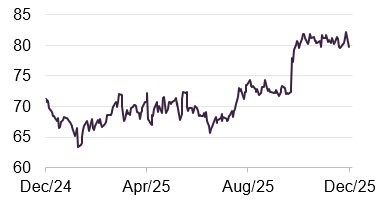
The shares have performed solidly this year, in line with the sector. The spike in the price in late September was due to settlement agreements being reached related to a 2021 fire in Colorado, claimed to be caused by Xcel equipment. Xcel agreed to pay c$640m whilst not admitting guilt, this removing a legal risk overhang.
Iberdrola
Figure 13: Iberdrola (EUR)
Source: Bloomberg
Iberdrola (www.iberdrola.com) is a major European multinational electric-utility group based in Bilbao, Spain. It supplies electricity (as well as gas in many markets) and operates across three main business lines: regulated networks, renewable generation and liberalised retail/wholesale energy supply. Its operations span multiple geographies, including Spain, the UK, the US (via subsidiaries such as Avangrid) and Latin America.
In recent years, Iberdrola has significantly deepened its commitment to the energy transition. This year it unveiled an investment plan committing €58bn of capital by 2028, mostly directed at transmission and distribution networks. This shift is aimed at transforming the company into a more regulated-asset-focused utility, reducing exposure to wholesale energy volatility and emphasising stable regulated returns.
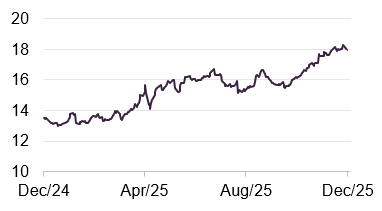
Iberdrola’s shares have rallied strongly over the past year. The company issued a series of positive corporate results, and undertook a €5bn equity raise in the middle of 2025. This was to fund further growth in grid and network investments and was very positively received by the market, being nearly four times oversubscribed.
Performance
Figure 14: Cumulative total return performance over periods ending 30 November 2025
| 3 months(%) | 6 months (%) | 1 year (%) | 3 years(%) | 5 years(%) | From launch1 | |
|---|---|---|---|---|---|---|
| EGL NAV | 10.6 | 14.9 | 24.1 | 33.4 | 74.9 | 172.2 |
| EGL share price | 12.3 | 13.9 | 27.9 | 28.2 | 61.7 | 212.7 |
| MSCI World Utilities | 11.3 | 14.8 | 15.9 | 35.6 | 64.6 | 131.2 |
| S&P Global Infrastructure | 6.6 | 10.6 | 13.1 | 33.1 | 74.6 | 104.6 |
| MSCI World | 7.8 | 16.6 | 12.9 | 54.6 | 89.4 | 206.5 |
| MSCI UK | 6.5 | 12.7 | 21.4 | 43.0 | 91.4 | 101.6 |
Source: Bloomberg, Marten & Co. Note 1) EGL was launched on 26 September 2016.
Up-to-date information on EGL is available on the QuotedData website.
EGL’s recent performance has been encouraging. As shown in Figure 14, over one year both NAV and share price growth have been ahead of the relevant utilities and infrastructure indices, as well as UK and world equity indices. Over the longer five-year period, it is unsurprising that EGL’s return is somewhat short of the general equity measures, given the difficult period for the sector when inflation and interest rates rose from the end of 2021. However, EGL’s NAV still outperformed the wider utilities and infrastructure sectors over the five-year period.
Figure 15: Performance of EGL NAV and relevant benchmark indices, since inception to 30 November 2025
Source: Bloomberg, Marten & Co
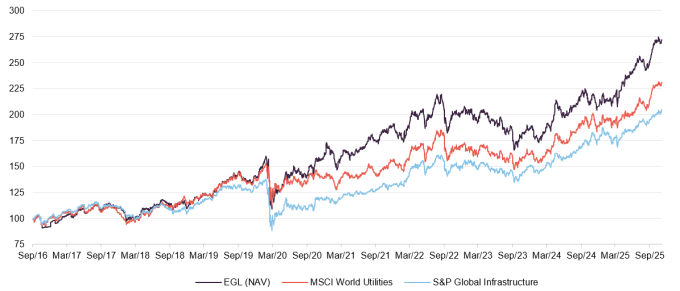
We are approaching the 10-year anniversary of the fund’s launch, so can get a true measure of Jean-Hugues’s long-term record, and here the picture is particularly positive. Since September 2016, both NAV and share price performance have been comfortably ahead of the utilities and infrastructure indices, and the UK market. In share price terms, if not NAV, the fund has even kept pace with global equities, which have been on a long-term bull run.
Figure 15 shows EGL’s performance against the MSCI World Utilities and S&P Global Infrastructure indices since inception, in graphical terms. The fund has outperformed both over this period, which encompasses a range of market conditions. The graph, and indeed many of the numbers in Figure 14, illustrate the ongoing benefit of active management in these sectors, with Jean-Hugues proving himself able to identify and exploit specific opportunities and market inefficiencies.
Premium/(discount)
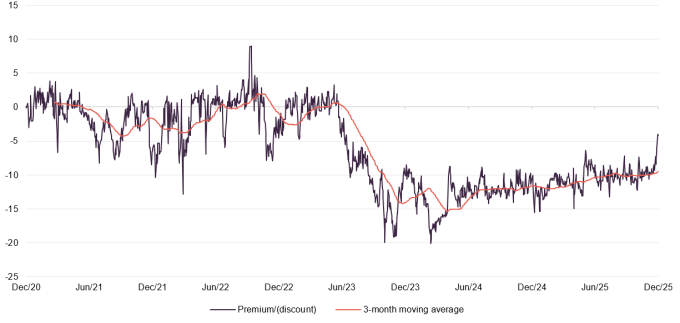
EGL has traded at a discount over the past year, within a 11.5% range.
Over the 12-month period ended 9 December 2025, EGL’s shares traded between a 4.0% and 15.5% discount to NAV. The average over that period was a 10.5% discount. As of publishing, EGL was trading at a 4.3% discount, and it is therefore encouraging to note the continuation of the narrowing trend over the past 12 months, as shown in Figure 16.
Figure 16:EGL premium/(discount) over five years to 9 December 2025
Source: Bloomberg, Marten & Co
There is the potential for the discount to close further if market conditions are broadly favourable, most obviously in an environment of low and stable interest rates and inflation. EGL regularly traded at a premium to NAV as recently as the middle of 2023. Conversely, rising interest rates would clearly be negative for the premium/discount position.
Share buybacks
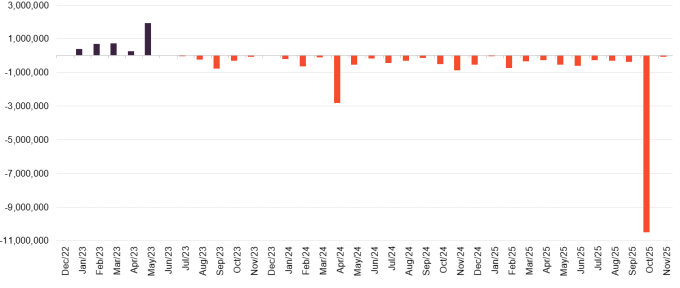
When the trust was trading at a premium, EGL consistently issued new shares, as shown in Figure 17. More recently, with the shares on a consistent discount, this has switched to a policy of regular buybacks.
16 October 2025 saw a very large repurchase of 10.15m shares, or nearly 10% of the total. This followed interactions with a block seller and was completed at the prevailing discount level. It was conducted under the authority granted at the EGL AGM, which covered repurchases up to 16.2m shares. The activist US hedge fund Saba Capital, whose last disclosed position in EGL was 5.11% of the company’s voting rights in August 2024, has been heavily involved in the investment trust sector in recent months, although due to dealing confidentiality, EGL has not disclosed the selling party.
Figure 17: EGL share buybacks and issuance
Source: Marten & Co, Ecofin Global Utilities and Infrastructure Trust
Gearing
EGL’s investment policy allows gearing of up to 25% and Jean-Hugues uses this flexibly. The level at any one time reflects his current level of conviction. Net gearing was 9.7% as of 31 October 2025, down from 15.4% at the end of May. This provides ample margin to the 25% maximum should a future market event throw up particular opportunities.
Dividend
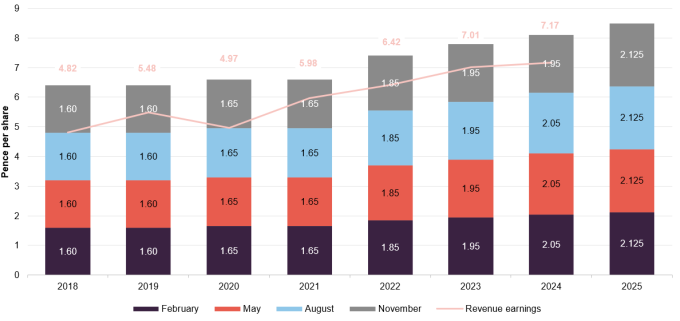
EGL has made four interim dividend payments in 2025, each of 2.125p. The most recent was paid on 28 November.
EGL’s stated aim is to deliver a dividend to shareholders that rises at least in line with inflation. Payouts for 2025 have totalled 8.5p per share, which is an increase of 4.9% over 2024. Based on the latest share price, the current yield is 3.5%. This is down from 3.9% at the time of our last note in June, but this simply reflects the strong share price performance in the intervening period.
In the most recent results statement, EGL’s chairman announced that the board has decided to increase the quarterly dividend by 5.9% to 2.25p per share (9.0p per annum) with effect from the payment to be made in February 2026. This increase exceeds the rate of inflation for the year and ensures the trust’s dividend has grown above inflation since inception.
Gearing and reserves can be used to augment the portfolio yield if necessary, and the dividend has tended to be uncovered in recent years. For example, in 2024 dividend per share was 8.1p on revenue earnings of 7.2p. Despite this, the reserves position remains very healthy, at £95m as of 31 March 2025, which equates to 101p per share.
Figure 18: EGL revenue income and dividend by financial year
Source: Ecofin Global Utilities and Infrastructure Trust
Fund profile
Further information regarding EGL can be found on the manager’s website:
https://www.redwheel.com/uk/en/individual/ecofin-global-utilities-and-infrastructure-trust-plc/
Ecofin Global Utilities and Infrastructure Trust Plc is a UK investment trust listed on the main market of the London Stock Exchange (LSE). The trust invests globally in the equity and equity-related securities of companies operating in the utility and other economic infrastructure sectors. EGL is designed for investors who are looking for a high level of income, would like to see that income grow, and wish to preserve their capital and have the prospect of some capital growth as well.
On 1 October 2024, Redwheel completed the purchase of the assets of Ecofin Advisors, the investment manager of EGL. The Ecofin team has relocated to Redwheel’s offices, but there are otherwise no changes to the investment strategy, process or Ecofin brand. Also effective from 1 October, the investment management fee was reduced to 0.9% p.a. of NAV on the first £200m; 0.75% above £200m and up to £400m; and 0.6% thereafter.
Reflecting its capital preservation objective, EGL does not invest in start-ups, small businesses or illiquid securities, as these may involve significant technological or business risk. Instead, it invests primarily in businesses in developed markets, which have “defensive growth” characteristics: a beta less than the market average; dividend yield greater than the market average; forward-looking EPS growth; and strong cash-flow generation.
It also operates with a strict definition of utilities and infrastructure, as follows:
- electric and gas utilities and renewable operators and developers – companies engaged in the generation, transmission and distribution of electricity, gas, liquid fuels and renewable energy;
- transportation – companies that own and/or operate roads, railways, and airports; and
- water and environment – companies operating in the water supply, wastewater, water treatment and environmental services industries.
EGL does not invest in telecommunications companies or companies that own or operate social infrastructure assets funded by the public sector (for example, schools, hospitals or prisons).
No formal benchmark
EGL does not have a formal benchmark and is not constructed with reference to any index.
EGL does not have a formal benchmark, and its portfolio is not constructed with reference to an index. However, for the purposes of comparison, the MSCI World Utilities Index and the S&P Global Infrastructure Index are the global indices deemed the most appropriate by the manager. The company also supplies data for the MSCI World Index and the All-Share Index in its own literature for general interest. We consider the MSCI World Utilities to be the most relevant – although it should be noted that this index has a strong bias towards US companies and excludes transportation services and some environmental services that EGL invests in.
SWOT analysis
Figure 19: SWOT analysis for EGL

| Strong performance track record, with NAV and share price returns comfortably ahead of the relevant utilities and infrastructure indices over the past year, and also since launch in 2016. |
| EGL aims to deliver a dividend that rises at least in line with inflation. With a yield of 3.5%, the shares are attractive on an income as well as a capital basis. |

| EGL is invested in sectors that are particularly sensitive to market sentiment. It can therefore be vulnerable to difficult periods irrespective of management skill. |

| Despite some inevitable bumps in the road, the clean-energy transition is a generational change, and the utilities and economic infrastructure sectors are right at the heart of it. |
| Artificial intelligence and cloud computing are rapidly-growing technologies that require enormous amounts of energy, much of which will be generated by the companies in EGL’s universe. |

| Rising inflation and interest rates are a particular risk to the utilities and infrastructure sectors. If we see a repeat of the period from late 2021 when both prices and rates rose significantly, EGL will inevitably suffer. |
Bull vs bear case
Figure 20: Bull vs bear case for EGL


| Performance | Strong performance over the past year and over the very long term since launch, in both NAV and share price terms. | Numbers for three and five years are more in-line with the relevant indices, although that is not a bad result, and absolute performance is good. |
| Dividends | Income payments have increased in each of the past four years, and EGL aims for the dividend to rise at least in line with inflation. | This is just an aim, and there is no guarantee of higher payouts, particularly if market conditions move against the fund. |
| Outlook | There are very clear structural tailwinds that should continue to boost the sector over the coming years. | Despite the tailwinds, the sector could still be vulnerable to a period of rising inflation and interest rates. |
| Discount | EGL continues to trade at a discount, which could narrow further, given both share buybacks and the fact the trust regularly traded at a premium up to 2023. | Discounts can persist for many years and there can be no guarantee that EGL’s discount will narrow, particularly if market conditions deteriorate. |
Source: Marten & Co
Previous publications
Readers interested in further information about EGL may wish to read some of the earlier notes that we have published, a list of which is provided below.
| Title | Note type | |
|---|---|---|
| Structural growth, low volatility and high income | Initiation | 23 May 2017 |
| Delivering the goods | Update | 9 November 2017 |
| On the contrary… | Update | 29 March 2018 |
| Staying nimble | Annual overview | 15 October 2018 |
| Unrecognised outperformance | Update | 11 April 2019 |
| Compelling three-year track record | Update | 17 October 2019 |
| Resilient income | Annual overview | 25 June 2020 |
| A wealth of opportunities | Update | 16 December 2020 |
| Happy birthday to ya! | Annual overview | 28 October 2021 |
| A portfolio for all seasons | Update | 22 November 2022 |
| Utilities and infrastructure at low tide | Annual overview | 22 August 2023 |
| Strong outlook as macro gloom lifts | Annual overview | 23 January 2024 |
| Momentum building | Update | 12 June 2024 |
| Virtues of diversification | Annual overview | 19 December 2024 |
| Feeling energised | Update | 26 June 2025 |
Source: Marten & Co
IMPORTANT INFORMATION
This marketing communication has been prepared for Ecofin Global Utilities and Infrastructure Trust Plc by Marten & Co (which is authorised and regulated by the Financial Conduct Authority) and is non-independent research as defined under Article 36 of the Commission Delegated Regulation (EU) 2017/565 of 25 April 2016 supplementing the Markets in Financial Instruments Directive (MIFID). It is intended for use by investment professionals as defined in article 19 (5) of the Financial Services Act 2000 (Financial Promotion) Order 2005. Marten & Co is not authorised to give advice to retail clients and, if you are not a professional investor, or in any other way are prohibited or restricted from receiving this information, you should disregard it. The note does not have regard to the specific investment objectives, financial situation and needs of any specific person who may receive it.
The note has not been prepared in accordance with legal requirements designed to promote the independence of investment research and as such is considered to be a marketing communication. The analysts who prepared this note are not constrained from dealing ahead of it, but in practice, and in accordance with our internal code of good conduct, will refrain from doing so for the period from which they first obtained the information necessary to prepare the note until one month after the note’s publication. Nevertheless, they may have an interest in any of the securities mentioned within this note.
This note has been compiled from publicly available information. This note is not directed at any person in any jurisdiction where (by reason of that person’s nationality, residence or otherwise) the publication or availability of this note is prohibited.
Marten & Co (which is authorised and regulated by the Financial Conduct Authority) was paid to produce this note on Ecofin Global Utilities and Infrastructure Trust Plc.
This note is for information purposes only and is not intended to encourage the reader to deal in the security or securities mentioned within it. Marten & Co is not authorised to give advice to retail clients. The research does not have regard to the specific investment objectives financial situation and needs of any specific person who may receive it.
The analysts who prepared this note are not constrained from dealing ahead of it but, in practice, and in accordance with our internal code of good conduct, will refrain from doing so for the period from which they first obtained the information necessary to prepare the note until one month after the note’s publication. Nevertheless, they may have an interest in any of the securities mentioned within this note.
This note has been compiled from publicly available information. This note is not directed at any person in any jurisdiction where (by reason of that person’s nationality, residence or otherwise) the publication or availability of this note is prohibited.
Accuracy of Content: Whilst Marten & Co uses reasonable efforts to obtain information from sources which we believe to be reliable and to ensure that the information in this note is up to date and accurate, we make no representation or warranty that the information contained in this note is accurate, reliable or complete. The information contained in this note is provided by Marten & Co for personal use and information purposes generally. You are solely liable for any use you may make of this information. The information is inherently subject to change without notice and may become outdated. You, therefore, should verify any information obtained from this note before you use it.
No Advice: Nothing contained in this note constitutes or should be construed to constitute investment, legal, tax or other advice.
No Representation or Warranty: No representation, warranty or guarantee of any kind, express or implied is given by Marten & Co in respect of any information contained on this note.
Exclusion of Liability: To the fullest extent allowed by law, Marten & Co shall not be liable for any direct or indirect losses, damages, costs or expenses incurred or suffered by you arising out or in connection with the access to, use of or reliance on any information contained on this note. In no circumstance shall Marten & Co and its employees have any liability for consequential or special damages.
Governing Law and Jurisdiction: These terms and conditions and all matters connected with them, are governed by the laws of England and Wales and shall be subject to the exclusive jurisdiction of the English courts. If you access this note from outside the UK, you are responsible for ensuring compliance with any local laws relating to access.
No information contained in this note shall form the basis of, or be relied upon in connection with, any offer or commitment whatsoever in any jurisdiction.
Investment Performance Information: Please remember that past performance is not necessarily a guide to the future and that the value of shares and the income from them can go down as well as up. Exchange rates may also cause the value of underlying overseas investments to go down as well as up. Marten & Co may write on companies that use gearing in a number of forms that can increase volatility and, in some cases, to a complete loss of an investment.