
Powering ahead
Ecofin Global Utilities and Infrastructure (EGL) has delivered strong absolute and relative performance and has been attracting attention. The board’s focus on controlling the discount has removed short-term shareholders, enabling the trust’s shares to trade at a premium and allowing it to expand again.
There are good reasons why share issuance is likely to continue. Demand for power grows, both to support new data centres for AI and the energy transition, while much infrastructure needs to be upgraded or replaced. The manager believes current valuations do not reflect this long-term growth potential. Investors also value the sectors’ reliable, often inflation-linked cash flows, especially given today’s uncertain environment.
Developed markets utilities and other economic infrastructure exposure
EGL aims to deliver a high and secure dividend yield with long-term growth, while protecting shareholders’ capital. It mainly invests in utility and infrastructure companies across Europe, North America, and other developed OECD countries.
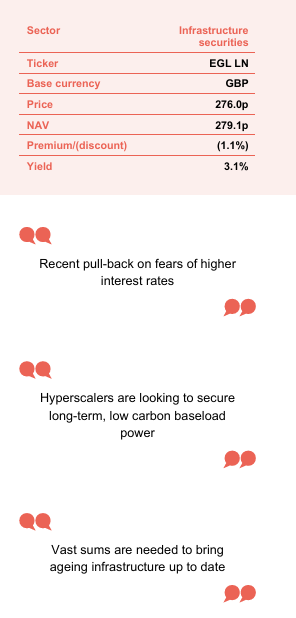
At a glance
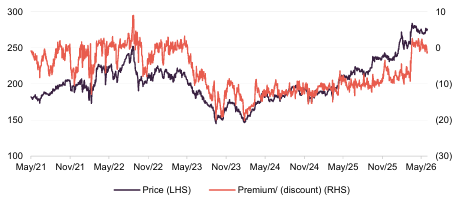
Share price and discount
EGL’s share price has risen strongly over the period, supported by solid NAV performance and improved investor demand. The discount has also narrowed significantly, helped by the board’s active use of buybacks and share issuance, with the trust recently moving close to par after trading at wider discounts in earlier years.
Time period 31 May 2021 to 26 June 2026
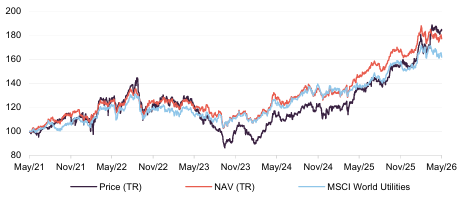
Performance over five years
EGL has delivered strong returns over five years, with both its share price and NAV total returns ahead of the MSCI World Utilities Index. Recent share price performance has been boosted by the narrowing discount, while underlying NAV gains reflect resilient sector fundamentals and strong stock selection.
Time period 31 May 2021 to 31 May 2026
| 12 months ended | Share price total return (%) | NAV total return (%) | MSCI World Utilities total return (%) | S&P Global Infra total return (%) | MSCI World total return (%) |
|---|---|---|---|---|---|
| 31/05/2022 | 26.3 | 24.8 | 20.8 | 25.5 | 6.9 |
| 31/05/2023 | (6.6) | (4.8) | (6.0) | (5.9) | 4.0 |
| 31/05/2024 | (4.2) | 8.4 | 9.9 | 9.5 | 21.6 |
| 31/05/2025 | 21.0 | 13.8 | 11.2 | 13.8 | 7.5 |
| 31/05/2026 | 34.5 | 20.8 | 16.6 | 16.7 | 27.4 |
Market backdrop
Jean-Hugues de Lamaze, EGL’s manager, believes the long-term growth prospects for utilities and infrastructure remain strong, despite some short-term challenges to investor confidence. EGL seems to be handling these conditions well.
Rate fears on Iran war
Recent pull-back on fears of higher interest rates
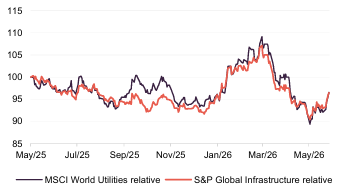
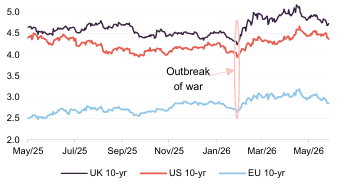
As Figure 1 shows, utilities and economic infrastructure sectors had been performing well compared to the broader market until recently. The outbreak of war involving the US, Israel, and Iran raised concerns about rising inflation and the possibility of higher interest rates, which usually hurt long-duration sectors like utilities and infrastructure. However, there are early signs these fears are easing as Trump tries to stop the conflict. Jean-Hugues notes that EGL’s European holdings have outperformed their US peers during this time, helping the trust to outperform.
Figure 1: MSCI World Utilities and S&P Global Infrastructure relative to MSCI World
Source: Bloomberg
Figure 2: UK, US, and EU 10-year bond yields
Source: Bloomberg
By closing the Strait of Hormuz, the war has underscored the need to improve energy security
The war has highlighted the need for greater energy security, leading many countries to invest more in renewables, nuclear power, energy storage, and more resilient power grids. Jean-Hugues notes that National Grid, EGL’s second-largest holding, plans to invest £70bn over five years across the UK and US. In Germany, nearly half of €700bn in infrastructure spending over the next decade will go towards upgrading the power grid.
Higher fuel prices more likely to hit long haul flights?
The war has also increased jet fuel prices. EGL has some exposure to airports, which Jean-Hugues says helps diversify the portfolio. EGL’s holdings, including Flughafen Zürich and Aena, focus on short-haul flights, which he believes will be less impacted. He points out that Flughafen Zürich’s May traffic grew 9.1% year-on-year.
The report also highlights a recurring theme: listed airport groups are valued much lower by the market compared to the higher prices seen in private equity deals.
EGL also owns ENAV, the Italian air traffic control company, which is handling more flights as conflicts in the region divert air traffic.
US LNG is in demand to make up shortfall from the Gulf
The Iran war has benefited US LNG producers, allowing them to fill supply gaps from the Gulf and increase prices. Jean-Hugues notes these companies have also gained from the Ukraine war for similar reasons. While some European countries still buy Russian gas, imports from the US have risen sharply.
Jean-Hugues believes demand for gas will remain strong for up to 20 more years, as it will take time to develop enough energy storage to replace gas-fired power plants. However, he warns that when the shift happens, it could be rapid, noting it took only 15 years for the UK to move from 50% coal power to none.
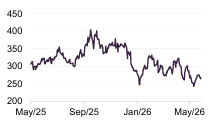
Figure 3: Constellation Energy (USD)
Source: Bloomberg
Growing demand for power
Jean-Hugues notes that investor enthusiasm for the AI data centre power demand theme, which drove the US utilities sector in 2024 and 2025, has eased recently. Share prices of US independent power producers like Vistra and Constellation Energy have been weak, likely due to profit-taking.
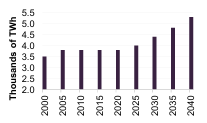
The fundamentals of the power sector remain strong. As highlighted previously, power demand growth turned positive in 2025 for the first time in 25 years, driven by AI data centres and the shift from fossil fuels to electricity in transport, heating, and cooling.
Figure 4: US electricity demand
Source: Ecofin Global Utilities and Infrastructure Trust
US utilities are signing long-term contracts with data centre customers, lasting 15-30 years, at prices up to $120/MWh. These rates are much higher than current and historical averages. Jean-Hugues expects similar long-term agreements to emerge in Europe and the UK, with companies like Drax already discussing the possibility. The first such deal was made in Pennsylvania in 2024, and Jean-Hugues believes this trend will continue. As more generator revenue becomes fixed for the long term, their business risk decreases, but he feels markets are not yet reflecting this.
He is not currently worried about the credit risk of these contracts, as the counterparties are usually large, cash-rich tech companies. However, he does see growing resistance at local and state levels, often due to concerns that new data centres strain local grids and raise domestic power prices. To avoid this, Hyperscalers are drawn to deals offering dedicated, especially baseload, energy supply – preferably low-carbon – which includes reactivating old nuclear plants and building new ones.
Hyperscalers are looking to secure long-term, low carbon baseload power
In October 2025, NextEra Energy and Google announced a $1.6bn investment to reopen the Duane Arnold Energy Center in Iowa. This 615MW nuclear plant is expected to restart by 2029, with Google signing a 25-year power purchase agreement, though details remain undisclosed.
In Europe, some companies are better positioned in this market; for example, Jean-Hugues points to Iberdrola as a possible beneficiary. However, more investment in energy storage is needed so these customers with constant demand can make greater use of renewable energy.
Renewing ageing infrastructure
Renewing and replacing ageing infrastructure is a key long-term theme in the portfolio. Jean-Hugues notes that infrastructure spending as a share of GDP peaked in the 1950s-70s and has since dropped, leaving much infrastructure at or beyond its intended lifespan.
Vast sums are needed to bring ageing infrastructure up to date
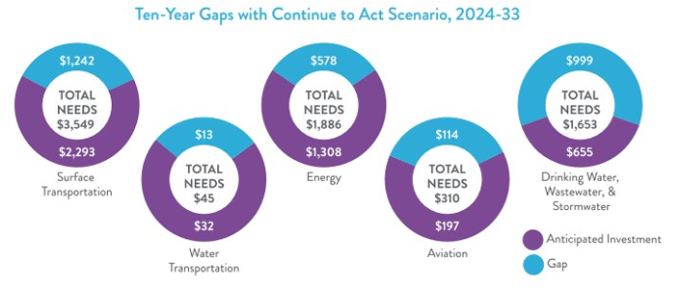
For example, the American Society of Civil Engineers (ASCE) highlights in its annual “Report Card for America’s Infrastructure” that, while recent acts like the Infrastructure Investment and Jobs Act of 2021 and Inflation Reduction Act of 2022 have helped, much more investment is needed. In its 2024 “Bridging the gap” report, the ASCE estimates an extra $9.1 trillion is required to bring US infrastructure up to a “good repair” standard.
Figure 5: The gap between planned and necessary infrastructure investment in the US
Source: ASCE, 2025 Report Card for America’s Infrastructure
It forecasts that $5.4 trillion of the investment would be covered if Congress keeps current funding levels, leaving a $3.7 trillion shortfall. The chart in Figure 4, taken the 2025 Report Card for America’s Infrastructure highlights a significant gap between planned and needed investment, excluding areas like broadband, dams, waste, parks, and schools, which add at least another $746bn to the shortfall.
This issue is not limited to the US. In March 2025, Germany announced a €500bn special fund to tackle years of underinvestment in infrastructure and climate projects.
Ofwat blamed for parlous state of UK’s water infrastructure
Jean-Hugues notes that in the UK, Ofwat is being scrapped as it discouraged investment, worsening the challenges in the water and wastewater sector. UK water leakages are much higher than in countries like the Netherlands, Germany, and Switzerland.
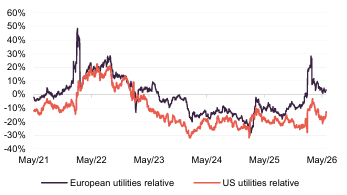
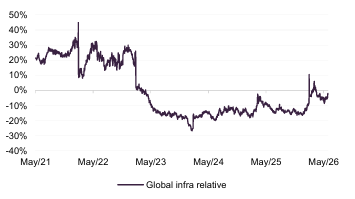
Valuations undemanding
Figure 6: US and European utilities P/E relative
Source: Bloomberg
Figure 7: S&P Global Infrastructure P/E relative
Source: Bloomberg
Apart from US utilities, valuation multiples are slightly above long-term averages but not by much. Jean-Hugues also notes that these companies are experiencing earnings upgrades.
Figure 8: P/E multiples of current-year earnings
| 29 June 2026 | Average since 31 May 2021 | |
|---|---|---|
| Euro Stoxx 600 Utilities | 16.3x | 14.2x |
| Euro Stoxx 600 | 15.6x | 14.5x |
| S&P 500 Utilities | 19.1x | 18.9x |
| S&P 500 | 21.5x | 21.6x |
| S&P Global Infrastructure | 19.9x | 19.0x |
| MSCI World | 20.1x | 19.2x |
Portfolio – asset allocation
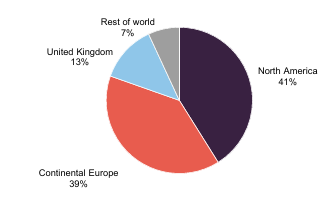
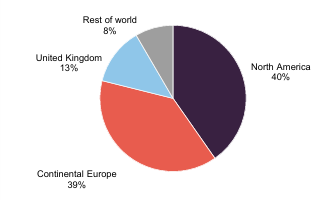
At the end of May 2026, EGL’s portfolio held 43 investments. The charts below show that EGL’s geographic and sector allocation has changed very little since our last update in October 2025.
Figure 9: Geographic allocation as at 31 May 2026
Source: Ecofin Global Utilities and Infrastructure Trust
Figure 10: Geographic allocation as at 31 October 2025
Source: Ecofin Global Utilities and Infrastructure Trust
Figure 11: Sectoral allocation as at 31 May 2026
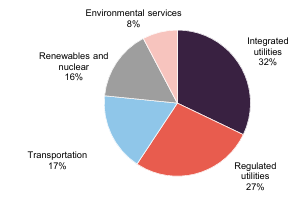
Source: Ecofin Global Utilities and Infrastructure Trust
Figure 12: Sectoral allocation as at 31 October 2025
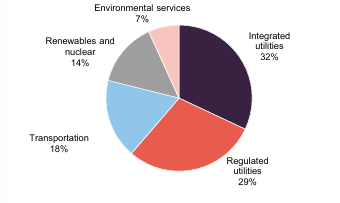
Source: Ecofin Global Utilities and Infrastructure Trust
Top 10 holdings
There has been some change in the portfolio since our last note in December 2025. Constellation Energy, Xcel Energy, Vinci, and SSE have left the top 10 holdings, while Veolia Environnement, Brookfield Renewable, Dominion Energy, and Exelon have entered the list.
The manager sold shares in Constellation and Vistra before their recent decline, noting that while their earnings outlook remains strong, their valuations had become stretched. These sales also helped diversify the portfolio away from the AI data centre theme.
A clear trend among the top 10 holdings is investment in power grids, with National Grid, Enel, EON, and Exelon all linked to the transmission sector.
Figure 13: Top 10 holdings as at 31 May 2026
| Holding | Sector | Country | Allocation 31 May 2026 (%) | Allocation 31 October 2025 (%) | Percentage point change |
|---|---|---|---|---|---|
| Iberdrola | Integrated utilities | Spain | 4.3 | 3.4 | 0.9 |
| National Grid | Networks/Regulated | UK | 4.1 | 4.1 | – |
| NextEra Energy | Integrated utilities | US | 3.7 | 3.7 | – |
| Veolia Environnement | Water and waste management | France | 3.7 | 3.1 | 0.6 |
| Enel | Integrated utilities | Italy | 3.5 | 3.6 | (0.1) |
| ENAV | Transportation | Italy | 3.4 | 3.7 | (0.3) |
| E.ON | Integrated utilities | Germany | 3.0 | 3.4 | (0.4) |
| Brookfield Renewable | Renewable energy | Canada | 3.0 | 2.9 | 0.1 |
| Dominion Energy | Integrated utilities | US | 3.0 | 2.3 | 0.7 |
| Exelon | Integrated utilities | US | 3.0 | 3.2 | (0.2) |
| Total of top 10 | 34.7 | 36.3 |
Veolia Environnement
Figure 14: Veolia Environnement (EUR)
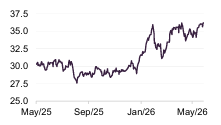
Source: Bloomberg
Veolia Environnement (veolia.com) is a water company, generating 60% of its revenue from water, 10% from waste, and 30% from energy efficiency. Unlike regulated water firms, Veolia focuses on non-regulated markets, which allows for faster growth and a higher beta, closer to the market average. EGL has increased its position in Veolia, with Jean-Hugues believing the company’s growth potential is undervalued.
Veolia claims to be the leading global water company, operating in 44 countries. It works mainly on long-term contracts averaging 11 years, serving both municipalities and businesses. Around 70% of its revenue is linked to inflation, which could benefit EGL if inflation rises. Most commodity price increases are passed on to customers.
Recently, Veolia acquired Clean Earth, a US hazardous waste business, for $3bn, and made a similar purchase in Australia for A$220m. Its water business has faced project delays in the Middle East due to the war. Despite this, Veolia achieved 2.1% revenue growth in Q1 2026 and improved margins, boosting profits.
The company expects to benefit from increased data centre spending and sees a similar opportunity in PFAS clean-up. It is targeting 5%-6% organic EBITDA growth for 2026.
Figure 15: Dominion Energy (USD)
Dominion Energy
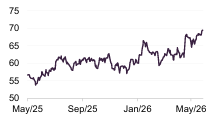
Source: Bloomberg
Dominion Energy (dominionenergy.com) is a US utility with mainly regulated revenues, providing electricity to 3.6 million customers in Virginia, North Carolina, and South Carolina, and natural gas to 500,000 customers in South Carolina. This makes its income stable and predictable.
Dominion positions itself as a leading US developer of regulated offshore wind and solar power, and is the largest producer of carbon-free electricity in New England.
The company is merging with NextEra Energy, EGL’s third-largest holding. This merger could create a $250bn company serving over 10 million customers, setting new records in the sector. Merger-related trading is affecting NextEra’s share price, but Jean-Hugues believes this is temporary and expects NextEra to benefit from the deal, though approvals may take time.
Both companies expect strong growth in power demand in the coming years.
Figure 16: Power demand is expected to grow six times faster over the next 20 years
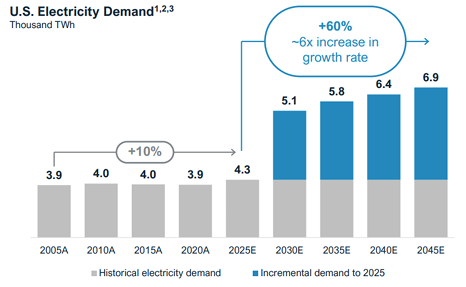
Source: Dominion/NextEra merger presentation. Note 1) Source: ISO/RTO Forecasts, NERC ES&D, Utility IRPs, ICF. Note 2) Historical demand represents data from NERC ES&D from 2000 to 2023, 2024 represents forecast from NERC ES&D. Note 3) Q1 2025 represents ICF’s demand for 2025; Q4 2025 represents ICF’s demand projects from 2030–2045.
After the deal, 90%-95% of revenue will come from regulated or long-term contracts, illustrating Jean-Hugues view regarding the de-risking of business models across the sector. NextEra’s strong position in Florida (Florida Power & Light) complements Dominion’s East Coast operations. The company expects earnings per share to grow at an average rate of 9% each year from 2025 to 2032.
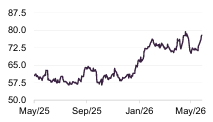
Figure 17: Williams (USD)
Williams Companies
Source: Bloomberg
Outside the top 10, EGL has a newer holding in Williams Companies (williams.com), a US natural gas pipeline operator. Williams has benefitted from recent disruptions to gas supplies from the Middle East. It was already providing double-digit earnings growth and was trading at a lower valuation than peers. The company’s earnings depend on pipeline volumes, not gas prices.
Williams operates over 32,000 miles of pipeline, handling about a third of US natural gas. In Q1 2026, it reported a 25% rise in earnings per share and expects to reach the upper half of its 2026 adjusted EBITDA target. New projects include Project Neo, a $2.3bn plan to supply 682MW of power to AI data centres by 2028.
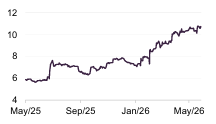
Figure 18: Athens Water (EUR)
Athens Water
Source: Bloomberg
Athens Water is another notable stock in EGL’s portfolio. As a regulated utility, it benefits from Greece’s upgrade from emerging to developed market status, which attracts more investors and could lead to a higher valuation. Jean-Hugues notes that this upgrade theme is used elsewhere in the portfolio.
When EGL invested, Athens Water had low free float and liquidity, making it a small position, but well-suited to a closed-end fund like EGL. A new five-year regulatory agreement, finalised last December, supports expected annual earnings growth of 15-20%. The stock’s re-rating was further supported by a large share placement at a premium to the market price.
Performance
Up-to-date information on EGL is available on the QuotedData website.
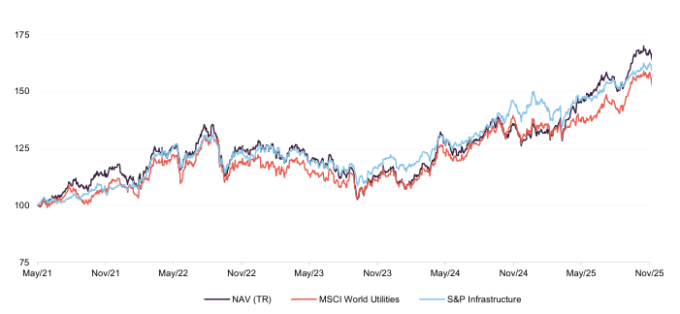
EGL’s NAV returns have outperformed the MSCI World Utilities Index across all periods shown in Figure 19, and have beaten the S&P Global Infrastructure Index for most periods. A recent narrowing of the discount has also boosted EGL’s share price returns.
The manager notes that EGL’s long-term total return has closely matched the MSCI World Index, but with much lower volatility.
While geographical allocation has helped, strong stock selection has been the main driver of returns.
Figure 19: Cumulative total return performance over periods ending 31 May 2026
| 3 months(%) | 6 months (%) | 1 year (%) | 3 years(%) | 5 years(%) | |
|---|---|---|---|---|---|
| EGL share price | 3.8 | 18.1 | 34.5 | 55.9 | 84.0 |
| EGL NAV | (5.8) | 5.1 | 20.8 | 48.9 | 76.9 |
| MSCI World Utilities | (5.8) | 2.0 | 16.6 | 42.4 | 61.6 |
| S&P Global Infrastructure | (4.2) | 5.6 | 16.7 | 45.5 | 71.7 |
| MSCI World | 7.2 | 9.5 | 27.4 | 66.6 | 85.3 |
Figure 20: Performance of EGL NAV and benchmark indices over five years to 31 May 2026
Source: Bloomberg, Marten & Co
Premium/(discount)
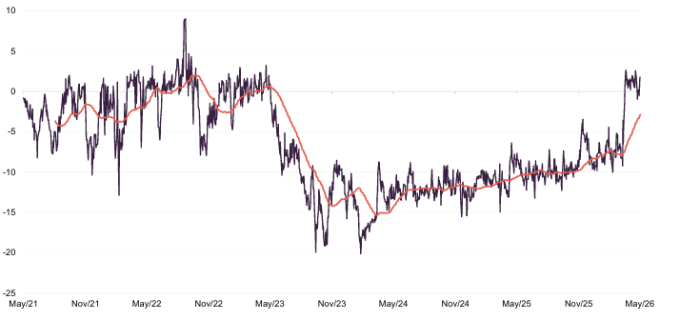
Over the 12 months to 31 May 2026, EGL’s shares moved between a 2.6% premium and a 13.2% discount to NAV, averaging a 7.5% discount. At the time of writing, EGL was trading at a 1.1% discount to NAV.
Concerns about the Iran war could push interest rates higher, which would negatively affect long-term assets like utilities and infrastructure. However, the conflict has also highlighted the need for energy security, supporting investment in nuclear, renewables, and electric vehicles. Growing power demand from AI investment is also a factor. The drive to strengthen power grids supports a positive outlook for the trust.
EGL is now the only trust with a clear focus on these themes, which should help maintain demand for its shares.
Figure 21: EGL premium/(discount) over five years to 31 May 2026
Source: Bloomberg, Marten & Co
Share buybacks and issuance
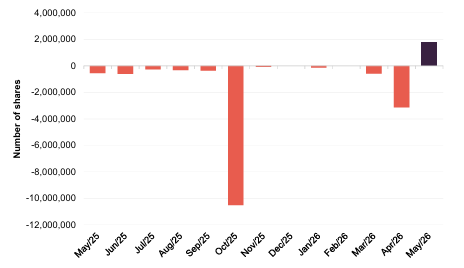
Figure 22: Number of shares issued/(repurchased) by month
Source: Ecofin Global Utilities and Infrastructure Trust, Marten & Co
The board has a strong record of buying back shares when EGL trades at a large discount and has recently reissued shares as the trust moved to a premium. Both actions have benefited EGL’s shareholders by enhancing net asset value.
Dividend
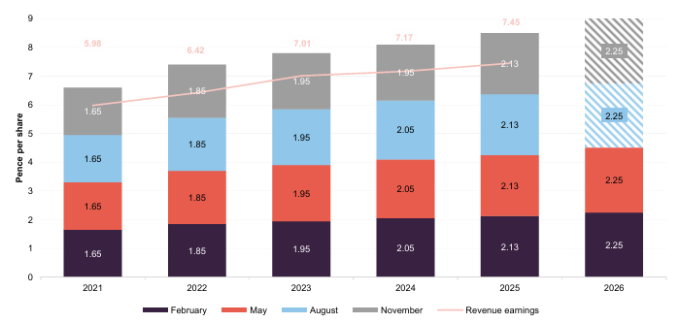
EGL is targeting four interim dividend payments of 2.25p for its current financial year
EGL aims to grow its dividend at least in line with inflation. For the year ending September 2026, it targets a 9.0p dividend, paid in four equal instalments of 2.25p, up 5.9% from 2025. At the current share price, this gives a yield of 3.1%.
The company can use gearing and reserves to boost portfolio yield if needed. Recently, part of the dividend has come from reserves, rather than being fully covered by income. As of March 2026, EGL had a special reserve of £62.5m, or 68.1p per share.
Figure 23: EGL revenue income and dividend by financial year
Source: Ecofin Global Utilities and Infrastructure Trust
Structure
Fees and costs
Frostrow will become EGL’s AIFM from 1 July 2025. RWC Asset Management LLP manages EGL’s portfolio and receives a fee of 0.9% per year on net assets up to £200m, 0.75% on the next £200m, and 0.60% above that. The management fee is calculated and paid quarterly in arrears, with no performance fee. For accounting, 60% of the management fee and borrowing costs are charged to capital and 40% to revenue.
Other main expenses include administration and company secretarial fees of £287k for FY25, and legal and advisory fees of £211k for FY25. As of 31 March 2026, the ongoing charges ratio was estimated at 1.30%, up from 1.25% at 31 March 2025 and 1.29% at 30 September 2025.
Capital structure
EGL has a straightforward capital structure with only one type of ordinary share. These shares are listed on the LSE’s main market. As of 31 May 2026, there were 114,920,697 shares issued, with 23,087,604 held in treasury. This means 91,833,093 shares carried voting rights.
Gearing
EGL’s investment policy allows borrowing up to 25%, which Jean-Hugues adjusts based on his confidence in the market. As of 31 May 2026, net gearing was 13.3%.
EGL borrows through a prime brokerage facility with Citigroup, which also acts as custodian. The interest rate is typically 0.5% above the relevant benchmark, depending on the currency. Citigroup charges a minimum annual fee of $200,000. The borrowings are flexible and can be repaid at any time.
Unlimited life with five-yearly continuation votes
EGL has an unlimited life but gives shareholders a continuation vote every five years. At the last vote in March 2024, 94.8% supported continuation. The next vote will take place at the AGM in March 2029.
Financial calendar
The trust’s year-end is 30 September, with annual results released in December and interim results in May. AGMs are usually held each March. EGL pays quarterly dividends on the last business day of February, May, August and November.
Board
EGL’s board has four non-executive directors, all independent of the investment manager.
Each director stands for re-election every year. The board expects directors to serve for up to nine years from their initial election, with the intention that they step down by the end of this period. The board was recently refreshed. David Simpson stepped down after the AGM on 5 March 2026, with Susannah Nicklin becoming chair. David Benda joined as a non-executive director on 1 November 2025. Biographies of the directors can be found on the trust’s website.
Figure 24: Board member – length of service and shareholdings
| Director | Position | Date of appointment | Length of service | Annual fee (GBP) | Shareholding |
|---|---|---|---|---|---|
| Susannah Nicklin | Chair and chair of the management engagement committee | 9 September 2020 | 5.8 | 46,000 | 22,7341 |
| David Benda | Non-executive director | 1 November 2025 | 0.6 | 32,500 | 20,891 |
| Max King | Senor independent director and chair of the remuneration committee | 11 September 2017 | 8.8 | 32,500 | 50,000 |
| Joanna Santinon | Chair of the audit committee | 12 September 2023 | 2.8 | 38,000 | 20,441 |
Fund profile
Further information regarding EGL can be found on the manager’s website:
https://www.redwheel.com/uk/en/individual/ecofin-global-utilities-and-infrastructure-trust-plc/
Further information regarding EGL can be found on the manager’s website: https://www.redwheel.com/uk/en/individual/ecofin-global-utilities-and-infrastructure-trust-plc/
Ecofin Global Utilities and Infrastructure Trust Plc is a UK investment trust listed on the London Stock Exchange. It invests worldwide in shares of companies in the utility and infrastructure sectors. EGL is aimed at investors seeking high and growing income, capital preservation, and some capital growth.
On 1 October 2024, Redwheel bought the assets of Ecofin Advisors, EGL’s investment manager. The Ecofin team moved to Redwheel’s offices, but the investment strategy and process remain unchanged.
EGL’s investment approach, detailed in our January 2024 note, focuses on capital preservation. It avoids start-ups, small businesses, and illiquid assets due to their higher risks. Instead, EGL invests mainly in established businesses in developed markets with defensive growth features: lower market risk, higher dividend yields, expected earnings growth, and strong cash flow.
EGL defines its investment universe strictly as:
- electric and gas utilities and renewable operators and developers – companies engaged in the generation, transmission and distribution of electricity, gas, liquid fuels and renewable energy;
- transportation – companies that own and/or operate roads, railways, and airports; and
- water and environment – companies operating in the water supply, wastewater, water treatment and environmental services industries.
EGL does not invest in telecommunications companies or in businesses that own or run public sector-funded social infrastructure, such as schools, hospitals or prisons.
No formal benchmark
EGL does not have a formal benchmark and is not constructed with reference to any index.
EGL does not use a formal benchmark or build its portfolio around an index. For comparison, the manager sees the MSCI World Utilities Index and the S&P Global Infrastructure Index as the most suitable global indices. The company also provides figures for the MSCI World Index and the All-Share Index for general interest. We see the MSCI World Utilities Index as the most relevant, though it is heavily weighted towards US companies and does not include transportation or some environmental services that EGL invests in.
SWOT analysis and bull versus bear
Figure 25: SWOT analysis for EGL
| Strength | Weakness |
| Strong performance track record, with NAV and share price returns comfortably ahead of the relevant utilities and infrastructure indices. | EGL is invested in sectors where sentiment can be sensitive to the direction of interest rates. |
| EGL aims to deliver a dividend that rises at least in line with inflation. An attractive dividend yield of 3.1% means that the shares are attractive on an income as well as a capital basis. | |
| Opportunities | Threats |
| Despite some inevitable bumps in the road, the clean-energy transition is a generational change, and the utilities and economic infrastructure sectors are right at the heart of it. | The failure, to date, to secure a definite conclusion to the war in Iran and a reopening of the Strait of Hormuz may prolong inflationary, and therefore interest rate, worries. |
| Artificial intelligence and cloud computing are rapidly-growing technologies that require enormous amounts of energy, much of which will be generated by the companies in EGL’s universe. | The utilities sector’s success story has, to some extent, become bound up investors’ minds with the AI data centre investment boom, and concerns about the boom’s longevity may weigh on sentiment. |
| Governments may be reluctant to invest in infrastructure renewal but face inexorable pressure to do so. |
Figure 26: Bull vs. bear case for EGL
| Bull | Bear | |
| Performance | Strong performance over the medium-to-long-term, both NAV and share price terms. | Short-term hit from concerns about inflation/interest rates may be extended. |
| Dividends | EGL aims for the dividend to rise at least in line with inflation. | There is no guarantee of higher payouts, particularly if market conditions move against the fund. |
| Outlook | There are very clear structural tailwinds that should continue to boost the sector over the coming years. | The AI capex boom won’t last forever |
| Discount | Decisive action on buybacks appears to have shaken out loose holders and paved the way for share issuance at a premium. | If performance deteriorates, that could lead to some discount widening – although we would expect the board to be on top of this. |
Previous publications
For more information about EGL, readers can refer to our earlier published notes listed below.
Figure 27: QuotedData’s previously published notes on EGL
IMPORTANT INFORMATION
Marten & Co (which is authorised and regulated by the Financial Conduct Authority) was paid to produce this note on Ecofin Global Utilities and Infrastructure Trust Plc.
This note is for information purposes only and is not intended to encourage the reader to deal in the security or securities mentioned within it.
Marten & Co is not authorised to give advice to retail clients. The research does not have regard to the specific investment objectives financial situation and needs of any specific person who may receive it.
The analysts who prepared this note are not constrained from dealing ahead of it but, in practice, and in accordance with our internal code of good conduct, will refrain from doing so for the period from which they first obtained the information necessary to prepare the note until one month after the note’s publication. Nevertheless, they may have an interest in any of the securities mentioned within this note.
This note has been compiled from publicly available information. This note is not directed at any person in any jurisdiction where (by reason of that person’s nationality, residence or otherwise) the publication or availability of this note is prohibited.
Accuracy of Content: Whilst Marten & Co uses reasonable efforts to obtain information from sources which we believe to be reliable and to ensure that the information in this note is up to date and accurate, we make no representation or warranty that the information contained in this note is accurate, reliable or complete. The information contained in this note is provided by Marten & Co for personal use and information purposes generally. You are solely liable for any use you may make of this information. The information is inherently subject to change without notice and may become outdated. You, therefore, should verify any information obtained from this note before you use it.
No Advice: Nothing contained in this note constitutes or should be construed to constitute investment, legal, tax or other advice.
No Representation or Warranty: No representation, warranty or guarantee of any kind, express or implied is given by Marten & Co in respect of any information contained on this note.
Exclusion of Liability: To the fullest extent allowed by law, Marten & Co shall not be liable for any direct or indirect losses, damages, costs or expenses incurred or suffered by you arising out or in connection with the access to, use of or reliance on any information contained on this note. In no circumstance shall Marten & Co and its employees have any liability for consequential or special damages.
Governing Law and Jurisdiction: These terms and conditions and all matters connected with them, are governed by the laws of England and Wales and shall be subject to the exclusive jurisdiction of the English courts. If you access this note from outside the UK, you are responsible for ensuring compliance with any local laws relating to access.
No information contained in this note shall form the basis of, or be relied upon in connection with, any offer or commitment whatsoever in any jurisdiction.
Investment Performance Information: Please remember that past performance is not necessarily a guide to the future and that the value of shares and the income from them can go down as well as up. Exchange rates may also cause the value of underlying overseas investments to go down as well as up. Marten & Co may write on companies that use gearing in a number of forms that can increase volatility and, in some cases, to a complete loss of an investment.