
Powering Ahead
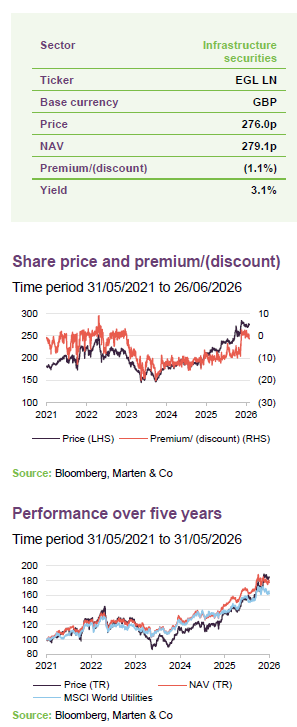
Ecofin Global Utilities and Infrastructure (EGL) has recently experienced a good period of absolute and relative performance that appears to be attracting attention. The board’s focus on discount control has helped loose and discount-driven shareholders to exit and appears to have contributed to the trust’s shares trading at a premium, which has allowed it to re-expand.
According to the manager, there are reasons why the recent share issuance could continue. It says that demand for power is rising, driven by investment in data centres and the energy transition, while infrastructure needs upgrading and replacing. The manager believes that this long-term growth potential is not reflected in valuations.
It appears that some investors may recognise the value of the sectors’ predictable cash flows in the current environment.
Developed markets utilities and other economic infrastructure exposure
EGL seeks to provide a high, secure dividend yield and to realise long‐term growth, while taking care to preserve shareholders’ capital. It invests principally in the equity of utility and infrastructure companies in Europe, North America, and other developed OECD countries.
| 12 months ended | Share price total return (%) | NAV total return (%) | MSCI World Utilities TR (%) | S&P Global Infra TR (%) | MSCI World TR (%) |
|---|---|---|---|---|---|
| 31/05/2022 | 26.3 | 24.8 | 20.8 | 25.5 | 6.9 |
| 31/05/2023 | (6.6) | (4.8) | (6.0) | (5.9) | 4.0 |
| 31/05/2024 | (4.2) | 8.4 | 9.9 | 9.5 | 21.6 |
| 31/05/2025 | 21.0 | 13.8 | 11.2 | 13.8 | 7.5 |
| 31/05/2026 | 34.5 | 20.8 | 16.6 | 16.7 | 27.4 |
Market backdrop
Jean-Hugues de Lamaze, EGL’s manager, believes that the supportive long-term growth outlook for the utilities and infrastructure sectors remains, but notes that there are some short-term headwinds to sentiment. EGL appears to be navigating this.
Rate fears on Iran war
Recent pull-back on fears of higher interest rates
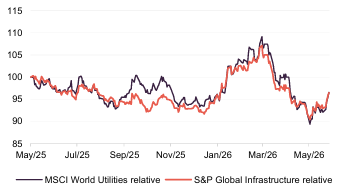
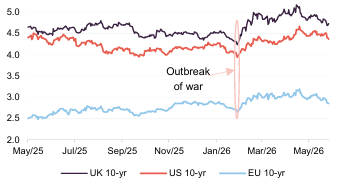
As Figure 1 shows, until very recently, the utilities and wider economic infrastructure sectors were performing relatively well compared to the wider market. However, since the outbreak of conflict involving the US/Israel and Iran, concerns have increased regarding rising inflation and the possibility that this could lead to higher interest rates. Higher rates have traditionally been viewed as a potential headwind for long duration sectors such as utilities and infrastructure. There are indications that these concerns may be easing as Trump attempts to stop the conflict. Jean-Hugues observes that EGL’s European names have performed better than their US counterparts over this period, which he says has contributed to the trust’s outperformance.
Figure 1: MSCI World Utilities and S&P Global Infrastructure relative to MSCI World
Source: Bloomberg
Figure 2: UK, US, and EU 10-year bond yields
Source: Bloomberg
By closing the Strait of Hormuz, the war has underscored the need to improve energy security
Jean-Hugues says that the war has also highlighted the perceived need to invest in energy security, which for many countries means increased investment in renewables and nuclear power, more energy storage, and more robust power grids. Jean-Hugues notes that National Grid (EGL’s second-largest holding) is planning to invest £70bn over the next five years (split between the UK and the US), and notes that in Germany, almost half of €700bn infrastructure spending over the next decade is expected to be invested in upgrading its power grid.
Higher fuel prices more likely to hit long haul flights?
One other effect of the war has been an increase in the price of jet fuel. EGL has some exposure to airports, which Jean-Hugues says have served as a diversifier for the portfolio. According to Jean-Hugues, EGL’s current positions – stocks such as Flughafen Zürich and Aena – are biased towards short-haul flights, which he believes will be less affected. He notes that Flughafen Zürich’s recent May traffic statistics showed 9.1% year- on-year growth in passenger numbers. He also reiterates a theme that we have discussed in past notes; that there is a big gap between the valuation that the market is prepared to ascribe to listed airport groups and the higher multiples that they change hands for in the private equity world.
EGL also holds Italian air traffic control company ENAV, which Jean-Hugues says is seeing more flights going through its airspace as a result of the various conflicts taking place at the moment.
US LNG is in demand to make up shortfall from the Gulf
The Iran war appears to have benefited US LNG producers, which have been able to address some of the shortfall of supply coming from the Gulf and raise their prices. However, Jean-Hugues observes that these companies have also benefited from the Ukraine war for similar reasons. Some European countries are still buying Russian gas, but they have also been importing more from the US.
According to Jean-Hugues, demand for gas will persist for some time, potentially for another 20 years, as it could take time to build out the volume of energy storage needed to replace gas-fired plants as the marginal producer of power. He also notes that when demand for gas declines, the transition may occur quickly. He cites the example that it took 15 years for the proportion of power generated from coal in the UK to fall from 50% to zero.
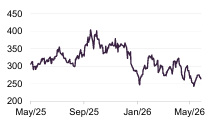
Figure 3: Constellation Energy (USD)
Source: Bloomberg
Growing demand for power
Jean-Hugues believes that investors’ focus on the AI data centre power demand theme, which was a significant factor for the utilities sector in the US over 2024/25, has lessened more recently. Share prices of US independent power producers such as Vistra and Constellation Energy have been relatively weak, which may reflect profit-taking by investors.
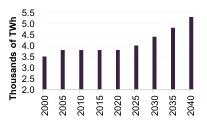
Jean-Hugues says that the underlying fundamentals of the power sector are positive. As discussed in the last note, the rate of change in demand for power turned positive in 2025, for the first time in 25 years – see Figure 4. AI data centre demand appears to be a significant factor in this, and the energy transition may also be contributing as electricity replaces fossil fuels in areas such as transport, heating and cooling.
Figure 4: US electricity demand
Source: Ecofin Global Utilities and Infrastructure Trust
US utilities are typically signing long-term (15-30 years) contracts with data centre customers at prices up to $120/MWh. This is above prevailing power prices and long-term averages. Jean-Hugues suggests that these very long-term PPAs may be reproduced in Europe and the UK in the future, citing that Drax has mentioned the possibility. The first of these deals was agreed in Pennsylvania in 2024. Jean-Hugues believes this trend could continue. According to Jean-Hugues, as more of power generators’ revenue is fixed for the long term, their business models may become less exposed to certain risks. Jean-Hugues does not believe that markets are currently pricing in this development.
Jean-Hugues says that he is overly concerned about the creditworthiness of the counterparties to these deals. He notes that they tend to be the hyperscalers, whose businesses are cash-generative.
Hyperscalers are looking to secure long-term, low carbon baseload power
He observes, however, that is increasing push-back at local and State level regarding the pace of these developments, which is often associated with new data centres putting strain on local grids and pushing up domestic power prices. To avoid this, he says that the hyperscalers are attracted to deals on dedicated supply, particularly baseload supply, with a preference for low-carbon supply. This interest extends to reactivating mothballed nuclear plants and building new ones.
For example, in October 2025, NextEra Energy and Google announced an investment of $1.6bn to support the reopening of Duane Arnold Energy Center in Iowa. The 615MW nuclear plant is scheduled to be operational by 2029. Google has agreed to a 25-year PPA, the terms of which have not been disclosed.
In Europe, some companies may be better positioned in this market than others. Jean-Hugues suggests that Iberdrola may be a beneficiary, for example. However, this is cited as another reason why more investment in energy storage may be needed, so that these 24/7-demand customers can make greater use of renewable supply.
Renewing ageing infrastructure
The need to renew and replace ageing infrastructure is identified as a long-term theme within the portfolio. Jean-Hugues notes that the proportion of GDP spent on infrastructure peaked in the 1950s-70s and then declined. He adds that much of that infrastructure is approaching or past the end of its design-life.
For example, the American Society of Civil Engineers (ASCE) produces a “Report Card for America’s Infrastructure” each year. The ASCE states that the Infrastructure Investment and Jobs Act of 2021 and Inflation Reduction Act of 2022 have had an impact, but estimates that additional investment is required. In a report entitled “Bridging the gap”, published in 2024, the ASCE estimated that an additional $9.1trn of investment would be needed to bring US infrastructure to a state of “good repair”.
Figure 5:The gap between planned and necessary infrastructure investment in the US
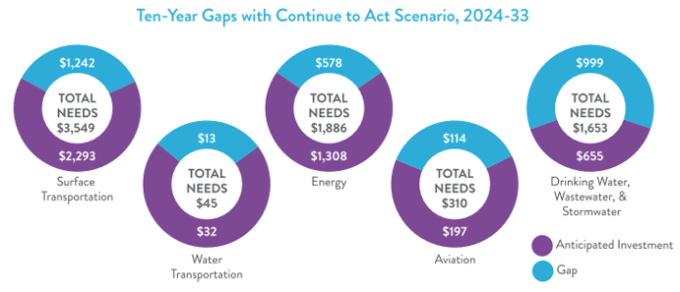
It is forecasting that $5.4trn of that investment may be met if Congress maintains existing funding levels, which could leave a deficit of $3.7trn. In the chart in Figure 4, which is taken from its 2025 Report Card for America’s Infrastructure, the organisation provides its estimate of the gap between planned and necessary investments in various sub-sectors of infrastructure. It says: “that figure does not include broadband, dams, levees, hazardous and solid waste, parks, and schools, which represent, at a minimum, an additional gap of $746bn”.
This issue is not limited to the US. The €500bn special fund for infrastructure and climate neutrality that Germany announced in March 2025 was intended to address what the government describes as decades of underinvestment.
Jean-Hugues comments that in the UK, Ofwat is being scrapped because it is believed to have acted as a deterrent to investment, which he suggests has compounded the problems that the water and wastewater sector faces today. According to Jean-Hugues, UK clean water leakages are significantly worse than in countries such as the Netherlands, Germany, and Switzerland.
Valuations undemanding
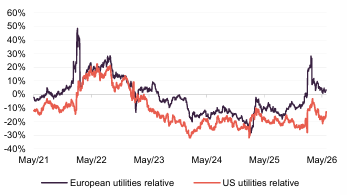
Figure 6: US and European utilities p/e relative
Source: Bloomberg
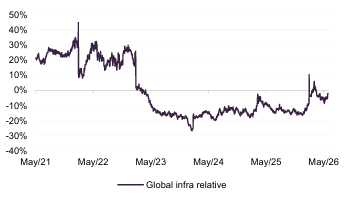
Figure 7: S&P Global Infrastructure p/e relative
Source: Bloomberg
AAlthough, with the exception of US utilities, valuation multiples appear to be somewhat higher than long-term averages, Jean-Hugues comments that the degree of this increase is not extreme. In addition, he notes that these businesses are experiencing earnings upgrades.
Figure 8: P/E multiples of current-year earnings
| 29 June 2026 | Average since 31 May 2021 | |
|---|---|---|
| Euro Stoxx 600 Utilities | 16.3x | 14.2x |
| Euro Stoxx 600 | 15.6x | 14.5x |
| S&P 500 Utilities | 19.1x | 18.9x |
| S&P 500 | 21.5x | 21.6x |
| S&P Global Infrastructure | 19.9x | 19.0x |
| MSCI World | 20.1x | 19.2x |
Source: Bloomberg
Portfolio – asset allocation
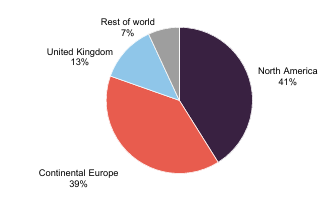
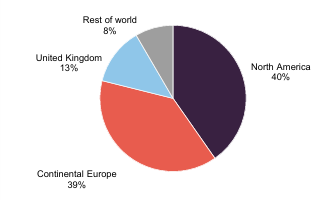
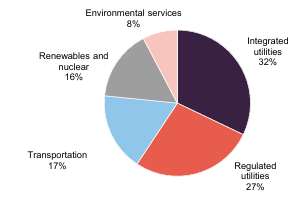
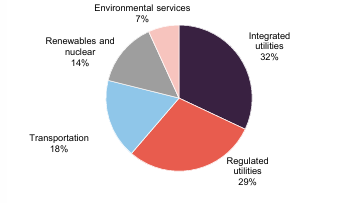
At the end of May 2026, there were 43 holdings in EGL’s portfolio. The following charts indicate that there appears to have been minimal change to EGL’s geographic and sectoral asset allocation since the last publication, which used data as at the end of October 2025.
Figure 9: Geographic allocation as at 31 May 2026
Source: Ecofin Global Utilities and Infrastructure Trust
Figure 10: Geographic allocation as at 31 October 2025
Source: Ecofin Global Utilities and Infrastructure Trust
Figure 11: Sectoral allocation as at 31 May 2026
Source: Ecofin Global Utilities and Infrastructure Trust
Figure 12: Sectoral allocation as at 31 October 2025
Source: Ecofin Global Utilities and Infrastructure Trust
Top 10 holdings
There has been more movement within the underlying portfolio. Since the last note in December 2025 (using data up to 31 October 2025), there has been some change to the top 10 holdings list. Constellation Energy, Xcel Energy, Vinci, and SSE are no longer in the top 10 holdings. Veolia Environnement, Brookfield Renewable, Dominion Energy, and Exelon have entered the top 10 holdings.
The manager took profits on stocks such as Constellation and Vistra, ahead of the recent sell-off in those names. Jean-Hugues says that the earnings profile of these companies is still attractive, but, in both cases, the valuation had run ahead of itself. The sales also contributed to a diversification of the portfolio away from the AI data centre theme.
One theme that is evident within the top 10 is the investment needed in power grids. National Grid, Enel, EON, and Exelon are all plays on the transmission theme to some extent.
Figure 13: Top 10 holdings as at 31 May 2026
| Holding | Sector | Country | Allocation 31 May 2026 (%) | Allocation 31 October 2025 (%) | Percentage point change |
|---|---|---|---|---|---|
| Iberdrola | Integrated utilities | Spain | 4.3 | 3.4 | 0.9 |
| National Grid | Networks/Regulated | UK | 4.1 | 4.1 | – |
| NextEra Energy | Integrated utilities | US | 3.7 | 3.7 | – |
| Veolia Environnement | France | 3.7 | 3.1 | 0.6 | |
| Enel | Integrated utilities | Italy | 3.5 | 3.6 | (0.1) |
| ENAV | Transportation | Italy | 3.4 | 3.7 | (0.3) |
| E.ON | Integrated utilities | Germany | 3.0 | 3.4 | (0.4) |
| Brookfield Renewable | Canada | 3.0 | 2.9 | 0.1 | |
| Dominion Energy | US | 3.0 | 2.3 | 0.7 | |
| Exelon | US | 3.0 | 3.2 | (0.2) | |
| Total of top 10 | 34.7 | 36.3 |
Veolia Environnement
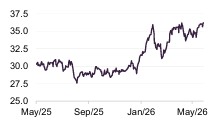
Figure 14: Veolia Environnement (EUR)
Source: Bloomberg
Veolia Environnement (veolia.com) is a water company (60% of revenue) with divisions in waste (10%) and energy efficiency (30%). Its focus on the non-regulated market is associated with a higher beta, which appears to be closer to the market, compared to a regulated water business (Pennon’s beta is about 0.3). This was a pre-existing position for EGL and has been increased. Jean-Hugues believes Veolia’s growth potential is not reflected in its rating.
Veolia says that it is the leading global water business, with a presence in 44 countries. The company operates on long-term contracts (an average of 11 years), with a mix of municipalities and companies, and reports inflation-linkage on 70% of its revenues, which is potentially an attractive quality for EGL if the war leads to higher inflation. Veolia reports that most commodity price inflation is passed through to the end customer.
In the US, Veolia recently acquired Clean Earth, a hazardous waste business, for $3bn, and paid A$220m for a similar business in Australia. Its water business has been affected by delays to projects in the Middle East, which the company attributes to the war. The company reported 2.1% revenue growth in Q1 2026 and an increase in margins, which contributed to higher profits.
The company sees potential to capture business related to the data centre capex boom and also identifies a similarly-sized opportunity in cleaning up PFAS. It is guiding towards 5%-6% organic EBITDA growth for 2026 as a whole.
Dominion Energy
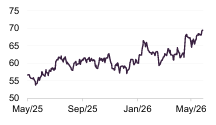
Figure 15: Dominion Energy (USD)
Source: Bloomberg
Dominion Energy (dominionenergy.com) is a US utility with mostly regulated revenues. It provides a regulated electricity service to 3.6m homes and businesses in Virginia, North Carolina, and South Carolina, and a regulated natural gas service to 500,000 customers in South Carolina. Its core revenues are regulated.
Dominion Energy says that it is a leading US developer and operator of regulated offshore wind and solar power and the largest producer of carbon-free electricity in New England.
It is currently undergoing a merger with NextEra Energy (EGL’s third-largest position). The deal is reported to set new records for the sector and could create a $250bn market cap company serving over 10m customers. Merger arbitrage activity appears to be affecting NextEra’s share price. Jean-Hugues believes that this is a temporary issue and that NextEra may benefit from the deal, although it could take time to secure the necessary approvals.
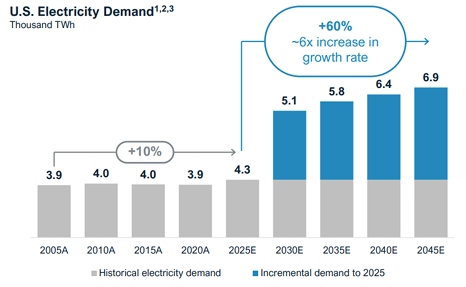
The companies are forecasting an increase in the growth of demand for power over coming years.
Figure 16: Power demand is expected to grow six times faster over the next 20 years
Source: Dominion/NextEra merger presentation. Note 1) Source: ISO/RTO Forecasts, NERC ES&D, Utility IRPs, ICF. Note 2) Historical demand represents data from NERC ES&D from 2000 to 2023, 2024 represents forecast from NERC ES&D. Note 3) Q1 2025 represents ICF’s demand for 2025; Q4 2025 represents ICF’s demand projects from 2030–2045.
They state that post-deal, 90%-95% of revenue will be regulated or long-term contracted. This is consistent with Jean-Hugues’s message regarding the de-risking of business models in the sector. He says that NextEra’s significant presence in Florida (Florida Power & Light) is complementary to Dominion’s East Coast business. Management is projecting a 9% compound annual growth rate (CAGR) in earnings per share (EPS) over the period from 2025 to 2032.
Williams Companies
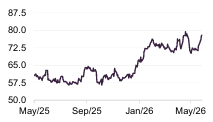
Figure 17: Williams (USD)
Source: Bloomberg
Outside of the top 10, EGL has a relatively new position in Williams Companies (williams.com), which is a natural gas midstream business in the US that has been benefitting from the disruption to gas supplies from the Middle East. The company has reported double-digit earnings growth and was valued attractively relative to peers, according to Jean-Hugues. Williams says that it bears no gas price risk, as earnings are driven by volumes flowing through its pipelines.
Williams’s transnational network comprises over 32,000 miles of pipeline. It handles approximately a third of all US natural gas.
The company reported a 25% increase in EPS for Q1 2026 and said it was on track to deliver adjusted EBITDA in the upper half of its 2026 guidance range. New business includes Project Neo, a $2.3bn behind-the-meter project to supply 682MW of power to AI data centres by 2028.
Athens Water
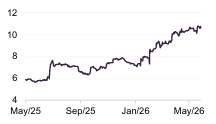
Figure 18: Athens Water (EUR)
Source: Bloomberg
Athens Water (eydap.gr) is a regulated utility. Part of the rationale for including this stock is that Greece is being upgraded from emerging markets status to developed market status. This could open up its stock market to a wider range of investors and potentially lead to a re-rating. Jean-Hugues says that this specific opportunity is being applied elsewhere in the portfolio.
At the time that EGL made its investment in Athens Water, it was a low free float, low-liquidity stock, and therefore not a large position within the portfolio. The manager sdays that this type of investment is suited to a closed-end fund such as EGL. A new five-year regulatory agreement was finalised last December, which, according to management, underpins expected EPS growth of 15%-20% per annum. The re-rating of the stock appears to have been influenced by the placing of a large block of stock at a premium to the prevailing market price.
Performance
Up-to-date information on EGL is available on the QuotedData website.
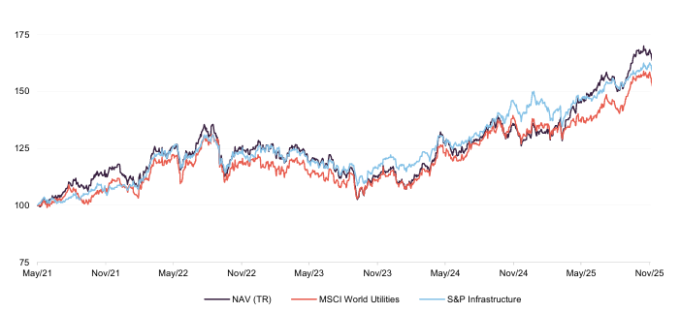
EGL’s NAV returns are ahead of those of the MSCI World Utilities Index over all time periods shown in Figure 19 and ahead of the S&P Global Infrastructure Index over most time periods. In addition, a recent narrowing of the discount has contributed to an increase in EGL’s share price returns.
The manager observes that over the long term, EGL’s total return performance has been similar to the performance of the MSCI World index but with lower volatility.
While geographical asset allocation has been helpful, stock selection appears to be contributing to returns.
Figure 19: Cumulative total return performance over periods ending 31 May 2026
| 3 months(%) | 6 months (%) | 1 year (%) | 3 years(%) | 5 years(%) | |
|---|---|---|---|---|---|
| EGL share price | 3.8 | 18.1 | 34.5 | 55.9 | 84.0 |
| EGL NAV | (5.8) | 5.1 | 20.8 | 48.9 | 76.9 |
| MSCI World Utilities | (5.8) | 2.0 | 16.6 | 42.4 | 61.6 |
| S&P Global Infrastructure | (4.2) | 5.6 | 16.7 | 45.5 | 71.7 |
| MSCI World | 7.2 | 9.5 | 27.4 | 66.6 | 85.3 |
Figure 20: Performance of EGL NAV and benchmark indices over five years to 31 May 2026
Premium (discount)
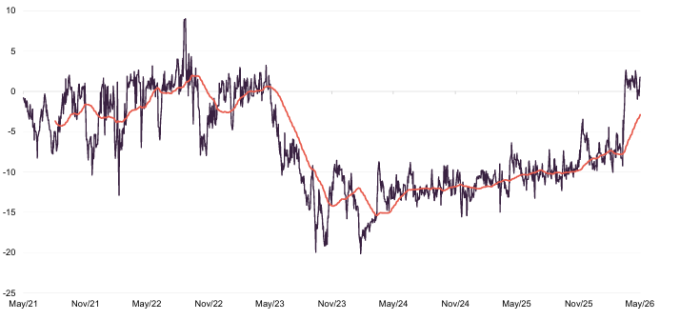
Over the 12-month period ended 31 May 2026, EGL’s shares traded between a premium of 2.6% and a discount of 13.2% to NAV. The average over that period was a 7.5% discount. As of publishing, EGL was trading at a 1.1% discount.
Concerns over the effect of the Iran war may put upward pressure on interest rates, which are usually viewed as negative for long-duration assets such as utilities and infrastructure. However, the war has also highlighted the importance of energy security and appears to have encouraged investment in alternative forms of generation such as nuclear and renewables, as well as supporting the case for EVs. At the same time, increased demand for power to support AI capex, and the need to make power grids, contribute to a positive outlook for the trust, in the manager’s view.
EGL is currently the only trust that offers a focused exposure to these themes, which could support demand for its shares.
Figure 21: EGL premium/(discount) over five years to 31 May 2026
Source: Bloomberg, Marten & Co
Share buybacks and issuance
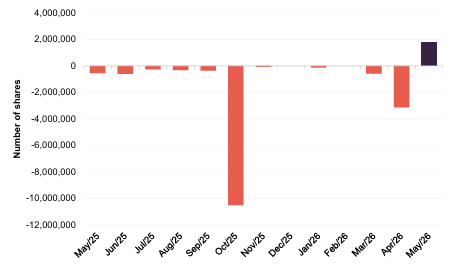
Figure 22: Number of shares issued/(repurchased) by month
Source: Ecofin Global Utilities and Infrastructure Trust, Marten & Co
The board has a track record of buying back shares when EGL trades at what it considers to be a wide discount, and it has reissued some shares recently as the trust moved to trade at a premium to asset value. In either case, the trades should have been NAV-enhancing for EGL’s shareholders.
Dividend
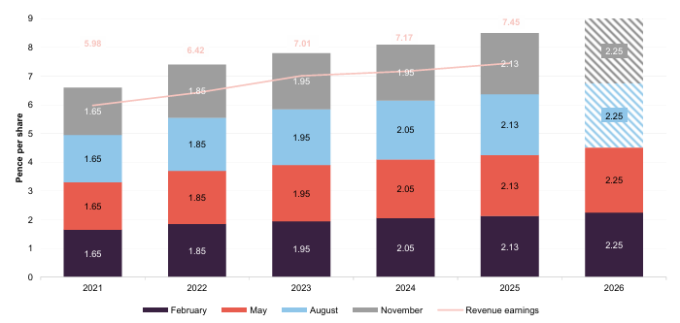
EGL is targeting four interim dividend payments of 2.25p for its current financial year
EGL’s stated aim is to deliver a dividend to shareholders that rises at least in line with inflation. Payouts for the financial year ending in September 2026 are targeted to be 9.0p, paid in four equal instalments of 2.25p, which represents an increase of 5.9% over 2025. Based on the latest share price, the current yield is 3.1%.
Gearing and reserves may be used to augment the portfolio yield if necessary, and the dividend has tended to be partially uncovered in recent years, with a small part of the dividend being paid from reserves. The company had a distributable special reserve of £62.5m at the end of March 2026, equivalent to 68.1p per share.
Figure 23: EGL revenue income and dividend by financial year
Source: Ecofin Global Utilities and Infrastructuust
Structure
Fees and costs
The board has appointed Frostrow as EGL’s AIFM, effective from 1 July 2025. RWC Asset Management LLP provides EGL with discretionary fund management services and is entitled to a management fee of 0.9% per annum of EGL’s net assets up to £200m, and 0.75% per annum on the next £200m of net assets, and 0.60% on any balance. The management fee is calculated and paid quarterly in arrears. There is no performance fee. For accounting purposes, the management fee and borrowing costs are allocated 60% to the capital account and 40% to the revenue account.
Aside from the management fee and the directors’ fees, the main expenses incurred by EGL relate to administration and company secretarial fees (£287k for FY25), legal and advisory fees (£211k for FY25). As at 31 March 2026, the ongoing charges ratio was estimated to be 1.30% (up from 1.25% as at 31 March 2025 and 1.29% as at 30 September 2025).
Capital structure
EGL has a simple capital structure with one class of ordinary share in issue. EGL’s ordinary shares have a premium main market listing on the LSE and, as at 31 May 2026, there were 114,920,697 in issue, 23,087,604 of which were held in in treasury. Therefore, the number of shares in issue with voting rights was 91,833,093.
Gearing
EGL’s investment policy permits gearing of up to 25%, and Jean-Hugues appears to use this flexibility. The level at any one time is determined by his current level of conviction. Net gearing was 13.3% as of 31 May 2026.
EGL’s gearing is provided via a prime brokerage facility with Citigroup, which is also EGL’s custodian. The interest rate on borrowings depends on the currency of the borrowing and is generally 50bps over the applicable benchmark rate. Citigroup charges a minimum monthly fee for its services, equivalent to $200,000 per annum. The gearing is not structural in nature and borrowings can be repaid at any time.
Unlimited life with five-yearly continuation votes
EGL has been established with an unlimited life but offers its shareholders a continuation vote at five-yearly intervals. The last continuation vote was conducted at the AGM in March 2024. The resolution was passed with 94.8% of votes cast in favour of continuation. The next continuation vote is scheduled for the company’s AGM in March 2029.
Financial calendar
The trust’s year-end is 30 September. The annual results are typically released in December (interims in May) and its AGMs are usually held in March of each year. EGL pays quarterly dividends on the last business day of February, May, August and November each year.
Board
EGL’s board is composed of four directors, all of whom are non-executive and are considered to be independent of the investment manager.
All directors submit themselves for re-election annually. The board states that it is appropriate for a director to serve up to nine years following their initial election, and it is expected that directors will stand down from the board by the conclusion of the AGM following that period. The board has undergone changes recently, with David Simpson standing down following the AGM on 5 March 2026, Susannah Nicklin becoming chair at that point, and the appointment of David Benda as a non-executive director of the company on 1 November 2025. The directors’ biographies are available on the trust’s website.
| Director | Position | Date of appointment | Length of service | Annual fee (GBP) | Shareholding |
|---|---|---|---|---|---|
| Susannah Nicklin | Chair and chair of the management engagement committee | 9 September 2020 | 5.8 | 46,000 | 22,7341 |
| David Benda | Non-executive director | 1 November 2025 | 0.6 | 32,500 | 20,891 |
| Max King | Senor independent director and chair of the remuneration committee | 11 September 2017 | 8.8 | 32,500 | 50,000 |
| Joanna Santinon | Chair of the audit committee | 12 September 2023 | 2.8 | 38,000 | 20,441 |
Fund profile
Further information regarding EGL can be found on the manager’s website:
https://www.redwheel.com/uk/en/individual/ecofin-global-utilities-and-infrastructure-trust-plc/
Ecofin Global Utilities and Infrastructure Trust Plc is a UK investment trust listed on the main market of the London Stock Exchange (LSE). The trust invests globally in the equity and equity-related securities of companies operating in the utility and other economic infrastructure sectors. EGL is structured for investors seeking a high level of income, income growth, capital preservation, and the potential for some capital growth.
On 1 October 2024, Redwheel completed the purchase of the assets of Ecofin Advisors, the investment manager of EGL. The Ecofin team relocated to Redwheel’s offices and there are otherwise no changes to the investment strategy or process.
EGL’s investment process was described in the note published in January 2024.
In line with its capital preservation objective, EGL does not invest in start-ups, small businesses or illiquid securities, as these may involve significant technological or business risk. Instead, it invests primarily in businesses in developed markets, which have characteristics described as “defensive growth”: a beta less than the market average; dividend yield greater than the market average; forward-looking EPS growth; and strong cash-flow generation.
It also operates with a strict definition of utilities and infrastructure, as follows:
- transportation – companies that own and/or operate roads, railways, and airports
- water and environment – companies operating in the water supply, wastewater, water treatment and environmental services industries.
- electric and gas utilities and renewable operators and developers – companies engaged in the generation, transmission and distribution of electricity, gas, liquid fuels and renewable energy
EGL does not invest in telecommunications companies or companies that own or operate social infrastructure assets funded by the public sector (for example, schools, hospitals or prisons).
No formal benchmark
EGL does not have a formal benchmark and is not constructed with reference to any index.
EGL does not have a formal benchmark, and its portfolio is not constructed with reference to an index. However, for the purposes of comparison, the MSCI World Utilities Index and the S&P Global Infrastructure Index are the global indices identified by the manager as the most appropriate. The company also supplies data for the MSCI World Index and the All-Share Index in its own literature for general interest. The MSCI World Utilities Index is often used as a reference point, although this index has a strong bias towards US companies and excludes transportation services and some environmental services that EGL invests in.
Previous Publications
Readers interested in further information about EGL may wish to read Previous publications some of the earlier notes that we have published, a list of which is provided below.
IMPORTANT INFORMATION
Marten & Co (which is authorised and regulated by the Financial Conduct Authority) was paid to produce this note on Ecofin Global Utilities and Infrastructure Trust Plc.
This note is for information purposes only and is not intended to encourage the reader to deal in the security or securities mentioned within it.
Marten & Co is not authorised to give advice to retail clients. The research does not have regard to the specific investment objectives financial situation and needs of any specific person who may receive it.
The analysts who prepared this note are not constrained from dealing ahead of it but, in practice, and in accordance with our internal code of good conduct, will refrain from doing so for the period from which they first obtained the information necessary to prepare the note until one month after the note’s publication. Nevertheless, they may have an interest in any of the securities mentioned within this note.
This note has been compiled from publicly available information. This note is not directed at any person in any jurisdiction where (by reason of that person’s nationality, residence or otherwise) the publication or availability of this note is prohibited.
Accuracy of Content: Whilst Marten & Co uses reasonable efforts to obtain information from sources which we believe to be reliable and to ensure that the information in this note is up to date and accurate, we make no representation or warranty that the information contained in this note is accurate, reliable or complete. The information contained in this note is provided by Marten & Co for personal use and information purposes generally. You are solely liable for any use you may make of this information. The information is inherently subject to change without notice and may become outdated. You, therefore, should verify any information obtained from this note before you use it.
No Advice: Nothing contained in this note constitutes or should be construed to constitute investment, legal, tax or other advice.
No Representation or Warranty: No representation, warranty or guarantee of any kind, express or implied is given by Marten & Co in respect of any information contained on this note.
Exclusion of Liability: To the fullest extent allowed by law, Marten & Co shall not be liable for any direct or indirect losses, damages, costs or expenses incurred or suffered by you arising out or in connection with the access to, use of or reliance on any information contained on this note. In no circumstance shall Marten & Co and its employees have any liability for consequential or special damages.
Governing Law and Jurisdiction: These terms and conditions and all matters connected with them, are governed by the laws of England and Wales and shall be subject to the exclusive jurisdiction of the English courts. If you access this note from outside the UK, you are responsible for ensuring compliance with any local laws relating to access.
No information contained in this note shall form the basis of, or be relied upon in connection with, any offer or commitment whatsoever in any jurisdiction.
Investment Performance Information: Please remember that past performance is not necessarily a guide to the future and that the value of shares and the income from them can go down as well as up. Exchange rates may also cause the value of underlying overseas investments to go down as well as up. Marten & Co may write on companies that use gearing in a number of forms that can increase volatility and, in some cases, to a complete loss of an investment.