
20 years on, potential undiminished?
Vietnam Holding (VNH) has recently marked its 20th anniversary. Both Vietnam and VNH have experienced various developments over the past 20 years – both successes and setbacks. Over the long term, VNH’s investment approach has delivered returns that are ahead of local benchmarks. However, more recently, VNH’s quality growth and ESG-focused approach appears to have been less favoured. Its companies continue to report strong results, which may be supported by Vietnam’s economy, but this does not appear to be reflected in their ratings.
Vietnam’s potential appears unchanged. The government has set targets that it believes could deliver significant economic transformation. VNH’s portfolio may benefit from these developments, and this could be recognised by investors, particularly if foreign investors return to the market. Vietnam’s upcoming inclusion in the FTSE Russell index series may contribute to this.
Capital growth from a concentrated portfolio of high growth Vietnamese companies
VNH aims to provide investors with long-term capital appreciation by investing in a portfolio of high-growth companies in Vietnam. These should come at an attractive valuation and demonstrate strong environmental, social, and corporate governance awareness.
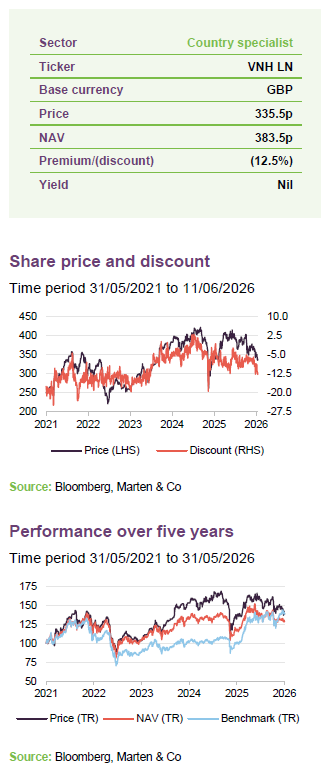
| Year ended | Share price total return (%) | NAV total return (%) | Vietnam All-Share TR (%) | MSCI Emerging Mkts TR (%) |
|---|---|---|---|---|
| 31/05/2022 | 26.4 | 22.7 | 10.9 | (8.5) |
| 31/05/2023 | (18.2) | (14.2) | (19.5) | (6.4) |
| 31/05/2024 | 48.2 | 25.8 | 14.2 | 9.7 |
| 31/05/2025 | (10.2) | (11.0) | (1.3) | 7.4 |
| 31/05/2026 | 1.2 | 9.1 | 37.7 | 55.0 |
Fund profile – listed Vietnamese equities with strong ESG focus
Further information on VNH can be found at the company’s website: www.vietnamholding.com
VNH is a closed-end fund, domiciled in Guernsey, that aims to provide investors with long-term capital appreciation by investing in a concentrated portfolio of high-growth companies in Vietnam that demonstrate strong environmental, social, and corporate governance (ESG) awareness.
VNH invests predominantly in publicly-traded companies in Vietnam, but it may also – subject to certain restrictions – invest in foreign companies if a majority of their assets and/or operations are based in Vietnam (up to a maximum of 25% of its net assets). It can invest in equity-like securities, such as convertible bonds, and may also hold private companies (up to a maximum of 20% of its net assets).
VNH does not have a formal benchmark. However, for the purposes of performance evaluation, the manager has traditionally included comparisons against the VN All-Share and the MSCI Emerging Markets Index in its literature.
Dynam Capital says it is searching for high-growth, compounding businesses that it can hold for the long-term.
In managing VNH’s portfolio, Dynam Capital (dynamcapital.com) seeks high-growth, compounding businesses that it can hold for the long term. It summarises this as growth at an attractive valuation. Dynam manages its portfolios using a mixture of top-down and bottom-up investment strategies. The top-down element of the investment process guides the manager towards the key sectors and sub-sectors on which to focus its attention, with the aim of achieving superior long-term returns. The bottom-up element of the process uses extensive fundamental research to select companies in those sectors and sub-sectors.
ESG incorporated into all investment and monitoring procedures
ESG research is fully integrated into its investment process.
An analysis of ESG criteria is central to Dynam’s approach, and has been part of its operations since inception. Vu Quang Thinh, Dynam’s CIO, is a founding member and former chairman of the Vietnam Institute of Directors (VIOD). Established in April 2018, VIOD was the first private and independent organisation in Vietnam, aimed at promoting standards and practices in corporate governance among domestic firms.
More information on VNH’s investment approach is contained within our April 2025 note.
A 20 year growth story…
VNH launched in April 2006, was admitted to trading on AIM in June 2006, and moved to the main market in March 2019. An investment of £1,000 at launch would be worth £3,140 by the end of May 2026.
Figure 1: Total return in sterling of VNH (NAV terms) and local indices since VNH’s launch
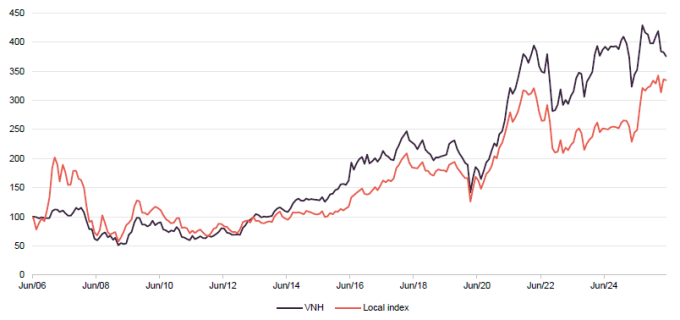
The market cap of Vietnam’s stock exchange today is over 19x larger than it was in June 2006
In 2006, economic growth was around 7.5% per annum. The manager was looking forward to Vietnam’s accession to the World Trade Organization. At the outset, its primary focus was on former State-Owned Enterprises (SOEs). The government had just announced a list of 178 SOEs that it planned to list on the Vietnam Stock Exchange.
At the time, Ms Min Hwa Hu Kupfer, VNH’s first chair, said: “This is a historically important period for Vietnam, as the country prepares its accession to the WTO. The announced wave of privatizations is expected to provide attractive investment opportunities for the global investment community. VNH is excited about being able to contribute to Vietnam’s economic growth through its strategic investments.”
Vietnam’s market capitalisation grew from $2.8bn in June 2006 to $16.9bn by June 2007. At the end of April 2026, it had grown to about $347.5bn. FTSE Russell recently confirmed that Vietnam would be upgraded to emerging market status. MSCI (which is tracked by more investors) may follow suit.
…with a long way to run
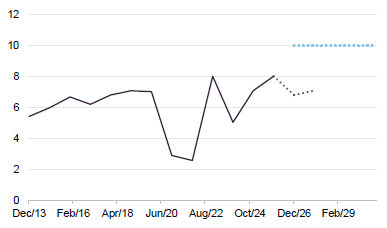
Over the past 20 years, Vietnam has become a wealthier country, with growth in exports, particularly of manufactured goods, contributing to this change. However, on a GDP per capita basis, it continues to lag behind China by a significant margin. The Vietnamese government has stated its intention to narrow that gap, and its policy agenda is designed to support this objective. The government is targeting 10% GDP growth per annum between 2026 and 2030, with the aim of reaching GDP per capita of $8,500 by 2030.
The World Bank projects GDP growth of 6.8% for 2026 and 7.1% in 2027. It revised its forecasts in May 2026, citing the possible impact of the Iran war on the economy.
Figure 2: GDP per capita in US dollars
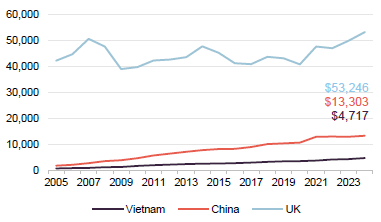
Figure 3: Real GDP growth rate (%)
Vietnam’s demographics differ from China’s, with China’s population ageing quickly, while the proportion of under-15s in the Vietnamese population has remained relatively stable. According to the manager, standards of education in Vietnam are high, and there are plans to ensure that students are bilingual in Vietnamese and English.
Figure 4: Population
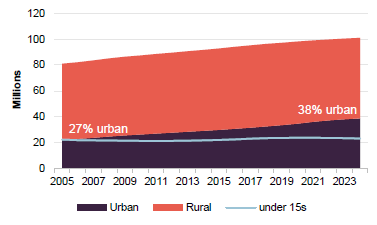
Figure 5: Index of value of exports (2015 = 100)
Vietnam is undergoing ongoing urbanisation, but the proportion of the population in rural areas remains relatively high (62% rural:38% urban in 2024, with the manager stating that the split is now closer to 60:40), which may indicate further potential for urbanisation.
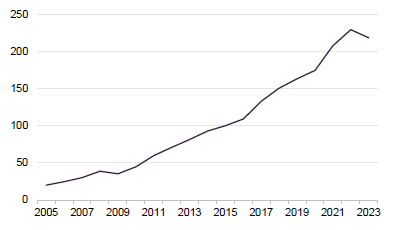
Economic growth in 2025 appeared strong, with Q1 GDP growth at 7.8%. US data shows that US goods exports to Vietnam in 2025 were $15.7bn (+20.0%), while imports were $193.8bn (+42.0%), resulting in a 44.3% increase in the US trade deficit.
The composition of Vietnam’s exports has also changed, from commodities to low-value-added goods, and then to high-value-added goods. In part, this appears to reflect a shift of manufacturing from China as firms sought to bypass US controls on Chinese imports.
Figure 6: US dollar / Vietnamese Dong exchange rate
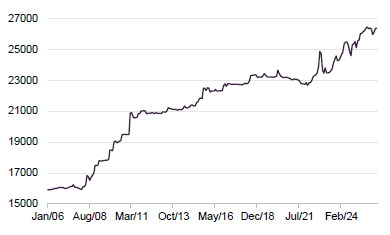
Figure 7: Inflation rate (%)
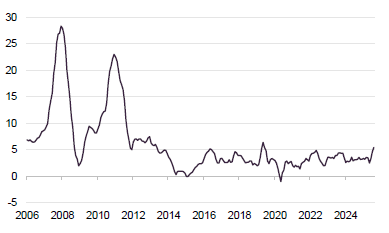
The Vietnamese Dong has been weakening relative to the dollar, which may have increased the attraction of its exports. Inflation appears to be more controlled than it was in VNH’s early days. However, it is currently running ahead of a State Bank of Vietnam target of 4.5%.
Significant infrastructure investment underway
Vietnam’s government debt is about 33% of GDP (according to Moody’s) and the budget deficit for 2026 is forecast at about 4.2% of GDP. The government is proceeding with its $129bn infrastructure investment plan, as mentioned in the previous note, alongside government resolutions 68 and 79, which are intended to support the growth of private businesses.
New government pushing to accelerate growth of digital economy
In April 2026 a new Prime Minister, Le Minh Hung, was elected by the National Assembly. VNH’s manager states that he and Tô Lâm, the general secretary of the party and now also the President, are business-minded and it views this as positive for the country. In May Le Minh Hung published a decree which identified 70 technologies and over 100 high-tech products that the government will prioritise for investment and development. This followed the announcement of a digital technology plan, targeting $300bn of revenue from this area by 2030.
One of the factors that may contribute to this is the work that Vietnam has undertaken in connection with “Project 6”, a programme of digitising government administration and the economy that began in 2022 and is scheduled to run until 2030. By the end of this year, it is expected that everyone will have a biometric digital ID (based on the VNeID scheme that was expanded to address COVID). This appears to be supporting growth in areas such as e-payments.
Plans with a long-term focus, including this and the infrastructure programme, are a feature of Vietnam’s economy and may have contributed to its evolution over the past 20 years. There have also been periods of volatility, such as real estate booms and busts, and the $44bn Saigon Commercial Bank fraud. The government has taken measures to address corruption, initially issuing death sentences in the latter case.
Figure 8: Number of mobiles and fixed broadband connections per 100 people
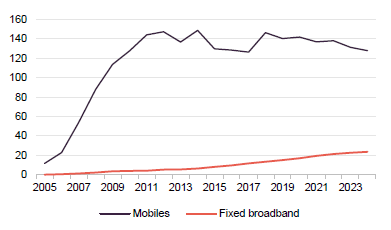
Figure 9: International tourist arrivals
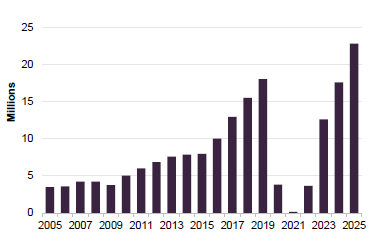
A surge in tourist arrivals over 2025 was reported. This sector is an increasingly significant contributor to GDP.
Figure 10: Vietnam energy generation by type
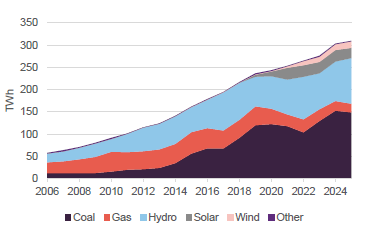
Figure 11: Oil & gas imports by value (in millions of dollars)
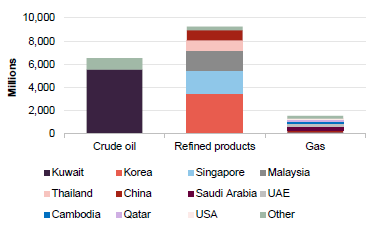
One risk that may arise is the potential effect of the Iran war on the cost of energy. The government has been promoting the development of renewable energy, which may help to mitigate some of the impact. The data in Figure 11 is somewhat out of date, but if it reflects current conditions, there may be a challenge associated with reliance on Kuwait for crude oil, which could need to be sourced from other suppliers. The potential effect on the Asian refineries that supply products to the country is not yet known. These factors may contribute to increased inflationary pressures.
Vietnam may not be alone in this, which could have a secondary effect on global demand for Vietnamese exports. Higher air fares might affect tourism.
Valuations of Vietnamese stocks are depressed
Valuations of Vietnamese stocks appear to be depressed relative to international peers. Foreign investors have been withdrawing capital from the market, now owning approximately 14.5%, and retail investors, now numbering more than 12 million, are dominating trading. This appears to have contributed to distortions such as the elevated value of Vingroup that was discussed in the last note. VNH continues to avoid the stock on governance and valuation grounds.
Figure 12: Valuation data
| Historic P/E (x) | Current P/E (x) | Forecast P/E (x) | |
|---|---|---|---|
| Vietnam Ho Chi Minh VN All-Share (VNAS) | 12.3 | 10.8 | 8.9 |
| Vietnam Ho Chi Minh Stock Index (VNI) | 15.0 | 12.5 | 10.7 |
| MSCI Vietnam | 19.3 | 15.5 | 13.2 |
| MSCI Emerging Markets | 18.8 | 13.3 | 11.0 |
| MSCI ACWI | 22.7 | 19.3 | 16.9 |
Figure 12 shows a wide range of valuations for different Vietnamese indices. In the previous note, the potential distorting effect of significant price movements within the Vingroup conglomerate on the indices was discussed. The different ratings appear to be influenced by variances in the weightings of these companies within the indices. VNH has an underweight exposure to companies within the conglomerate, which has likely affected its returns relative to comparative indices in recent months.
Asset allocation
As at 30 April 2026, VNH’s portfolio had exposure to 25 securities (unchanged from 31 December 2025, the data used in the previous note). On average, these were valued at 10.1x prospective earnings and may offer the potential for 18.6% earnings growth. The top 10 holdings accounted for 63.2% (63.7%) of VNH’s portfolio as at 30 April 2026.
Figure 13: VNH portfolio sectoral allocation as at 30 April 2026
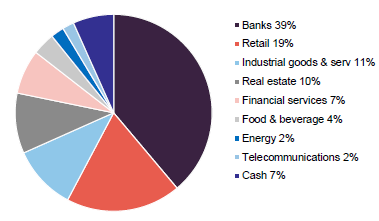
Figure 14: VNH change in portfolio sectoral allocation since 31 December 2025
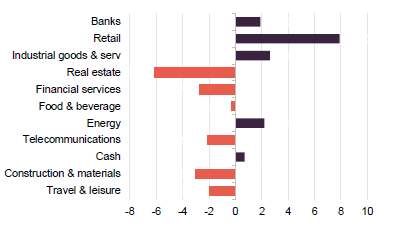
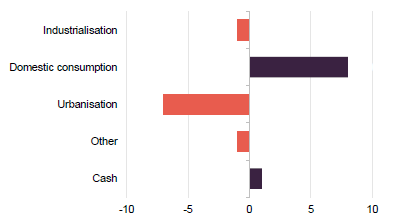
As at the end of April 2026, since the last publication using data as at the end of December 2025, there has been a shift in the portfolio from real estate to retail, and from urbanisation to domestic consumption. According to the manager, this is partly due to profit taking following the increase in Vinhomes’s share price and a positive outlook for the domestic economy. The manager notes that retail sales were up 12.1% year-on-year in April and 11.1% year-on-year for the first four months of 2026.
Figure 15: VNH portfolio by theme as at 30 April 2026
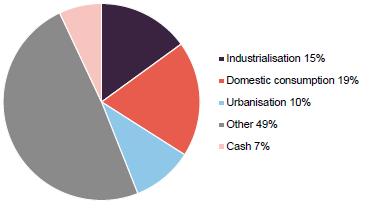
Figure 16: VNH change to split of portfolio by theme since 31 December 2025
Top 10 holdings
Since the last publication, which used data at the end of December 2025, SSI Securities and FPT have fallen out of the top 10, to be replaced by longstanding holding Phu Nhuan Jewelry and the conglomerate Masan Group.
Figure 17: Top 10 holdings as at 30 April 2026
| Stock | Sector | Portfolio weight 30 Apr 2026 (%) | Portfolio weight 31 Dec 2025 (%) | Change(%) |
|---|---|---|---|---|
| Mobile World | Retail | 10.0 | 10.0 | – |
| Hoa Phat Group | Industrials | 9.5 | 7.4 | 2.1 |
| MB Bank | Banks | 9.2 | 8.5 | 0.7 |
| VPBank | Banks | 6.8 | 6.4 | 0.4 |
| Techcombank | Banks | 6.7 | 6.4 | 0.3 |
| VietinBank | Banks | 5.5 | 5.4 | 0.1 |
| Vinhomes | Real estate | 4.7 | 6.1 | (1.4) |
| Asia Commercial Bank | Banks | 3.7 | 5.4 | (1.7) |
| Masan | Conglomerate | 3.7 | n/a | n/a |
| Phu Nhuan Jewelry | Retail | 3.4 | n/a | n/a |
| Total of top 10 | 63.2 | 63.7 |
Masan Group
Figure 18: Masan Group share price (VND)
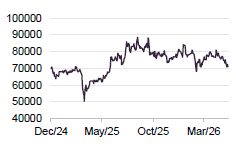
Masan Group (masangroup.com) is a conglomerate that was incorporated in 2004 as Ma San Shipping and now includes a number of companies in retail, branded FMCG, food, and beverages (including chilled meat and tea & coffee), financial services, and high-tech materials.
- Masan owns a stake in another VNH top 10 position, Techcombank. Its share of Techcombank’s profits increased 11.8% year-on-year (YoY) in Q1 2026.
- WinCommerce is a nationwide chain of over 4,800 supermarkets and minimarts (with 225 new store openings in Q1 2026).
- Masan Consumer Holdings is one of Vietnam’s largest local diversified FMCG companies. It is targeting 11%-15% revenue growth over 2026.
- Masan MEATDeli is a chilled and processed meat business. Revenue was up 19.8% YoY over Q1 2026.
- Phuc Long Heritage has 205 tea and coffee stores and plans to open 40-50 more this year.
- Masan High-Tech Materials is a significant producer of fluorspar and bismuth, and it also owns the Nui Phao tungsten mine, which is described as the world’s largest. An investment in high-performance and ultra-fast-charging battery business Nyobolt in 2022 was aimed at being a precursor to developing a vertically integrated tungsten business.
Performance
VNH reports its NAV in US dollars, and its returns have been translated into sterling for the purposes of producing the numbers in Figure 19.
Figure 19: Cumulative total return performance over periods ending 31 May 2026
| 3 months(%) | 6 months (%) | 1 year (%) | 3 years(%) | 5 years(%) | |
|---|---|---|---|---|---|
| VNH share price | (13.6) | (11.0) | 1.2 | 34.6 | 39.2 |
| VNH NAV | (10.3) | (5.5) | 9.1 | 22.1 | 28.5 |
| VN All-Share | (1.8) | 3.5 | 37.7 | 55.3 | 38.6 |
| MSCI Emerging Markets | 9.4 | 27.3 | 55.0 | 82.7 | 56.5 |
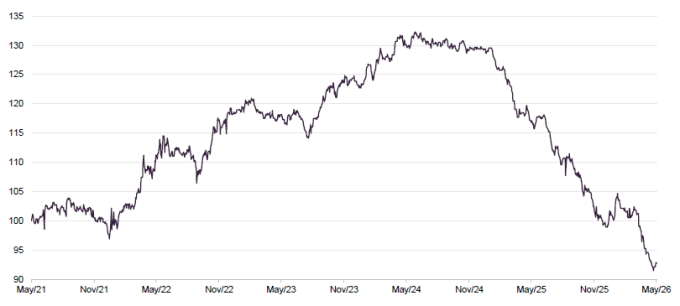
A period of relative outperformance for VNH ended early in 2025, and the trust has since lost these gains. Net FDI remains strong, but foreign investors have been withdrawing funds from the market, which may be partly in response to the tariff announcements in April 2025 and more recently to concerns about the potential impact of the Iran war. Retail investors appear to be less focused on governance issues and may be more influenced by momentum investing. According to the manager, the companies in the portfolio are, on average, still delivering the sales and profits increases that were anticipated, though this does not appear to be reflected in their valuations.
Figure 20: VNH’s NAV performance relative to the VN All-Share over five years to 31 May 2026
Premium/(discount)
Over the 12 months to the end of May 2026, VNH traded in a discount range of 0.7% to 12.7% and averaged 7.4%. As at 11 June 2026, VNH was trading on a discount of 12.5%.
Figure 21: VNH premium/(discount) over five years
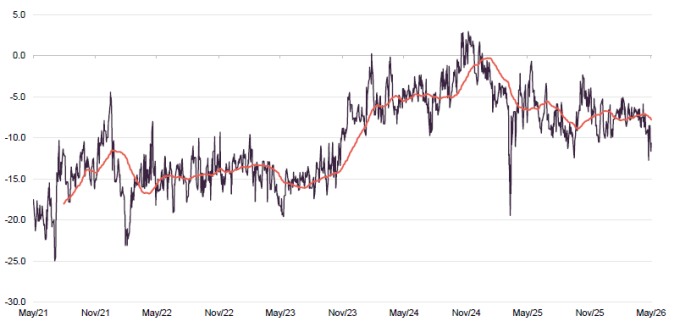
VNH’s board has stated that it aims to keep the discount tight, with the intention of re-expanding the company by issuing shares at a premium if investor demand for Vietnam increases. The company issued a small amount of stock in January 2025.
In addition to regular share buybacks, VNH operates an annual redemption facility. This was announced towards the end of 2023 and first implemented in September 2024, when about 12% of the issued share capital was redeemed. The manager believes that the facility has contributed to keeping the discount tight. To be eligible to participate in the facility, shareholders must have held the stock they wish to redeem for at least six months, which is intended to deter arbitrageurs from using the facility for short-term gain.
In 2025’s redemption opportunity, investors holding approximately 4.2 million shares (about 17.9% of VNH’s shares in issue) opted to redeem these shares.
Previous publications
Readers interested in further information about VNH, such as investment process, fees, capital structure, life, and the board, may wish to read our note – Cheap stocks, bold reforms, big ambitions – published on 29 April 2025. You can read the notes by clicking on them in Figure 22 or by visiting our website.
Figure 22: QuotedData’s previously published notes on VNH
IMPORTANT INFORMATION
Marten & Co (which is authorised and regulated by the Financial Conduct Authority) was paid to produce this note on Vietnam Holding Limited.
This note is for information purposes only and is not intended to encourage the reader to deal in the security or securities mentioned within it.
Marten & Co is not authorised to give advice to retail clients. The research does not have
regard to the specific investment objectives financial situation and needs of any specific person who may receive it.
The analysts who prepared this note are not constrained from dealing ahead of it but, in practice, and in accordance with our internal code of good conduct, will refrain from doing so for the period from which they first obtained the information necessary to prepare the note until one month after the note’s publication. Nevertheless, they may have an interest in any of the securities mentioned within this note.
This note has been compiled from publicly available information. This note is not directed at any person in any jurisdiction where (by reason of that person’s nationality, residence or otherwise) the publication or availability of this note is prohibited.
Accuracy of Content: Whilst Marten & Co uses reasonable efforts to obtain information from sources which we believe to be reliable and to ensure that the information in this note is up to date and accurate, we make no representation or warranty that the information contained in this note is accurate, reliable or complete. The information contained in this note is provided by Marten & Co for personal use and information purposes generally. You are solely liable for any use you may make of this information. The information is inherently subject to change without notice and may become outdated. You, therefore, should verify any information obtained from this note before you use it.
No Advice: Nothing contained in this note constitutes or should be construed to constitute investment, legal, tax or other advice.
No Representation or Warranty: No representation, warranty or guarantee of any kind, express or implied is given by Marten & Co in respect of any information contained on this note.
Exclusion of Liability: To the fullest extent allowed by law, Marten & Co shall not be liable for any direct or indirect losses, damages, costs or expenses incurred or suffered by you arising out or in connection with the access to, use of or reliance on any information contained on this note. In no circumstance shall Marten & Co and its employees have any liability for consequential or special damages.
Governing Law and Jurisdiction: These terms and conditions and all matters connected with them, are governed by the laws of England and Wales and shall be subject to the exclusive jurisdiction of the English courts. If you access this note from outside the UK, you are responsible for ensuring compliance with any local laws relating to access.
No information contained in this note shall form the basis of, or be relied upon in connection with, any offer or commitment whatsoever in any jurisdiction.
Investment Performance Information: Please remember that past performance is not necessarily a guide to the future and that the value of shares and the income from them can go down as well as up. Exchange rates may also cause the value of underlying overseas investments to go down as well as up. Marten & Co may write on companies that use gearing in a number of forms that can increase volatility and, in some cases, to a complete loss of an investment.