
Back this horse
Vietnam appears to have shrugged off the impact of US tariffs and is cantering ahead with reforms designed to remove any bottlenecks to its goal of double-digit annual GDP growth between now and 2030. A 28% jump in one of Vietnam Holding (VNH)’s comparator indices over 2025 might have suggested that this upside is being priced in, but – as we detail in this note – over half of that came from just one company that VNH has chosen not to own. The reality is that, despite the impressive growth prospects, the bulk of the Vietnamese market remains attractively valued (VNH’s portfolio was trading on a forecast P/E of just 9.5x at end December 2025), not least because foreign investors are yet to return. However, the country’s long journey towards an upgrade to emerging market status is moving in the right direction, as FTSE Russell is set to upgrade it with effect from September this year.
17 February 2026 marks the beginning of the year of the Fire Horse in Vietnam. It is an auspicious time for those who believe in those things, but for those who don’t, there are always Vietnam’s attractive fundamentals to fall back on.
Capital growth from a concentrated portfolio of high growth Vietnamese companies
VNH aims to provide investors with long-term capital appreciation by investing in a portfolio of high-growth companies in Vietnam. These should come at an attractive valuation and demonstrate strong environmental, social, and corporate governance awareness.
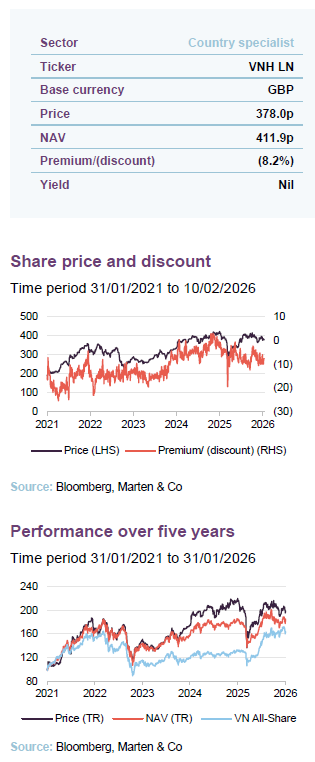
| Year ended | Share price TR (%) | NAV total return (%) | Vietnam All-Share TR (%) | MSCI Emerging Mkts TR (%) |
|---|---|---|---|---|
| 31/01/2022 | 67.7 | 64.0 | 54.4 | (5.1) |
| 31/01/2023 | (9.9) | (12.2) | (25.1) | (3.9) |
| 31/01/2024 | 15.5 | 9.3 | 2.4 | (5.6) |
| 31/01/2025 | 23.0 | 17.4 | 11.8 | 17.7 |
| 31/01/2026 | (7.3) | (0.0) | 23.8 | 30.4 |
Source: Bloomberg, Marten & Co
Fund profile – listed Vietnamese equities with strong ESG focus
Further information on VNH can be found at the company’s website: www.vietnamholding.com
VNH is a closed-end fund, domiciled in Guernsey, that aims to provide investors with long-term capital appreciation by investing in a concentrated portfolio of high-growth companies in Vietnam that demonstrate strong environmental, social, and corporate governance (ESG) awareness.
VNH invests predominantly in publicly-traded companies in Vietnam, but it may also – subject to certain restrictions – invest in foreign companies if a majority of their assets and/or operations are based in Vietnam (up to a maximum of 25% of its net assets). It can invest in equity-like securities, such as convertible bonds, and may also hold private companies (up to a maximum of 20% of its net assets).
VNH does not have a formal benchmark. However, for the purposes of performance evaluation, the manager has traditionally included comparisons against the VN All-Share and the MSCI Emerging Markets Index in its literature.
Macroeconomic outlook
Vietnam delivered 8% growth in GDP in 2025
Vietnam delivered an impressive 8% growth in GDP in 2025, up from 7.1% in 2024, and the rate of growth accelerated through the year, helped by government reforms and economic stimulus. A ceremony on 19 December 2025 celebrated the launch of 148 new infrastructure projects and the inauguration of a further 86, collectively worth a total of $129bn. These include Long Thanh International Airport (which is scheduled to open later this year and will have the capacity to handle 100m passengers each year – for comparison, Heathrow managed 84.5m in 2025), the 400km Lao Cai–Hanoi–Hai Phong railway, three new metro lines, and the creation of a new Olympic park in Hanoi.
The tourism sector is thriving too, with a 20% growth in visitor numbers over 2025 to a record 21.2m of international arrivals. The majority of these (79%) are coming from other countries in Asia, notably China and South Korea.
Tariffs – not as bad as feared
Vietnam’s trade surplus with the US looks to have grown over 2025 despite US tariffs
Our last note on VNH was published on 29 April 2025, in the wake of “Liberation Day”, when Trump imposed some of the harshest tariffs on Vietnamese imports (an initial rate of 46%) and the subsequent “pause” to these, as the associated market backlash triggered some backtracking by the US regime and the rate was temporarily reduced to 10%. The Vietnamese government reacted swiftly and was one of just two countries to secure a trade deal with the US ahead of the original July 9 deadline for these. The terms of this look one-sided, in that Vietnamese imports to the US attract a 20% tariff while US imports to Vietnam are tariff-free. However, Vietnam’s trade surplus with the US looks to have grown over the course of 2025.
VNH’s manager observes that within those figures, electronics and computers made a significant contribution, reflecting Vietnam’s shift towards higher-added-value manufacturing.
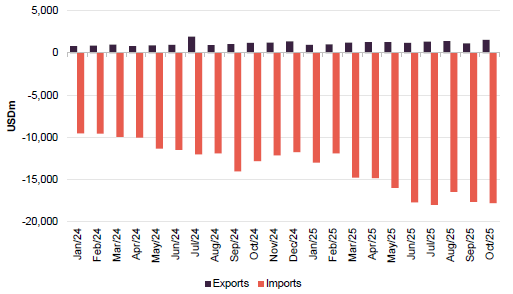
Figure 1 uses data from The US Census Bureau. Based on its data, by end October 2025, the US had already imported goods worth $158bn from Vietnam in 2025 and the trade deficit was running at $146bn.
Figure 1: US exports/imports to/from Vietnam
Source: The US Census Bureau
Vietnamese figures for 2025 were for total exports of $475bn over 2025, up by 17% year-on-year and within that, total exports to the US of $153bn. While there is some discrepancy in the figures, the underlying message is clear; US tariffs are less of a problem for Vietnam than had been feared. It also helps that Vietnam has trade agreements in place with its other leading trading partners, including China.
Inflation, interest rates, and currency
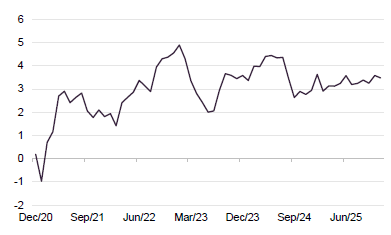
Figure 2: Vietnam CPI
Source: Bloomberg
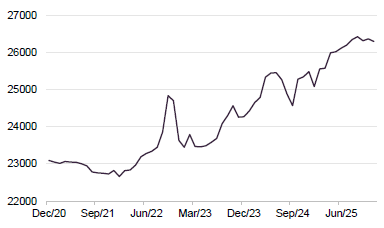
Figure 3: Vietnamese Dong US dollar exchange rate
Source: Bloomberg
As Figure 2 shows, inflation remains stable and at a comfortable level. The official interest rate has remained flat at 4.5% since June 2023, but lending rates ticked up by 100bp towards the end of 2025, which the manager thinks is manageable. Credit growth was strong in 2025 at 19% year-on-year. The government is running a budget surplus, but despite this and foreign direct investment running at $38.4bn (of which FDI disbursed was $27.6bn), the Vietnamese Dong has weakened a bit against the dollar (but by considerably more against sterling – see page 10).
Politics – driving an ambitious growth agenda
Target of $8,500 per capita GDP by 2030, up by about 80% on 2025
The 14th Party Congress appears to have concluded without upset and has confirmed Tô Lâm as its General Secretary for a further five years. To further its goal of becoming a high-income nation by 2045, the Vietnamese government is targeting 10% GDP growth in 2026. The ambition is to maintain that rate of growth through to 2030 and achieve per capita GDP of $8,500 by that date (it was about $4,700 in 2024. For comparison, China’s GDP per capita in 2025 was estimated at about $13,800). As household wealth grows and Vietnam’s middle class expands, that should flow through into retail sales and a growing services sector. The manager highlights the political support for the economy, citing two “Resolutions” in particular.
Resolution 68
In May 2025, Resolution 68 officially recognised the private sector as the key driving force behind Vietnam’s economic growth. It aims to promote entrepreneurship with a goal to double the number of private enterprises in the country to 2m by 2030 and to hit 3m by 2045.
There is a target of supporting the creation of at least 20 large private Vietnamese companies with strong brands capable of integrating into global value chains and driving industrial growth. Some commentators have suggested that this is an attempt to copy the success of South Korea’s chaebols (the likes of Samsung, LG, and Hyundai). This appears to have contributed to the soaring share price of Vin Group (see page 6).
There is also an ambition to see 10%–12% annual economic growth within the private sector.
To meet these targets, the plan is to slash bureaucracy, make it easier to access finance, reform taxation, and end the automatic preference of State-Owned Enterprises (SOEs) and foreign investors over domestic private enterprises. Amongst other things, this should translate into more IPOs and privatisations.
Resolution 79
Creating national champions to become leading Asian companies
In January 2026, Resolution 79 reinforced and expanded on 68. It sets out a goal of having at least 50 SOEs within Asia’s 500 largest enterprises by 2030, with an expectation that this would support the growth of the private businesses that support these SOEs. It also aims to have three state-owned commercial banks ranked among the top 100 banks in Asia by that date.
However, it wants the SOEs to achieve these targets without receiving preferential state support and it wants these SOEs to adopt OECD levels of governance.
Markets
EM status
As expected, FTSE Russell upgraded Vietnam to emerging market status last year. The decision is subject to an interim review in March this year and would take effect in September. The effect may be muted, given that most investors and tracker funds tend to favour the MSCI series of indices. MSCI is expected to look again at Vietnam’s status. It looks increasingly anomalous that Vietnam makes up over 30% of its frontier markets index and can boast daily turnover averaging in excess of $1bn, well ahead of many emerging markets. There is also talk that Vanguard is exploring launching funds investing in the country.
Valuations and the Vingroup problem
Figure 4: Valuation data
| Historic P/E (x) | Current P/E (x) | Forecast P/E (x) | |
|---|---|---|---|
| Vietnam Ho Chi Minh VN All-Share (VNAS) | 13.2 | 11.1 | 9.2 |
| Vietnam Ho Chi Minh Stock Index (VNI) | 14.8 | 13.1 | 10.9 |
| MSCI Vietnam | 16.7 | 15.3 | 12.8 |
| MSCI Emerging Markets | 17.8 | 17.0 | 13.3 |
| MSCI ACWI | 22.5 | 22.1 | 19.3 |
Source: Bloomberg as at 9 February 2026
In its factsheets, VNH compares its returns to the Vietnam Ho Chi Minh VN All-Share (VNAS), but its peers use the narrower, more large cap focused Vietnam Ho Chi Minh Stock Index (VNI). The MSCI Vietnam Index is more concentrated still.
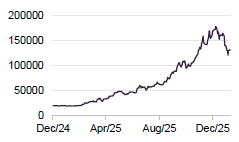
Currently, a significant constituent of all three indices is Vingroup, which is not held by VNH, on the grounds of its fundamentals, low liquidity, and governance. It is the holding company for a diverse group of businesses which includes resorts, robotics and cybersecurity divisions, the NASDAQ-listed EV company VinFast Auto, and Vinhomes, which is in VNH’s top 10 (see page 8).
Figure 5: Vingroup (VND)
Source: Bloomberg
As Figure 5 shows, Vingroup’s share price was extremely strong over 2025. The manager says that a relatively small free float and domestic investor interest in the stock (partly on the back of the potential for it to be one of the leading groups of companies identified in Resolution 68), have driven its valuation up to extreme levels. At the time of publication, it was trading on a P/E of 79x. At the end of December 2025, Vingroup and its associated companies accounted for about a quarter of the market cap of the Ho Chi Minh Stock Exchange (HOSE) and Vingroup alone accounted for 25.3% of the MSCI Vietnam Index, with Vinhomes accounting for a further 8.3%. VNAS is a free float-adjusted index. However, the manager thinks that due to the out-sized market cap of Vingroup, none of these indices would constitute a valid and replicable performance benchmark.
Vingroup has distorted the performance of VNH’s benchmark comparator
The net of this is that the Vietnamese market looks more expensive than it would otherwise do, and the various indices performed much better over 2025 than they would otherwise have done (Vingroup accounted for about half the return on the VNI, for example).
A growing market in Vietnamese corporate bonds
The equity market is healthy, with a return to IPOs – three totalling $1.5bn in 2025 – after a seven-year drought, and more planned for this year. However, VNH’s manager also observes that one of the government’s goals is to develop Vietnam’s corporate bond sector, as one way of deepening the pool of capital available to its growing companies. Domestic ratings agency FiinRatings says that issuance of VND644.3trn of corporate bonds by 122 issuers over 2025 took the total size of the market to VND1,413trn across 321 issuers. However, at about 11.4% of GDP, this is far below a 20% target for 2025 that had been set by the government. It is also small relative to other markets and to the Vietnamese equity market.
New financial leverage limits of 5x debt-to-equity should help improve the overall credit quality of the market in FiinRatings’ view, while a Ministry of Finance decision to permit new investment funds should help channel more of the domestic savings market into this area.
Asset allocation
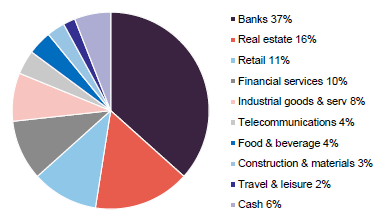
As at 31 December 2025, VNH’s portfolio had exposure to 25 securities (up from 23 at 31 March 2025, the data that we used in our last note). On average, these were valued on just 9.5x prospective earnings despite offering the potential for 18.0% earnings growth. The top 10 holdings accounted for 63.7% (65.6%) of VNH’s portfolio as at 31 December 2025.
Figure 6: VNH portfolio sectoral allocation as at 31 December 2025
Source: Dynam Capital, Marten & Co
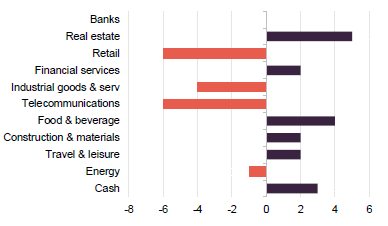
Figure 7: VNH change in portfolio sectoral allocation since 31 March 2025
Source: Dynam Capital, Marten & Co
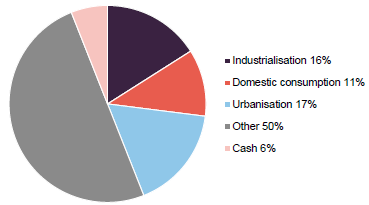
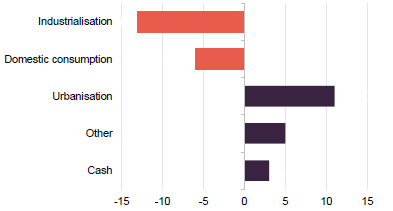
The shift towards greater exposure in real estate (Figure 7) and the urbanisation theme (Figure 9) reflects a healthier residential property market and the rise in Vinhome’s share price (see below).
Figure 8: VNH portfolio by theme as at 31 December 2025
Source: Dynam Capital, Marten & Co
Figure 9: VNH change to split of portfolio by theme since 31 March 2025
Source: Dynam Capital, Marten & Co
Top 10 holdings
Since we last published using data at the end of March 2025, Sacombank, Sai Gon VRG Investment, FPT Digital Retail, and Phu Nhuan Jewelry have dropped out of the list of the 10 largest holdings to be replaced by VP Bank, Vinhomes, VietinBank, and SSI Securities.
Figure 10: Top 10 holdings as at 31 December 2025
| Stock | Sector | Portfolio weight 31 Dec 2025 (%) | Portfolio weight 31 Mar 2025 (%) | Change(%) |
|---|---|---|---|---|
| Mobile World | Retail | 10.0 | 8.2 | 1.8 |
| MB Bank | Banks | 8.5 | 7.3 | 1.2 |
| Hoa Phat Group | Industrials | 7.4 | 6.1 | 1.3 |
| VPBank | Banks | 6.4 | 6.6 | (0.2) |
| Techcombank | Banks | 6.4 | 8.7 | (2.3) |
| Vinhomes | Real estate | 6.1 | 3.9 | 2.2 |
| Asia Commercial Bank | Banks | 5.4 | 7.3 | (1.9) |
| VietinBank | Banks | 5.4 | 5.7 | (0.3) |
| SSI Securities | Financials | 4.5 | 4.4 | 0.1 |
| FPT Group | Telecommunications | 3.6 | 9.8 | (6.2) |
| Total of top 10 | 63.7 | 65.6 |
Source: Vietnam Holding Limited, Marten & Co
Mobile World
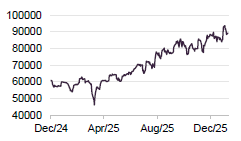
Figure 11: Mobile World share price (VND)
Source: Bloomberg
Mobile World Investment Corporation (mwg.vn) is Vietnam’s leading multi-category retailer, with over 6,000 stores nationwide, a fast-growing ecommerce business, and a joint venture that is building a retail business in Indonesia. The largest part of its revenue (38%) relates to phones and accessories, but its product range includes food, fast moving consumer goods, consumer electronics, pharmaceuticals, and mother & baby products. Revenue grew by 16% over 2025 to over VND156trn, exceeding the company’s own target by 4%. Revenue growth also outpaced Vietnam’s retail sales growth of 9.2%.
For 2026, Mobile World is targeting 18% revenue growth and 30% profit growth, which the company believes is supported by government policy and opportunities to use AI to reduce costs, improve labour productivity, and enhance operational efficiency. It also helps that the company has in-house warehousing, logistics, delivery, installation, and after-sales services.
VNH’s manager is enthused about the prospects for growth in consumer spending and Mobile World, in particular.
VPBank
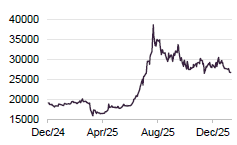
Figure 12: VPBank share price (VND)
Source: Bloomberg
The manager says that, in general, Vietnam’s banks are in good shape, helped by favourable monetary policy, strong credit growth, and low bad debts. It is also reassured by healthy levels of provisions. The recovery in the real estate market is also helpful to the sector. The manager sees further upside in banks’ share prices over 2026.
Vietnam Prosperity Joint-Stock Commercial Bank, or VPBank (vpbank.com.vn/en), wants to be one of the 100-largest banks in Asia, although as a private bank it would not count towards the Resolution 79 goal.
Q4 2025 figures show 35% year-on-year growth in its loan book, a 52% jump in profit before tax, and 52% increase in its EPS, helped by strong credit growth and lower provisioning. Analysts are also saying that its asset quality is improving.
Vinhomes
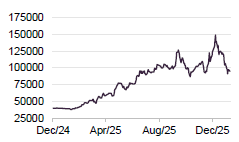
Figure 13: Vinhomes share price (VND)
Source: Bloomberg
Vinhomes (vinhomes.vn/en) is one of Vietnam’s largest developers. 2025 saw a welcome recovery in sales after a difficult couple of years for the residential property sector. Pre-sales of its new-build homes are running at record levels, prices are rising, and margins are improving. It was targeting 27% revenue growth and 20% profit growth for 2025.
Vinhomes has an extensive residential landbank of over 17,000ha, which it says is over 10x the size of its nearest competitor, a 1,970ha industrial landbank, and 379,000sqm of offices (of which 75% is occupied).
Its development pipeline includes a number of mega projects such as Olympics Village in Hanoi (where Vietnam is building the infrastructure to support a bid for the Asian games and later support a bid for the Olympics).
VietinBank
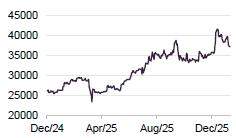
Figure 14: VietinBank share price (VND)
Source: Bloomberg
The manager says that The Vietnam Joint Stock Commercial Bank for Industry and Trade or VietinBank (vietinbank.vn/en) is State-owned but well-run, with a high ROE (about 21.6% in 2025), relatively low cost-income ratio of about 27% and low bad debts (NPL of about 1%). It delivered over 25% annual profit growth over the past couple of years, helped by lower bad debts. The valuation is also attractive (about 1.6x price/book and about 8.3x P/E).
As an SOE, it has a role in financing the government’s infrastructure projects. The bank is headquartered in Hanoi but operates across the whole country.
SSI Securities
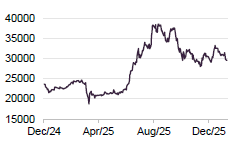
Figure 15: SSI Securities share price (VND)
Source: Bloomberg
SSI Securities (ssi.com.vn/en) is one of the three-largest brokers in Vietnam, with a 12.5% market share at the end of 2025. Higher brokerage volumes, growth in its margin lending and fund management businesses, and the launch of new products all helped drive a 54% growth in revenue for 2025 versus 2024 and that fed through into a 46% uplift in profits. Over 800,000 new trading accounts were opened in Q4 2025.
SSI also has a strong presence in bond underwriting, which should bode well if the corporate bond market expands as the manager expects.
Performance
Whilst VNH reports its NAV in US dollars, we have translated its returns into sterling for the purposes of producing the numbers in Figure 16. As we showed in Figure 3, the Vietnamese Dong weakened by about 3% relative to the US dollar over 2025. However, relative to sterling, the Dong’s depreciation was more marked – about 12% over the 12 months to the end of January 2026.
Figure 16: Cumulative total return performance over periods ending 31 January 2026
| 3 months(%) | 6 months (%) | 1 year (%) | 3 years(%) | 5 years(%) | Since 31 Mar 191 (%) | 10 years(%) | |
|---|---|---|---|---|---|---|---|
| VNH NAV | (8.0) | 4.1 | (7.3) | 31.7 | 99.0 | 111.0 | 210.1 |
| VNH share price | (0.9) | 5.3 | (0.0) | 28.3 | 85.0 | 102.7 | 183.4 |
| VN All-Share | 2.0 | 14.3 | 23.8 | 41.7 | 63.9 | 80.9 | 208.0 |
| MSCI Emerging Markets | 4.9 | 19.6 | 30.4 | 44.9 | 32.3 | 65.8 | 184.5 |
Source: Bloomberg, Marten & Co. Note 1) We are using the 31 March 2019 as a cut off for when VNH’s board and manager had completed their remedial measures (largely corporate governance- and investment management-related) as part of the major overhaul that was undertaken to address failings on the part of the previous board and investment manager (see page 4 of our December 2019 note for more details of these).
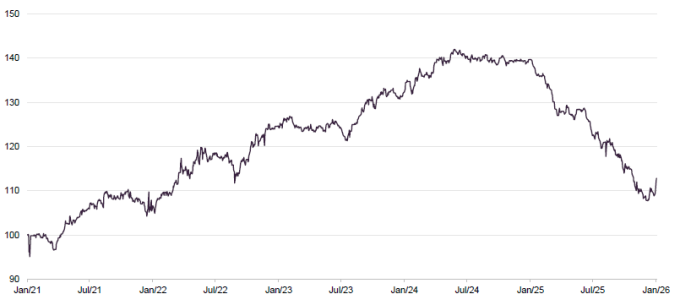
As Figure 17 shows, VNH has lagged the VNAS recently and this has dragged down its longer-term relative returns. The main reason for this was the lack of exposure to Vingroup that we discussed above. Given the extreme valuation that it trades on, it feels likely to us that Vingroup’s meteoric rise, which – as Figure 5 – shows has already stalled, may reverse to the benefit of VNH’s relative performance.
That relative performance move is very evident in the period from February 2025 onwards.
Figure 17: VNH’s NAV performance relative to the VN All-Share over five years to 31 January 2026
Source: Bloomberg, Marten & Co
Premium/(discount)
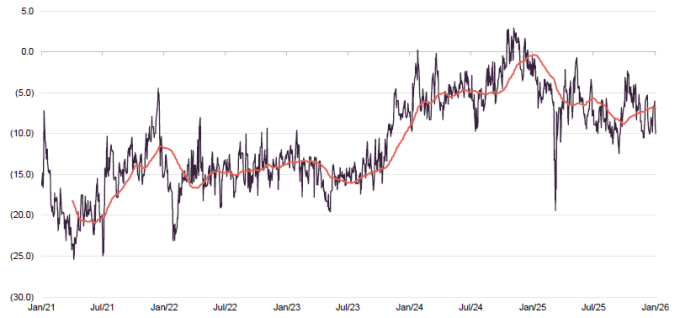
Over the 12 months to the end of January 2026, VNH traded in a discount range of 0.7%–19.4% and averaged 6.8%. As at 10 February 2026, VNH was trading on a discount of 8.2%.
VNH’s board is keen to keep the discount tight with the ultimate aim of re-expanding the company by issuing shares at a premium when investors re-embrace the Vietnam story. It was able to issue a small amount of stock in January 2025.
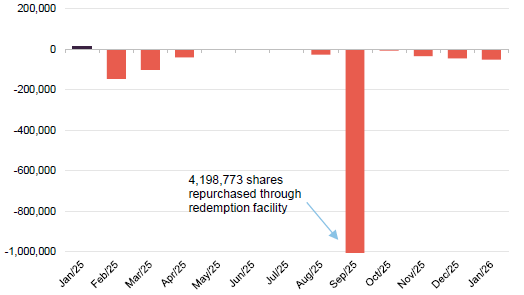
To that end, in addition to regular share buybacks VNH operates an annual redemption facility. This was announced towards the end of 2023 and first implemented in September 2024, when about 12% of the issued share capital was redeemed. We believe that the facility has made a significant contribution towards keeping the discount tight. To be eligible to participate in the facility, shareholders have to have held the stock that they want to redeem for at least six months, which helps to deter arbitrageurs from gaming it.
Figure 18: VNH premium/(discount) over five years
Source: Bloomberg, Marten & Co
In 2025’s redemption opportunity, investors holding c.4.2m shares (about 17.9% of VNH’s shares in issue) opted to redeem these shares.
Figure 19: VNH share repurchases over the past year
Source: Vietnam Holding
SWOT and bull versus bear analysis
Figure 20: SWOT analysis for VNH
| Strengths | Weaknesses |
|---|---|
| Great long-term track record of NAV and share price growth | Lack of exposure to Vingroup has damaged track record in the short term |
| Tough on discount control, including provision of annual redemption facility | Annual redemption opportunity creates risk that the company may no longer be viable, especially if it coincides with a period of market instability |
| Small enough to be nimble in what can still be an illiquid market | Small size pushes up expense ratio and reduces liquidity in VNH’s shares |
| Opportunities | Threats |
| Vietnamese market and stocks in VNH’s portfolio are cheap, especially considering their growth potential | Unpredictable White House could double down if US/Vietnam trade deficit widens further |
| When foreign investor confidence returns, VNH is positioned to re-expand | |
| Vingroup’s bubble might burst to the benefit of VNH’s relative performance |
Source: Marten & Co
Figure 21: Bull versus bear case for VNH
| Aspect | Bull case | Bear case |
|---|---|---|
| Performance | Good long-term | Vingroup weighs on short-term numbers |
| Dividends | N/A | N/A |
| Outlook | Vietnam’s government has its foot on the economy’s accelerator, which should feed through into positive share price performance | Unpredictable White House could impose new tariffs; any slowdown in the global economy could weigh on Vietnam’s exports |
| Discount | Strong discount control has been achieved through shrinking the trust, but renewed appetite for the shares could see it trading at a premium and issuing stock | Continued shrinkage makes VNH’s shares less liquid, which could exacerbate discount problem |
Source: Marten & Co
Previous publications
Readers interested in further information about VNH, such as investment process, fees, capital structure, life and the board, may wish to read our note – Cheap stocks, bold reforms, big ambitions – published on 29 April 2025, as well as our previous notes (details are provided in Figure 22 below). You can read the notes by clicking on them in Figure 22 or by visiting our website.
Figure 22: QuotedData’s previously published notes on VNH
Source: Marten & Co
IMPORTANT INFORMATION
This marketing communication has been prepared for Vietnam Holdings Limited by Marten & Co (which is authorised and regulated by the Financial Conduct Authority) and is non-independent research as defined under Article 36 of the Commission Delegated Regulation (EU) 2017/565 of 25 April 2016 supplementing the Markets in Financial Instruments Directive (MIFID). It is intended for use by investment professionals as defined in article 19 (5) of the Financial Services Act 2000 (Financial Promotion) Order 2005. Marten & Co is not authorised to give advice to retail clients and, if you are not a professional investor, or in any other way are prohibited or restricted from receiving this information, you should disregard it. The note does not have regard to the specific investment objectives, financial situation and needs of any specific person who may receive it.
The note has not been prepared in accordance with legal requirements designed to promote the independence of investment research and as such is considered to be a marketing communication. The analysts who prepared this note are not constrained from dealing ahead of it, but in practice, and in accordance with our internal code of good conduct, will refrain from doing so for the period from which they first obtained the information necessary to prepare the note until one month after the note’s publication. Nevertheless, they may have an interest in any of the securities mentioned within this note.
This note has been compiled from publicly available information. This note is not directed at any person in any jurisdiction where (by reason of that person’s nationality, residence or otherwise) the publication or availability of this note is prohibited.
Accuracy of Content: Whilst Marten & Co uses reasonable efforts to obtain information from sources which we believe to be reliable and to ensure that the information in this note is up to date and accurate, we make no representation or warranty that the information contained in this note is accurate, reliable or complete. The information contained in this note is provided by Marten & Co for personal use and information purposes generally. You are solely liable for any use you may make of this information. The information is inherently subject to change without notice and may become outdated. You, therefore, should verify any information obtained from this note before you use it.
No Advice: Nothing contained in this note constitutes or should be construed to constitute investment, legal, tax or other advice.
No Representation or Warranty: No representation, warranty or guarantee of any kind, express or implied is given by Marten & Co in respect of any information contained on this note.
Exclusion of Liability: To the fullest extent allowed by law, Marten & Co shall not be liable for any direct or indirect losses, damages, costs or expenses incurred or suffered by you arising out or in connection with the access to, use of or reliance on any information contained on this note. In no circumstance shall Marten & Co and its employees have any liability for consequential or special damages.
Governing Law and Jurisdiction: These terms and conditions and all matters connected with them, are governed by the laws of England and Wales and shall be subject to the exclusive jurisdiction of the English courts. If you access this note from outside the UK, you are responsible for ensuring compliance with any local laws relating to access.
No information contained in this note shall form the basis of, or be relied upon in connection with, any offer or commitment whatsoever in any jurisdiction.
Investment Performance Information: Please remember that past performance is not necessarily a guide to the future and that the value of shares and the income from them can go down as well as up. Exchange rates may also cause the value of underlying overseas investments to go down as well as up. Marten & Co may write on companies that use gearing in a number of forms that can increase volatility and, in some cases, to a complete loss of an investment.